
The short answer: the debt avalanche method costs less in interest, and the debt snowball method is easier to finish. Both work the same way mechanically — minimums on everything, every extra dollar aimed at one target, then roll that payment into the next target. The only real difference is how you sort the list.
Sorted by balance size, that list produces quick wins in the first few months. Sorted by interest rate, it produces the smallest total bill. With average US credit card APRs sitting near 21.5% according to Federal Reserve data, that gap is not small.
So the honest framing is arithmetic versus behaviour. A method you abandon in month four saves nothing at all, which is why plenty of people deliberately pay a bit more interest to buy consistency. How the debt snowball vs debt avalanche choice lands depends less on theory than on which one you will still be running next year.
Table of Contents
- Debt Snowball vs Debt Avalanche at a Glance
- What Is the Debt Snowball Method?
- How the debt snowball works, step by step
- Why the quick wins matter so much
- What Is the Debt Avalanche Method?
- How the debt avalanche works, step by step
- Which Method Saves More Interest?
- When the gap closes
- Which Method Is Easier to Stick With?
- How to Choose Between Snowball and Avalanche
- The hybrid: snowball first, then avalanche
- When neither method is the answer
- Debt Snowball vs Debt Avalanche: Which Should You Choose?
- Frequently Asked Questions
- Does Dave Ramsey recommend the snowball or the avalanche?
- What is debt avalanche and how does it differ from the snowball?
- Which debt payoff method pays off debt fastest?
- Can I switch from the debt snowball to the avalanche halfway through?
- Does paying off debt hurt your credit score?
- Is the debt snowball worth the extra interest it costs?
- Conclusion
Debt Snowball vs Debt Avalanche at a Glance
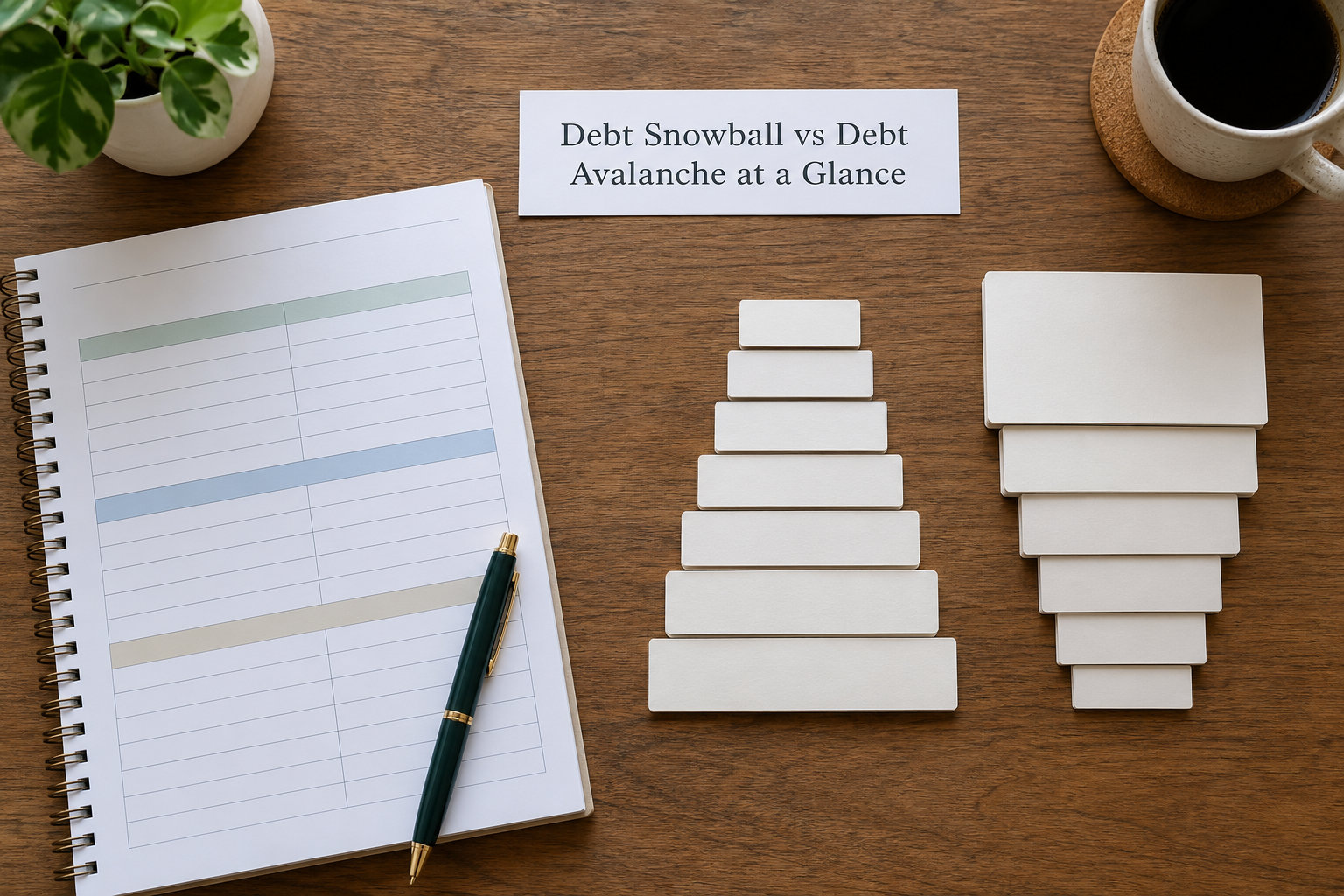
Here is the whole comparison on one page. The rows below are the ones people argue about, and rows four and five usually decide it.
| Criteria | Debt snowball | Debt avalanche |
|---|---|---|
| Payoff order | Smallest balance first | Highest APR first |
| Total interest paid | Higher | Lower |
| Time to first payoff | Often 1 to 3 months | Can be a year or more |
| What motivates you | Visible accounts dropping to zero | Shaving the cost line |
| Best fit | Prior attempts failed, money stress is high | You have steady cash flow and patience |
| Main drawback | You may pay noticeably more interest | Early months feel unrewarding |
| Common starting point | Hybrid: snowball first, avalanche later | Straight through to cheapest total |
What Is the Debt Snowball Method?
The debt snowball method is a payoff order based on account size: you clear your smallest balance first, then apply that freed payment plus your extra money to the next smallest, and repeat. Interest rates are ignored entirely. The name comes from the way each cleared payment makes the next one grow, like a snowball rolling downhill.
How the debt snowball works, step by step
Four moves, and the first three are identical in both methods:
- Write down every debt with its balance, APR and minimum payment.
- Keep paying the minimum on all accounts so nothing goes late.
- Send every extra dollar to one target — here, the smallest balance.
- When it clears, roll that payment into the next target and repeat.
Why the quick wins matter so much
Debt is an exhausting slog before any of it feels like progress. Behavioural work cited by PocketGuard, drawing on Journal of Marketing Research and Harvard Business Review studies, finds that concentrating on one debt at a time sustains motivation better than spreading effort thin. Visible wins appear to be part of why.
The forum evidence lines up. One r/personalfinance user, StillEnjoyLegos, cleared 16,000 dollars across nine credit cards in a bit over two years using the snowball and credited the entire result to the high of each payoff. That same poster noted in the disclaimer that avalanche costs less and is the more recommended approach — which tells you the method is working as designed even when it is not the cheapest.
A 500 balance at 18% APR with a 25 dollar minimum is gone in about twenty-one months if you add 50 a month. Under an avalanche order, that same card might sit untouched for a year while a 3,000 balance at 22% APR absorbs everything. The accounts are not equivalent to your nervous system.
What Is the Debt Avalanche Method?
The debt avalanche method sorts debts by interest rate instead of size: you attack the highest APR account first, then move down the rate list. Every dollar of interest you avoid accrues is a dollar you keep, so this ordering always produces the lowest total cost for the same balances and the same monthly extra payment.
The mechanics mirror the snowball exactly — list, minimums everywhere, one target, roll the payment forward. The ordering is the whole difference. It is often called the mathematically optimal method for that reason.
How the debt avalanche works, step by step
- Sort every debt from highest APR to lowest.
- Pay the minimum on all of them, on time, every month.
- Apply the full extra payment to the top-rate account.
- When it clears, roll that payment into the next rate down.
Why does rate order matter so much? Because interest accrues on the balance still outstanding, and the highest-rate balance is the most expensive per dollar you pay it. It is the difference between clearing a 9,000 auto loan at 3% and a 15,000 card at 22% — the auto loan is cheap money you are ignoring while the card compounds against you.
One catch worth naming: with a big high-APR balance and a modest extra payment, the first avalanche payoff can be genuinely slow. On a 10,000 balance at 22% with 200 a month extra, clearing it takes over four years. That is the point where people quit.
Which Method Saves More Interest?
The avalanche always saves more, and the difference is often larger than people expect. Here is the same four-debt household run both ways, with 3,000 a month going to debt — minimums plus a large extra payment on top.
| Debt | Balance | APR |
|---|---|---|
| Store card | 1,200 | 26.99% |
| Visa card | 10,000 | 18.99% |
| Auto loan | 9,000 | 3.00% |
| Student loan | 15,000 | 4.50% |
Under the avalanche order the store card still goes first — it happens to be both the smallest balance and the highest rate. Visa comes next, then the student loan, then the auto loan. Total interest comes to roughly 1,012 dollars.
Under the snowball order the balances dictate the queue: store card first, then auto loan, then Visa, then student loan. Total interest comes to roughly 1,515 dollars.
That is about 503 dollars more on 35,000 of debt — the figures Investopedia publishes for this same scenario. Push the extra payment lower and the gap widens, because a smaller monthly amount spends more time accruing at the high rate. Push it higher and the gap narrows.
When the gap closes
The snowball stops costing extra interest when your smallest balance is also your highest-rate debt, which is common with store cards and overdue medical bills sent to collections at punitive rates. If both methods pick the same first target, run the next balance and the next rate: if the orderings coincide all the way down, they are the same plan with two names.
Another case: debts with similar rates. If your rates sit within a couple of points of each other, ordering matters far less than how much you pay extra. UKPersonalFinance posters running larger balances make the same point — the extra amount drives the outcome, not the sequence.
Which Method Is Easier to Stick With?
The snowball, for most people, and this is the part competitors tend to soften. r/DaveRamsey consensus lands on a tidy line: avalanche is better mathematically, but you are more likely to actually finish with the snowball. Nobody finishes a plan they resent.
Adherence beats optimisation because an abandoned plan costs full price. If the avalanche makes you quit at month eight, the avalanche result is worse than the snowball result you would have reached. A modest, reliable extra payment clears debt slowly and surely; a large one you abandon for a year clears nothing.
Motivation is not the only factor, though. Money stress is real, and an account hitting zero is a concrete event rather than an abstract balance declining. For people carrying medical debt or balances that arrived without any spending decision attached to them, that visible closure matters.
The trap to watch: a small low-interest balance, like an old utility bill or a family loan at 2%, sits at the front of the snowball queue while a 24% card keeps compounding. Paying it first feels good and costs you. If the smallest debt on your list is under 10% APR, the snowball as written is pointing you at the wrong account.
How to Choose Between Snowball and Avalanche
Work through these four questions before committing.
1. What is your highest APR, and can you clear it within a year? If the top rate is under 20% and the balance is modest, the avalanche is safe to run — you will see progress. If it is above 22% on a big balance, calculate the payoff date before committing, because that date is what demotivates people.
2. What is your real extra payment after minimums? List minimums, subtract them from what you actually have each month, and treat the remainder as the number that decides everything. Irregular income makes this harder; a smaller consistent figure beats a bigger one you cannot keep.
3. Have you quit a payoff plan before? If yes, the snowball’s short early wins are worth the extra interest. Treat the higher cost as the price of finishing. r/personalfinance posters describe collapsing motivation as the trigger, not the numbers.
4. Do you have a starter emergency fund? Keep a small buffer — even a few hundred dollars — so a flat tire does not send you back to a card. Then go all-in. Save first only if your job or income is unstable.
The hybrid: snowball first, then avalanche
This is what most people actually do, and almost no competitor explains it properly. Run the snowball until the small accounts clear, then switch to the highest remaining APR and switch permanently.
The switch trigger is simple: go to avalanche once your smallest balance is something you can clear inside six months, or once the queue of accounts under 1,000 is empty. Either way, you keep the early wins and then stop paying extra interest for nothing. Progress never resets — cleared accounts stay cleared.
When neither method is the answer
If every rate sits under 10%, ordering barely matters and consolidation is worth pricing. A balance transfer card or a consolidation loan can cut a 22% rate to under 10%, which changes the arithmetic more dramatically than the sequence does. Just remember a consolidation loan usually extends the term, so you trade rate for time and pay interest longer.
For federal student loans, income-driven repayment is a separate lever entirely — payments tied to income can sit far below what either method assumes. Negotiating medical bills before paying them can also cut balances outright. Neither method can beat a rate reduction that has not happened yet.
Debt Snowball vs Debt Avalanche: Which Should You Choose?
Match yourself to one of these:
- Choose the snowball if your smallest balance is under 1,000 and you want an account gone this quarter, if a previous payoff plan collapsed, or if money anxiety is part of the picture.
- Choose the avalanche if your top rate is above 20% and stable cash flow covers the minimums with room over, or if your smallest balance is also your lowest rate — a sign the snowball would waste money.
- Choose the hybrid if you want quick wins and the cheapest ending. Snowball through the small accounts, then pivot on the trigger above.
- Choose consolidation if rates across the board are high and no single balance is worth attacking alone.
Most of my defaults sit with the hybrid, honestly, because it captures the motivational half of the snowball and the financial half of the avalanche. The pure snowball is a deliberate purchase of consistency with your money.
Frequently Asked Questions
Does Dave Ramsey recommend the snowball or the avalanche?
Dave Ramsey recommends the debt snowball. His argument is behavioural rather than mathematical: paying off small balances quickly produces visible wins that keep people motivated to finish. He also pushes a debt-free lifestyle, no borrowing for lifestyle spending, and an emergency fund before aggressive payoff. He does not argue the snowball costs least in interest, because it usually does not.
What is debt avalanche and how does it differ from the snowball?
Debt avalanche orders your debts by interest rate, highest first, so every extra dollar attacks the most expensive balance you hold. The debt snowball orders them by balance size, smallest first, and ignores rates. Both keep minimum payments on every account and roll each cleared payment into the next target. The avalanche costs less in interest; the snowball delivers faster early wins.
Which debt payoff method pays off debt fastest?
Whichever one you sustain. The avalanche clears the most total debt per dollar spent on interest, so it finishes first when extra payments stay high. But adherence decides everything: a snowball plan you complete beats an avalanche plan you abandon in month four. If you can run either one consistently, take the avalanche. If your history says you quit plans, take the snowball.
Can I switch from the debt snowball to the avalanche halfway through?
Yes, and switching costs you nothing. Accounts you already cleared stay closed, and their rolled payments simply redirect to whatever account you name next. A practical trigger: move to the avalanche once your smallest balance is clearable inside six months, or once no account under 1,000 remains. Many people run the snowball for the first few months purely for momentum.
Does paying off debt hurt your credit score?
Not in any lasting way. Closing an account can shorten your credit history and its total available credit, which may nudge your score down briefly. But paying balances down lowers your credit utilisation ratio, and falling behind on any minimum damages your score far more than closing an account does. Keep the oldest card open with a zero balance if you want the history to continue counting.
Is the debt snowball worth the extra interest it costs?
Sometimes, yes. On 35,000 of mixed debt, the snowball can run roughly 500 dollars more in interest than the avalanche over the full payoff. You pay that premium to get accounts cleared inside your first few months, which is what keeps a lot of people going. If your smallest balance is also your highest rate, both methods order identically and there is no premium to pay.
Conclusion
Choose the avalanche when you can hold the pace and your top rate is genuinely high — it is the cheapest exit. Choose the snowball when quick wins are the thing keeping you in the game. Many people do both, starting with the snowball and pivoting to the avalanche once the small accounts clear.
Do one thing before deciding anything: list every balance, APR and minimum, then subtract the minimums from what you actually have each month. That single number — your real extra payment — settles most of the argument, and it takes ten minutes to find out. Rules and rates vary by country and state, so check the figures on your own statements before acting.