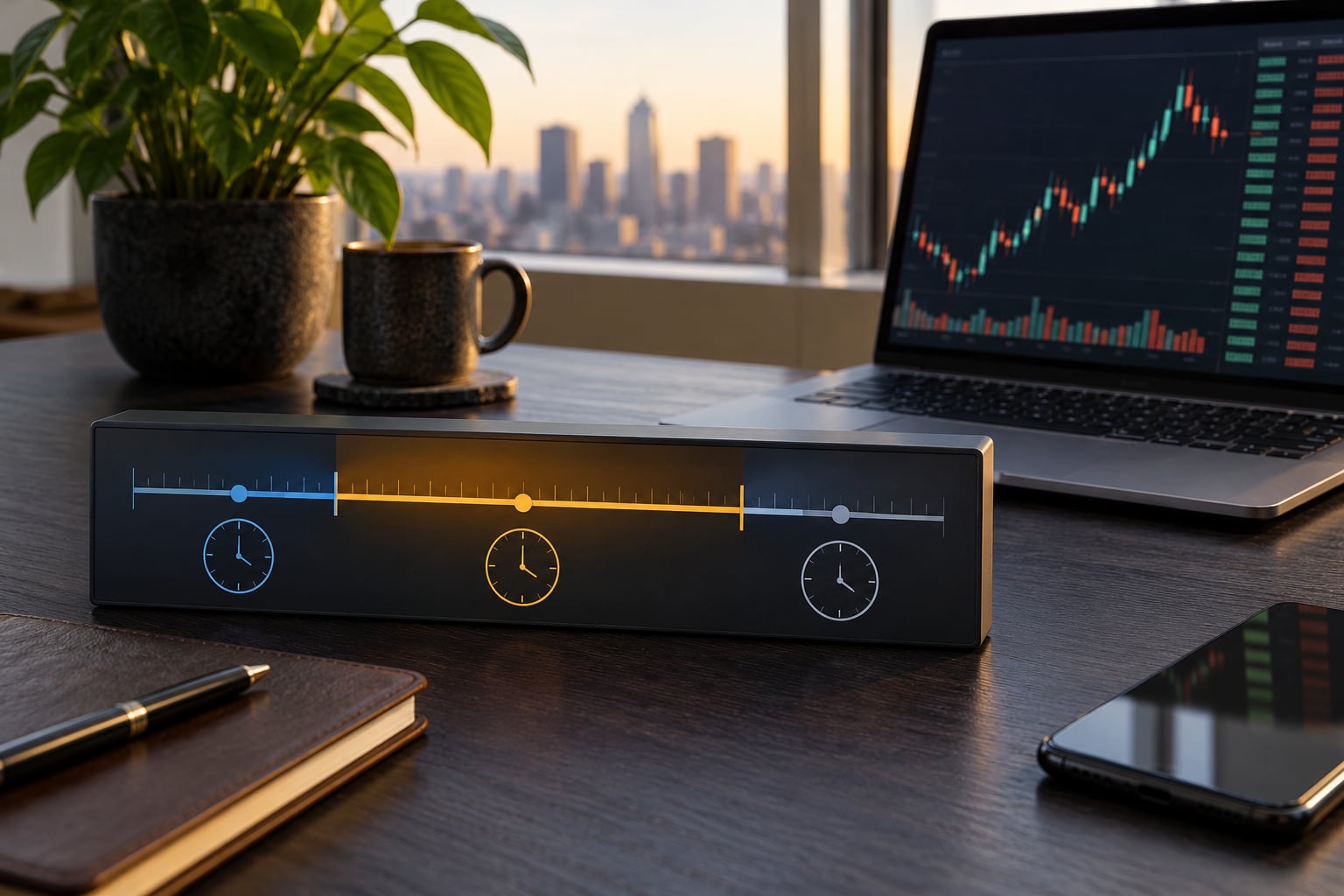
After hours trading explained in one line: it is buying and selling U.S. stocks after the regular market closes, in a session that runs from 4:00 p.m. to 8:00 p.m. Eastern Time. This guide walks through what actually changes once the closing bell sounds, why the spreads widen, which order types work, and where beginners usually get hurt. Everything here is general education, not investment advice, and broker rules change often enough that you should confirm your own platform’s windows before you trade.
One thing to clear up first: most of the headline-grabbing moves people associate with “night trading” happen in this four-hour window, not overnight. Futures and foreign markets run much closer to a full 24-hour clock. If a trader says they trade overnight, check which session they mean before you compare notes.
Table of Contents
- After Hours Trading Explained: What Changes After the Close
- What Are the U.S. After-Hours Trading Hours?
- Why Do Stocks Trade After Hours?
- How Does After-Hours Trading Work?
- Can Individuals Trade After Hours?
- How Do Prices Move After the Market Closes?
- After-Hours Trading Example: Following an Earnings Report
- What Are the Main Risks of After-Hours Trading?
- What Order Types and Fees Should Investors Consider?
- What After-Hours Trading Costs in Plain Numbers
- Is After-Hours Trading Worth the Risk?
- Frequently Asked Questions
- What time does after-hours trading end in the U.S.?
- Can I trade any stock during after-hours trading?
- Why are after-hours prices different from regular-session prices?
- Do limit orders guarantee the price I want during after-hours trading?
- Is it better for beginners to trade after hours or wait for the market to open?
- Conclusion
After Hours Trading Explained: What Changes After the Close
The short version: nothing about the securities changes after 4:00 p.m., but almost everything about the market does. The companies still exist, the tickers still resolve to the same shares, and your brokerage app will still show a price. What changes is how many buyers and sellers are actually at the counterparty’s screen when your order arrives.
During the regular session, the exchanges and the electronic communication networks that route to them run a price-forming process under Regulation NMS, with thousands of participants quoting two-sided markets in a large-cap name. Take that same order book and cut the participants by something like 90 percent, and you get the extended-hours session. Prices still form, but they form on much less information and much less size.
Three practical differences show up immediately for a retail participant. Spreads are wider, because the cost of posting a quote in a thin book is higher and market makers step back. Volatility is higher in percentage terms, because a small order moves the price further. And the order types you can use narrow considerably, because a market order in a thin book is a blunt instrument most brokers refuse to send.
Who can trade it is a broker question, not a market question. There is no rule that says only institutions or only professionals may trade extended hours. The limit is that your own brokerage has to support the session and has to let you turn it on.
It also helps to separate the two extended sessions. Pre-market trading runs before the regular open and tends to carry the overnight news, the foreign market moves and index futures. After-hours trading runs after the close and tends to carry earnings, guidance revisions, and news released into a market where retail attention has already thinned out. The mechanics are nearly identical; the participants and the volume profile are not.
What Are the U.S. After-Hours Trading Hours?
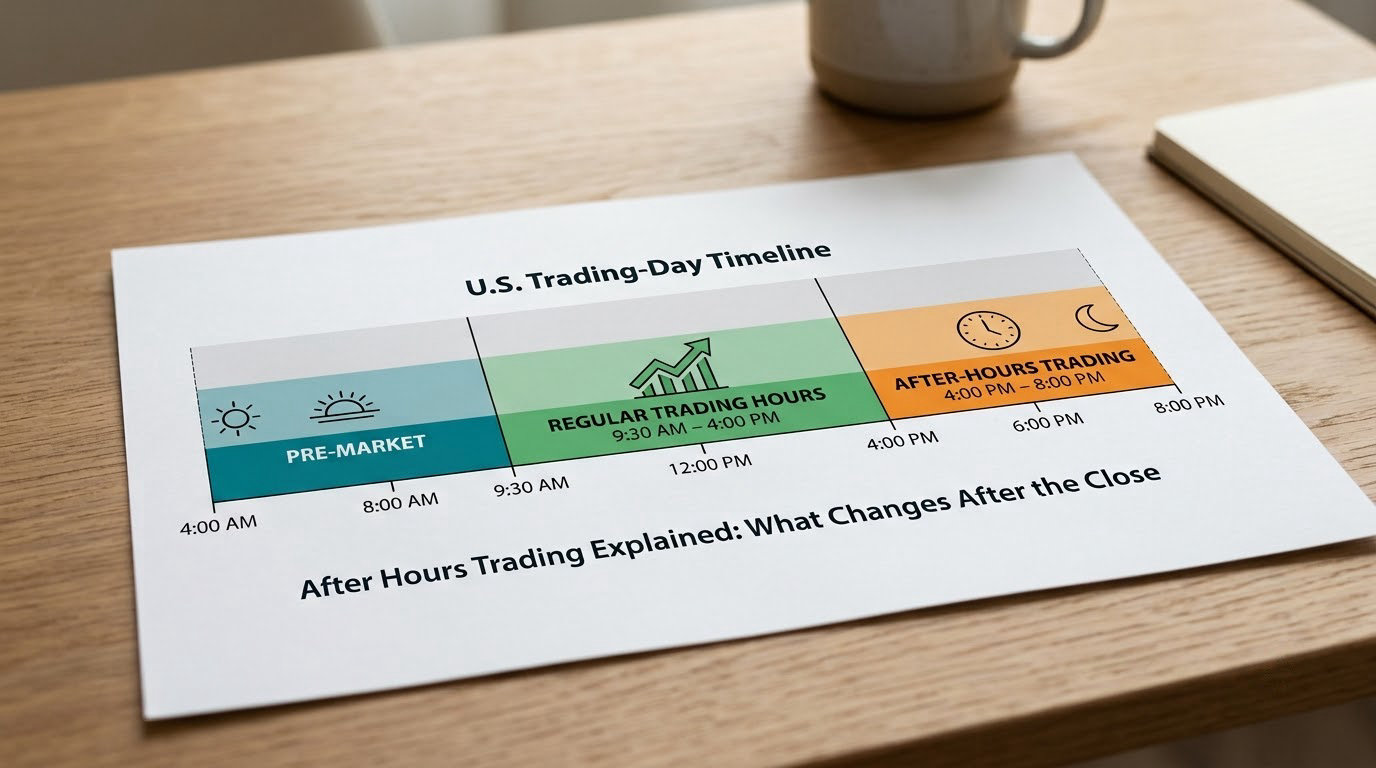
The windows below are the exchange-standard times in Eastern Time. Brokers often quote a narrower set than the exchange allows, so your platform’s window may be shorter than the table.
| Session | Eastern Time | What it is |
|---|---|---|
| Pre-market | Roughly 4:00 a.m. to 9:30 a.m. ET (many brokers start at 7:00 or 8:00) | Trades queued overnight news, futures, and European session moves |
| Regular session | 9:30 a.m. to 4:00 p.m. ET | Highest volume, tightest spreads, full order-type support |
| After-hours | 4:00 p.m. to 8:00 p.m. ET | Post-close news reaction, mostly earnings and corporate announcements |
| Early close days | Regular session ends at 1:00 p.m. ET | After-hours generally begins at 1:00 p.m. and still ends at 8:00 p.m. ET |
Two practical notes on the clock. First, everything on this page is Eastern Time, so if you are on the West Coast the after-hours window is 1:00 p.m. to 5:00 p.m. during daylight-saving time and 12:00 p.m. to 4:00 p.m. during standard time. Second, holidays compress things: the day after Thanksgiving closes regular trading at 1:00 p.m. and the full Christmas and New Year’s Week sessions are closed entirely, so the extended sessions around them are shorter or absent too.
Broker windows vary more than most people expect. Some retail platforms stop extended hours at 6:00 p.m. ET. Some begin pre-market at 9:00 a.m. One large broker offers access from the early morning overseas sessions onward. That is a settings difference, not a market difference, and it is the first thing to check on your own account.
Why Do Stocks Trade After Hours?
Because the information does not stop at 4:00 p.m. Corporate America files its earnings after the close as a matter of routine, and the market’s main price-discovery window for that news would otherwise be deferred a full night. A stock that reports a 20 percent earnings move and then sits untouched until the next morning is effectively repricing itself in private.
Other common drivers each leave their own fingerprint on the tape:
- Earnings and guidance. The single largest source of extended-hours volume in large caps, released in the hour or two after the close.
- Corporate announcements. Mergers, regulatory decisions from the FDA and similar agencies, product approvals, executive departures, and restatements.
- Economic data. Scheduled releases often land after 4:00 p.m. Eastern, and index futures react immediately whether or not any single stock does.
- Analyst actions. Rating changes and price-target revisions cluster in the post-close window because that is when the research is published.
- Overnight foreign markets. Asian and European sessions trade while the U.S. is shut, and any of them can reprice a U.S. sector by the time pre-market opens.
- Index and fund rebalancing. Mechanical closing trades cluster at the end of the session and spill past the close.
There is also a smaller set of participants with a different motive: institutions managing overnight event risk. Rather than reacting to a release, they hedge or pre-position before it, then adjust afterward. That group is a real part of why extended-hours books behave oddly, and it is a reminder that the traders you are trading against are often not making a directional bet at all.
How Does After-Hours Trading Work?
Step through one session and the machinery becomes clear. At 4:00 p.m. the regular session ends with a closing auction, which sets an official price and carries imbalances into the tape. Immediately afterward, the exchange-operated books stop and the ECNs and alternative trading systems take over. Those venues are the ones registered with the SEC under Regulation ATS, and they are where extended-hours orders actually match.
Your broker routes your order to one of those venues, where it sits as a maker or taker against whatever quotes are posted. If it matches, you get filled at the price on the other side of the book, not at the last trade price. If nothing matches at your limit, the order simply does not fill, and that outcome is entirely normal rather than an error. Most brokers treat extended-hours orders as day orders scoped to the session, so an unfilled order expires when the window closes instead of carrying into the next morning.
After the session ends, nothing trades until the next open. The clearing and settlement machinery runs on its standard T+1 cycle regardless of which session produced the trade, so an after-hours fill settles on the same schedule as a mid-morning fill. Extended hours is trading, not a separate market with its own settlement rules.
Can Individuals Trade After Hours?
Yes, subject to your broker. There is no accreditation requirement for trading a listed stock in extended hours, though some brokers impose a minimum account balance or a signed risk agreement before enabling it. The feature usually lives in account settings under something like extended-hours trading, extended session access, or overnight trading, and it has to be switched on before orders will route outside regular hours.
Once enabled, a retail participant typically has a narrower set of choices than during the day:
- Limit orders are the workhorse and usually the only order type many brokers allow in extended hours.
- Market orders are restricted or discouraged because they can fill far from the displayed price in a thin book.
- Stop and stop-limit orders vary widely by broker and are frequently disabled in extended hours, which removes the automatic protection many traders assume they have.
- Time-in-force settings matter, because a session-scoped order that never fills disappears at the close.
To check what you actually have: open your account’s trading settings, look for the extended-hours toggle, confirm whether it is on, then read which order types the platform lists for the extended session. If stop orders are not listed, assume your protective stop will not trigger outside regular hours. That single check has prevented more overnight damage than any strategy rule.
How Do Prices Move After the Market Closes?
After-hours volume is a small fraction of a full day’s activity, commonly estimated in the low single digits of percent for most large-cap names, and far less for anything mid- or small-cap. That is the whole story of why prices behave differently. Price change equals order flow divided by available size, and if the size shrinks by an order of magnitude while the flow does not, the same buying or selling produces a much larger move.
Wider spreads are the visible symptom. In the regular session you might see a one-cent spread on a heavily traded name, essentially the minimum tick. After hours, the same name can quote two, three, or five cents apart, and on a less liquid name the gap can be a full percentage point or more. A wide spread is not a market maker being greedy; it is the price of being the only quote on the screen when an order shows up.
Order imbalance does the rest. In a continuous book, buyers and sellers arrive constantly and small imbalances get absorbed. In a thin book, one side may simply be absent for stretches, and any sizeable order walks the book from top to bottom. A headline hits, a few hundred thousand dollars of buying arrives, and the last print moves several percent on what looks like a dramatic tape. It is dramatic in percentage terms and small in dollar terms, which is exactly the illusion that catches beginners out.
Users on trading forums describe this precisely. Commenters in r/investing consistently describe the post-close book as having very little liquidity and very wide spreads, and single out particular retail platforms as the worst offenders. EliteTrader regulars talk about depth-of-market during these sessions in similar terms: less effort moves price. The mechanism is not a secret, it is simply arithmetic that most screens do not display in a way that makes it obvious.
After-Hours Trading Example: Following an Earnings Report
Consider a hypothetical mid-cap software company, Meridian Software, that closes at 4:00 p.m. at 50 dollars on about 2 million shares for the day. It reports earnings at 4:12 p.m. and guides higher. By 4:45 p.m. the last trade prints at 55 dollars, a 10 percent move.
Now the mechanics. The screen shows a bid at 54.90 and an ask at 55.20. An investor who wants to buy pays the ask, 55.20, not 50 and not the midpoint. A seller who acts on the news hits the bid, 54.90. The cost of a round trip in that book is 0.30 dollars per share, or about 0.55 percent of the position, paid before any judgment about the company turns out to be right or wrong. On a large-cap name with a one-cent spread the same round trip costs roughly 0.02 percent. That is the structural cost difference in a single number.
Two more details matter. Total extended-hours volume in that example might be 60,000 shares against 2 million for the day, so the 10 percent move happened on a fraction of the size. And the fill is not guaranteed: an investor who places a limit order at 54.95 simply does not trade, because no seller came to that price. r/etrade users describe exactly this frustration, the sense that a stock visibly traded through their price and the order still sat unfilled.
What the move does not prove is that the market has settled on a fair value of 55. The next morning’s opening auction may print well above it, well below it, or near it, and pre-market futures trading will have repriced the stock for hours before regular volume returns. A large after-hours percentage change is evidence of a headline meeting a thin book, not evidence of skill or of a settled price.
What Are the Main Risks of After-Hours Trading?
Thin volume. This is the root cause behind nearly every other item on the list. With few participants, the same news produces a larger move and reverts more easily.
Wider bid-ask spreads. The immediate, measurable cost. It scales with size, so the larger the order relative to the book, the more of it you pay across the spread.
Slippage and partial fills. Market orders fill at whatever is available, often several ticks worse than the quote. Limit orders may fill partially or not at all.
Gap risk into the open. The after-hours print is not the next morning’s price. Retailers trading this session describe being surprised by the 9:30 gap after assuming momentum would simply continue.
Stale or thin quotes. A displayed quote can be old. In a book with few quotes, the level-two view often shows one line per side, which is not a market, it is a rumor with a timestamp.
Trading halts. Limit-up and limit-down rules can pause a single name when it moves through the bands, sometimes for a short period and sometimes longer. You cannot react to a halt while it is in effect.
Missing stop orders. Many brokers do not support stop or stop-limit orders in extended hours, so the risk control you rely on during the day may be absent exactly when volatility is highest.
Reacting to an incomplete picture. Headline moves on minimal size look bigger than they are and are frequently faded during the following regular session. r/Daytrading regulars, who are generally sympathetic to short-term trading, still advise limit orders and reduced size for this reason.
FINRA and the SEC both publish investor education on extended-hours trading that lands on the same conclusions, and their guidance is worth reading before enabling the feature. The regulators’ framing is the fair one: this is a tool with a specific purpose and specific costs, not an edge by itself.
What Order Types and Fees Should Investors Consider?
| Order type | Regular session | Extended hours | Practical note |
|---|---|---|---|
| Market | Allowed | Restricted or disabled at many brokers | Walked across a thin book; avoid |
| Limit | Allowed | Generally the only type offered | Price is protected, fill is not |
| Stop-limit | Allowed | Varies by broker | No trigger during extended hours at some brokers |
| Day | Allowed | Usually scoped to the session | Unfilled orders expire at the session close |
The mechanics of a limit order in extended hours are worth internalizing. A limit order is a promise about price, never a promise about execution. If the market never trades at your price, you keep the order unfilled. Traders who complain about orders that should have filled are usually reasoning from the last trade price rather than from the book, and in a thin book the last trade price is often not a level anybody is currently offering.
On costs, the commission is usually the smallest piece. Most large retail brokers charge no per-trade commission on equities, so the real expense is the spread and the slippage, both of which scale with order size and with how fast the stock is moving. Some brokers add a fee or a condition for extended-hours access, and some require a minimum account balance or a signed agreement. Check your schedule rather than assuming it is free, because these details change.
What After-Hours Trading Costs in Plain Numbers
Take the Meridian example again and make the drag concrete. A 1,000-dollar position bought at 55.20 and sold at 54.90 the next morning loses 0.30 dollars per share immediately, before commission, which is about 5 dollars on 20 shares. On a 10,000-dollar position the same round trip costs roughly 55 dollars, a little over half a percent. Do the identical trade during regular hours at a one-cent spread and the cost falls to about 1.90 dollars and 19 dollars respectively.
Add the behavioral cost, which is usually larger. A 10 percent headline move invites a position sized like a regular-hours decision, and gap risk then decides the outcome at the open. Sizing down in extended hours, roughly half a normal position, is the single habit experienced traders recommend most consistently, and it is the cheapest risk control available. It costs nothing and it caps the damage from the one thing you cannot control, which is what the opening auction does with the stock.
Is After-Hours Trading Worth the Risk?
For a beginner, usually not. The session asks you to make your hardest decisions in the least liquid part of the day, with narrower order support, wider costs, and no reliable stop protection. Most of the people who do well with it are either already experienced active traders or have a specific operational need, such as hedging an overnight event or rebalancing after the close.
Waiting for the regular session is the safer default in most situations. If the reason for trading after hours is that you read a headline and felt you had to act immediately, that reaction is itself the risk. If the reason is a genuine need to manage exposure overnight, the honest alternative is pre-positioning or hedging rather than reacting to the print.
A few situations make sense: a large-cap name with a genuine overnight catalyst and a real reason to act before the open, hedged or sized down; a portfolio rebalance that does not need to move before the open anyway; or a trader who has already paper-traded the session and understands the fill mechanics. Everything else is better handled in regular hours.
A short checklist before your first extended-hours trade: confirm your broker’s exact window in writing rather than from memory, confirm which order types are supported, confirm whether stop orders trigger, look at the level-two book rather than the last price, size the position at roughly half, and decide in advance what you will do at the 9:30 open. Paper-trade the session first. The mechanics are learnable and the costs are not forgiving.
Frequently Asked Questions
What time does after-hours trading end in the U.S.?
The standard after-hours window ends at 8:00 p.m. Eastern Time, running from the 4:00 p.m. close. Brokers often offer less than the full window, and some stop at 6:00 p.m. ET, so check your platform’s own hours. On early-close days the session begins right after the shortened close but usually still ends at 8:00 p.m. ET. Holiday weeks can shorten or remove the session entirely.
Can I trade any stock during after-hours trading?
Most listed U.S. stocks with quotes available can trade in extended hours, but availability depends on the exchange and your broker. Large-cap names with active after-close volume are the most reliable. Small-cap and mid-cap stocks often quote with very wide spreads and thin books, and some names are not tradeable outside regular hours at all. Check whether your broker supports extended hours for a specific ticker before you plan a trade.
Why are after-hours prices different from regular-session prices?
Because far fewer buyers and sellers are active after the close. Extended-hours volume is a small fraction of a full day’s trading, so each order moves the price further and market makers widen their quotes to cover the risk of being the only side on the screen. The result is a wider bid-ask spread and larger percentage moves on the same news. Quotes can also be stale when the book is nearly empty.
Do limit orders guarantee the price I want during after-hours trading?
No. A limit order guarantees a price, not a fill. Outside regular hours most brokers accept limit orders only, and if no counterparty trades at your price, the order does not fill at all. It is also usually a day order scoped to the session, so it expires when the window closes rather than carrying into the next morning. That is the single most common surprise for new extended-hours traders.
Is it better for beginners to trade after hours or wait for the market to open?
Waiting is better for almost everyone starting out. Extended hours mean wider spreads, thinner volume, restricted order types, and stop orders that many brokers will not trigger. A beginner can do everything right and still lose to the spread and an overnight gap. If you want to learn the session, paper-trade it first, watch the level-two book instead of the last price, and size any real trade at roughly half a normal position.
Conclusion
After-hours trading is a genuinely useful window for reacting to news that lands after 4:00 p.m., and a poor default for anyone who simply wants to act faster. The trade is straightforward: you get four hours of access in exchange for wider spreads, thinner volume, fewer order types, and a real chance of a gap at the open.
Start with the mechanics rather than a trade. Find your broker’s exact extended-hours window in settings, read which order types it supports there, and confirm whether stop orders trigger. Then look at the level-two book instead of the last price, and size the position at roughly half. When the after-hours picture is uncertain, the regular session is where the liquidity is, and liquidity is what makes the price you see a price you can get.