
First time home buyer programs are government-backed loans, grants and tax breaks that cut the cash you need up front, usually by lowering your down payment or covering some of your closing costs. Most of them work as a second, subordinate loan stacked on top of a primary mortgage such as an FHA, VA, USDA or conventional loan, and nearly all of them come with rules attached.
That last part is where a lot of buyers get tripped up. There is no single national program called the first time home buyer program, and the thing you hear described as a free grant is often a loan you repay when you sell or refinance.
Table of Contents
- What Are First Time Home Buyer Programs?
- How Do First Time Home Buyer Programs Work?
- What Is the First Time Home Buyer Program?
- Which Programs Can Help With a Down Payment?
- Down payment assistance programs
- Forgivable second mortgage
- Deferred second mortgage
- Grants and housing trust funds
- What Credit Score and Income Requirements Apply to First Time Home Buyer Programs?
- What Do FHA, VA, USDA, and Conventional Loans Offer?
- How Much Money Do First Time Home Buyers Need?
- What Costs and Rules Should Buyers Check Before Applying?
- How to Apply for the Right First Time Home Buyer Program
- First Time Home Buyer Programs: Common Mistakes to Avoid
- Frequently Asked Questions
- Are first time home buyer programs grants?
- Can I use a down payment assistance program with an FHA loan?
- Do I have to be a first time home buyer to qualify?
- How much money do I need to buy my first home?
- How long does it take to get approved for a home buyer program?
- Can I use home buyer assistance if I buy with family?
- Conclusion
What Are First Time Home Buyer Programs?

They are any program that reduces the upfront cost of buying your first home, whether that means a smaller down payment, help with closing costs, a lower interest rate, or a tax advantage later. What most people mean by first time home buyer programs are the low-down-payment loans plus the state and local assistance layered on top of them.
The pieces live in five different places, and knowing which is which saves a lot of confusion:
- Federal loan programs run by the Department of Housing and Urban Development (FHA), the Department of Veterans Affairs (VA) and USDA Rural Development. These back the primary mortgage itself.
- Federal tax incentives such as mortgage credit certificates, administered by state housing finance agencies.
- State housing finance agency programs like CalHFA or the Idaho Housing Finance Association, which hold the actual assistance funds.
- County, city and employer programs, funded by local housing trust funds or a relocation package.
- Nonprofit and community land trust programs that sell homes below market with resale restrictions attached.
One warning before the details: income limits, purchase price caps and funding availability change often and are set by state and county, not by a federal rulebook. Verify every figure for your area with your state housing finance agency or a HUD-approved housing counselor before you rely on it.
How Do First Time Home Buyer Programs Work?
Most assistance funds your down payment and closing costs by recording a second lien on the property, junior to your main mortgage. You sign two loan documents at closing instead of one, and the second one comes with its own rate, term and repayment trigger.
The sequence usually looks like this:
- Confirm your status. Most programs want you to have not owned a home in the last three years, and they check the last three years of your public record.
- Find a participating lender. Some programs only work through lenders approved for them, so a loan officer who cannot process yours is a dead end, not a judgment on you.
- Complete homebuyer education. Many states require a certificate from an approved course, sometimes online, before the assistance is released.
- Qualify for the primary loan. The lender underwrites you for the FHA, VA, USDA or conventional loan first, because assistance rides on top of an approved first mortgage.
- Stack the second loan at closing. The assistance pays your down payment and eligible closing costs on the same closing disclosure as everything else.
- Serve the terms. You occupy the home as your primary residence and follow the repayment or forgiveness schedule your second lien requires.
| Program type | What it typically provides | Common restriction |
|---|---|---|
| Forgivable second loan | Down payment and closing costs, forgiven after occupancy | Must stay in the home for the full forgiveness period |
| Deferred second | Down payment, no monthly payment until sale or refinance | Owed in full at exit, plus interest in some states |
| Repayable second | Down payment or closing costs as an amortizing second loan | Monthly payment for the full term |
| Mortgage credit certificate | Annual tax credit on mortgage interest paid | Income cap and purchase price limit, use it or lose it |
| Shared appreciation | Home sold below market | Resale price formula keeps your gain below market |
| Below-market rate home | Reduced purchase price on a specific property | Owner occupancy term, then a regulated resale price |
What Is the First Time Home Buyer Program?
There is no single program by that name. What people call the first time home buyer program is usually a bundle: a federal or conventional loan that accepts a low down payment, plus a state or local program that supplies the missing cash.
Here is how the four main pieces differ:
- Federal loan programs (FHA, VA, USDA) reduce the down payment you must bring and, in the VA case, eliminate it entirely.
- Down payment assistance fills the gap the first loan leaves, either with a forgivable loan or a second you repay.
- Grants sound like gifts but are the least common form. When a program says forgivable, the money comes back if you sell, refinance or move out early.
- Mortgage credit certificates and state tax credits reward you after the fact instead of at closing, so they do nothing for your cash to close.
Because each layer comes from a different administrator with its own rules, no benefit is automatic. A 3 percent down conventional loan, for example, is available to first-time buyers nationwide, while forgivable assistance may be capped at 80 percent of area median income in one county and 100 percent in the next.
Which Programs Can Help With a Down Payment?
Down payment assistance programs
Down payment assistance is the most common name for state and local money that covers part of your upfront cash. You still buy the home with an FHA, VA, USDA or conventional loan; the assistance simply fills the gap so you can put less of your own savings in.
Forgivable second mortgage
A forgivable second is forgiven if you meet two conditions: you keep the home as your primary residence and you stay for a set number of years, often five to fifteen. Miss either one and the balance comes due at sale or refinance.
Deferred second mortgage
A deferred second makes no monthly payment while you live in the home. Nothing accrues until you sell, refinance or stop occupying it, and then the full principal plus any contracted interest is owed.
Grants and housing trust funds
True grants exist but they are thin on the ground, since funding is limited and usually earmarked for homeowners buying in distressed neighborhoods or for specific groups such as veterans or teachers. Many programs described online as grants have quietly been restructured as repayable seconds, so read the note that states the repayment terms.
Across all four, expect the same set of gates: an income limit tied to area median income, a purchase price ceiling, an owner occupancy requirement for the first year or longer, a homebuyer education certificate, and a primary residence rather than an investment property.
What Credit Score and Income Requirements Apply to First Time Home Buyer Programs?
There is no universal score. The FHA can work with credit in the low 500s, conventional loans generally want the high 500s or 600s, and each state agency sets its own floor, which is often higher than the lender minimum.
| Screening factor | What is checked | Why it trips people up |
|---|---|---|
| First-time buyer status | No ownership in the previous three years | Co-buyer or prior home in another state can reset the clock |
| Income | Household income against area median income for your household size | Limits are often a percentage of AMI, not a flat number, so stale blog figures mislead |
| Credit | Score plus payment history, collections and public records | Chapter 7 discharge timing and recent collections carry different waiting periods |
| Debt-to-income | Total monthly debt against gross monthly income | Student loan payments count even when in deferment |
| Assets and reserves | Cash after down payment and closing costs, plus post-closing reserves | Using every dollar up front can still leave you short of the reserve rule |
| Education | Housing counseling or an online course certificate | Free course, but it must be an approved provider and sometimes in person |
Then there are lender overlays, which are the bank’s internal rules sitting on top of the program rules. A credit union can decline a borrower who qualifies on paper because of the payment history on a medical collection or a thin file. Buyers in forums describe loan officers steering them away from assistance because of the extra paperwork, which is a staffing problem, not a verdict on your credit.
What Do FHA, VA, USDA, and Conventional Loans Offer?
These four loan types cover nearly every buyer, and they stack differently with assistance. The table below is the one I send people to when they ask which loan they are actually shopping for.
| Loan type | Minimum down | Credit flexibility | Extra cost | Key eligibility |
|---|---|---|---|---|
| FHA | 3.5 percent with 580 plus, 10 percent below | Most flexible of the four | Annual and upfront mortgage insurance | Any first-time buyer, no first-time designation needed |
| VA | Zero | Flexible for eligible service members and survivors | Funding fee, waived for some eligible veterans | Eligibility rules set by the VA |
| USDA | Zero | Moderate, with an added rural lender overlay | Guarantee fee, often income-based | Eligible rural area and household income limits |
| Conventional | 3 percent for first-time buyers | Least forgiving on credit | Private mortgage insurance under 20 percent down, removable later | Income and asset limits apply to the low-down-payment version |
A 3 percent down conventional loan requires you to meet the federal first-time buyer guidelines, which is why buyers in the r/FirstTimeHomeBuyer forum describe it as a first time home buyer program even though no state agency runs it. The VA and USDA routes are effectively zero down with no stated first-time requirement, so they are worth checking before you assume you do not qualify.
How Much Money Do First Time Home Buyers Need?
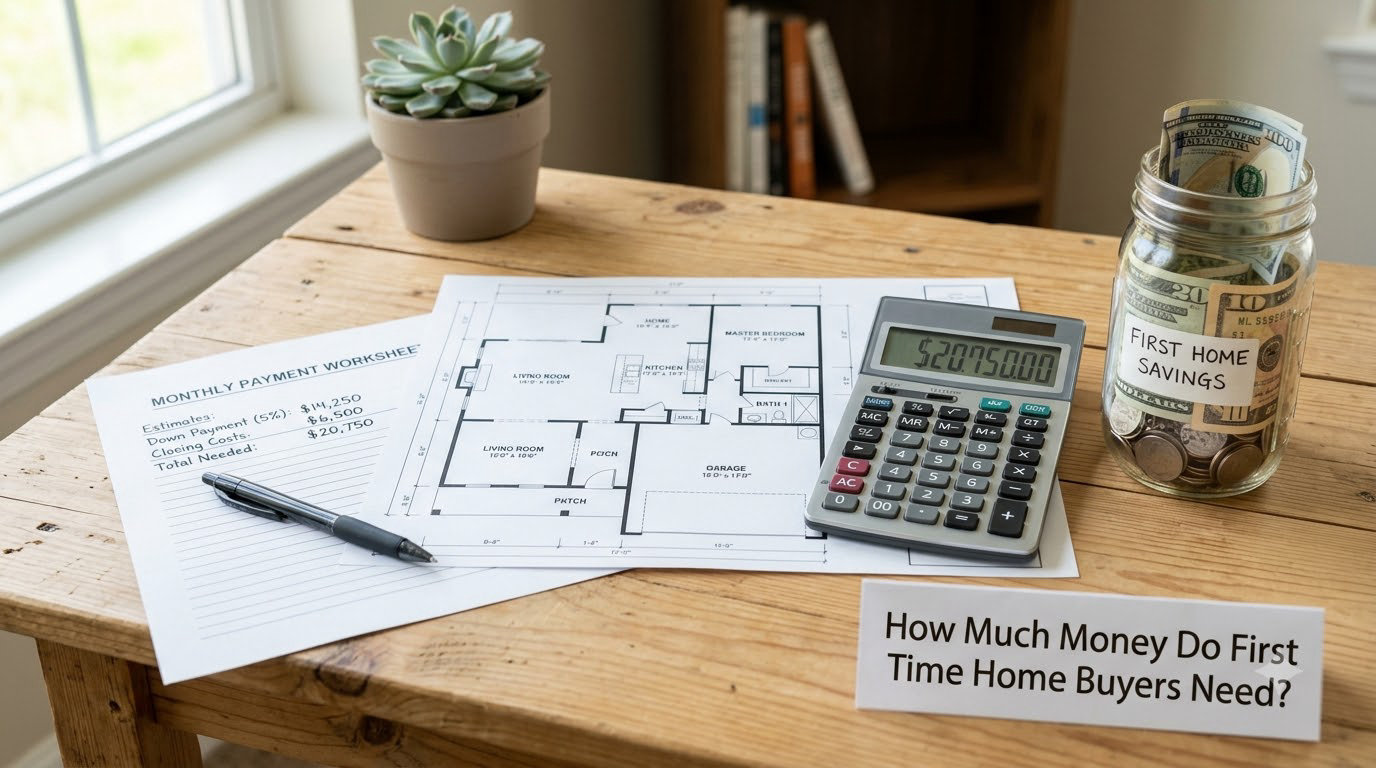
Budget for three separate pots of cash: money that goes toward the purchase, money that goes toward closing, and money you keep in reserve afterward. Most first time home buyer programs only touch the first two.
- Earnest money is typically 1 to 3 percent of the price, due when the purchase contract is signed and credited at closing.
- Down payment can be as low as zero on a VA or USDA loan, 3.5 percent on FHA, 3 percent on an eligible conventional loan, or that amount covered by assistance.
- Closing costs run roughly 2 to 5 percent of the price: lender fees, title work, recording, taxes prepaid at closing.
- Prepaid escrow for taxes and homeowners insurance, often a full year of both.
- Inspection and appraisal fees, which are not closing costs but come due before closing.
- Reserves of several months of payments, required by many programs even after you have closed.
- Moving costs and immediate repairs, which first time buyers routinely forget to fund.
As a planning illustration, on a home priced at 300,000 dollars you would look at roughly 10,500 in earnest money, 10,500 down on a 3.5 percent FHA loan, about 9,000 in closing costs and prepaid items, and a few thousand for inspection, appraisal and reserves.
On a home priced at 400,000 dollars those same percentages land at 14,000 in earnest money, 14,000 down, and roughly 14,000 in closing costs, before inspection and appraisal. These are planning examples drawn from standard percentages, not quotes, and your own numbers come from the Loan Estimate your lender prepares.
What Costs and Rules Should Buyers Check Before Applying?
Assistance is not free money, and the costs show up in a few predictable places. An origination fee of around 1 percent of the loan amount is the one buyers report learning about late, which works out to several thousand dollars on a larger purchase.
Beyond that:
- The second lien adds a payment, or defers one to your exit. On a 15,000 dollar second at 2 percent over 15 years, one buyer described paying about 100 dollars a month and considered it a good trade.
- Mortgage insurance or a funding fee applies on the primary loan and cannot be bundled into the assistance.
- Rate buydowns cost upfront cash to lower your rate for a set period. Buyers should see the full cost in the Loan Estimate rather than treat it as free.
- Recapture means the assistance comes back if you sell, refinance or stop occupying within the required period.
- Program fees and compliance requirements, including the occupancy rule that often runs a full year.
Watch for scams too. Real programs do not charge you to apply, do not guarantee approval, and do not need your bank login or Social Security number over a text message. Forum threads describe fake programs impersonating state agencies and a popular video claiming most assistance is fraudulent. The federal First Homebuyer Tax Credit from 2008 and 2009 has not existed since, so any offer naming it is a lie.
On the credit side, a mortgage credit certificate issued through your state housing finance agency can give you an annual tax credit for the mortgage interest you pay, and it stacks with a first loan rather than replacing it. It cannot be sold and usually expires if you do not use it.
How to Apply for the Right First Time Home Buyer Program
Work through these in order. Skipping the early steps is how buyers end up preapproved with a lender who cannot process the assistance at all.
- Find your state housing finance agency. Search your state name plus housing finance agency, then look for its first-time buyer or down payment assistance page. That page holds the real income limits and purchase price caps.
- Check your local trust fund programs. City and county housing departments fund separate programs that your state agency will not list.
- Talk to a HUD-approved housing counselor. These are free or low cost, neutral, and they can tell you which programs you miss.
- Get preapproved by a lender approved for the program. Ask directly which programs this lender can process, and get more than one quote.
- Finish the education requirement early. The certificate takes a few hours, and some programs will not release funds without it.
- Compare total cost, not just cash to close. Put assistance, 3 percent down conventional and FHA side by side with your own numbers and compare the full monthly payment including mortgage insurance.
- Read the second lien note before you sign. Know the rate, term, repayment trigger and what happens on an early sale.
Skip any program that asks for an upfront fee, promises a guaranteed approval, or wants bank credentials before an appointment with a licensed lender.
First Time Home Buyer Programs: Common Mistakes to Avoid
1. Treating everything as a grant. If the document says forgivable, deferred or repayable, it is a loan. The fix is to read the repayment note before the closing date, not after.
2. Focusing only on the down payment. Assistance often does not cover closing costs, prepaid escrow or your reserves. The fix is to total cash to close with the assistance included.
3. Ignoring the occupancy rule. Selling, refinancing to pull cash or moving out within the first year can trigger full recapture. If you might need flexibility, weigh that before choosing the program.
4. Accepting unverified claims. A number quoted in a video or a flyer means nothing until your state agency confirms it in writing.
5. Taking family money without documenting the source. A gift needs a documented donor statement. Undocumented funds read as an undisclosed second lien to the lender and can sink the loan at underwriting.
6. Letting one loan officer speak for the whole market. One lender may not be approved for a program. The fix is asking the agency directly for a list of participating lenders.
7. Missing the funding window. Many programs run out of money partway through the year. Applying early in a cycle matters more than applying the day you find the listing.
Frequently Asked Questions
Are first time home buyer programs grants?
Most are not. A true grant is rare and usually restricted to specific groups or distressed neighborhoods. Far more common are forgivable loans, which are forgiven only if you occupy the home as your primary residence for the full period, and deferred seconds, which you repay when you sell or refinance. Repayable second mortgages make monthly payments from day one. Always read the repayment note before you sign, because what looks like free money at the table often becomes a balance due at your exit.
Can I use a down payment assistance program with an FHA loan?
Yes, and that pairing is common, because FHA loans already accept a low down payment. The assistance simply supplies the cash for the down payment and eligible closing costs, so your own money goes further. Most state programs will work with a primary FHA, VA, USDA or conventional loan, though some restrict the choice. Ask your lender which primary loan types the program allows and confirm with the administering agency before you commit.
Do I have to be a first time home buyer to qualify?
Often, yes, but not always. Most state and local assistance requires that you have not owned a home in the previous three years. FHA loans require no first-time designation, and VA and USDA loans apply only their own eligibility rules, so a veteran or a rural buyer may qualify without meeting a state program. A 3 percent down conventional loan does require you to meet federal first-time buyer guidelines.
How much money do I need to buy my first home?
Plan on the down payment, closing costs and reserves together. A common target is 5 to 10 percent of the purchase price for a low down payment loan, which on a 300,000 dollar home means roughly 15,000 to 30,000 dollars, and on a 400,000 dollar home roughly 20,000 to 40,000 dollars. Assistance can cover part of the down payment, but rarely all of it plus closing costs and reserves. Use these as planning ranges and get your own Loan Estimate.
How long does it take to get approved for a home buyer program?
Preapproval usually takes one to two weeks once documents are in, and the education course takes a few hours. The longer variable is the home search itself, which runs four to six months in a competitive market. Assistance approval often adds one to three weeks because the agency reviews income, the purchase contract and the seller. Some programs run out of funds mid-year, so applying early in a cycle shortens the wait.
Can I use home buyer assistance if I buy with family?
It depends on how the title is structured. If one co-buyer buys and the rest live there as family members, the assistance generally requires the borrower to occupy the home as a primary residence. If everyone on the deed is a first-time buyer, all of them may need to qualify, and the income limit is measured for the whole group. Lenders also want gift funds from family documented with a donor statement before closing.
Conclusion
First time home buyer programs come down to four decisions: which layer you actually qualify for, how much cash you still need after the assistance, what the second lien will cost you, and whether you can live with the occupancy and recapture rules for the full period.
Start with your state housing finance agency, since it holds the authoritative limits and the list of participating lenders, and add a free session with a HUD-approved housing counselor before you make an offer. Verify any number you read, including the ones here, because these limits move and this article is not a substitute for advice about your own finances.