
An HSA is the only account in the US tax code that is triple tax advantaged. Contributions reduce your taxable income, the money grows tax-free while it sits in the account, and withdrawals for qualified medical expenses are tax-free too. Here is the HSA triple tax advantage explained, including who qualifies, what you can contribute, and what happens if you use the money the wrong way.
This is general information about how health savings accounts are taxed in the United States, not tax advice. Limits and rules change, so check IRS Publication 969 and Form 8889 before you make a move.
Table of Contents
- What Is the HSA Triple Tax Advantage?
- How Does the HSA Triple Tax Advantage Work?
- Who Qualifies for an HSA?
- HSA Contribution Limits and Tax Rules
- HSA vs. FSA: Which Offers the Tax Advantage?
- HSA Triple Tax Advantage Explained for Investing
- Pay out of pocket, save the receipts, reimburse later
- What Happens If You Use an HSA for Nonqualified Expenses?
- Frequently Asked Questions
- What is the HSA loophole?
- Can I invest my HSA money, and should I?
- What happens if I make a non-qualified withdrawal?
- What are the downsides of having an HSA?
- Do employer contributions count against my own contribution limit?
- Can I open an HSA without an employer, and what if I lose my HDHP mid-year?
- Conclusion: Start by Checking Your Eligibility and Limits
What Is the HSA Triple Tax Advantage?

The triple tax advantage is the only combination in the tax code where money goes in, grows and comes out without being taxed at any stage. A traditional 401(k) gets you two of the three. An HSA gets all three, plus it stays yours if you change jobs.
- Tax-free contributions. Money you contribute through payroll or by reducing taxable income lowers your federal taxable income. If it comes straight out of a paycheck, it also escapes Social Security and Medicare taxes, which is why some people call it quadruple tax advantaged.
- Tax-free growth. Interest, dividends and capital gains earned inside the account are never taxed while they stay in it. Nothing is pulled out annually for tax, so the whole balance compounds.
- Tax-free qualified withdrawals. Withdrawals for qualified medical expenses are tax-free at any age, with no penalty. There is no deadline, no use-it-or-lose-it rule and no required minimum distribution.
Those three advantages only apply if you pair the account with a qualifying high-deductible health plan. Without HDHP coverage, you are not eligible to contribute, and an ineligible contribution can be taxed with a penalty.
How Does the HSA Triple Tax Advantage Work?
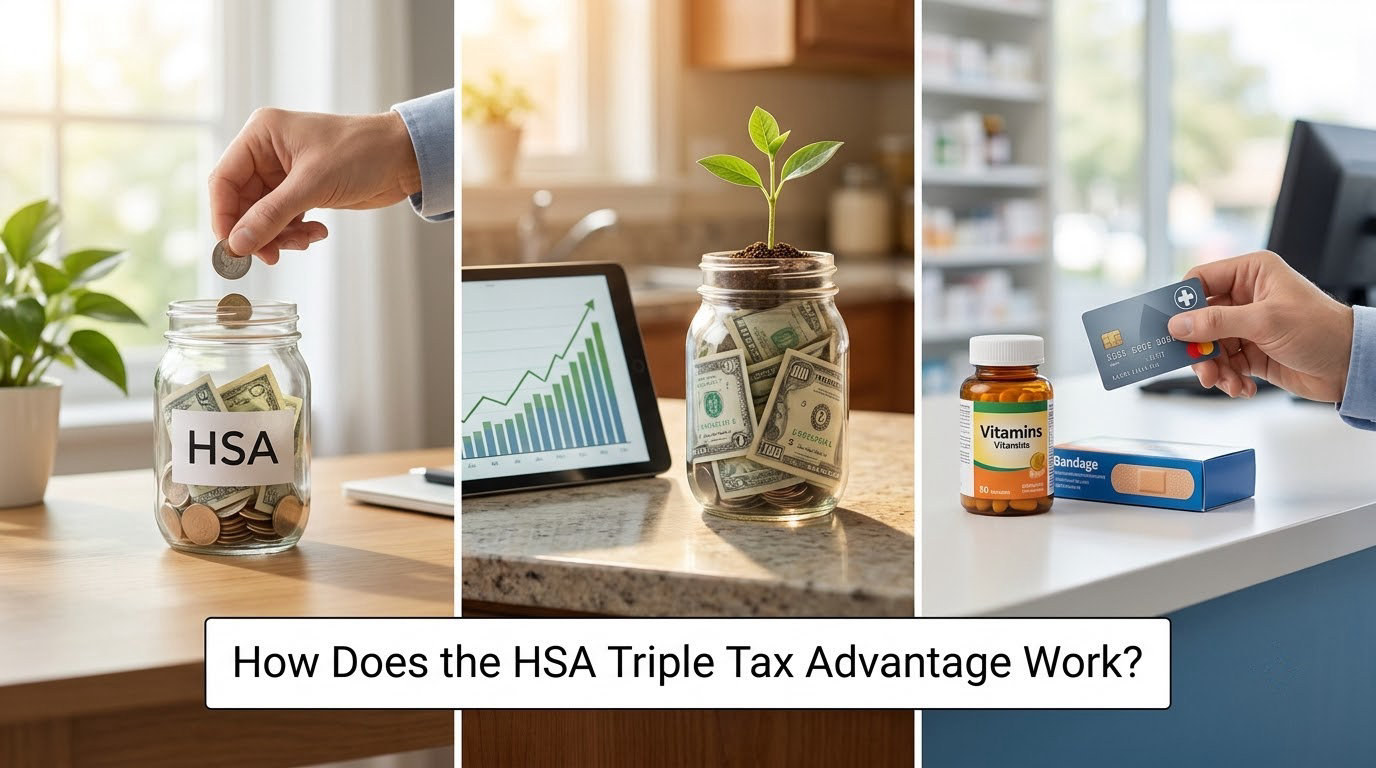
The advantage works in three stages, and each stage has its own tax treatment. Keeping the stages separate makes it much easier to see where most mistakes happen.
| Stage | What happens | Tax treatment |
|---|---|---|
| Going in | You contribute from payroll, from a bank transfer, or as a deduction on your tax return | Reduces federal taxable income; payroll contributions also avoid FICA |
| Growing | The balance earns interest or is invested in index funds, ETFs or mutual funds | Interest, dividends and gains are not taxed |
| Coming out | You withdraw for qualified medical expenses at any point after the HSA was opened | Tax-free and penalty-free at any age |
Two details trip people up. First, if you fund the account yourself rather than through payroll, the deduction still counts, but you have to claim it yourself on Form 8889 rather than waiting for a W-2. Second, the money is not locked up. You can pay medical bills out of pocket, keep every receipt, and reimburse yourself years later as long as the expense happened after the account was opened and you never deducted it elsewhere.
Who Qualifies for an HSA?
You qualify if you are enrolled in a qualifying high-deductible health plan and four specific conditions are met. Most people fail on one of the last two, not the plan type.
| Requirement | What it means in practice |
|---|---|
| HDHP coverage | Your plan must meet the annual deductible threshold set by the IRS, which for 2026 is 1,700 dollars for self-only coverage and 3,400 dollars for family coverage |
| Only HDHP coverage | You cannot be covered by a general-purpose health plan that is not an HDHP. A spouse on a traditional plan can make you ineligible, and a general-purpose dental or vision plan disqualifies you for the months it is in force |
| Not on Medicare | Once you are enrolled in Medicare Part A, B or C you cannot contribute. You can still use and invest an existing balance |
| Not a dependent | You cannot be claimed as a dependent on someone else’s tax return |
Self-employed people can open an account directly with a bank or brokerage once they buy an HDHP on the individual market. Advice on r/fidelityinvestments repeats the same point for employees whose employer offers no HSA: the tax advantage still applies, as long as the HDHP requirement is genuinely met.
Eligibility is tested month by month, which produces a partial-year situation. If you had qualifying coverage for only seven months, you can contribute a prorated share of the annual limit. If at any point in the year you had disqualifying coverage such as Medicare or a general-purpose plan, the pro-rata rule applies and the contribution limit drops sharply for the whole year rather than for that month alone.
HSA Contribution Limits and Tax Rules
For 2026 the IRS contribution limits are 4,400 dollars for self-only coverage and 8,750 dollars for family coverage, plus a 1,000 dollar catch-up contribution for anyone age 55 or older. Limits are set by statute and rise in steps, so the 2026 limits are already published.
| Limit | 2026 | 2027 |
|---|---|---|
| Self-only contribution limit | 4,400 dollars | 4,500 dollars |
| Family contribution limit | 8,750 dollars | 9,000 dollars |
| Catch-up contribution, age 55 and over | 1,000 dollars | 1,000 dollars |
| HDHP deductible threshold, self-only | 1,700 dollars | Set by IRS in late 2026 |
| HDHP deductible threshold, family | 3,400 dollars | Set by IRS in late 2026 |
Your employer contribution comes out of the same limit, not on top of it. If your employer puts 1,000 dollars into your account and you want to hit the family maximum, you contribute the remaining 7,750 dollars yourself. Employer money is not part of your compensation, so it does not show up on your W-2 and does not reduce your taxable income.
Self-employed people can make an above-the-line deduction for contributions they make for themselves, and that deduction is generally available whether or not they itemize. People who itemize can claim HSA contributions as an adjustment to medical expenses.
One last rule catches families out. You can fund an HSA for a child or an adult dependent, but you cannot be reimbursed for expenses already covered by that person’s own plan. Keep the receipts separated by person so an audit is not a headache.
HSA vs. FSA: Which Offers the Tax Advantage?
An HSA is the only one of these accounts with all three advantages, and it is the only one you own outright. An FSA gives you one of the three and takes it back if you do not spend it.
| Account | Tax-free going in | Tax-free growth | Tax-free coming out | Early withdrawal | Portability |
|---|---|---|---|---|---|
| HSA | Yes | Yes | Yes | 20 percent penalty plus income tax before age 65 | Yours, always |
| FSA | Yes | No, use-it-or-lose-it | Yes | No, forfeited or taxed | Lost on job change |
| Traditional 401(k) | Yes | Yes, deferred | No, taxable as ordinary income | 10 percent plus income tax with a job change | Yours, with a rollover |
| Roth IRA | No, after-tax | Yes | Yes | None | Yours |
| Taxable brokerage | No | No | No | None | Yours |
The practical difference for a family is usually this: put the FSA on the low-spending spouse for small predictable costs like prescriptions, and put the HSA on whoever will actually save. An HSA you never touch for fifteen years behaves like a Roth IRA that also covers medical expenses after 65.
Advice on r/Bogleheads is consistent on the order of operations. Max the HSA before or alongside a 401(k) or IRA, especially under the Social Security earnings phaseout range, because the HSA contribution is the one that avoids FICA as well as income tax.
HSA Triple Tax Advantage Explained for Investing
Tax-free growth only matters if you invest. CNBC has cited EBRI research showing that only about 13 percent of HSA holders put their balance to work in the market. Most sit in cash earning almost nothing, which quietly turns advantage two off.
Most HSA custodians offer a menu of index funds, ETFs and mutual funds once your balance clears a small threshold. The problem, according to posts on early-retirement.org, is that the menus are often thin and the expense ratios are higher than you would accept in a brokerage account. One fix is to keep enough cash near-term for the current year’s deductible and out-of-pocket maximum, then move the rest into a low-cost index portfolio once you have confirmed the custodian’s menu and fees.
Pay out of pocket, save the receipts, reimburse later
This is the strategy that unlocks the account, and it is the one most people find hardest to believe. You keep your own money for the medical bill, invest the HSA balance instead, and reimburse yourself whenever you want from the receipts you saved.
Worked example. Your family deductible is 3,400 dollars. You pay all 3,400 dollars out of pocket in year one and keep every itemized receipt and explanation of benefits. The same year you contribute 8,750 dollars and invest it. At a hypothetical 7 percent average annual return, that 8,750 dollars becomes roughly 41,000 dollars after 25 years, 76,000 dollars after 35 years, and around 137,000 dollars after 45 years, all without a single tax bill on the growth. That projected balance is illustrative, not a promise; returns vary and you can lose money in a bad stretch of years.
Because the receipts have no deadline, a year of orthodontics or a planned procedure can be reimbursed whenever you want. You can also reimburse expenses from before you retired, as long as they occurred after the account was opened.
What Happens If You Use an HSA for Nonqualified Expenses?
A non-qualified withdrawal before age 65 is taxed as ordinary income and hit with a 20 percent penalty. The 20 percent does not apply once you reach 65, but the income tax still does on any withdrawal that is not for qualified medical expenses. For someone in the top marginal bracket, that combination is expensive enough that HSA money behaves like a taxable account.
Common non-qualified expenses include insurance premiums other than for COBRA continuation coverage, cosmetic procedures, gym memberships, vitamins and general household items. Death, disability and end-of-life expenses do count, as does early retirement once you are 65.
After 65, withdrawals for qualified medical expenses stay tax-free, and the account simply becomes a health reimbursement arrangement for the rest of your life. Medicare premiums, supplemental insurance premiums and long-term care premiums all qualify.
Four mistakes account for most of the damage I see people do. Over-contributing, which attracts a 6 percent excise tax until you fix it. Taking money out for something personal. Losing HDHP coverage mid-year, which can retroactively trigger the pro-rata rule and a taxable contribution. And throwing out receipts, which removes the only proof you had of a legitimate expense decades earlier.
Two more traps deserve a mention. If you die with a balance, a non-spouse beneficiary inherits it as income in the year it is paid out. And in California and New Jersey the HSA deduction does not reduce state taxable income, a detail that quietly shrinks the headline advantage for residents of those two states.
Frequently Asked Questions
What is the HSA loophole?
It is the idea that you can pay a medical bill yourself, keep the receipt, invest the HSA money and withdraw years later to reimburse yourself tax-free. It is not a loophole at all. The expense has to be a qualified medical expense incurred after the account was opened, and you cannot deduct it a second time elsewhere. The rule simply lets the tax-free money stay invested while you cover current costs from your paycheck.
Can I invest my HSA money, and should I?
Most custodians let you choose index funds, ETFs and mutual funds once your balance passes a minimum, though the menus are often limited and fees run higher than a brokerage account. Investing is what makes tax-free growth meaningful, but keep a cash cushion near your deductible and out-of-pocket maximum. The money should cover the current year without a sale.
What happens if I make a non-qualified withdrawal?
Before age 65, a non-qualified withdrawal is added to your taxable income and carries a 20 percent penalty. The same withdrawal after 65 is penalty-free but still taxable unless it pays for qualified medical expenses. Death, disability and end-of-life expenses count as qualified at any age, so an early withdrawal is not automatically a penalty.
What are the downsides of having an HSA?
The real downsides are administrative. You must be on an HDHP every month, and any disqualifying coverage such as Medicare or a general-purpose dental plan can make a contribution taxable. You also need the cash to pay medical bills before reimbursing yourself, and provider menus can be poor. California and New Jersey residents get no state deduction.
Do employer contributions count against my own contribution limit?
Yes. Employer money comes out of the same annual limit rather than adding to it, so if your employer contributes 1,000 dollars toward a family limit of 8,750 dollars, you can add the remaining 7,750 dollars yourself. Employer contributions are not part of your compensation, so they are not reported on your W-2 and do not reduce your taxable income.
Can I open an HSA without an employer, and what if I lose my HDHP mid-year?
Anyone can open an account directly with a bank or brokerage once they hold a qualifying HDHP, which matters for self-employed people and freelancers. If qualifying coverage ends partway through the year, your limit is prorated by the months you were covered. If you had disqualifying coverage for even one month, the pro-rata rule applies to the entire year instead.
Conclusion: Start by Checking Your Eligibility and Limits
The HSA triple tax advantage is three breaks in one account: money in comes out of taxable income, growth is never taxed, and qualified medical withdrawals are tax-free at any age. Add the FICA exemption on payroll contributions and it becomes the most tax-efficient retirement account available to Americans under 65, with no required distributions and no expiration.
Start with the boring part. Confirm that you are on a qualifying high-deductible health plan for the whole year, read the current IRS contribution limits for your coverage type, and check whether your employer already funds the account. Then decide how much you can contribute without touching the balance for your current deductible and out-of-pocket maximum. Whatever stays above that line is money you never pay tax on again.