
Retirement income from investments is the cash that keeps arriving after your paycheck stops: dividends, bond interest, annuity payments, rental income, and planned sales from your portfolio, sized so the money lasts as long as you need it. Building it takes four things in order — a real spending number, an honest inventory of what you already receive, a withdrawal framework you can adjust, and accounts arranged so taxes do not eat the difference.
This guide walks through that sequence in six steps, then flags the mistakes that flatten most retirement income plans. It takes about an hour to work through the first time.
Nothing here is personalized advice. Tax rules, withdrawal limits and interest rates differ by state and country and change from year to year, so treat every number as a planning estimate and check the details where you live.
Table of Contents
- What You Need to Create Retirement Income From Investments
- Step-by-Step: Build a Retirement Income Plan
- 1. Estimate Your Annual Retirement Spending
- 2. Review Your Portfolio and Income Sources
- 3. Decide How Much to Withdraw Each Year
- 4. Build a Reliable Mix to Create Retirement Income From Investments
- 5. Choose a Withdrawal and Investment Schedule
- 6. Manage Taxes, Inflation, and Investment Risk
- Common Mistakes
- Frequently Asked Questions
- How much can I withdraw from my retirement account each year?
- How much money do I need to invest to make 3,000 dollars a month?
- What is the 3 bucket strategy for retirement planning?
- Do dividends or a bond ladder create better income than planned withdrawals?
- What is the number one mistake retirees make with income?
- How do I handle a market crash in the first years of retirement?
- Conclusion
What You Need to Create Retirement Income From Investments
Before choosing a single income strategy, gather seven inputs. Skipping this stage is why two people with identical portfolios end up with completely different paychecks.
- Portfolio value and account locations. Every dollar, split by taxable brokerage, traditional 401(k) or IRA, Roth, and HSA.
- Annual spending target. Your estimate of what retirement costs each year, in today’s dollars.
- Time horizon. The date of your first withdrawal, and how long the money has to last.
- Cash reserve. Two to three years of spending already parked somewhere safe.
- Tax picture. Your bracket, deductions, and whether you expect a bigger income year ahead.
- Risk tolerance. How a 30 percent market drop would actually change your behavior.
- Other income. Social Security, a pension, rental income, part-time work, consulting fees.
Two of these deserve extra care. Portfolio inertia is common — a 401(k) loaded with shares of the employer you spent 20 years at is not a retirement portfolio, and moving that position is a tax and planning decision, not an afterthought. And risk tolerance is not a questionnaire score; it is whether you would sell 20 percent of your holdings in a bad month and then stay invested for the recovery.
Step-by-Step: Build a Retirement Income Plan
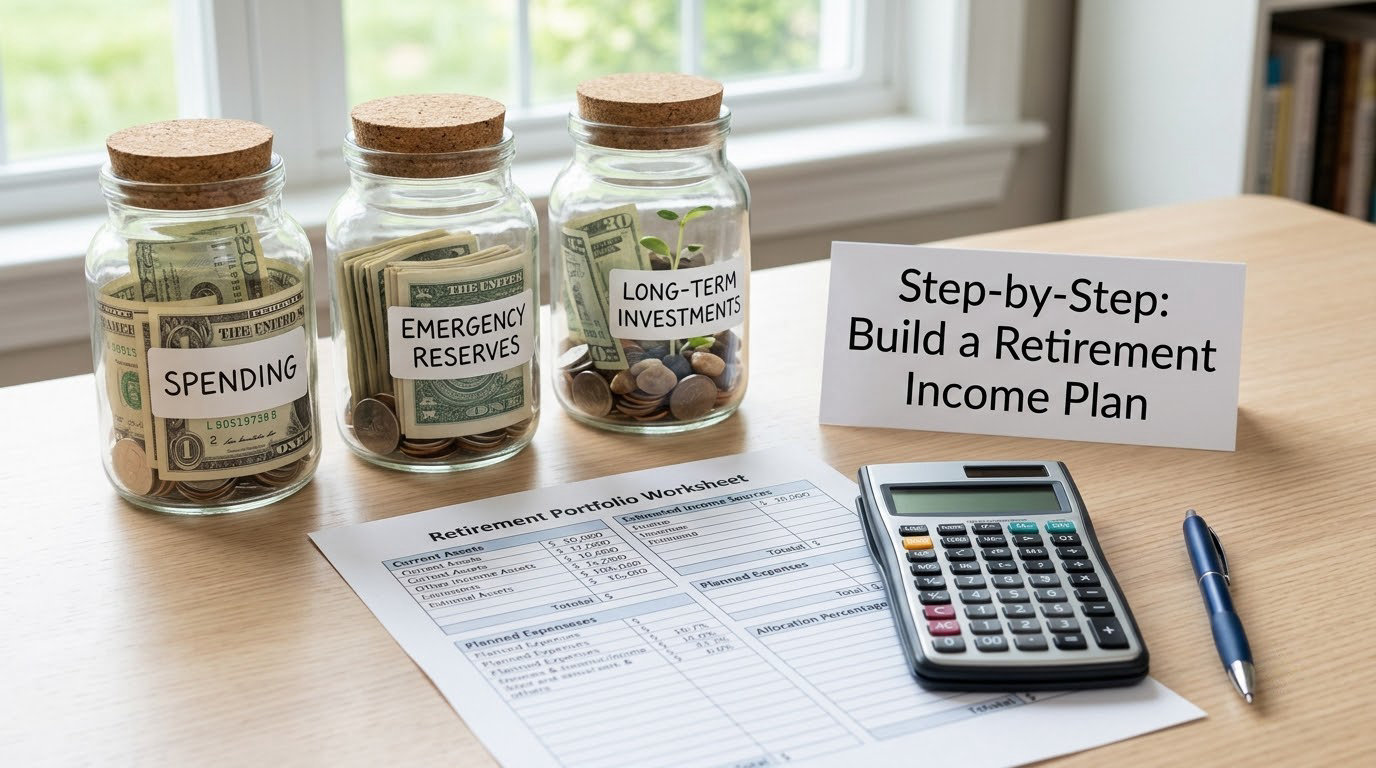
1. Estimate Your Annual Retirement Spending
Start with the last twelve months of actual spending, not a guess. Export your bank and credit card statements and sort them into three buckets: essentials such as housing, groceries, insurance and health care; wants such as travel, dining and hobbies; and aspirations such as the longer trips, the second home, or helping family.
Essentials usually account for roughly 60 to 70 percent of a retiree’s budget, but yours will differ. Then add the irregular costs that hide in averages: a new roof, a replacement car, dental work, an annual insurance premium that jumps.
Turn that into an annual cash-flow target. A common shortcut is the replacement rate — planning on 70 to 90 percent of pre-retirement income — but it breaks badly for people with a paid-off house or a large pay-your-own-way lifestyle. Your spending number should be built from your own statements, then sanity-checked against the replacement rate. Finally, adjust the target for inflation so you are not solving 2026 and running out by the early 2030s.
2. Review Your Portfolio and Income Sources
List every dollar of income already arriving, and put a start date on each one. Social Security with its annual cost-of-living adjustment, a defined benefit pension, a rental property with its vacancy and repair reality, a part-time job, annuity payments.
Subtract your spending target from that total. The remainder is the gap your investments must fill, and that number — not your portfolio balance — is the one to plan around.
A stockholder’s dividend cut or a bond that you have not counted on maturing next year changes the gap without warning, so record how dependable each source really is rather than just how large it is.
3. Decide How Much to Withdraw Each Year
Divide the gap by your portfolio to get a starting withdrawal rate. The famous 4 percent rule takes your balance in the first year of retirement, multiplies it by 0.04, raises that dollar amount by inflation each year, and hopes the portfolio survives 30 years. On a 1 million dollar portfolio that is 40,000 dollars in year one.
Recent Morningstar research puts the median safe withdrawal rate closer to 3.9 percent, and closer still when guardrails are added — rules that cut withdrawals in bad markets and raise them in good ones. The honest framing from retirement researchers such as Early Retirement Now is that the rule’s usefulness depends on valuations when you retire: starting into expensive markets makes 4 percent shaky, starting into cheap markets makes it cautious.
Here is the arithmetic people search for most. Portfolio needed = annual income target divided by the withdrawal rate.
| Monthly income target | Annual target | At 3% | At 3.5% | At 4% | At 4.5% |
|---|---|---|---|---|---|
| 2,000 dollars | 24,000 | 800,000 | 686,000 | 600,000 | 534,000 |
| 3,000 dollars | 36,000 | 1,200,000 | 1,029,000 | 900,000 | 800,000 |
| 5,000 dollars | 60,000 | 2,000,000 | 1,715,000 | 1,500,000 | 1,334,000 |
| 10,000 dollars | 120,000 | 4,000,000 | 3,429,000 | 3,000,000 | 2,667,000 |
Use a rate at the conservative end if you are within ten years of retiring, if a large share of the portfolio is in shares of one company, or if you want the income stream to be dependable rather than maximized. A flexible spending rule beats a rigid one: many retirees cap the annual increase at a few percent and let spending fall during a bad stretch rather than selling into one.
4. Build a Reliable Mix to Create Retirement Income From Investments
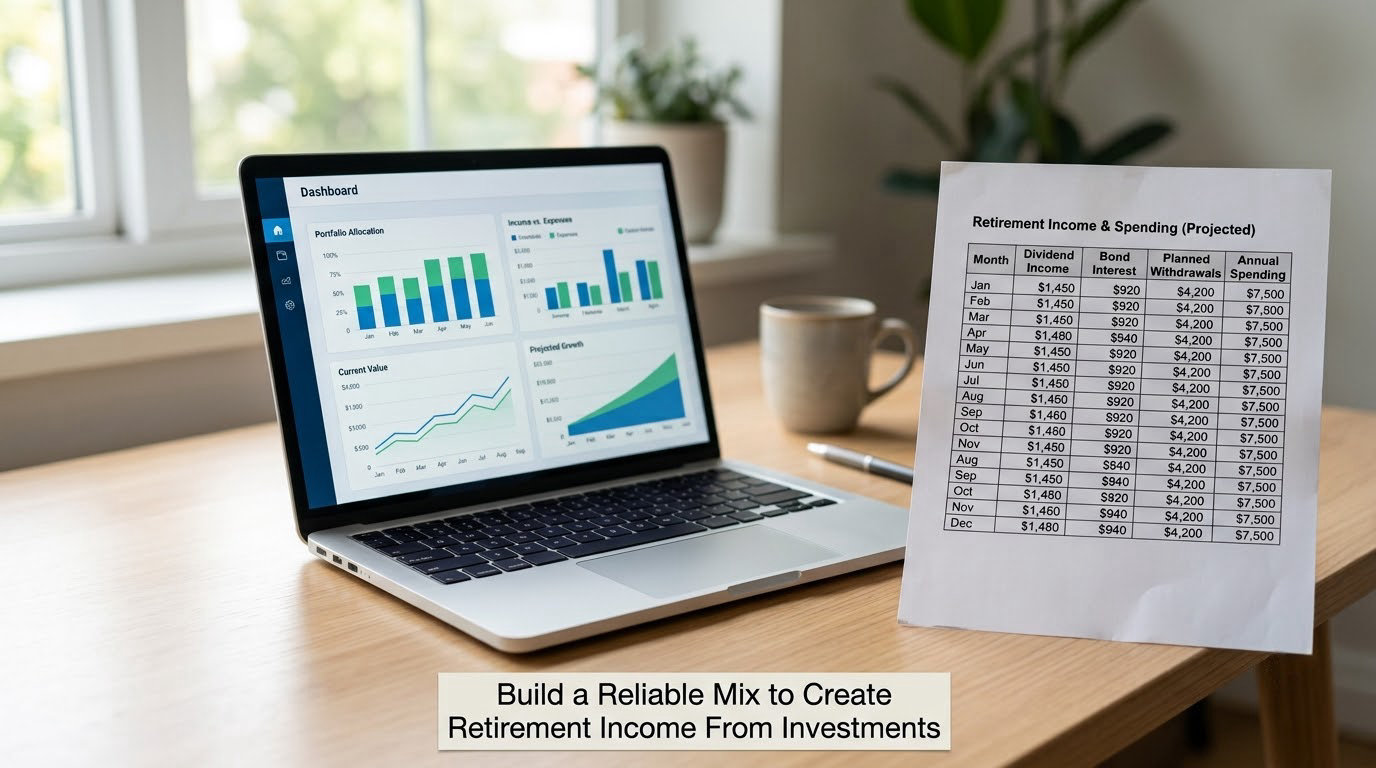
No single method covers everything, so classify each one before you buy it. Guaranteed income is fixed for life and cannot be cut by a bad quarter. Semi-guaranteed income varies with a market but follows a floor, such as a bond ladder maturing every year. Variable income moves with the market and can shrink in a downturn.
| Strategy | Type | Income ceiling | Liquidity | Tax treatment | Best used for |
|---|---|---|---|---|---|
| Dividend shares and dividend ETFs | Variable | Limited by share prices | High | Qualified dividends, taxed at long-term capital gains rates | Growth that pays something along the way |
| Bonds and bond ladders | Semi-guaranteed | Fixed by coupon | Medium, worse at maturity | Ordinary income, bond interest can push you into a higher bracket | Reliable income with a known schedule |
| Certificates of deposit and multi-year guaranteed annuities | Guaranteed for a term | Fixed by rate | Penalty for early exit | Ordinary income | Locking in rates on money needed in 3 to 10 years |
| Immediate annuity with lifetime payments | Guaranteed for life | Fixed, may include an inflation rider | None | Ordinary income on the payout portion | Covering essential costs late in life |
| Treasury inflation-protected securities | Semi-guaranteed | Adjusts with inflation | Medium | Ordinary income, federal taxed but state exempt | Purchasing power protection |
| REITs | Variable | Required distributions | High | Ordinary income, no qualified dividend treatment | Real estate exposure without the property |
| Total return with planned sales | Variable | Whatever the portfolio returns | High | Depends entirely on account type | Larger portfolios with a long horizon |
A workable mix usually pairs a variable growth bucket with something dependable underneath it. Dividend shares fund the wants, a bond ladder or annuity covers essentials, and planned sales from the growth bucket top up the difference. What matters more than the choice is that no single source carries the whole load. One company cutting its dividend, or one annuity contract sitting too small, should not break your monthly plan.
The 3-bucket approach is the simplest version of this idea. Bucket one holds one to three years of spending in cash or short-term instruments. Bucket two holds the next several years in bonds or guaranteed instruments that mature on a schedule. Bucket three holds the long-term growth portfolio. Spend from the top bucket each year and refill it as the lower buckets mature.
5. Choose a Withdrawal and Investment Schedule
Sequence matters more than most people expect, and it starts before retirement. Layering in income five to ten years before you stop working lets you cut your hours, replace some salary, and find out what your plan actually pays without betting your career on it.
Then line up the fixed dates. Social Security can begin as early as 62, at full retirement age for your birth year, or at 70 for the highest lifetime monthly benefit, and delaying costs nothing in benefits while giving the portfolio fewer years to cover you. Required minimum distributions generally begin at age 73 in current US law, and that rule can change, so verify it each year.
Order the annual withdrawals deliberately. Take required distributions first because the penalty for skipping them is severe. In most cases after that, sell from the taxable account and realize long-term gains in a lower bracket, then draw from traditional accounts, and keep Roth money as the last line because those withdrawals are tax-free. If you are in a high-income year, converting part of a traditional balance to Roth ahead of the conversion window can spread the tax across several years.
6. Manage Taxes, Inflation, and Investment Risk
Where a strategy lives changes what it costs you. A dividend ETF inside a taxable account throws off qualified dividends taxed at long-term capital gains rates, while a bond fund in the same account pushes ordinary interest into your bracket. Treasury inflation-protected securities owe federal tax but no state tax, which matters if you live in a high-tax state.
Sequence of returns risk is the danger nobody sees coming: a large withdrawal in year one, followed immediately by a deep market decline, can damage a portfolio that would have survived the same returns in reverse order. Two to three years of spending in cash or short-term bonds is the usual defense, and flexible spending is the second one. Rebuild those reserves each good year rather than leaving the account permanently thin.
Rebalance on a written schedule, often annually, back to your target allocation. Finally, stress-test the plan by walking through what happens if markets fall 30 percent in your first two years, your expenses run 10 percent higher, and Social Security arrives two years late. If the plan survives that story, it is a plan. If it does not, you want to know now, not in year three.
Common Mistakes
Most retirement income plans fail on the same handful of errors. Each has a straightforward fix.
- Relying on one source for everything. A single dividend-paying company or one annuity is a bet, not a plan. Spread essential costs across at least two dependable sources.
- Buying yield traps. A very high yield usually means the price has already fallen or the payout is about to be cut. Check the coverage of the payout, not just its size.
- Withdrawing the same dollar amount for 30 years. Fixed dollar withdrawals ignore both inflation and market performance. Increase with inflation, cap the increase, or tie the amount to performance with guardrails.
- Ignoring account order. The difference between selling appreciated shares in a taxable account and drawing the same amount from a traditional account can be several thousand dollars a year.
- Leaving next year’s money in shares. Money needed within two years should not be exposed to a 30 percent drawdown. Move it to cash or short-term instruments as it approaches.
- Never rebalancing. A portfolio that ran up during the bull years quietly becomes a momentum bet. Set a date and a rule in advance.
- Treating a withdrawal rate as a promise. It is a planning guideline from historical data. Real returns, longer lifespans and higher health care costs all push it around.
Frequently Asked Questions
How much can I withdraw from my retirement account each year?
A common starting point is 3.5 to 4 percent of your portfolio in the first retirement year, then raising that dollar amount by inflation each year. Recent research puts the median safe withdrawal rate near 3.9 percent. Treat it as a planning guideline, not a promise, and lower the rate if your portfolio is concentrated or you are retiring early.
How much money do I need to invest to make 3,000 dollars a month?
At 3,000 dollars a month you need 36,000 dollars a year. Dividing by the withdrawal rate gives the portfolio: 1.2 million dollars at 3 percent, about 1.03 million at 3.5 percent, 900,000 at 4 percent, and 800,000 at 4.5 percent. Those figures assume the withdrawals are adjusted for inflation over a long retirement.
What is the 3 bucket strategy for retirement planning?
It splits the portfolio by time horizon. Bucket one holds one to three years of spending in cash or short-term instruments. Bucket two covers years three to ten with bonds or guaranteed products that mature on a planned schedule. Bucket three holds the long-term growth portfolio. You spend from the top bucket and refill it as the lower buckets mature.
Do dividends or a bond ladder create better income than planned withdrawals?
They answer different problems. Dividends come from companies that can cut them, bond interest is fixed but sensitive to rates and credit quality, and planned sales are limited by what markets deliver. In practice most workable plans combine them: dependable income for essentials, growth assets for wants, and planned sales to bridge the gap.
What is the number one mistake retirees make with income?
Concentrating income in one source that can be cut, most often a single company or a single high-yield investment, then over-withdrawing early. A second close contender is treating a withdrawal rate as a fixed lifetime salary instead of a guideline that flexes with markets, inflation and health care costs.
How do I handle a market crash in the first years of retirement?
Keep two to three years of spending out of equities so you are not forced to sell into the decline, and pre-write spending guardrails that cut discretionary spending by a set amount if the portfolio falls past a threshold. Do not reset the long-term withdrawal target because of one bad year, and review the plan annually rather than weekly.
Conclusion
The first action takes an afternoon: pull twelve months of spending out of your bank statements, build one annual number from it, and list every income source you will actually receive with its start date. The gap between those two numbers is the real retirement income you have to create.
From there, work through the six steps in order, write your rebalancing and guardrail rules down while you are calm, and review the whole plan once a year. When taxes, annuity contracts or investment decisions come up, a qualified professional can handle the details that are specific to your situation — and that is exactly what they are for.