
To create a monthly budget that actually works, give every dollar of your take-home pay a job before you spend it: fixed bills on their due dates, sinking funds for annual costs, savings transferred automatically, and one guilt-free bucket for spending. Build it from three months of real bank statements rather than from percentages, then review it for 20 minutes at the end of each month.
The setup takes about two hours spread over an evening or a weekend. The part that keeps it alive is ten minutes a week and twenty minutes a month.
Here is the whole process in one place:
- Calculate your monthly take-home income, not your gross pay.
- List every fixed and variable expense from the last three months of statements.
- Turn annual and irregular bills into monthly sinking fund amounts.
- Sort spending into needs, wants, savings and debt using 50/30/20 as a starting guess.
- Set one specific limit per category and make the totals match.
- Automate savings transfers and minimum debt payments so they run without you.
- Review the plan every month and roll it forward instead of rebuilding it.
Table of Contents
- What You Need
- Step-by-Step: How to Create a Monthly Budget That Actually Works
- Calculate Your Monthly Take-Home Income
- List Every Fixed and Variable Expense
- Separate Needs, Wants, Savings, and Debt
- Set Specific Spending Limits for a Budget That Actually Works
- Automate Savings and Minimum Debt Payments
- Track Spending for the First Full Month
- Review and Adjust the Budget Every Month
- Common Mistakes
- Frequently Asked Questions
- How much money should I budget for savings each month?
- What if my income changes every month?
- Should I budget for irregular expenses like car repairs or annual fees?
- How do I know which budget category is causing overspending?
- What if I have debt while trying to build an emergency fund?
- How often should I update my monthly budget?
- Conclusion
What You Need
You need roughly one hour of gathering and one hour of building. Everything else is optional.
- Three months of bank and credit card statements. Three is the sweet spot. One month misses seasonal spending; a full year is more work than most people will finish.
- Your last two pay stubs. They show take-home pay, deductions, and whether anything is being withheld that you have forgotten about.
- A list of debts with balances and interest rates. Credit cards, student loans, car loans, medical payment plans.
- Your annual and seasonal bills. Car registration, renters insurance, property tax, tuition, gifts, memberships that bill yearly.
- A spreadsheet, a notebook, or a budgeting app. Any of the three works. The tool matters far less than the review you do with it.
- Access to your bank’s transfer and bill pay settings. You will need this in step 6.
If you owe money to collections or are behind on rent, skip the percentage rules entirely. A written plan that shows you every due date is worth more right now than a perfectly balanced one.
Step-by-Step: How to Create a Monthly Budget That Actually Works
Calculate Your Monthly Take-Home Income
Budget from the money that lands in your account, never from your salary. Gross pay includes taxes, Social Security, health insurance, and retirement contributions that never reach you, and building a plan on it guarantees failure in the first month.
For a salaried paycheck, take the net amount and multiply by the number of pay periods per year, then divide by twelve. If you are paid 1,720 net every two weeks, that is 1,720 times 26, divided by 12, which comes to roughly 3,726 a month.
Then add other income you can count on, but add only what reliably arrives: a second job, a regular pension, rental income from a unit that is already leased. A commission check or a freelance invoice is not income until it clears.
If your income changes every month, budget off your lowest month from the past year. Freelancers in r/personalfinance and r/budget consistently describe this as the workable version: set the plan to the smallest month, then sweep anything above it into a smoothing account so a slow quarter does not break the budget.
List Every Fixed and Variable Expense
Go through three months of statements and write down every line. Two columns matter here: fixed costs, which rarely change and have due dates, and variable costs, which move with your choices.
Fixed costs usually include rent or mortgage, utilities, car payment, insurance, phone, internet, and the minimum payment on every debt. Variable costs include groceries, gas, dining out, personal spending, and pet costs.
Do not skip annual bills in this list, because they are the single biggest cause of a budget that breaks in a predictable month. Divide each one by twelve and save that amount every month in a separate account. A 600 car registration becomes 50 a month. A 1,800 yearly premium becomes 150 a month. A 1,200 annual repair reserve becomes 100 a month.
| Irregular or annual cost | Illustrative yearly amount | Set aside each month |
|---|---|---|
| Car registration and tags | 600 | 50 |
| Renters or auto insurance premium | 1,800 | 150 |
| Car repair reserve | 1,200 | 100 |
| Holiday and birthday gifts | 900 | 75 |
| Memberships billed yearly | 240 | 20 |
These amounts are examples, not quotes. Run your own numbers, and round each monthly figure up slightly so a small surprise does not leave you short.
Separate Needs, Wants, Savings, and Debt
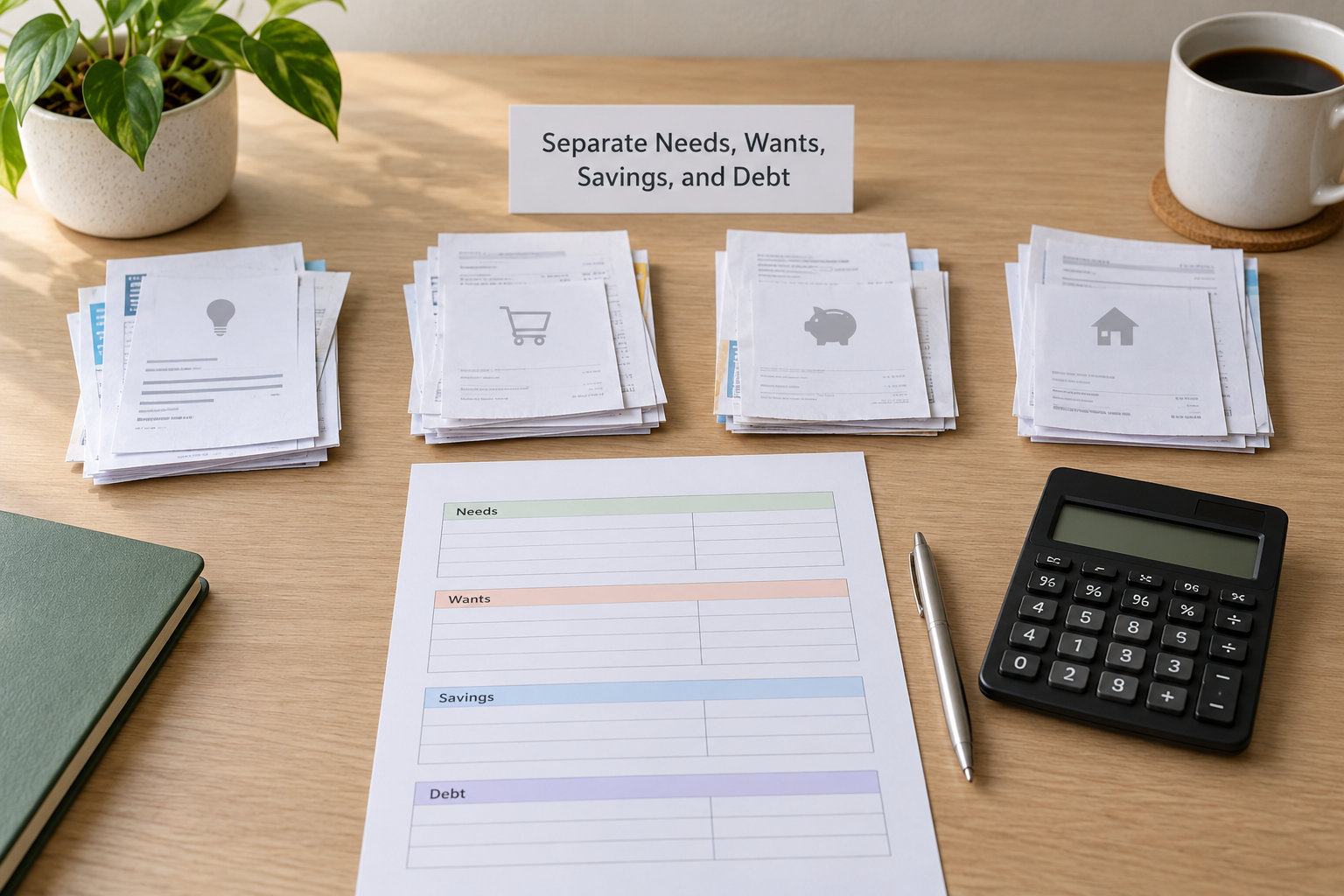
Now sort every line into three buckets. Needs are things you cannot avoid this month, wants are lifestyle spending you would choose again, and the third bucket holds savings plus every debt payment above the minimum.
The 50/30/20 rule, popularized by Elizabeth Warren and her book All Your Worth, is a reasonable starting guess: 50 percent of take-home pay to needs, 30 percent to wants, 20 percent to savings and debt. Treat it as a diagnostic rather than a grade. Plenty of people in high-cost cities legitimately spend 65 or 70 percent on needs, and a budget that tells them they are failing is a budget they abandon.
Useful modifications exist for common situations. A household carrying high-interest credit card debt might run 60/20/20 until the balance is gone. Someone building a first emergency fund might run 50/20/30 for a year. A couple in a high-cost-of-living area might run 70/10/20 and accept the smaller wants bucket deliberately.
At 4,200 a month in take-home pay, the standard split looks like this:
| Category | Share of take-home | Monthly amount |
|---|---|---|
| Needs: rent, utilities, insurance, groceries, transport, minimum payments | 50% | 2,100 |
| Wants: dining out, subscriptions, hobbies, personal spending | 30% | 1,260 |
| Savings and debt: emergency fund, retirement, extra debt payments | 20% | 840 |
Two rules keep this honest. Minimum debt payments come first inside that third bucket because they are not optional, and a small emergency fund comes before extra debt payoff so the next flat tire does not land back on a credit card.
Set Specific Spending Limits for a Budget That Actually Works
Set the limit from your baseline, not from the number you hope for. Take the average of the three months you just reviewed for each category, then trim the two or three categories where your spending drifted the most by about ten percent. That produces a limit you can actually hit.
Then make the totals reconcile. Here is a completed example at 4,200 a month, shaped by a high rent and a car payment:
| Category | Monthly limit | Notes |
|---|---|---|
| Rent, utilities, phone, internet | 1,750 | Fixed, autopay |
| Groceries | 450 | Variable, weekly check |
| Insurance, car payment, transport | 400 | Fixed plus fuel |
| Minimum debt payments | 250 | Autopay, never late |
| Sinking funds | 300 | Annual bills divided by 12 |
| Wants and fun money | 650 | Dining, subscriptions, hobbies |
| Emergency fund and extra debt payoff | 400 | Transferred on payday |
| Total | 4,200 | Matches take-home pay |
When your numbers do not balance, cut in a fixed order. Cut wants first, because that column is genuinely adjustable. Then look at needs for cheaper options such as a phone plan or a cancellation you keep forgetting about. Never cut the savings column to make the math work, because that is the column that makes the budget hold up next month.
If the needs column alone exceeds your take-home pay, the plan has a structural problem that adjusting categories will not fix. That is a debt, income, or housing decision, and it is worth naming plainly on the page.
Automate Savings and Minimum Debt Payments
A budget you have to remember fails. Schedule every transfer for payday, the day after the deposit lands, so the money leaves before it can be spent.
Work through this priority order, and stop at each rung until it is funded:
- Employer retirement match, because it is part of your pay that you never see.
- Emergency fund up to one month of essential expenses.
- Extra payments on high-interest credit card balances.
- Remaining retirement contributions and the rest of the emergency fund.
Leave enough in your checking account to cover bills that fall due before the next payday. Most banks show a scheduled-payment calendar, and paying a bill early on a fixed schedule is simpler than watching a balance and hoping.
Track Spending for the First Full Month
Do not track daily. Long-time budgeters report that a five to fifteen minute weekly check is the habit that survives, while daily logging is what they quit in week three.
Each week, look at three numbers per category: the limit, the amount spent so far, and what is safe to spend for the remaining days. If groceries have a 450 limit and 300 is already gone at the halfway point, you have about 10 a day for the rest of the month. That single division is more useful than a daily log.
Record budget against actual once a week in a two-column sheet. The gap between them is your variance, and one bad week is not a failed budget. Judge the month as a whole.
Review and Adjust the Budget Every Month
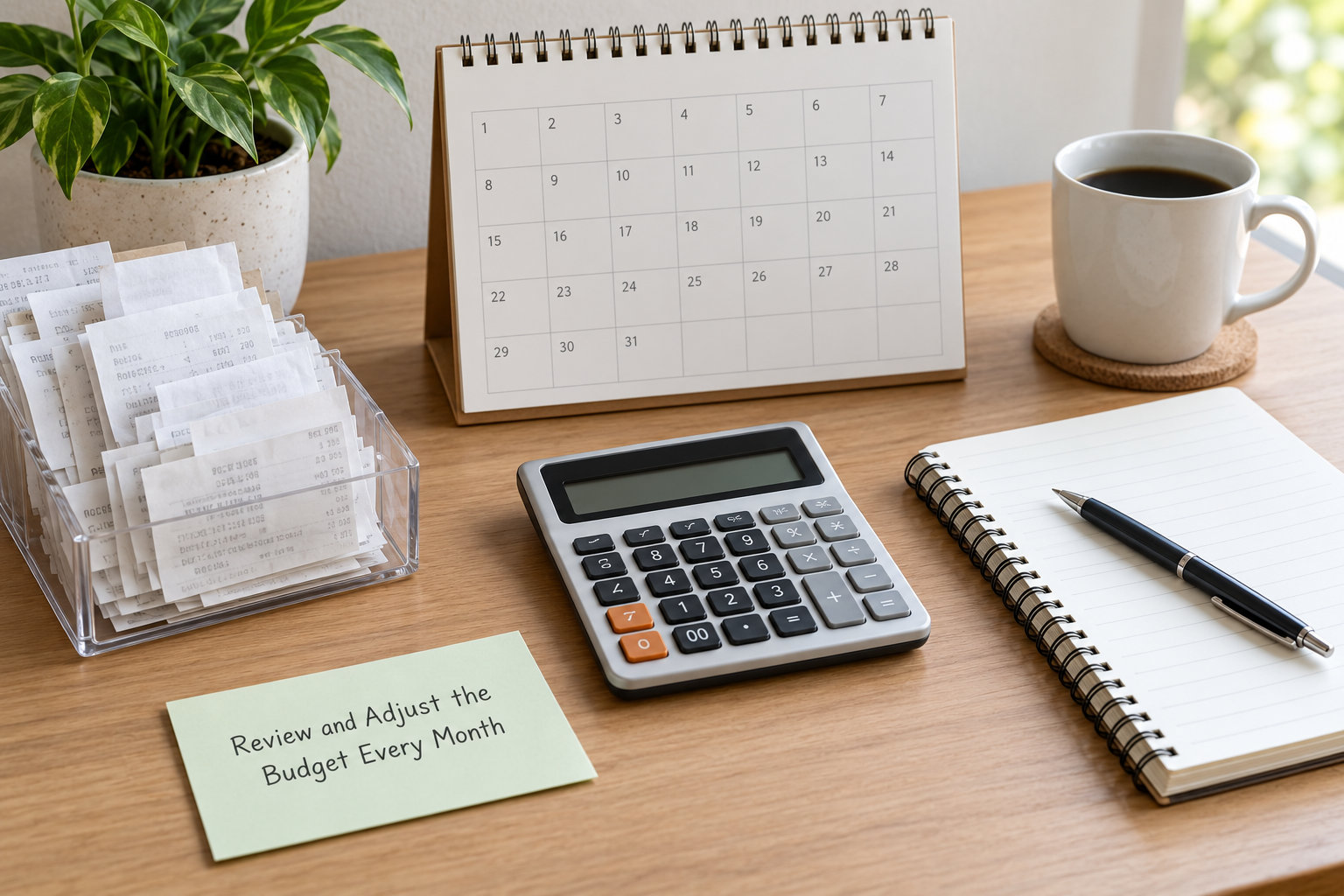
Budgets die because people rebuild them from scratch, which is tedious, and that complaint shows up repeatedly in budgeting forums. Instead, roll the plan forward: last month’s numbers become next month’s starting point, and you change only what needs changing.
Keep the review to twenty minutes, spread across the month.
- Week one: confirm fixed bills cleared, sinking funds were filled, and no transfer bounced.
- Week two: check the two categories that usually drift, usually groceries and dining.
- Week four: compare actual spending against each limit and note the variance.
- Last day: update sinking fund targets for bills coming in the next three months and set next month’s limits.
Change one or two numbers at a time. A limit you revised three times in a month never became a habit.
Common Mistakes
Six failure modes account for most budgets that collapse, and each has a straightforward fix.
Budgeting on gross income. The plan is built on money that never reaches your account. Fix: use the net number from your pay stub, every time.
Forgetting irregular expenses. A budget with no sinking funds breaks in the month the car needs a registration or the insurance premium bills. Fix: divide every annual cost by twelve on day one.
Setting targets that are wishes. A target built on what you should spend rather than what you did spend creates variance from day one. Fix: derive limits from your three-month baseline.
Using too many categories. Category-based apps invite 20-category setups, and users describe that friction as the reason they stopped. Fix: cap yourself at ten to twelve categories and merge the rest.
Never reviewing, or rebuilding every month. A plan you do not look at cannot be corrected. Fix: a fixed twenty-minute appointment at the end of each month, and roll categories forward instead of starting over.
Leaving no room for enjoyment. A plan with a zero wants column produces an all-or-nothing blowout in month two. Fix: fund the wants bucket deliberately and treat it as spendable, guilt-free money.
Budgeting has honest downsides worth naming. It takes time you would rather spend elsewhere. In lean months it can feel like a scoreboard instead of a tool, and for people with genuinely unstable income a monthly plan can be the wrong shape entirely. People also describe budgeting as awareness rather than restriction, which is the framing that keeps them doing it.
Frequently Asked Questions
How much money should I budget for savings each month?
Aim to move at least 5 percent of take-home pay toward savings as a starting point, and 10 to 20 percent once your minimum debt payments are covered. If you have no emergency fund, the first month of savings should go entirely to building one month of essential expenses. A 4,200 take-home budget might start at 210 a month rather than the full 840, then step up as your income or your comfort allows.
What if my income changes every month?
Budget from your lowest month of the past year and treat anything above it as surplus. Freelancers and commission earners usually send the surplus into a separate smoothing account, then draw from that account to top up a slow month back to the baseline. This keeps your category limits stable instead of rewriting the whole plan every time a payment lands late.
Should I budget for irregular expenses like car repairs or annual fees?
Yes, and they belong in a sinking fund. Take the realistic yearly cost, divide it by twelve, and transfer that amount every month to a separate savings account. A 600 registration becomes 50 a month and a 1,200 annual repair reserve becomes 100 a month. Spending from the fund turns an unplanned shock into a cost you already paid for.
How do I know which budget category is causing overspending?
Compare budget against actual for every category once a week, and look at the variance column rather than your total balance. Overspending usually concentrates in two or three categories rather than spreading everywhere. Dividing the remaining limit by the days remaining in the month turns an abstract overrun into a concrete daily number, which is far easier to act on.
What if I have debt while trying to build an emergency fund?
Pay minimums on everything first so nothing falls behind, then split what is left between a small emergency fund and your highest-interest balance. One month of essential expenses is enough to start, and it stops the next surprise from returning to a credit card. Many people clear high-interest cards first because the interest saved compounds quickly.
How often should I update my monthly budget?
Run a full review once a month, about twenty minutes, and a quick check of five to ten minutes each week. Update sinking fund targets when an annual bill approaches and adjust category limits at the end of the month based on variance. Many people also recheck the whole plan every six months, after a raise, a move, or a change in debt.
Conclusion
To create a monthly budget that actually works, start with three things tonight: your take-home pay from a recent pay stub, every bill that leaves your account automatically, and one realistic spending limit for the category you overspend on most.
Build from that data, fund the savings automatically, and give yourself a real fun money line so the plan is survivable. Then give it thirty days, review the variance honestly, and roll it forward. Budgeting advice in the US changes with the tax code and with local costs, so treat the numbers here as working examples rather than prescriptions.
Last updated in 2026.