
Leveraged ETFs are risky because they target a multiple of an index’s daily return, not the return over the period you hold them. Daily rebalancing compounds volatility against you, so a 2x fund can lose money while the index finishes flat or higher. Fees and financing costs add to the drag. That daily reset is the whole story behind leveraged ETFs risks explained, and it is worth understanding before you buy anything.
That is the whole argument in three sentences. Everything below is the arithmetic behind it, plus what you can actually do about it.
Last updated: October 2026. This is general educational information, not personalized investment advice. Fund costs, objectives and tax treatment change, so read the current prospectus before you buy anything.
Table of Contents
- What Is a Leveraged ETF?
- Leveraged, inverse and unleveraged funds are not the same thing
- What Risks Do Leveraged ETFs Have?
- 1. Daily reset and path dependency
- 2. Volatility decay
- 3. Leverage magnifies drawdowns
- 4. Costs: expense ratio, financing and spreads
- 5. Derivatives and counterparty risk
- 6. Tax inefficiency
- 7. Concentration, closures and reverse splits
- How Does the Daily Reset Create Compounding Risk?
- Why Can Leveraged ETFs Lose Money in a Rising Market?
- What Does Volatility Decay Mean for Investors?
- How Does the Holding Period Change Leveraged ETF Risk?
- Leveraged ETFs risks explained by holding period
- What Fees and Trading Costs Can Reduce Returns?
- Can a Leveraged ETF Lose More Than the Money You Invest?
- Who Should—and Should Not—Use Leveraged ETFs?
- Where leveraged ETFs actually work
- Who should stay away
- How Can U.S. Investors Manage the Risks?
- Frequently Asked Questions
- Are leveraged ETFs bad investments?
- How long should you hold a leveraged ETF?
- Can a 2-times leveraged ETF underperform a normal index?
- Is a leveraged ETF suitable for beginners?
- What should I do before investing in a leveraged ETF?
- Conclusion
What Is a Leveraged ETF?
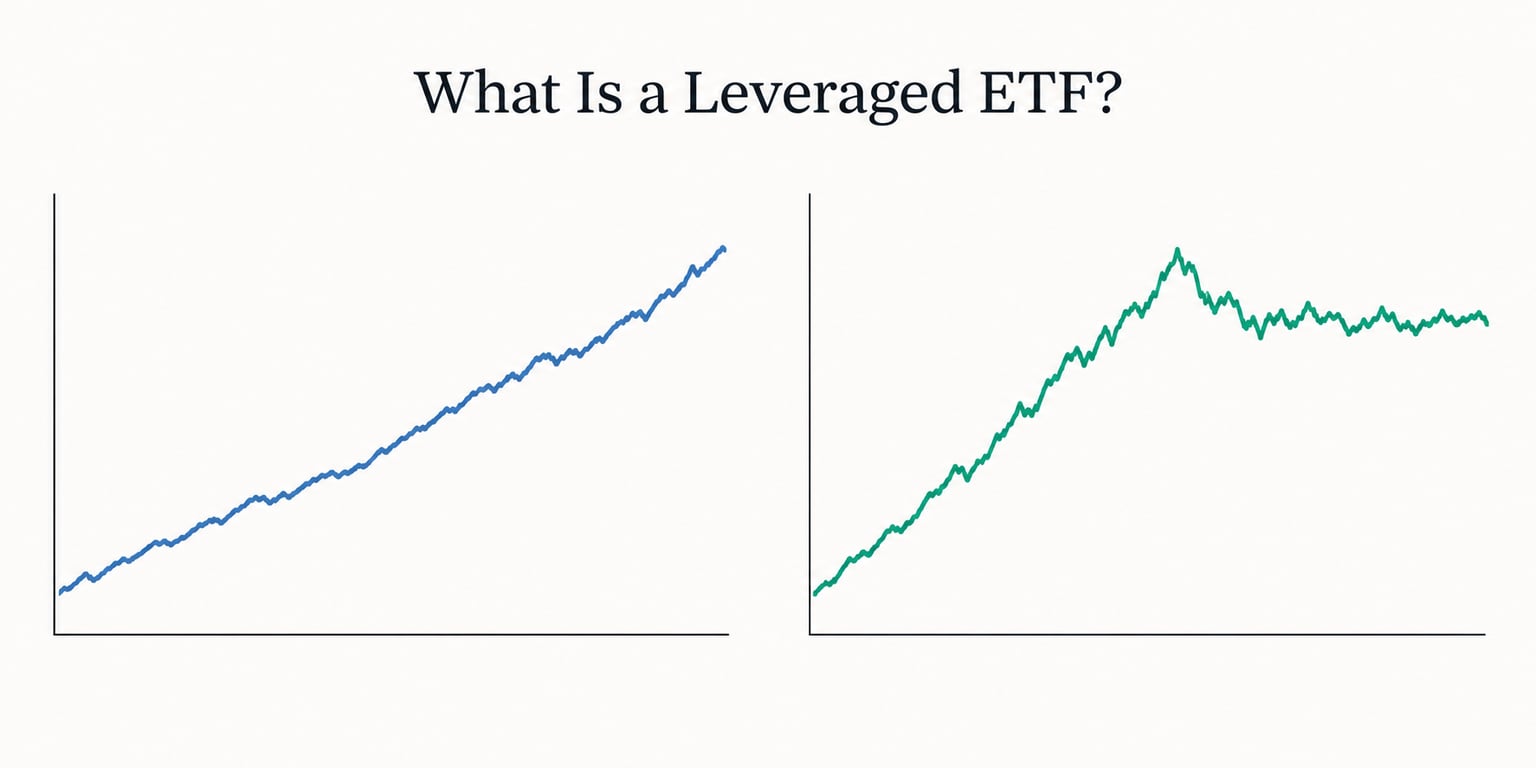
A leveraged ETF is an exchange-traded fund built to deliver a set multiple of an index’s return over a single trading day, most often 2x or 3x. It gets that exposure through swaps and other derivatives rather than by simply holding more of the index, and it resets its target at the close every day.
That daily reset is the entire difference between a leveraged ETF and an ordinary index fund. An index fund buys the shares and lets the value sit. A leveraged fund rebalances back to its target multiple each evening, which means it buys after gains and sells after losses, every single day, automatically.
Leveraged, inverse and unleveraged funds are not the same thing
- Leveraged funds (TQQQ, UPRO, SOXL) target a multiple of the daily return, long side.
- Inverse funds (SPXS, SQQQ) target a negative multiple, so they rise when the index falls.
- Unleveraged funds (SPY, QQQ) simply hold the index and track it over long periods.
Regulatory history helps explain why the ETF wrapper matters. After leveraged and inverse mutual funds drew scrutiny over their daily-reset structure, U.S. regulators effectively ruled in 2009 that they could not be offered to the public. Exchange-traded funds sat outside that restriction, which is why every leveraged product you can buy today is an ETF.
No leveraged ETF promises you a multiple over a holding period, and none guarantees a positive return. The multiple is a daily objective, and it resets.
What Risks Do Leveraged ETFs Have?
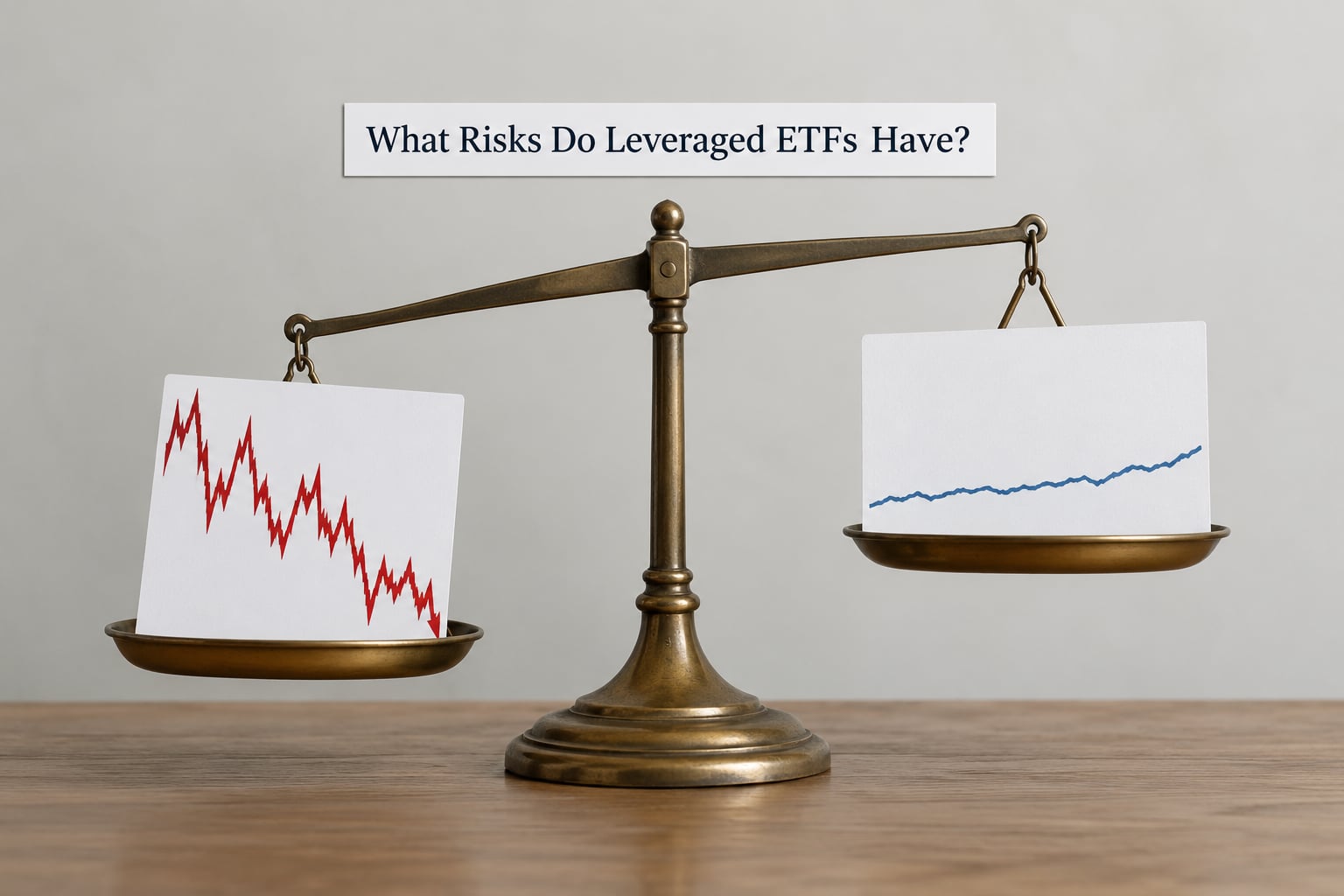
Here is the short list. The first two do most of the damage in practice; the rest accumulate quietly in the background.
1. Daily reset and path dependency
The fund targets its multiple for one day at a time, so its return over a week or a year is a product of daily returns, not the multiple times the index’s cumulative move. Two index paths that start and end in the same place can produce very different fund results.
2. Volatility decay
Choppy markets that go nowhere still subtract value, because every reversal forces the fund to give back part of its gain. The drag grows with the leverage multiple and with the size of the daily swings.
3. Leverage magnifies drawdowns
A 3x fund targeting the Nasdaq-100 can lose close to 3 times the index’s daily decline on a bad day. After a sharp drop, the fund needs a much larger percentage move just to recover, and the gap widens with each down day.
4. Costs: expense ratio, financing and spreads
Expense ratios run roughly ten times higher than broad equity index funds. The swaps also carry financing costs, and bid-ask spreads widen when a fund’s assets shrink or the market turns fast.
5. Derivatives and counterparty risk
These funds depend on swap agreements with banks. If a counterparty fails, the fund can lose the value of those positions regardless of what the underlying index did. The prospectus names the counterparties; read that section.
6. Tax inefficiency
Daily rebalancing inside the fund routinely triggers short-term capital gains distributions, even in a tax-advantaged account, because the fund itself is trading constantly. Investors on r/personalfinance regularly report being surprised by a tax bill for money they never sold.
7. Concentration, closures and reverse splits
Single-stock leveraged funds concentrate all of that risk in one company, where a gap down on earnings is not a temporary drawdown but a step change. Funds that decay badly get liquidated, and survivors often conduct reverse splits.
How Does the Daily Reset Create Compounding Risk?
Start with an index at 100 and a 2x fund tracking it. The fund aims for roughly double the index’s daily move, then resets.
Day one: the index rises 10%. The fund rises about 20%, moving from 100 to 120.
Day two: the index gives back 9.09% and returns to exactly 100. The fund drops about 18.18%, landing at roughly 98.18.
The index finished the two days unchanged. A true 2x position would be worth exactly 100. The leveraged fund lost about 1.82% instead, and nothing about the market’s direction changed. That gap is the reset doing its work.
Two days in either order end the same way, which is itself worth noticing: the damage comes from the round trip, not from the sequence. Add a third day and the gap against a true 2x position grows in whichever direction the volatility leaned.
| Index daily path | Index total | 2x fund | A true 2x position |
|---|---|---|---|
| +10%, -9.09% | 0.00% | -1.82% | 0.00% |
| -9.09%, +10% | 0.00% | -1.82% | 0.00% |
| +10%, -9.09%, +10% | +10.00% | +17.82% | +20.00% |
| -9.09%, +10%, -9.09% | -9.09% | -19.67% | -18.18% |
Row three is the one that surprises people. The index rose 10% and the leveraged fund rose too, just less than double. Row four shows the other side: the fund lost more than double. Multiply small daily returns often enough and the compounding runs in whichever direction the volatility pushed it, which is why leveraged etfs risks explained always comes back to path, not endpoint.
Why Can Leveraged ETFs Lose Money in a Rising Market?
A rising index is not the same thing as a rising leveraged fund, and the gap opens in choppy markets that repeatedly move up 3% and back down 3% without setting new highs. Each round trip costs the fund about 6% of its value at 2x, while the index goes nowhere.
Long flat stretches are the problem. Markets spend a lot of time in ranges while headlines say “record high,” and experienced holders on r/LETFs consistently describe these funds as trend instruments: they win in strong directional moves and bleed in sustained chop.
Timing adds a separate hazard. Buying a 3x fund near a local peak means the fund suffers its largest daily losses first, and it then needs a much larger recovery to break even. You can be right about the index’s direction over a year and still be wrong about the position you held through the first three weeks.
The bull case is real, and I want to be straight about it. In a smooth, persistent uptrend, a 2x fund on a strong index can hand you close to twice the index’s move, because the daily reset keeps compounding in your favor when moves arrive in the same direction. Traders on r/thetagang use 2x funds tactically for exactly that reason, buying dips and trimming into strength.
What Does Volatility Decay Mean for Investors?
Volatility decay is the loss that comes from volatility itself, independent of fees. Take a fund alternating between +10% and -10% daily returns while the index goes nowhere.
At 2x, one up day gives 20% and one down day takes 20% off the top. A 120 becomes 96. Two days later you are at 0.96 of where you started, and the index is unchanged.
Repeat that cycle ten times and 0.96 to the power of ten leaves the fund at roughly 66% of its starting value, a loss of about a third, while the index sat still the entire time. Fees are not in that calculation, which is why decay and expenses need to be tracked separately.
Decay is not automatic, though. If every daily move is positive, or every move is negative, volatility drag works for you instead of against you and the fund tracks its multiple closely. The effect depends on the size, sequence and direction of daily returns, so a single dramatic trend can overwhelm it.
How Does the Holding Period Change Leveraged ETF Risk?
Leveraged ETFs risks explained by holding period
| Holding period | What the daily reset does | Realistic expectation | Who it suits |
|---|---|---|---|
| Intraday | Minimal, the fund has not reset yet | Close to the stated multiple | Active day traders |
| One day | Matches the fund’s stated objective | About 2x or 3x the index’s daily move | Event bets, hedges |
| One week | Compounds five daily results | Materially less than the multiple times the index | Short-swing traders with an exit rule |
| One month | Around 21 compounding steps plus fees | Often diverges sharply either way | Only actively managed positions |
| Multi-year | Thousands of resets | Decay, reverse splits and possible closure | Nobody as a core holding |
There is no safe universal number of days. The honest rule is that the holding period must be short enough that the expected volatility drag stays small next to the gain you are trying to capture.
What Fees and Trading Costs Can Reduce Returns?
The expense ratio is the visible part. ETF researchers at VettaFi put the average leveraged fund expense ratio near 100 basis points, against under 10 basis points for broad equity ETFs. At 3x, the fund takes roughly 95 basis points a year; at 2x, roughly 90. A longer holding period pays that every year.
Financing sits inside the derivatives and never shows up as a line item. A 2x fund holds roughly twice the market value in swaps, so when rates rise the financing embedded in those swaps costs more. That is why leveraged fund costs move with interest rates.
Trading costs matter too. Bid-ask spreads on leveraged funds widen during fast markets and in the last few minutes of the session, which is exactly when retail tends to trade. Market orders in a gap can fill far from the displayed price. Use limit orders.
Taxes add a layer that is easy to miss. Because the fund rebalances daily, it frequently realizes short-term gains and distributes them, which creates a bill even in a Roth IRA or 401(k) where selling normally would not. Tax rules vary by state and situation, so confirm the details with a tax professional.
Can a Leveraged ETF Lose More Than the Money You Invest?
Not through the fund itself. An ETF is a pooled vehicle, so a total collapse of a leveraged fund reduces your position to zero and no further. You would lose the amount you put in and owe nothing extra.
What does create obligations beyond your deposit is everything around the fund. Buying on margin against the position means a large loss can trigger a margin call for cash you never intended to risk. Options contracts can carry defined obligations far beyond the premium you paid. And a market order during a gap can execute far below the price you saw.
The practical answer: keep the fund position unleveraged itself, and never buy a leveraged ETF with borrowed money. r/StockMarket threads on this come back to the same point consistently.
Who Should—and Should Not—Use Leveraged ETFs?
Where leveraged ETFs actually work
Short-term tactical positioning, hedging a concentrated long portfolio, event-driven trades around earnings, and trend-following in a market with a clear direction. In each case the investor has a defined entry, a defined exit and a position small enough that being wrong is survivable.
What these uses share is active management. The position is opened, monitored and closed on purpose rather than left to sit.
Who should stay away
- Anyone who cannot absorb a 30% drawdown in a position they cannot sell quickly.
- Retirement savers. The daily reset fights a long time horizon directly, and rebalancing inside the fund creates taxable events in accounts meant for tax-free growth.
- Investors building income or retirement income plans, where reverse splits and closure risk disrupt distributions.
- First-time investors. The mechanics take practice to understand, and the most common beginner mistake is treating a 3x fund as a long-term holding.
How Can U.S. Investors Manage the Risks?
- Define the purpose first. Hedging, a one-week swing, or an earnings bet. “Long-term growth” is not a purpose a leveraged fund can serve.
- Cap the position size. Treat it as a satellite position, not a core holding. Many traders keep it in the low single digits as a share of a portfolio.
- Set the exit rule before you enter. A price level, a date, or a move against you that closes the trade. Deciding after a big drop is how people hold these through the worst part of a decline.
- Check the daily objective in the prospectus. The stated multiple is a single-day target, and the summary prospectus says so in the first paragraph.
- Use limit orders. Spreads widen in fast markets, and a market order is how a good trade turns into a bad fill.
- Watch the fund’s asset size and spread. Funds that lose assets get closed, and a closure forces a taxable sale at whatever the market offers that day.
- Rebalance only on purpose. Adding to a falling leveraged position is averaging down into a product whose daily reset is working against you.
- Avoid retirement accounts. Unless you are deliberately hedging, the daily distributions create tax bills that an unleveraged fund does not.
Frequently Asked Questions
Are leveraged ETFs bad investments?
Not inherently, and not for every purpose. They are engineered for short-term tactical use, hedging and trend-following, and in a strong directional trend they can deliver close to their stated daily multiple. The problems appear when a product built for days gets held for years, when the position is too large, or when there is no exit plan. Judge them by holding period and intent, not by the leverage number on the label.
How long should you hold a leveraged ETF?
Treat it as a day-trading to short-swing instrument, and manage it actively against a predefined exit rule. Many issuers describe the intended use as one day at a time. There is no safe universal number of days, because the honest test is whether expected volatility drag stays small relative to the gain you are targeting. If you cannot name your exit date or price level in advance, the answer is that you should not hold it.
Can a 2-times leveraged ETF underperform a normal index?
Yes, and it happens more often than most investors expect. A 2x fund can return less than the unleveraged index over months when the market is choppy, and it can lose money while the index gains. Over a single day it should track roughly double the index move. Over longer periods, daily compounding, fees and financing costs pull it away from the multiple, sometimes in the index’s favour and sometimes against it.
Is a leveraged ETF suitable for beginners?
Usually not as a first investment product. The mechanics of daily resetting are genuinely confusing, and the most common expensive mistake is buying a 3x fund and treating it like a long-term holding. Beginners who want concentrated exposure can learn the idea safely through an unleveraged sector ETF, which carries the same directional bet without the daily compounding. If you still want the leveraged version, make it a small, short-term position.
What should I do before investing in a leveraged ETF?
Read the summary prospectus and confirm the daily objective, the expense ratio, the swap counterparties and the tax treatment. Then write down your purpose, position size, exit rule and the loss you can accept. This matters because leveraged etfs risks explained always come down to daily compounding, financing costs and volatility decay, none of which show up on a chart. Verify current fund documents and disclosures before you buy, since details change over time.
Conclusion
The central point is simple: a leveraged ETF resets its target every day, so its return depends on the path the market takes and how volatile that path is, not simply on where the index started and finished. Two markets that end in the same place can produce very different fund results, and choppy ranges are where the damage accumulates quietly. Before buying anything, verify the current daily objective, expense ratio, financing costs and full risk disclosures in the fund’s own documents, and confirm how distributions are taxed in your account. The first step is understanding that the stated multiple is a one-day target. Nothing else in this guide matters if that part is still unclear.