
Term life insurance vs whole life comes down to one question: do you want cheap protection for a defined stretch of life, or permanent coverage with a savings account attached? Term covers you for a set period at a low premium and then expires. Whole life covers you for life and builds cash value, but the premium runs several times higher. For most households, term wins on math. Whole life earns its keep in a narrower set of situations, and this guide lays out both fairly.
Table of Contents
- Term Life Insurance vs Whole Life at a Glance
- How Coverage Differs
- How to choose a term length
- Which Policy Costs More?
- Cash Value and Investment-Like Growth
- What Happens When the Policy Ends?
- Tax and Accessibility Considerations
- Riders, Underwriting, and Policy Flexibility
- Which Should You Choose?
- Frequently Asked Questions
- Is whole life insurance a good investment?
- Can I convert term life insurance into whole life insurance?
- How much life insurance do most families need?
- Do I need life insurance if I am single with no dependents?
- What happens when a term life insurance policy ends?
- Is whole life insurance tax-free?
- The Short Version
Term Life Insurance vs Whole Life at a Glance
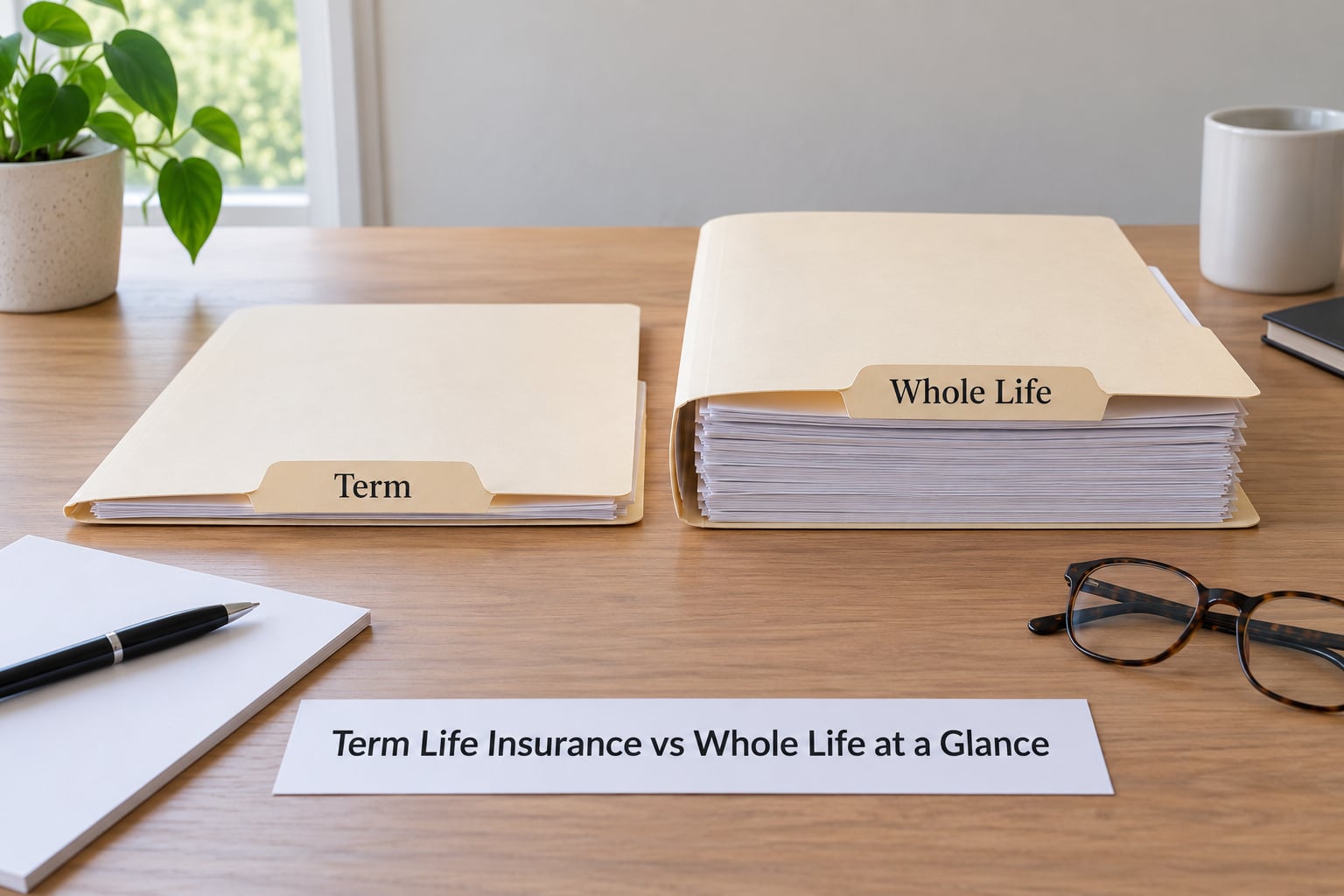
If you only read one thing, read the table. Term wins on cost and simplicity; whole life wins on permanence and liquidity.
| Criterion | Term life insurance | Whole life insurance |
|---|---|---|
| Coverage period | A set term, commonly 10, 15, 20 or 30 years | Lifetime, as long as premiums are paid |
| Typical cost structure | Low level premium for the term | Premium several times higher, usually level for life |
| Cash value | None, except in return-of-premium designs | Guaranteed cash value that grows tax-deferred |
| Death benefit | Larger face amount, paid only during the term | Usually tied to the death benefit stated in the policy |
| Investment potential | None | Dividends on participating policies are not guaranteed |
| Policy loans | Not available | Available against cash value, with interest |
| Conversion | Often convertible to a permanent policy without a new medical exam | Already permanent; can be exchanged for term in some cases |
| Underwriting | Often a paramed exam for larger face amounts | Full medical underwriting is common |
| Best for | Income replacement, mortgage payoff, most families | Estate liquidity, special needs, business succession |
| Complexity | Simple, one page of contract language to read | More moving parts, illustrations and riders to review |
How Coverage Differs
Both policies pay a death benefit to your named beneficiaries. Everything else about them is different.
Term insurance is pure protection. You pay a premium, the insurer pays a fixed death benefit if you die during the term, and the contract ends on the last day of that term. If you survive, there is no payout and nothing to collect. That is why term is cheap: the insurer is only covering a window of years.
Whole life insurance is permanent coverage with a savings component bolted on. A portion of each premium funds the insurance, and a smaller portion goes into a cash value account that the carrier promises to grow. It stays in force as long as premiums are paid, which is the feature that matters enormously to estate planners and to families caring for someone with lifelong special needs.
Level term keeps the premium and the death benefit constant for the whole term. Decreasing term, usually sold through an employer or mortgage lender, has a benefit that steps down on a schedule. It costs less because the coverage shrinks, and it only makes sense if your need shrinks on the same timeline.
How to choose a term length
Match the term to the obligation you are covering, not to your age.
- 10 years. Enough for a young child’s early years, or a bridge while you build savings. Often the cheapest per dollar of coverage.
- 15 years. Covers the years a child is most dependent on you, typically through high school.
- 20 years. The workhorse for parents with young kids and a mortgage. Most carriers price the 20 and 30 year terms similarly.
- 25 years. Uncommon but useful when a later-life health condition could make new coverage hard to qualify for.
- 30 years. The longest standard term. Premiums usually rise after age 50, but a 30 year policy bought at 30 can stay level through age 80.
Most people buy term to bridge a mortgage plus the years until the youngest child is independent. Add a few years on either end and you have your number.
Which Policy Costs More?
Whole life costs substantially more than term. Published comparisons put the gap at roughly 5 to 15 times the term premium, and carrier-issued educational material often puts it closer to 6 to 10 times.
Here is why. Part of a whole life premium is insurance expense, and part is funding the cash value account. In the first few years, more of the premium goes to commissions, issue costs and the carrier’s own expenses than to your savings. The account grows slowly at first and faster later, but the crossover is decades away.
The comparison gets sharper when you look at what the extra money does. One policyholder quoted in a forum thread had paid 10,914 dollars into a permanent policy and seen 4,464 dollars of cash value. That gap is normal for the first decade, and it is the single fact that decides most comparisons.
One more wrinkle: term premiums are not always flat. A level term policy holds the premium steady for the full term. A renewable and convertible term policy lets the carrier raise the premium at each renewal, and those steps can get steep in your sixties. Read which one you are buying.
Whole life premiums can also increase after the first decade or two on some contracts, so ask where the step-ups sit and how large they are. Neither product has a permanently unchanging premium forever unless the contract says so.
Cash Value and Investment-Like Growth
Cash value is the reason whole life costs what it costs, and it is the part most often oversold.
The carrier guarantees a minimum growth rate on the cash value account, typically in the low single digits. Participating, or par, policies can pay additional dividends that are not guaranteed and can change year to year. Non-participating policies pay only the guaranteed amount. A policy illustration shows the projected value including those assumed dividends, which is the number most people remember and the number most likely to disappoint.
Three things to keep straight. A policy loan is not a withdrawal: you borrow against the account and the outstanding loan plus interest reduces what your beneficiaries receive at death, or comes due at maturity. A surrender is a withdrawal, and surrender charges typically run high for the first several years and then decline. And the cash value account is not a brokerage account. It is an insurance account that grows slowly, and the insurance charges are paid from your premium.
Term insurance has no cash value, with one exception. Return-of-premium term, or ROP, costs more than plain level term and pays your premiums back if you survive the term. The catch is that the death benefit shrinks over the term in step with the premiums you paid back, so late in the policy you may be protecting less than you think.
What Happens When the Policy Ends?
Term coverage stops at the end of the term unless you act. The policy does not renew automatically in most cases, and if it lapses, your beneficiaries get nothing.
Renewal usually means a new medical exam at your current age and health, at a price that has climbed with the term length. Your options at renewal are to buy new coverage, convert to a permanent policy if the contract has a conversion provision, or go without. Without a conversion provision, you are reapplying cold, and that is where people get unpleasantly surprised.
A whole life policy has no renewal event. Keep paying and the coverage stays in force for life. Miss premiums and the policy enters a grace period, then lapses, surrender charges apply, and your beneficiaries lose the death benefit.
Two early windows are worth knowing. Most policies have a free-look period of about 10 to 14 days after delivery, when you can cancel and get your money back in full. The contestability period, usually two years, is when an insurer can contest a claim on the grounds of misrepresentation in the application.
Tax and Accessibility Considerations

Life insurance is one of the few assets that passes to beneficiaries outside the estate, which is why estate planners care about it so much.
The death benefit from a life insurance policy generally passes to beneficiaries income-tax-free, subject to the estate tax rules that apply in your situation. Cash value grows tax-deferred: you do not pay income tax on it while it stays inside the policy. Once you borrow against it or surrender it, the treatment gets complicated, and policy loans are generally the more tax-efficient route to access than withdrawals. Talk to a tax professional about your own situation, because rules and rates change.
The distinction most articles blur is estate liquidity versus estate transfer. Life insurance does not move wealth to your heirs so much as keep it liquid. When a policy is inside a large estate, the carrier can often pay the death benefit directly to the beneficiaries within weeks, which is exactly what an executor needs when estate taxes, debts and probate costs are due. For a typical family, an ordinary investment account works fine. For a family with a large estate, a special needs beneficiary, or a business owner with buy-sell obligations, permanent coverage solves a liquidity problem that nothing else does.
Also weigh how long it takes to get at the money. Money in a whole life policy is not liquid in the way a savings account is. Access is priced in through surrender charges, loan interest and a decade of slow growth, so it should sit behind your emergency fund, your retirement contributions and your high-interest debt.
Riders, Underwriting, and Policy Flexibility
Riders are add-ons that cost extra and either waive premiums or pay an additional benefit. The common ones are waiver of premium, which keeps coverage alive if you become disabled; accidental death benefit; and child rider, which puts a small death benefit on each of your children.
Term policies are usually the practical choice for temporary needs because you can buy a large death benefit for a small premium, which keeps the approval process proportionate. Whole life needs more underwriting, often including a full medical exam, paramed exam and prescription history review, and carriers can decline or re-rate on that basis.
There is a legitimate strategy here worth naming. Several people in insurance forums describe buying cheap term first and converting to a permanent policy only after a health diagnosis. It is time-sensitive and it is not guaranteed, so if keeping coverage after a diagnosis matters to you, buy a policy with a strong conversion provision now and do not count on qualifying later.
Universal life is the third option most comparisons skip. It also allows loans against the account, and variable universal life lets you direct the investments inside. Returns vary widely, sometimes badly, and the fees run higher than whole life. Mentioning it exists keeps the comparison honest.
Which Should You Choose?
Buy term if your need has an end date. Most people fall in this group.
- Young or middle-aged parents. The classic case. Cover the mortgage plus the years until your youngest is independent, usually a 20 or 30 year term.
- Homeowners with a mortgage. Term sized to the balance is exactly what the lender wants to see.
- Business owners and key employees. Term for buy-sell funding, loan covenants, or a key person.
- Single people with no dependents. Coverage sized to final expenses, burial and any debts a parent co-signed. Forum regulars on personal finance generally say skip the permanent policy here.
- Anyone who can invest the difference. This is the strongest argument for term. The difference between premiums, invested consistently, usually beats the cash value growth rate after enough years.
Whole life makes sense in a smaller set of cases.
- You need coverage you cannot lose. No renewal, no new medical exam, no step premium at 65.
- Estate liquidity matters. A large estate needs cash quickly at death, and a life insurance check arrives in weeks rather than through probate.
- Someone with lifelong special needs depends on you. A beneficiary arrangement and structured, permanent funding can protect care across a lifetime, in ways a term policy ending at 70 cannot.
- Your retirement accounts are already maxed. If you have filled every tax-advantaged account you qualify for, permanent insurance becomes a candidate for the leftover dollar.
- A business succession plan requires guaranteed funding. A carrier’s general account can be more dependable than a market portfolio for a buy-sell obligation with a fixed date.
And in a few cases you need neither. If nobody depends on your income, no one inherits your debts, and your net estate is small enough that federal estate tax will never apply, a small term policy for final expenses may be all the insurance you need.
Whatever you pick, buy it from an independent broker rather than the agent who knocked on your door. Agents earn commissions, and the commission on a permanent policy is far larger. That is not an accusation, it is just the incentive structure, and it explains the sales pressure people describe in the forums.
Frequently Asked Questions
Is whole life insurance a good investment?
Usually not on its own. The guaranteed growth rate on the cash value account is typically low, and dividends on participating policies are not guaranteed. The better framing is that it is an insurance product with a savings feature, not an investment account. Compare it against term coverage plus investing the premium difference in low-cost index funds over a long horizon, and the math usually favors the outside investment. Whole life earns its place when the insurance itself is the goal, such as permanent estate liquidity.
Can I convert term life insurance into whole life insurance?
Often yes, if you bought term from a carrier that writes permanent policies and the contract has a conversion provision. You usually convert at your age at the end of the term, sometimes without a new medical exam, and the new premium is set at that age rather than the age you started. Read the conversion deadline in the policy, because the window is limited and conversion rights are usually more valuable earlier in the term.
How much life insurance do most families need?
Most families land between 10 and 20 times annual income, but the better method is a needs analysis. Add your mortgage balance, the income your family would lose, childcare through the youngest child’s independence, college costs, final expenses, and any debt a co-signer is on. Subtract liquid assets and existing coverage. A 35 year old with two young kids and a mortgage often needs between 10 and 15 times income, which is more than most people actually buy.
Do I need life insurance if I am single with no dependents?
Usually much less than people assume. Nobody is replacing your income, so the need is limited to final expenses, burial costs and any debt where you co-signed or had a joint obligation. Parents who would inherit your student loans are a real exposure worth covering. A small whole life policy sized to those costs can work, but a modest term policy is usually the cheaper and simpler answer for the same job.
What happens when a term life insurance policy ends?
The policy simply expires with no payout. If you still need coverage, you buy a new policy, which means a current medical exam and a premium based on your age today, or you convert to a permanent policy if you kept the conversion provision. That conversion window is exactly why it is worth checking for when you first buy, and it is also why people convert after a health diagnosis when new coverage would be hard to qualify for.
Is whole life insurance tax-free?
Partly. The death benefit generally passes to beneficiaries free of income tax, and cash value grows tax-deferred while it stays inside the policy. But cash value becomes taxable when it is accessed, the treatment depends on whether you borrowed or withdrew, and the cash value left in the estate can be pulled into the estate tax calculation. Some policies also carry estate tax riders that assign ownership to a trust. Rules and rates vary, so get tax advice before you plan around it.
The Short Version
Buy level term sized to your real obligation, fund your retirement accounts first, and invest whatever the premium difference leaves you. Save whole life for when permanence itself is the requirement: estate liquidity, a special-needs beneficiary, a business succession date, or retirement accounts you have already maxed.
Before you sign anything, ask an independent broker for quotes on both, compare the total premium over the full term rather than the monthly number, and read the surrender charge schedule on any permanent policy. Updated for 2026; rules and rates in your state may differ, so confirm specifics with a licensed agent and a tax professional before you buy.