
A REIT is a company that owns, operates or finances income-producing real estate and passes at least 90% of its taxable income to shareholders. When you buy shares, you own a slice of a property portfolio and receive part of the rent and lease income it collects. That is the core of how REITs work for income investors.
Everything else is detail, and the detail matters. A REIT can pay you a fat distribution one quarter and a thinner one the next, because distributions are not a bond coupon. They move with occupancy, rents, expenses, interest rates and the timing of maintenance spending.
This guide walks through that machinery in plain numbers, because most explainers stop at “REITs pay dividends” and leave out the part that decides whether your income actually lasts. All dollar figures below are in US dollars. Nothing here is investment advice; tax rules in particular vary by investor and change, so confirm your own situation with a tax professional.
Table of Contents
- How REITs Work for Income Investors: Rent In, Cash Out
- How REITs Work for Income Investors Step by Step: From Rent to a Distribution
- What Types of REITs Exist? Equity, Mortgage, and Hybrid
- How REIT Distributions Are Calculated: From Net Income to Cash
- A worked example: why earnings and cash differ
- What Determines the Income You Receive? Occupancy, Rents, and Rates
- REIT Returns: Where the Total Return Comes From
- What Risks Should Income Investors Understand? Rates, Refinancing, and Tenants
- How US REIT Dividends Are Taxed: Mostly Ordinary Income
- How to Evaluate a REIT for Income: A Repeatable Checklist
- How REITs Can Fit an Income Portfolio: Role and Allocation
- Frequently Asked Questions
- Do REITs pay dividends every month?
- What is the minimum amount needed to invest in a REIT?
- Can I automatically reinvest a REIT dividend?
- Where can I find a REIT’s dividend and financial information?
- Are REIT dividends guaranteed?
- Conclusion
How REITs Work for Income Investors: Rent In, Cash Out
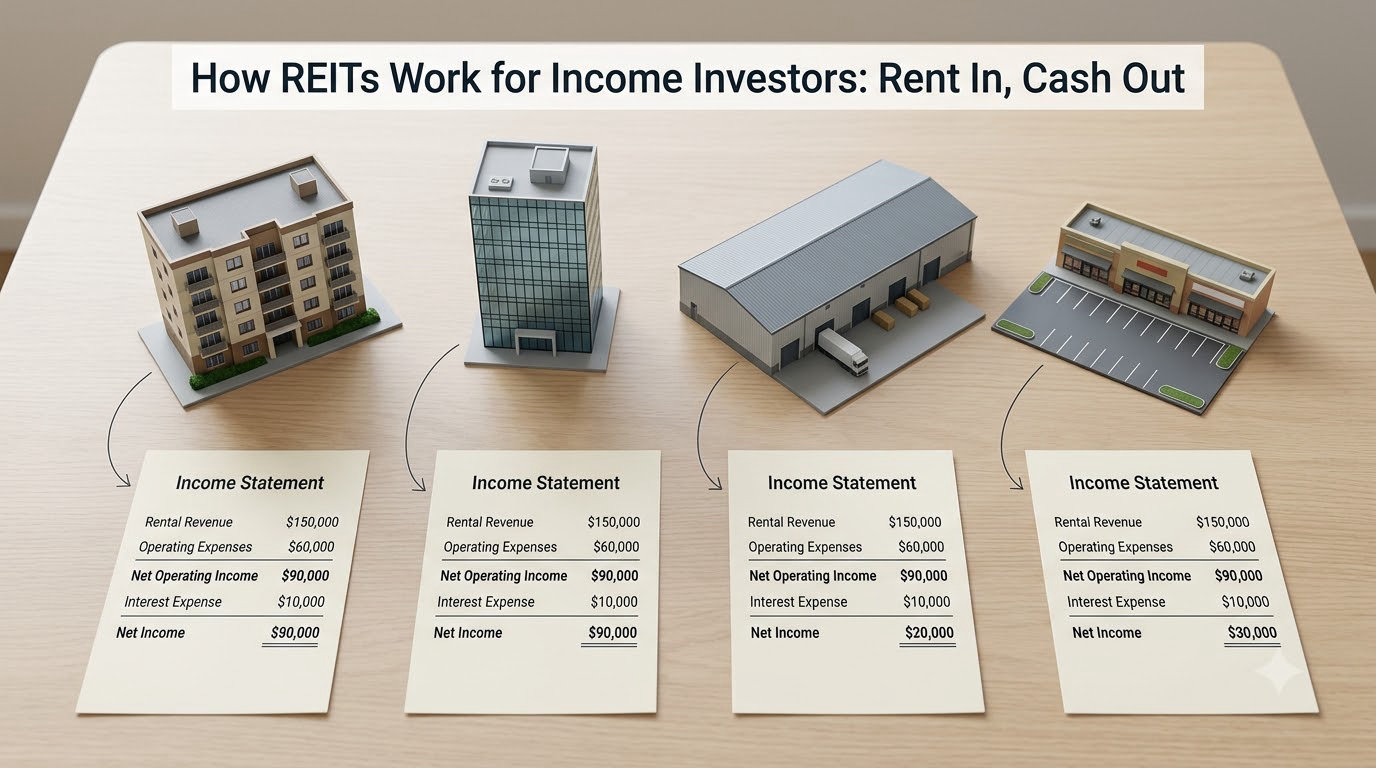
Most REITs work as a pooled vehicle. You buy shares in the market, the pooled money buys and manages properties, and the rent collected flows back to shareholders as a distribution. You never see a lease, never field a tenant call, and never repair a roof.
Two things are worth separating right away, because beginners blend them together. The first is the value of the real estate itself, which moves with rents, vacancy and interest rates. The second is the income you actually receive, which depends on how much cash the REIT has left after paying its own bills and lenders.
Those are different clocks. You can own a portfolio of fantastic buildings and still have a bad year for distributions if the roof replacements land in the same quarter, or if a major tenant files for bankruptcy protection.
To qualify as a REIT under US tax law, a company must put the bulk of its assets and income into real estate, hold its properties for a limited period, and distribute at least 90% of taxable income to shareholders each year. In practice most REITs pay that out quarterly, many monthly, and many leave a small retained amount to fund growth and repairs.
How REITs Work for Income Investors Step by Step: From Rent to a Distribution
- Capital comes in. Investors buy shares on an exchange, or subscribe to a non-traded REIT fund directly.
- The REIT buys assets. It purchases apartments, warehouses, hospitals, data centers, cell towers or mortgages, either directly or through an UPREIT operating partnership structure that lets property owners roll into the REIT and defer capital gains.
- Income arrives. Tenants pay rent, lease fees, resident fees or mortgage interest. Mortgage REITs earn interest on loans rather than rent.
- Costs come out. Property taxes, insurance, repairs, salaries, management fees and interest on the REIT’s own debt.
- Cash remains. What survives those costs is distributable cash, the pool the REIT actually distributes from.
- Management decides the split. Because the 90% rule applies to taxable income over a year, boards can hold back cash in strong quarters and top up distributions in weak ones. That is one reason quarterly payouts wiggle.
- Shareholders receive cash. The distribution arrives monthly or quarterly, and shares keep trading throughout the day on their exchange.
The pool behind those payouts is real money from real properties. It is not an interest payment on your savings account, and it is not guaranteed. REIT investors on r/reits talk about this constantly, largely because the word “dividend” invites the wrong mental model.
What Types of REITs Exist? Equity, Mortgage, and Hybrid
Three structures cover almost everything you will run into: equity REITs own property, mortgage REITs lend to property owners, and hybrids hold both.
| Type | What it holds | Where income comes from | Main pressure points |
|---|---|---|---|
| Equity REIT | Ownership interests in apartments, warehouses, hospitals, data centers, stores, timber, farmland | Rent, lease payments and resident or service fees | Occupancy, tenant solvency, property taxes, insurance, refinancing at maturity |
| Mortgage REIT | Agency and non-agency mortgage-backed securities, commercial mortgages, agency debt | Interest paid by borrowers, earned as a spread over funding cost | Rate moves, spread widening, prepayments, mortgage credit, repo funding costs |
| Hybrid REIT | A mix of owned properties and mortgage or debt securities | Both rent and interest | A bit of everything, which makes cash flow harder to read |
The cash-flow behaviour differs because the inputs differ. An equity REIT’s income is slow-moving and contractual: a lease signed today pays roughly the same rent next year unless it has an escalation clause. A mortgage REIT’s income reprices with the market, sometimes within weeks.
That distinction is where beginners get hurt. r/investing threads regularly feature people who bought a mortgage REIT for its higher yield, watched the yield fall apart when rates moved, and assumed something about the buildings had gone wrong. Nothing had. The spread is what changed.
A third, smaller group sits outside the three types: private and non-traded REITs, which file with the SEC but are not exchange-listed. We will get to those under buying.
How REIT Distributions Are Calculated: From Net Income to Cash
A REIT’s distribution is sized off cash it can genuinely spend, which is why funds from operations and adjusted funds from operations exist at all.
Net income under accounting rules includes depreciation on those properties, and depreciation on a 40-year-old apartment building is a large non-cash deduction. Net income therefore understates the cash a REIT generates. The industry measure, funds from operations, starts from net income and adds back real estate depreciation and gains or losses on property sales.
AFFO goes one step further. It adjusts FFO for the recurring capital spending a REIT needs to keep its properties competitive: roof replacements, tenant improvements, leasing commissions and, for health care and data center owners, ongoing equipment investment. AFFO is not a GAAP measure, so definitions vary slightly between managers. Read how each one computes it.
The payout ratio is the number that follows: distribution per share divided by AFFO per share. Long-time REIT investors on r/reits generally treat an AFFO payout ratio in the 70 to 80 percent range as a sign the distribution is comfortably funded, and a payout above 100 percent as a warning that the REIT is paying out more than it earns.
A worked example: why earnings and cash differ
Take a small apartment REIT with 100 million in property value, 3 million of annual cash collected from rent, 1.2 million of operating expenses including taxes and insurance, and 600,000 of interest on the debt that financed the purchase. That leaves 1.2 million of cash before distributions.
Now suppose 700,000 of that 1.2 million goes to recurring maintenance and tenant improvements on the existing buildings. Real cash available for distribution is 500,000. Management distributes 450,000, which is a 90 percent AFFO payout ratio. The board keeps 50,000 for the balance of the year and reports net income after depreciation that is much smaller, possibly negative.
Two readers looking at the same year can disagree about health. One sees a loss on net income. The other sees a fully funded distribution. The AFFO payout ratio is the number that settles it, which is why it sits at the top of the checklist later in this guide.
One caution: a REIT can look safe on AFFO and still be short of cash if it over-distributes for several years running. Watch whether the distribution history matches the reported AFFO over time, not just in the latest quarter.
What Determines the Income You Receive? Occupancy, Rents, and Rates
Distribution per share is the last number in a long chain, and it moves even when the buildings are full.
Occupancy. Every percentage point of vacancy is a percentage point of rent not collected. Self-storage and suburban apartments report monthly occupancy because it is the single number that drives them.
Rents and escalations. A lease signed three years ago with a 2 percent annual step-up grows the rent automatically. A flat lease does not. Investors who want to understand income growth look at whether new leases are signed above the expiring rent.
Tenant credit. A hospital operator, an office tenant or a national retailer can all pay for months and then stop. Medical REIT income in particular tracks the solvency of its operators, which is why health care names get screened on tenant concentration rather than on occupancy alone.
Operating costs. Property taxes, insurance and labour are the three that move unpredictably. Insurance costs rose sharply across many property types, and a REIT whose leases cannot pass that increase through to tenants sees margin compress without any change in occupancy.
Interest rates. Rates matter twice for an equity REIT: directly on debt that matures soon, and indirectly on the property valuations that set the capitalization rate. Mortgage REITs feel it immediately and continuously through their funding spread.
Share count. If a REIT issues shares to fund an acquisition, distributable cash rises but is divided across more shares. Per-share income can fall even in a good year for the business.
Timing of capital spending. This is the one that catches people. A year with deferred maintenance can look generous, and the catch-up spending lands in a later quarter, cutting that quarter’s income sharply. Quarterly distributions from equity REITs are lumpy for exactly this reason.
REIT Returns: Where the Total Return Comes From
Total return is distributions plus the change in share price, with reinvested distributions counted again as they grow.
Break it into three pieces. The distribution is the cash you collect, usually quarterly or monthly, and it varies as described above. The price change is what happens to the share price over the year, and it can be large in either direction. Reinvestment is what happens when you put every distribution back into more shares instead of spending it.
The arithmetic matters because a high yield can coexist with a disappointing total return. An 8 percent distribution paired with a share price that falls from 40 to 30 produces a loss overall for that year, before reinvestment. Conversely a REIT yielding 3 percent can still deliver a strong total return if rent growth and property values climb.
Over long periods, reinvested distributions do a lot of the work. r/drip_dividend and r/dividends regulars argue this constantly: a distribution that is automatically reinvested buys more shares while the original units are still generating income. That compounding effect is why investors comparing two REITs on yield alone are usually comparing the wrong number.
What matters for an income investor is the after-tax, reinvested total return and the stability of the payout, in that order. The yield is an input to the question, not the answer.
What Risks Should Income Investors Understand? Rates, Refinancing, and Tenants
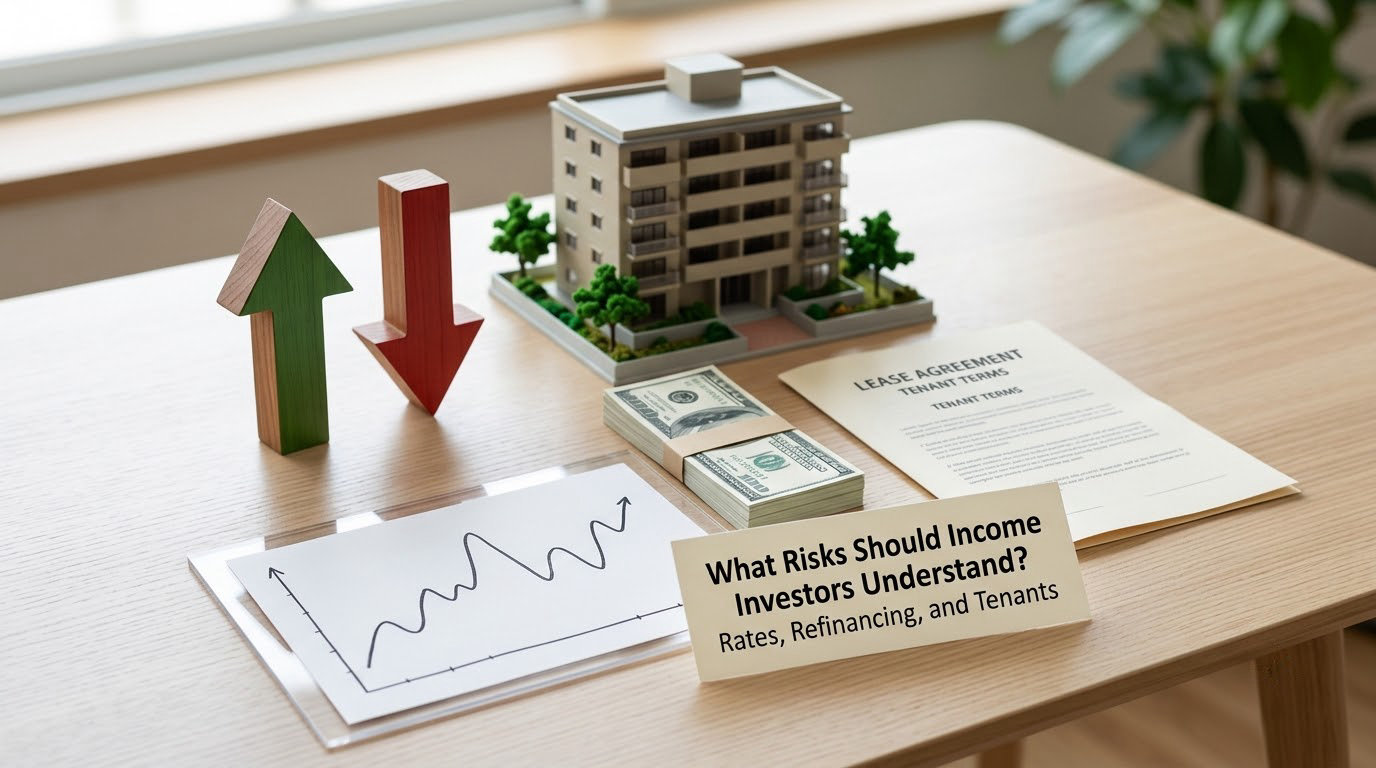
REITs are equities with a steady habit of paying out, not bonds with a coupon. The price of a REIT share can fall by half and the business can still be fine, which is the whole reason prices and income behave differently.
Interest rate sensitivity. Higher rates push yields on newly issued bonds up, and income-oriented buyers demand more from real estate, so share prices fall. Mortgage REITs react faster and harder because their spread moves with rates. Forum discussions describe mREIT income as a bond proxy rather than real estate exposure for exactly this reason.
Refinancing risk. A REIT that bought buildings with cheap debt has a maturity wall. When those loans roll at today’s rates, the interest expense can exceed what the properties produce. This is the single largest threat to a specific REIT’s distribution, and it is scheduled in advance, which means it can be read ahead of time.
Property cycles. Office, retail and hospitality have moved through severe repricing. Demand for industrial and logistics space has been the stronger story. Data centers and health care sit at the growth end; no REIT sector stays favoured forever, so sector concentration is a real exposure rather than a preference.
Tenant concentration. When a single tenant takes 15 percent of a REIT’s revenue, that tenant’s credit is now part of the investment. This shows up repeatedly with medical operators and with any REIT tied to one large corporate tenant.
Operating cost inflation. Taxes, insurance and repairs rise without a matching increase in rent when leases are fixed. Occupancy can stay at 98 percent and margins still compress.
Borrowing. Debt-to-EBITDA is the balance sheet number REIT investors watch; the 1x to 5x range is broadly considered workable, and above 6x starts to raise questions in forum threads about rate sensitivity and refinancing capacity. Interest coverage tells you how comfortably operating income covers interest payments.
Geographic concentration. A portfolio of coastal office buildings behaves very differently from one spread across sunbelt multifamily. Property type and geography both concentrate risk.
Management decisions. The board sets the distribution. Excessive growth funded with new equity and debt, or cutting the payout to cover a balance sheet problem, both show up in the numbers long before the press release.
None of this argues against REITs. It argues for reading the balance sheet and the maturity schedule before buying a high yield, which is a much cheaper exercise than finding out afterwards.
How US REIT Dividends Are Taxed: Mostly Ordinary Income
Most REIT distributions are taxed as ordinary dividend income at your marginal rate, not at the lower qualified dividend rate.
The reason is structural. A REIT that pays out more than 90 percent of taxable income cannot also retain enough profit to qualify for the corporate qualified dividend treatment that makes a qualified dividend pay out at a lower rate for the shareholder. Tax law resolves that tension by taxing the distribution at ordinary rates.
The breakdown lands on your annual tax form in the 1099-DIV section. Box 1a holds ordinary dividends, which is where most REIT distributions sit. Box 2a reports capital gain distributions, which occur when the REIT sells a property and passes the gain through. A return of capital is reported separately and reduces the cost basis of the shares instead of being taxed immediately; if basis falls to zero, subsequent return of capital is treated as a capital gain.
Box 2b reports the portion of REIT dividends paid to investors who are not qualified dividend recipients, which is most individuals, at the higher rate. Funds in a taxable brokerage account pass the higher tax treatment through to the investor with no offsetting credit.
Where the income sits changes the result more than people expect. A REIT inside an IRA or 401(k) generates no current tax on the distribution, though the account structure contributes its own rules and limits. A REIT in a taxable account hands you a bill every quarter whether or not you reinvested. Roth accounts treat qualified distributions as ordinary income and never as a return of capital.
Selling shares also interacts with holding period. Long-held REIT assets sold by the REIT can generate long-term capital gain treatment for shareholders who have held the shares for a long period, which is a meaningful difference on a large gain. Confirm the current holding period rules and your own position with a tax professional before a large purchase.
How to Evaluate a REIT for Income: A Repeatable Checklist
Work through these ten checks in order, using the REIT’s own filings rather than a summary page. The order matters because the first few items can disqualify a REIT on their own.
1. AFFO payout ratio. Below about 75 to 80 percent is generally treated as sustainable by experienced REIT investors. Above 100 percent means the distribution is being funded from something other than current cash generation.
2. Distribution history. Look for years of uninterrupted or near-uninterrupted payments, and read how any past cut happened. A cut is rarely a surprise once you track the payout ratio over time.
3. Debt-to-EBITDA. How much debt sits against operating income. Staying under roughly 5x leaves room for rate shocks.
4. Interest coverage. Operating income divided by interest expense. Thin coverage means a small rent decline or a rate reset can hit the distribution.
5. Fixed versus floating debt. How much of the debt is locked at a fixed rate, and when the next maturities fall. This is the refinancing risk calendar.
6. Weighted average lease term and escalations. A long lease with 2 to 3 percent annual bumps is predictable income. A short lease roll is a recurring negotiation.
7. Tenant quality and concentration. Investment grade credit or a creditworthy operating partner, and no single tenant dominating revenue.
8. Recurring capital requirements. How much capital the REIT spends on tenant improvements and maintenance as a share of revenue, compared with peers in the same sector.
9. External growth requirements. If the portfolio needs constant acquisitions funded with new shares, per-share income depends on continuous issuance.
10. Price versus net asset value. Net asset value is an estimate of what the properties are worth. Trading well above it means paying for optimism; a discount to NAV can be opportunity or a warning, depending on the reason.
Red flags worth pausing on: a payout ratio climbing for several quarters, a management fee structure that pays for acquisitions rather than performance, tenant concentration above 15 percent, a large share of debt maturing within two years, or a distribution that has grown far faster than rents.
A note on capital allocation bias. Berkshire Hathaway has generally favoured owning operating companies outright, including its large utility holdings, rather than holding REIT shares, where management cannot redeploy cash into the highest-return use. That is a reasonable thing to weigh when a REIT keeps raising equity just to keep the distribution growing.
How REITs Can Fit an Income Portfolio: Role and Allocation
REITs sit between bonds and dividend shares, and their value in a portfolio comes from occupying that middle ground.
Against bonds and bond funds, REITs offer equity-level price movement with contractual rent underneath. Against dividend shares, they add real assets, a different cycle and a structural payout requirement. Against cash, they pay you to accept volatility, which is a trade some portfolios want and some do not.
Three practical considerations come before the percentage. First, income stability versus price volatility: some investors need cash that does not move, and a REIT cut during a downturn is a problem for them in a way it is not for a long-horizon accumulator. Second, time horizon, since a REIT position that has not recovered from a rate shock is uncomfortable for someone drawing income in three years and irrelevant to someone twenty years out. Third, concentration, since holding three healthcare REITs is not diversification.
Allocation depends on those answers rather than on a rule of thumb. A common structure pairs a broad real estate ETF with a small number of individual sector positions, and uses a dividend reinvestment plan to keep the position growing without extra cash. Online discussion is split on whether that combination adds value over a broad fund alone; the honest answer is that it adds concentration, which is useful if you have a view and expensive if you do not.
Reinvesting distributions is worth a sentence of its own. Automatic reinvestment turns quarterly cash into additional units, which is how a 4 percent distribution becomes meaningful growth over decades. It also means a cut hurts the compounding as well as the cash flow.
REITs also carry an inflation argument. Rents reset and properties appreciate over time, which is part of why some investors hold them as an inflation hedge. The caveat is that the hedge shows up in the asset value over years, not in the quarterly distribution, so it only works if you can stay invested.
And the last point for anyone filing taxes. Because REIT distributions are generally taxed as ordinary income, the same portfolio can produce a very different after-tax result depending on whether it sits in a taxable brokerage account, a traditional IRA or 401(k), or a Roth. The order of operations matters: choose the account before you choose the REIT.
Frequently Asked Questions
Do REITs pay dividends every month?
It depends on the vehicle. Most publicly traded equity and mortgage REITs pay monthly, while REITs inside ETFs, index funds and mutual funds distribute whatever the fund collected, usually quarterly. Non-traded REITs typically pay quarterly, and some private structures pay on a schedule set in the offering documents. Check the payment frequency before you buy, because reinvestment plans on monthly payers compound considerably faster than quarterly ones.
What is the minimum amount needed to invest in a REIT?
For a publicly traded REIT, one share, which is usually in the tens of dollars and sometimes under 20. Brokerages also sell fractional shares of most REITs and of REIT ETFs, so a few hundred dollars is enough to start. Non-traded REITs usually have minimum investments in the thousands, and private REITs often start near 100,000. The real constraint is not the entry cost but how large a position you need for the income to be worth managing.
Can I automatically reinvest a REIT dividend?
Yes, most brokers offer a dividend reinvestment plan for individual REITs and REIT ETFs, and some allow automatic reinvestment for free with fractional shares. Enrol before the ex-dividend date and the cash buys additional units automatically. Non-traded REITs usually offer a limited-time reinvestment window rather than an ongoing plan. Watch the brokerage fee, because some older DRIPs charge a per-share fee that quietly eats the benefit.
Where can I find a REIT’s dividend and financial information?
Start with the REIT’s own filings, which are free: the annual report on Form 10-K, the quarterly report on Form 10-Q, and the investor relations page, where supplementals show FFO, AFFO, payout ratios, occupancy, leverage and debt maturities. The SEC’s EDGAR database holds all of them. NAREIT publishes sector and index data, and fund providers publish holdings and expense ratios for REIT ETFs.
Are REIT dividends guaranteed?
No. A REIT is required by law to distribute at least 90 percent of taxable income when the income exists, but it cannot guarantee a payment out of capital when income collapses. Distributions rise and fall with occupancy, rents, expenses and interest costs, and boards cut payouts when cash flow weakens. Several REITs cut distributions in recent years, so treat the payout as variable income and check the AFFO payout ratio before relying on it.
Conclusion
Start with coverage, not yield. Before you buy any REIT, pull the AFFO payout ratio, the debt-to-EBITDA figure, the debt maturity schedule and the tenant concentration list, then check how the same income would be taxed in your account type. Those four items tell you more than the distribution rate ever will.
Understanding how REITs work for income investors comes down to this: you are buying a cash flow generated by property, and cash flows move with occupancy, rents, costs and interest rates. Use the checklist, read the filings, and reinvest the distributions rather than chasing the highest number on a screen.
REIT income is variable and REIT values can fall sharply. Nothing here guarantees a return, and this is general information rather than advice for your situation.