
A futures contract is a legally binding agreement to buy or sell an asset at a predetermined price on a specific date in the future. That is the whole idea in one sentence, but how futures contracts work in practice involves three mechanics beginners miss: the exchange fixes every term except the price, both sides post a deposit called margin, and profits and losses settle in cash every single night instead of at the delivery date.
Almost nobody who trades futures ever takes delivery of the underlying asset. You open a position, the market moves, and you either close it for a gain or a loss or you roll it into a later expiry, all before anyone hands over barrels or bushels. Everything below explains how that machine works, with real contract sizes and arithmetic you can check on a calculator.
This is educational information, not financial advice. Futures are complex, leveraged products, and how much you can lose depends on your judgment, your sizing and the market.
Table of Contents
- How Futures Contracts Work: The Core Mechanics
- The Futures Trading Process From Quotation to Settlement
- What Is Margin in a Futures Contract?
- Cash Settlement vs Physical Delivery
- How Futures Prices Are Determined
- Types of Futures Contracts
- Futures Contracts vs Stocks, ETFs, and Options
- Key Risks and Common Mistakes
- Frequently Asked Questions
- How do you make money on a futures contract?
- Do you need 25,000 dollars to trade futures?
- Is 1,000 dollars enough to trade futures?
- Are futures basically gambling?
- What is the 80% rule in futures trading?
- Can you lose more money than your deposit on a futures contract?
- Conclusion: Start With the Contract Specifications
How Futures Contracts Work: The Core Mechanics
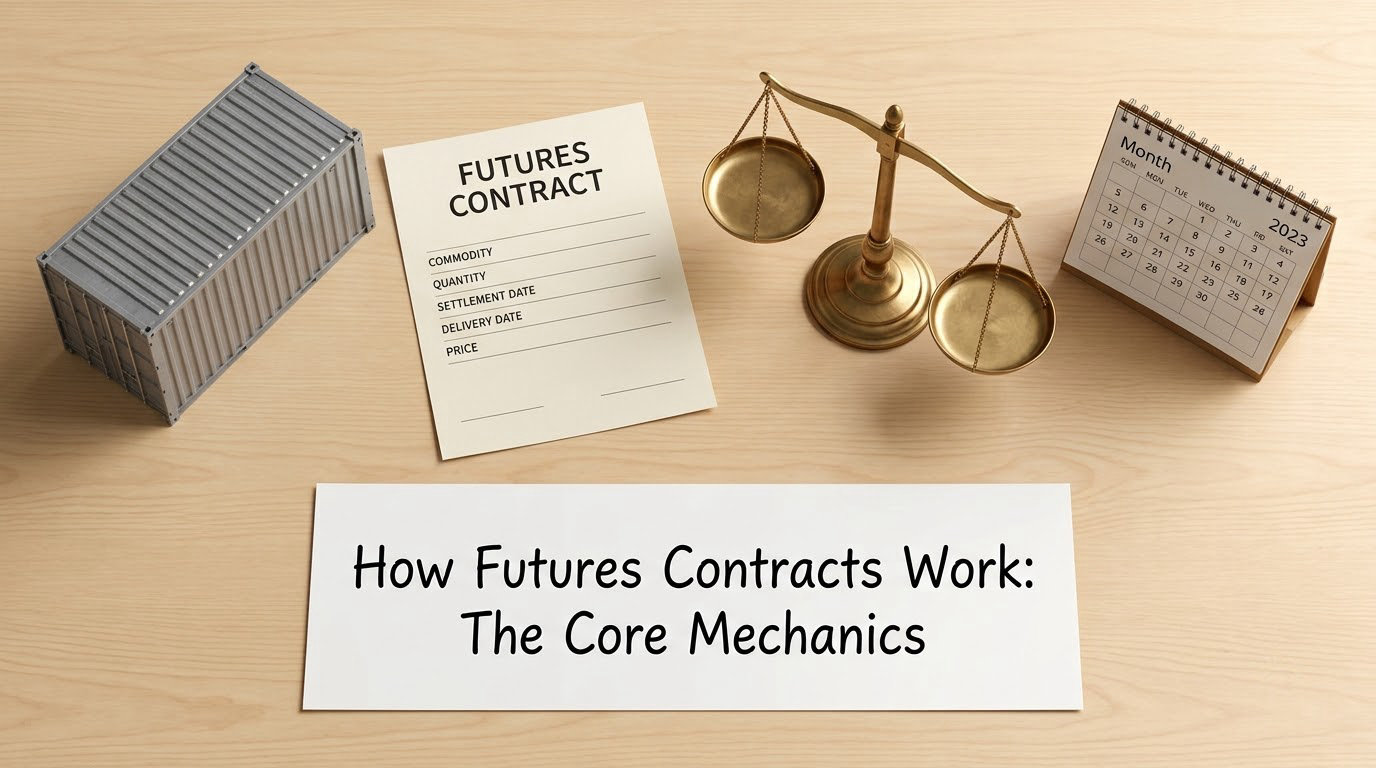
Futures trading works because five features are built into every contract, and once you can name them the rest of the mechanics follow logically:
- Standardization: The exchange defines the underlying asset, contract size, delivery month and settlement method.
- Margin, not full payment: You post a small deposit, typically 2% to 12% of the contract’s notional value, to hold it.
- Mark-to-market: Every trading day the contract is re-priced and gains or losses are settled in cash immediately.
- Offsetting positions: Closing out one contract with an opposite one ends your exposure without any delivery.
- Central clearing: The clearinghouse stands between buyer and seller, so neither carries the other’s credit risk.
A contract is more than a price. The four terms fixed at listing are the underlying asset, the contract size or multiplier, the expiry month, and whether the contract settles in cash or by physical delivery. The only thing that moves is the price, and that price is quoted continuously on the exchange floor.
That contract size surprises almost everyone the first time they see it. One crude oil futures contract on NYMEX covers 1,000 barrels, and one E-mini S&P 500 contract represents 50 times the index level. Buying one is not like buying one share.
The Futures Trading Process From Quotation to Settlement
A futures trade runs through a fixed sequence, whether you are hedging a crop or day-trading an index:
- Select a contract. Pick the underlying, the expiry month and the size that fits the account.
- Check the specifications. Confirm contract multiplier, tick size, tick value, expiry, settlement method and trading hours.
- Place an order. A market order fills at the next available price; a limit order fills only at your price or better.
- Post margin. The broker debits the initial margin requirement from your account.
- Monitor the position. The contract is marked to market daily against the exchange settlement price.
- Close, roll or hold to expiry. Closing out with an offsetting trade ends the position; rolling moves you to a later month; holding to the delivery month triggers settlement or delivery rules.
The exchange itself never lets one trader owe another. Your broker routes the trade to a clearing member, and the clearinghouse records it as a matched long against a matched short. That structure is why the same contract can be exchanged thousands of times a day without anyone worrying about credit.
What Is Margin in a Futures Contract?
Margin is a performance bond, not a fee and not your total cost. It is the cash that keeps you honest on an open position, and it is set by the exchange based on the volatility and systemic risk of the contract, not on the size of your account. That distinction is the one r/FuturesTrading keeps repeating: a bigger balance does not buy you a bigger contract automatically.
- Initial margin is what you deposit when you open the position. Most brokers ask for a bit more than the exchange minimum.
- Maintenance margin is the minimum equity required to keep the position open. Brokers generally set it above the exchange floor.
- Variation margin is the daily cash settlement of your profit or loss, which is what mark-to-market actually means.
- A margin call happens when your equity falls below the maintenance level, and the broker demands more cash.
Here is the arithmetic. Assume an index at 6,500 points, which makes one E-mini S&P 500 contract worth 50 x 6,500 = 325,000 dollars of notional value. With an initial margin requirement of 5%, you deposit about 16,250 dollars.
A 1% adverse move on the index is 65 points, and 65 x 50 = 3,250 dollars of loss. That is 20% of your deposit gone in a single day. A 3% adverse move is 195 points, or 9,750 dollars, which wipes out roughly 60% of what you posted. A 5% move is 325 points, or 16,250 dollars, which is the entire deposit. Gains and losses can run well past the number you started with, in either direction, before the contract is closed.
An overnight gap makes it harsher, because there is no chance to add funds before the open. This is an illustration of how the arithmetic works, not a recommended trade.
Mark-to-market is the piece that keeps the math honest. If you bought that contract at 6,500 and the settlement price at the close was 6,435, 3,250 dollars leaves your account that afternoon. You are not waiting until expiry to find out.
Cash Settlement vs Physical Delivery
Futures contracts work in one of two ways at expiry, and the difference decides what you end up with. Cash settlement pays you the price difference in dollars. Physical delivery means a warehouse receipt and an actual barrel, bushel or bond face value, and only a handful of traders ever do that.
Cash settlement covers most financial contracts. The E-mini S&P 500, the Nasdaq 100 index contracts, Treasury bond futures and currency futures all expire into a published settlement price, and your broker simply credits or debits the difference. Most retail positions never get that far because traders close them out or roll them first, and closing out means no delivery and no obligation at all.
Physical delivery shows up in contracts tied to a real, storable thing. Corn, soybeans, live cattle, cocoa and coffee can be delivered into a designated warehouse. Gold and silver contracts can be settled in physical metal or cash at your broker’s election. Even these are delivered by a very small share of participants, because taking delivery means arranging storage, insurance and financing for something you did not want to own.
Expiration is still something to respect. Contracts have a last trade date and a first notice day that arrives earlier, and a broker will often close a position out for you just before the notice date rather than let you take delivery of something you cannot handle. Know both dates before you hold anything past the current month.
How Futures Prices Are Determined
Futures prices are set by the same thing that sets any price: buyers competing with sellers. What makes futures different is that the people in the market have different motives. Hedgers want to remove risk, speculators want to take on risk for a profit, and arbitrageurs step in whenever the price drifts away from what the rules say it should be.
- Hedgers lock in a price they already depend on. A farmer selling corn futures in spring knows exactly what the crop will bring later and removes the risk of a price drop. An airline buying jet fuel futures does the same with fuel costs.
- Speculators take the other side, betting on direction without needing to own or use the underlying. They are the liquidity that makes hedging affordable.
- Arbitrageurs trade the gap between related markets, such as a futures price and the spot price of the same asset, and keep prices tied together.
Interest rates, storage, insurance and transportation also sit in the price. Because a futures price applies to a later date, it carries the cost of carrying the asset until then, plus whatever the market believes the supply and demand picture will be. That is called cost of carry.
When the futures price sits above spot, the market is in contango, which is the normal state for storable goods with financing and storage costs. When it sits below spot, the market is in backwardation, usually because current supply is tight or holders would rather keep the physical item than sell it forward. The difference between the two prices is called basis, and it narrows or flips as expiry approaches.
Rates feed in too. Higher interest rates raise the cost of financing an asset for months, which pushes futures prices further above spot, all else equal. Speculation about weather, harvests, production quotas and economic data shapes expectations that show up long before delivery.
Types of Futures Contracts
US futures are grouped by what they track, and each group settles differently. The examples below are the most widely followed contracts, all listed on CME Group venues such as CME, CBOT, COMEX and NYMEX.
| Category | Examples | What it tracks | Typical settlement |
|---|---|---|---|
| Equity index | E-mini S&P 500 (ES), Micro E-mini S&P 500 (MES), E-mini Nasdaq 100 (NQ), Dow (YM), Russell 2000 (RTY) | A broad basket of company shares | Cash against the settlement index |
| Interest rate and bonds | 10-Year T-Note (ZN), 5-Year Treasury (ZF), Eurodollar (GE) | US government debt yields | Cash against the reference bond |
| Energy | WTI Crude Oil (CL), Natural Gas (NG), Heating Oil (HO), RBOB Gasoline (RB) | Barrels and therms of fuel | Physical delivery possible, cash in practice |
| Metals | Gold (GC), Silver (SI), Platinum (PL), Copper (HG) | Troy ounces of metal | Physical or cash, at holder’s election |
| Agricultural | Corn (ZC), Soybeans (ZS), Wheat (ZW), Live Cattle (LE), Coffee (KC) | Crops and livestock | Physical delivery |
| Currency | Euro FX (6E), Japanese Yen (6J), British Pound (6B), Australian Dollar (6A) | Exchange rates between currencies | Cash settlement |
| Volatility | VIX futures | Expected movement of the S&P 500, not a direction | Cash settlement |
| Interest rate spread and crypto | SOFR futures, Bitcoin futures | Expected short-term rates and digital asset prices | Cash settlement |
Contract multipliers and tick values vary enormously, and that is where the real money sits. A useful reference table of the most common US contracts:
| Contract | Contract size | Tick size | Tick value |
|---|---|---|---|
| E-mini S&P 500 (ES) | 50 x index | 0.25 points | 12.50 dollars |
| Micro E-mini S&P 500 (MES) | 5 x index | 0.25 points | 1.25 dollars |
| E-mini Nasdaq 100 (NQ) | 20 x index | 0.25 points | 5.00 dollars |
| WTI Crude Oil (CL) | 1,000 barrels | 0.01 dollars | 10.00 dollars |
| Gold (GC) | 100 troy ounces | 0.10 dollars | 10.00 dollars |
| 10-Year T-Note (ZN) | 1,000 face value | 1/64 of a point | 15.625 dollars |
Notional value is simply contract size times price, so it changes with the market rather than sitting fixed. The MES exists for exactly this reason: at one-fifth the multiplier of the ES, it lets a smaller account trade the same index with roughly one-fifth the margin and one-fifth the dollars at risk per point.
Futures Contracts vs Stocks, ETFs, and Options
The clearest way to understand futures is to compare them with the two other things people buy to gain exposure to a market: owning something through shares or a fund, and buying an option. They look similar on a chart and behave very differently in the account.
| Feature | Shares or ETF | Futures contract | Option |
|---|---|---|---|
| Expiration | None | Yes, fixed delivery month | Yes, fixed expiration date |
| Capital required | Full purchase price | Margin, often 2% to 12% of notional | Premium paid up front |
| Maximum loss | What you paid | Can exceed your deposit | Limited to the premium |
| Margin required | None | Yes, ongoing | None after purchase |
| Delivery obligation | None | Yes unless you offset or roll | None |
| Direction | Long only | Long or short | Long or short |
| Best for | Long-term ownership and income | Hedging a known future cost or exposure, or short-term speculation | Defined-risk directional bets |
Buying an ETF gives you a piece of the market with no expiration and no margin call. A futures contract gives you much bigger exposure for much less cash, but the position expires, has to be managed, and can cost more than you put up. An option buys time and caps the loss at the premium, which is why some people who cannot watch a position daily prefer it despite the decay cost.
Forwards are worth a quick mention too, since the names get confused. A forward is a custom, over-the-counter agreement between two parties that usually settles at the end of the term and carries counterparty risk. A futures contract is standardized, exchange-traded, margined daily and cleared, which is why it can be bought and sold by strangers.
Key Risks and Common Mistakes
Leverage is what makes futures useful and what breaks beginners. Losses can exceed the deposit, and the gap risk is real: a position held over a close can move against you before you can react. Position sizing is the single habit that separates people who survive their first margin call from people who do not.
These are the mistakes I would flag to anyone starting out:
- Treating margin as the cost of the trade. It is a deposit, and it comes back to you in whole or in part when you close. The cost is the spread and the slippage.
- Believing one contract equals one unit. The contract multiplier is the biggest single misconception in futures, and it is where beginner accounts blow up. Check the multiplier before anything else.
- Over-sizing. Size the position so a realistic adverse daily move is a survivable hit. If a 1% move against you would be painful, take fewer contracts.
- Holding through the first notice day. Expiry, delivery months and roll dates have calendar consequences that catch out new traders who assume they can hold indefinitely.
- Trading something that is not a futures contract. People on r/FuturesTrading regularly post about buying CFDs or prop-firm funded accounts believing they are trading real exchange futures. The protections and the margins are not the same.
- Ignoring liquidity. A thin contract can have wide spreads and price limits that trap you in a position you cannot exit.
Habits that help: read the contract specifications before the first order, set a price alert for your maintenance level rather than discovering it the hard way, know your broker’s margin call and liquidation policy in advance, and pick a product you can monitor during its trading hours. Futures markets run nearly around the clock, and a position you cannot watch is a position you cannot manage.
On whether this is gambling: futures are leveraged instruments with real risk, and so are shares and real estate. What makes them lose money is usually over-sizing and trading a position you cannot manage, not the instrument itself. Regulated US futures are supervised by the CFTC, and most retail losses come from leverage rather than from chance. Treat it as a serious money decision, because it is one.
Frequently Asked Questions
How do you make money on a futures contract?
You profit when the price moves in your favor by more than your margin requirement and your trading costs. Buy low and sell higher for a long position, or sell high and buy lower for a short. Your gain is the number of points of favorable movement times the contract multiplier, marked to market daily so the money moves in and out of your account each session rather than at expiry.
Do you need 25,000 dollars to trade futures?
No. That figure is a US regulatory threshold for a futures commission merchant offering a particular product, not a requirement to open a standard futures account. Individual brokers set their own minimums, often far lower, and micro contracts such as the MES exist precisely for smaller accounts. You can trade futures with less capital, but position size then matters more, not less.
Is 1,000 dollars enough to trade futures?
It is enough to start, with a warning. A micro contract on an index such as the Micro E-mini S and P 500 (MES) gives you the same exposure at one-fifth the multiplier of the standard ES, so a modest move costs a modest amount. The catch is that 1,000 dollars does not change the percentage risk of a loss, so keep one contract and learn the mechanics before adding.
Are futures basically gambling?
No, though the honest answer has caveats. Futures are leveraged and losses can exceed a deposit, but so are shares, real estate and most investments. What destroys accounts is usually over-sizing, ignoring margin calls, and trading positions you cannot monitor. Regulated US futures are overseen by the CFTC, and a trader who sizes conservatively is making a calculated bet, not a random one.
What is the 80% rule in futures trading?
It is a self-imposed risk guideline, not a rule of the market: risk no more than roughly 1% of your account on a single trade, so eight similar losses would cut your balance by about 80% rather than wiping you out. Some traders use a different percentage. The principle behind it is sound, since surviving a losing streak matters more than winning any single trade.
Can you lose more money than your deposit on a futures contract?
Yes. Margin is a deposit, not a cap on losses. Because the contract is a multiple of the underlying, a 5% adverse move on an index contract can consume an entire 5% margin deposit, and a larger or overnight move can cost more than the cash you posted. That is why account size does not determine the size of the position you should hold.
Conclusion: Start With the Contract Specifications
How futures contracts work comes down to a short list: the exchange standardizes the underlying asset, contract size, expiry and settlement method; buyer and seller agree a price and post margin; the clearinghouse guarantees performance; both sides are marked to market daily; and most positions are closed or rolled well before any delivery happens.
Before any trade, verify the contract multiplier, the tick size and tick value, the notional value at the current price, the margin and maintenance requirement, the last trade date and first notice day, the settlement method, and the liquidity of that specific month. Then decide the maximum you can afford to lose, because that is the only number the exchange does not set for you.
Futures are complex leveraged instruments, and talking to a qualified financial professional before trading one is a reasonable step, particularly with money you cannot afford to lose.