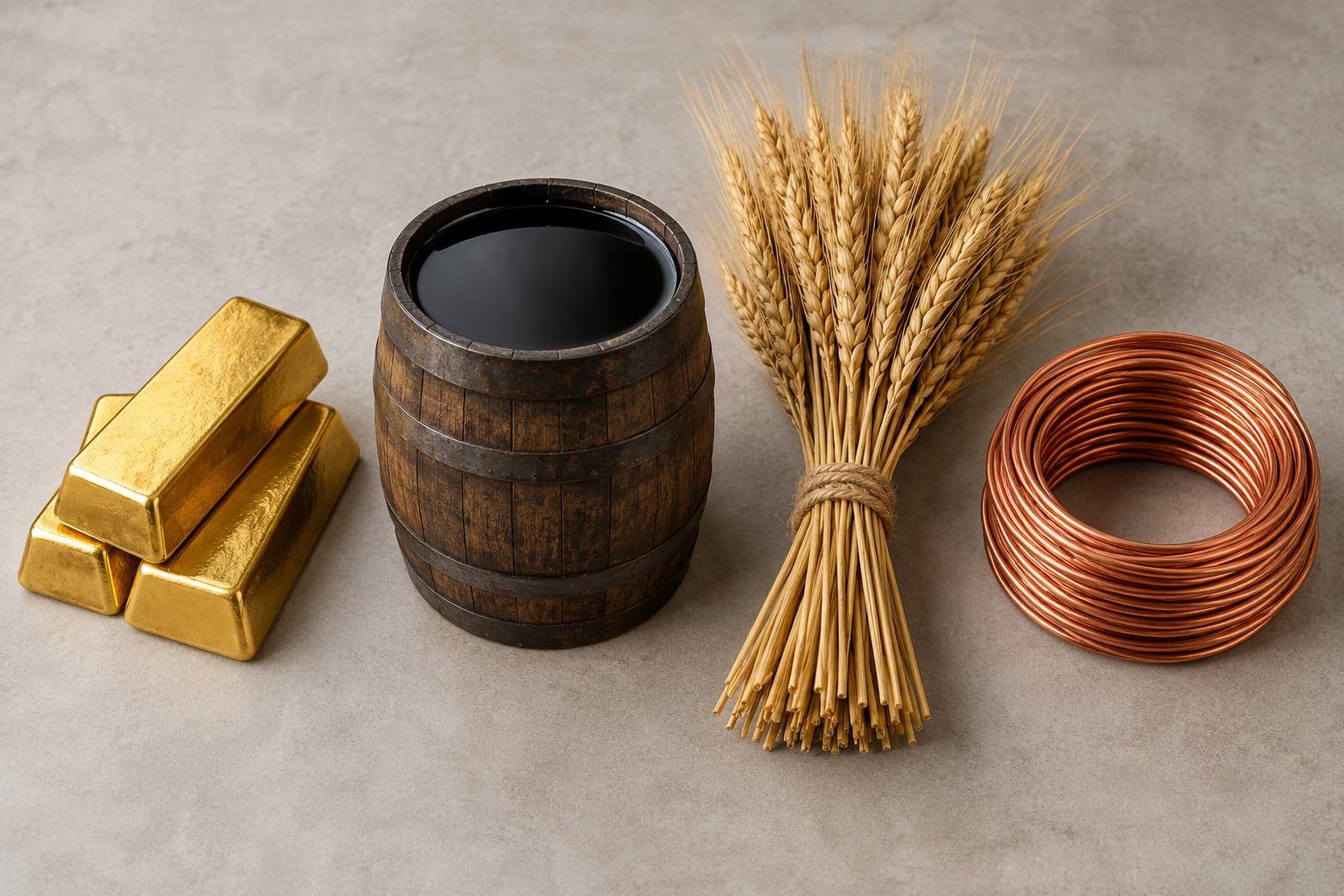
Commodities investing explained for beginners comes down to this: you are buying exposure to raw materials like oil, gold, wheat or copper, either as physical goods, through futures contracts, or far more commonly through funds and ETFs that hold those contracts. Most newcomers start with a fund, because it spreads risk and needs no margin. This guide explains the mechanics, the costs nobody mentions, and where beginners usually go wrong.
One thing to sort out early is the difference between investing and trading. Investing means buying something and holding it while it does its work. Trading commodities means holding leveraged positions for days or weeks, watching margin, and hoping to be right about a price move. Most people who search for a beginner’s guide to commodities investing want the first one.
The rest of this piece is written for readers in the United States. Rules, tax treatment and available funds vary by country and state, and nothing here is personal financial advice. What follows is a description of how the market works so you can judge for yourself whether any of it belongs in your portfolio.
Table of Contents
- What Are Commodities?
- Why Do Investors Buy Commodities?
- How Commodity Prices and Returns Work
- Contango, Backwardation and Roll Yield
- What Are the Main Commodity Categories?
- How Beginners Can Invest in Commodities
- Commodities Investing Explained for Beginners: Compare the Main Routes
- What Risks Should Beginners Understand?
- How to Start With a Beginner-Friendly Approach
- Frequently Asked Questions
- Is investing in commodities suitable for beginners?
- What is the easiest way to invest in commodities?
- Do commodity funds hold physical commodities?
- How much money do I need to start investing in commodities?
- Are commodities a good hedge against inflation?
- Conclusion
What Are Commodities?
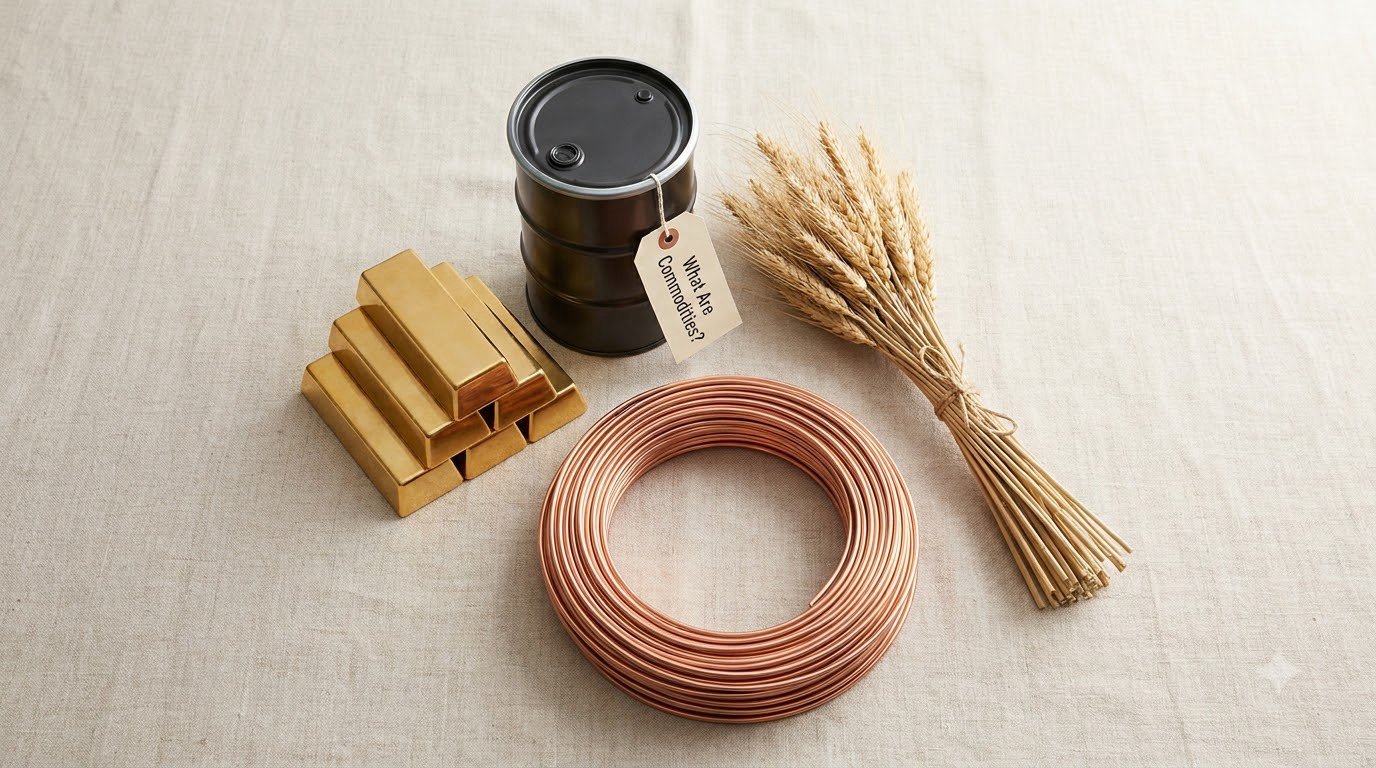
Commodities are raw, unprocessed materials bought and sold on exchanges and used to make something else. That includes crude oil, natural gas, gasoline, gold, silver, copper, corn, wheat, soybeans, coffee, sugar, cotton and livestock. Their prices move with supply and demand, not with company earnings or interest-rate decisions, which is exactly why they can behave so differently from the rest of your portfolio.
The market splits into hard and soft commodities. Hard commodities are energy and metals, things pulled out of the ground. Soft commodities are agricultural products and livestock, which are grown and raised and therefore exposed to weather and seasons.
You will also hear hedgers and speculators, and it helps to know who is who. A hedger has an actual business that would lose money if prices moved the wrong way, so a farmer or an oil producer buys futures to lock in a price. Speculators are the other side of that trade: they have no wheat field and no drilling rig, only a view on price.
Why Do Investors Buy Commodities?
There are four honest reasons, and none of them is a get-rich scheme.
Diversification. Commodity prices often move in the opposite direction from shares and bonds. When companies lose money on higher input costs and markets fall, some raw materials gain. A small slice of a commodity fund can soften the bumps in a portfolio that is mostly shares.
Some protection when cash loses value. Commodities have historically had a tendency to keep pace with inflation over long stretches, and gold in particular has a long history as a store of value. Keep the word tends in mind. It is a tendency across decades, not a promise about any given year.
Hedging a real exposure. If your income depends on oil prices, farming or shipping, a commodity position is a business tool rather than an investment. If it does not, hedging is a trading decision, not an investing one.
Exposure to a supply cycle. Sometimes an investor simply wants a position in a specific industry. Over the past decade that has meant betting on electricity demand from data centres, on copper supply gaps, and on where oil demand goes next. That is a theme bet, and it can lose money for years.
What commodities do not do is pay you while you wait. They generally produce no dividends and no interest. Any income you see is a change in price, which is a different and less reliable thing.
How Commodity Prices and Returns Work
Prices move because of supply, demand and what people expect next. Supply shifts when a producer adds output, a mine shuts down, a well goes offline, a crop fails or a shipping route closes. Demand shifts with economic growth, weather, industrial activity and currency moves, because raw materials are priced in dollars and a stronger dollar makes them cheaper for buyers elsewhere.
Policy has its own effect. OPEC decisions on production quotas, export restrictions, tariffs and sanctions all show up in the price. So does the weather, especially for grain, coffee and sugar. The same logic holds in 2026 as in any other year: a hot summer in the middle states, a strike at a port, or a supply cut announced on a Friday evening will move quotes faster than any quarterly earnings report does.
Returns come from one of two places: the change in the price of the commodity, and the return you get from rolling a futures position along the curve. That second one quietly decides your return and rarely gets explained.
Contango, Backwardation and Roll Yield
A commodity fund cannot hold one contract forever, because every futures contract has an expiration date. It has to sell the expiring contract and buy the next one. What it pays or collects during that switch is called roll yield, and its sign depends on the shape of the curve.
In contango, later contracts cost more than near ones. Selling cheap and buying expensive each month means the fund pays away a little every roll, a drag that quietly eats returns. In backwardation, later contracts cost less than near ones, so the roll adds a small gain. Many oil contracts spent years in backwardation, which is one reason energy-heavy funds have looked better than their headline expense ratios suggest.
The curve flips with storage economics. When inventories are low and demand is tight, prompt prices run high and backwardation appears. When storage is full and supply is abundant, contango appears. Funds holding futures during contango can still rise in value when spot prices climb, but they usually underperform the spot price itself. Over a decade, that shortfall is the most misunderstood cost in commodities investing, and it is not printed on the expense ratio line.
What Are the Main Commodity Categories?
Most broad commodity products hold futures across a spread of categories rather than betting on one. Knowing what moves each group helps you understand why a fund labelled diversified can still drop heavily for a week.
| Category | Examples | What moves the price | Typical character |
|---|---|---|---|
| Energy | Crude oil, natural gas, gasoline, heating oil, ethanol | Production quotas, drilling activity, refinery shutdowns, weather-driven demand, inventories | The most volatile category; shaped heavily by policy decisions and supply disruptions |
| Precious metals | Gold, silver, platinum, palladium | Currency moves, real interest rates, safe-haven demand, mine supply, jewellery and industrial demand | Less cyclical than energy, more sensitive to currency and rate expectations |
| Industrial metals | Copper, aluminium, nickel, zinc | Construction and manufacturing activity, grid and data centre buildouts, mine supply | Behaves like a hybrid of economic growth story and physical supply story |
| Grains and oilseeds | Corn, wheat, soybeans, oats, soybean oil | Planting, rainfall, drought, export demand, crop conditions reports | Weather-driven and seasonal; futures curves often sit in contango |
| Softs | Coffee, cocoa, sugar, cotton, orange juice | Harvests in specific countries, disease, frost, currency crises, blend demand | Thinly traded, so single events can move prices sharply |
| Livestock | Live cattle, feeder cattle, lean hogs | Feed costs, herd cycles, disease outbreaks, packer margins | Slow-moving, driven by multi-month production cycles |
The five most heavily traded contracts in the world sit mostly in the top three rows: crude oil, natural gas, gold, silver and corn. Volume matters for a beginner because it means tight spreads and reliable pricing in funds that track them.
How Beginners Can Invest in Commodities
There are seven routes in, and they differ far more than the fund names suggest. Some give you the commodity, some give you a business that uses the commodity, and some give you borrowed exposure with a time limit.
Physical commodities. You own the actual thing: a bar of gold, a bushel of grain, a barrel of oil in a tank. Ownership is real and there is no counterparty, but you pay storage, insurance and handling, and selling a large amount privately brings its own risk of fraud. This is a route for people with space and a long horizon, not a beginner’s first trade.
Futures contracts. A futures contract is an agreement to buy or sell a fixed quantity of something at a set price on a future date, traded on exchanges such as CME Group. You can go long or short, and the exchange requires a margin deposit. One standard contract on West Texas crude covers 1,000 barrels, so the exposure dwarfs the deposit. That is how a small deposit hides a large position, and it is why futures belong to experienced traders rather than to beginners who want exposure.
Options on futures. An option gives the right, not the obligation, to buy or sell at a set price by a date. That caps your downside, which is the appeal, and the premium you pay is the known cost. Options on futures are traded for their own sake and for hedging, and they are more complex to price than the underlying contract.
Commodity ETFs. These exchange-traded funds hold futures or the physical metal, trade like a share during market hours, and usually cover many contracts at once. They are the route most beginners choose because the minimum is small, no margin is involved, and setting up takes a few minutes. The trade-off is the expense ratio plus whatever the roll costs you.
Commodity mutual funds and index funds. These are priced once a day at the closing value rather than intraday, which suits people who want to buy and hold without watching the tape. Because pricing is once daily, orders placed after the cutoff execute at the next close.
Mining and farming companies, and partnerships. Here you buy a business rather than the metal. A miner can rise while gold falls, because costs, management and debt all move separately. Master limited partnerships pass through K-1 tax forms and can issue distribution notices that surprise first-year investors.
CFDs and certain offshore platforms. Contract for difference products let you take a position without owning anything, usually with borrowed money. Some are regulated, many marketed to beginners are not, and losses can exceed your deposit. We treat them as a caution rather than a route.
Commodities Investing Explained for Beginners: Compare the Main Routes
Match the route to the job you want done, then read across before you choose. People new to this look at access and cost first; the tax and leverage columns decide the rest.
| Route | Minimum to start | Ongoing cost | Borrowed money | Complexity | Beginner verdict |
|---|---|---|---|---|---|
| Physical commodity | Thousands for a workable quantity | Storage, insurance, handling | None | Low to run, high to liquidate | Fine for gold, awkward for anything else |
| Futures contract | Margin deposit, a small fraction of contract value | Broker fees, commissions, spread | Yes, standard feature | High | Not a beginner route |
| Options on futures | Premium plus margin | Premium, commissions | Yes, shaped by the premium paid | High | A hedging tool first |
| Commodity ETF | One share, through any brokerage | Expense ratio plus roll drag | None | Low | Most common beginner choice |
| Commodity mutual or index fund | Varies by fund, often a few thousand | Expense ratio plus roll drag | None | Low | Good for set-and-forget money |
| Mining and farming companies | One share | Brokerage fee only | None | Low, but you must research the business | Not the same as owning the commodity |
| CFD or offshore platform | Small deposit | Spread, swap charges | Yes, often high | Medium, with counterparty risk | Approach with caution |
What Risks Should Beginners Understand?
Volatility. Commodity prices can move several percent in a session on news you never saw coming, and a broad fund can fall hard in a single quarter. This is not a place to put money you need soon.
Margin calls. Futures require you to top up your deposit when the trade moves against you. If you cannot, the broker closes the position at a loss you had no time to think about. This is the single reason experienced money managers keep futures exposure tiny even when they are right about the direction.
Contract complexity and expiration. Every futures contract has an expiry date. Open interest rolls off on a fixed schedule, and positions in expiring contracts must be closed or rolled. Beginners who buy a contract months before expiry are exposed to the roll rather than to the commodity they had in mind.
Roll drag and tracking difference. A fund can underperform the commodity it tracks, sometimes by a meaningful margin over years, and the reported return will not tell you why. Compare the fund against the spot price of its index, not only against its peers.
Concentration. A fund holding crude oil futures is not diversified. It is a single bet on one commodity with a small annual expense ratio attached. Read the holdings, not the name.
Fees at several layers. An expense ratio, broker commissions and spread, plus storage costs for physical products, plus the roll. The total is what matters, and it is rarely the number printed in large type.
Tax treatment. This is where beginners get genuinely surprised. Physical gold and silver held as investments are taxed as collectibles, currently at the top marginal rate of 28 percent in the United States, and they get no capital gains rate advantage. Direct futures positions held as a trade are generally treated under the 60/40 rule, where 60 percent of gains and losses receive long-term capital gains treatment. Funds structured as partnerships issue K-1 forms for a business you did not start. ETF taxation depends on whether the fund holds physical metal, which creates an occasional surprise bill when shares are sold. Rules vary by state and change, so take specifics to a tax professional before trading.
The company is not the commodity. A mining share can fall in an appreciating market because the company raised debt badly, and a farming business can survive a price fall that would break another. Buying businesses is a different investment with its own research requirements.
Unregulated platforms. Complaints on commodity trading forums repeat the same pattern: unsolicited calls, guaranteed returns, pressure to deposit quickly, and withdrawal problems appearing once a profit is on screen. Legitimate US brokers register with the CFTC and the NFA, and you can verify a firm in the CFTC’s registration database before sending money. The CFTC is explicit that trading commodity futures and options carries a substantial risk of loss, and no one legitimate will promise you an outcome.
How to Start With a Beginner-Friendly Approach
Step one: name the job. Write down whether you want diversification, a hedge against inflation, or a theme bet. Different jobs point at different products, and a theme bet deserves a smaller share of money than a diversifier.
Step two: pick a liquid, multi-commodity vehicle. For most beginners that means a fund holding a broad basket of futures rather than a single commodity or a single stock. Volume matters: heavily traded products have tighter spreads and closer tracking.
Step three: read the fund’s own documents. Check the holdings, the expense ratio, whether it holds futures or physical metal, and the roll schedule. Compare those numbers with how the fund has performed against the spot price of the index it tracks.
Step four: set a small allocation. Most advisers who include commodities suggest somewhere between 5 and 10 percent of a portfolio, used as a supplement rather than a base. A simple shape for a beginner: a broad, diversified fund as the core, and a small single-theme position, such as an energy or metals fund, as the satellite. If you are unsure how the pieces fit together, learning how a diversified portfolio is built is a better first step than picking a fund.
Step five: rebalance on a schedule. Pick a review date once a year and stick to it. Commodities have strong multi-year cycles, and constant fiddling tends to convert a long-term holding into a series of badly timed short trades.
Avoid individual futures contracts and borrowed-money products until you understand margin mechanics well enough to lose real money doing it. Not knowing yet is a perfectly good reason to wait.
Frequently Asked Questions
Is investing in commodities suitable for beginners?
Commodities investing can suit beginners, but only through a diversified fund rather than individual futures. A broad commodity fund or ETF needs a small minimum, carries no margin requirement, and spreads exposure across many contracts. Individual futures contracts use borrowed money and can close out a beginner’s account quickly. Start with the fund, keep the position small, and treat it as a supplement to a portfolio built mainly from shares and bonds.
What is the easiest way to invest in commodities?
A broad commodity exchange-traded fund bought through a normal brokerage account is the easiest route for most beginners. You buy one share like any other, no margin is involved, and the fund holds futures across many commodities. Check the expense ratio, the holdings, and whether it holds futures or physical metal before you buy. Physical metals, futures contracts and partnerships all add costs and complexity that a beginner does not need yet.
Do commodity funds hold physical commodities?
It depends on the fund. Commodity futures funds hold exchange-traded contracts and never take delivery of the actual barrel or bushel. Some precious metals funds hold physical metal in a vault, allocated to the fund’s shareholders. That physical holding carries storage and insurance costs and changes the tax treatment when you sell. Read the fund’s prospectus and look for the words futures or physical before you buy.
How much money do I need to start investing in commodities?
You need very little for a commodity fund. Most exchange-traded funds let you buy a single share through any brokerage, and many mutual funds have low minimums as well. Physical metals, by contrast, mean vault fees that only make sense on a larger holding. Futures are different again, because the margin deposit is small while the contract behind it covers 1,000 barrels of oil or thousands of bushels of grain.
Are commodities a good hedge against inflation?
Sometimes, over long periods, and not reliably in any single year. Commodity prices tend to rise when consumer prices rise, and they can do better than cash and bonds during inflationary periods. But the relationship breaks down year to year, and the return you collect from a fund is reduced by fund expenses and by the cost of rolling futures contracts. Treat commodities as partial protection, not a dependable insurance policy.
Conclusion
The first decision is which job you want commodities to do in your portfolio, and the first action is a fund, not a futures contract. Read the holdings, the expense ratio and the roll schedule, then set an allocation in the 5 to 10 percent range that fits your plan rather than your news feed.
Everything in this guide is general information about how commodity markets work, and the details of funds, taxes and regulations change. Check the current documents and confirm your local rules before committing money, and keep borrowed-money products off the table until margin mechanics make sense to you.