
An options contract is a time-limited agreement between two investors. One pays a premium for the right, but not the obligation, to buy or sell a set quantity of an underlying security at a fixed strike price on or before a set expiration date. That single sentence covers how options contracts work for beginners, and everything else on this page is detail hung off it.
The part beginners miss is the asymmetry. The buyer gets a choice. The seller does not. One side decides whether to act, the other side has to follow along if the price moves the wrong way. Get that straight and the rest of the mechanics, payoff charts, and terminology start making sense on their own.
What follows covers the contract terms, both option types, the way an option’s price is built, what happens at expiration, how to work out profit and loss, and the risks that catch beginners out. Prices and settlement conventions vary by country and by asset class, so treat the examples as US equity-option mechanics and check your own broker’s rules.
Table of Contents
- What Is an Options Contract?
- Who is on each side of the trade
- The Four Parts of an Options Contract
- How Options Contracts Work for Beginners
- How a Call Option Gives the Buyer the Right to Buy
- How a Put Option Gives the Buyer the Right to Sell
- Intrinsic Value, Time Value, and the Option Premium
- What Happens at Expiration?
- How to Calculate Profit, Loss, and the Break-Even Point
- Long call
- Long put
- Short put
- Why an Option Can Expire With No Value
- Main Risks Beginners Should Understand
- What to Check Before Buying or Selling an Option
- Frequently Asked Questions
- Can I exercise an option at any time?
- Does an option buyer have to use the option?
- Who assigns a short option, and when can that happen?
- What is the difference between American and European exercise?
- Are all options physically settled with shares?
- Start With the Contract, Not the Prediction
What Is an Options Contract?
An options contract gives its buyer the right, not the obligation, to buy or sell 100 shares of an underlying stock at a predetermined strike price on or before a predetermined expiration date, in exchange for a premium paid to the seller. The buyer can walk away. The seller cannot.
An option is a derivative, which just means its value comes from something else. Here that something else is the stock. The contract itself does not transfer ownership of the shares, so an option holder has no voting rights, receives no dividends, and has no claim on the company’s assets. The most an option buyer ends up owning, if they ever exercise, is the standard 100 shares any shareholder can buy on the open market.
Who is on each side of the trade
Every options contract has a buyer and a seller, and they hold opposite views of the same contract. The buyer is sometimes called the holder or the long. The seller is called the writer or the short. The broker is the middleman that matches them and holds the collateral, but it is not a party to your economics.
| Side | What they pay | What they owe | Worst case |
|---|---|---|---|
| Buyer (long) | The premium, upfront | Nothing, if they let it expire | Loses the full premium paid |
| Seller (short) | Nothing upfront | The obligation to buy or sell at the strike | Losses can exceed the premium, in some cases by a lot |
That last column is the sentence to remember. Buying an option has a known maximum loss. Writing one usually does not, and the danger is asymmetric in a way that surprises people who assume the two sides are mirror images of each other.
The Four Parts of an Options Contract
Most option contracts are described by four things: the underlying asset, whether it is a call or a put, the strike price, and the expiration date. The premium, the quantity, and the exercise terms are what turn that description into a trade. Here is the same contract, piece by piece.
| Part | What it is | Example (underlying trading at 100) |
|---|---|---|
| Underlying asset | The security the option is tied to | Shares of one listed company |
| Right type | Call (buy) or put (sell) | A call |
| Strike price | The agreed price for the underlying | 100 |
| Expiration date | The last day the right can be used | 60 days from today |
| Premium | What the buyer pays the seller | 2.50 per share, so 250 per contract |
| Quantity | Shares per contract | 100 shares; two contracts means 200 |
| Exercise and assignment terms | When and how the right can be used | Any time through expiration, American style |
A strike price of 100 is not a prediction that the stock is worth 100. It is the price both sides agreed to transact at if the right is used. A contract with a 100 strike gives the buyer a chance to buy at 100, whether the market is at 95 or 130 on the day it matters.
Two conventions trip up first-timers. Contract size is fixed at 100 shares in US equity options, so a 2.50 premium is a 250 outlay, not 2.50. And corporate actions rewrite contracts: a stock split or a special dividend changes strikes, contract size, and contract names, so an option you tracked last month may not exist under the same symbol now.
How Options Contracts Work for Beginners
The mental model is simple enough to say in one line: the buyer pays now for the right to choose later. If the buyer’s choice is to act, the seller is required to act too. If the buyer’s choice is to walk away, nobody is forced to do anything.
So who has to do what? The buyer of a call, when the stock trades above the strike, can buy 100 shares at the strike price. The seller of that call is then obliged to sell those 100 shares at the same price. The buyer sets the price by exercising, the writer receives the instruction through assignment. The reverse applies to a put: the buyer can sell 100 shares at the strike, and the writer must buy them.
If the buyer does nothing, the contract simply ends. An out-of-the-money option expires worthless and the premium paid is gone. That is the whole loss for a long position, and it is why buying an option is described as having a defined risk.
Most beginners never exercise at all. In practice the usual exit is to sell the contract back to the market before expiration, a few dollars or cents different from what you paid. The gain or loss is the difference, and it shows up on the statement the same way an exercise would. The two routes differ in taxes and in how the position is shown on your account, which is one of the reasons a beginner should decide the exit before opening the trade rather than at the last minute.
Sellers do not get a say in the timing of the other side’s decision, but they do get control over one thing: they choose when to enter. That is the trade-off. The buyer caps the loss, the seller trades the capped loss for a bigger obligation.
How a Call Option Gives the Buyer the Right to Buy
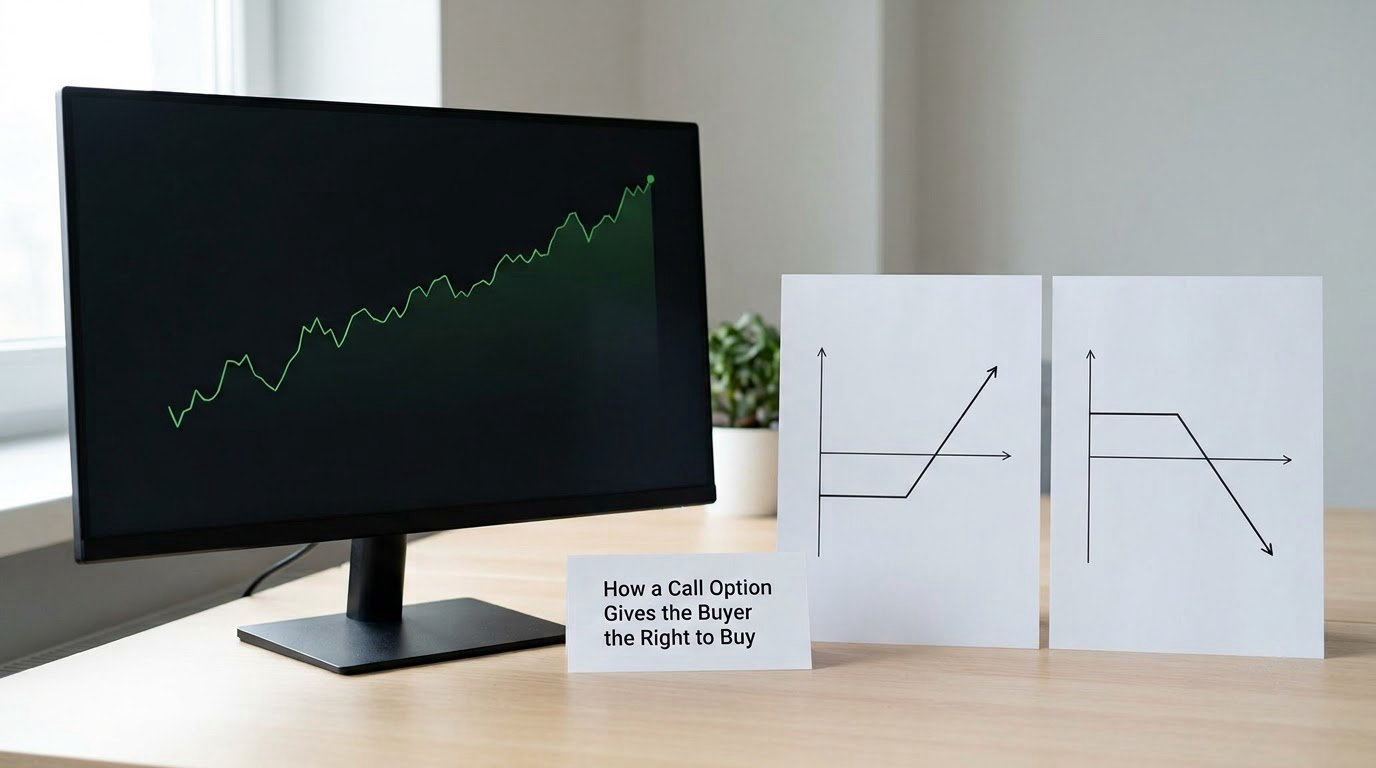
A call gives the buyer the right to buy 100 shares at the strike price. Suppose the stock is at 100 and you buy a 100 strike call expiring in 60 days for 2.50 per share. You pay 250 for one contract, and you now have 60 days in which buying 100 shares for 10,000 is something you can do but not something you must do.
What that contract is worth depends entirely on the stock price at the moment it matters. The three descriptions you will hear everywhere are simple comparisons against the strike.
- In the money: the stock is above the strike. A 100 call with the stock at 115 is in the money by 15 points, and the right is worth at least 15 per share.
- At the money: the stock is at or very near the strike. The 100 call with the stock at 100 is at the money, and its immediate exercise value is zero.
- Out of the money: the stock is below the strike for a call. The 100 call with the stock at 92 is out of the money, and exercising it would mean paying 100 for something worth 92.
Notice that a call can be in the money and still not be a good idea to exercise, because you would be handing over 2.50 per share of remaining time value for nothing. That is the subject of the next section on how the premium is built.
On the seller side, a written call is the position people describe as having unlimited risk. If the stock runs far above the strike, the writer has to deliver shares that are now worth much more than the agreed price, and there is no ceiling on the loss. That asymmetry is why short calls are not a beginner’s first trade.
How a Put Option Gives the Buyer the Right to Sell
A put gives the buyer the right to sell 100 shares at the strike price. It is the mirror image of a call, and it is how people build insurance or express a view that a stock is going lower.
Same example, different direction. The stock is at 100, you buy a 100 strike put expiring in 45 days for 2.40 per share, so 240 for the contract. At expiration the stock is at 92. You can now sell 100 shares for 10,000 when they are worth 9,200, which is 800 before the premium, or 560 after it. If the stock is at 100 or higher at expiration, you do nothing and the 240 is the loss.
The moneyness language runs opposite to a call. The 100 put is in the money when the stock is below 100, at the money at 100, and out of the money above 100.
What makes a put different from selling the stock short directly is the shape of the risk. Shorting stock usually requires margin, exposes you to an unlimited loss if the stock climbs, and obliges you to cover the dividend cost on the shares you borrow. A long put is paid for in full upfront and its maximum loss is the premium. The trade-off is that a put’s gain is capped, because the stock cannot fall below zero.
Intrinsic Value, Time Value, and the Option Premium
An option’s price has exactly two components. Intrinsic value is what the right is worth if you used it right now, and it can never be negative. Time value, sometimes called extrinsic value, is everything you pay above that: the price of the option to have the choice for a while longer. The premium is the sum of the two.
Using a stock at 100, here is what the split looks like across a few strikes and expiries. The numbers are illustrative rather than quoted market prices.
| Position | Stock price | Intrinsic value | Time value | Premium |
|---|---|---|---|---|
| 90 call, long dated | 100 | 10.00 | 0.20 | 10.20 |
| 100 call, 60 days | 100 | 0.00 | 2.50 | 2.50 |
| 110 call, 60 days | 100 | 0.00 | 0.40 | 0.40 |
| 90 put, 60 days | 100 | 10.00 | 0.30 | 10.30 |
| 100 put, 45 days | 100 | 0.00 | 2.40 | 2.40 |
| 110 put, 60 days | 100 | 0.00 | 0.25 | 0.25 |
Two things fall out of that table. A deep in-the-money option is mostly intrinsic value with a sliver of time attached, because there is very little left for time to be worth. An out-of-the-money option is pure time value, which is why it is worth something today and nothing at all on expiration day if the stock never moved.
It also explains why a stock that is not moving still has a price on it. A 100 call with the stock at 100 would be worth nothing to exercise right then, yet it trades at 2.50. Somebody is paying for the chance that the stock travels far enough, soon enough, to make the right useful.
How much time value sits in a contract depends on how long until expiration and how much the market expects the stock to move. Long-dated contracts carry more time value than near-dated ones, and contracts on stocks that move a lot typically trade richer than contracts on quiet ones. That expectation has a name, implied volatility, and when the real market stops matching it, option prices move for reasons that have nothing to do with the direction of the stock.
What Happens at Expiration?
Expiration is a fixed date, and for US equity options the last trading day is generally a Friday, with 4:00 p.m. Eastern as the cutoff for exercising. Index options such as those on the S&P 500 usually expire on a Thursday and settle in cash. Weeklies, monthlies, and LEAPS contracts are just different expirations, and the same three outcomes apply to each.
Here is the decision, scenario by scenario.
- Call in the money: the buyer can exercise and buy at the strike, and the writer is assigned and must sell. In practice the buyer often sells the contract for a profit instead, and the writer closes at a loss.
- Put in the money: the buyer can exercise and sell at the strike, and the writer is assigned and must buy 100 shares at that price. On an ETF or stock option this can create a real share position in the account overnight.
- At the money or out of the money: no one exercises, nothing is assigned, and both sides let the contract die. The buyer’s loss is the premium, the seller’s gain is the premium.
Time value is the reason to act before that last day. As expiration approaches, the time value of an at-the-money option drains toward zero, and the drain is not even. In the final week the decay accelerates, which is why an option held to expiration can lose most of its value in days while the stock barely moves.
Early exercise complicates the picture too. A holder can usually exercise at any time before expiration on a US stock option, and some holders do it early to capture a dividend. On a high implied volatility contract that decision can look irrational, which is why brokers tend to flag it and clients are advised to set exercise preferences in advance. A contract sitting exactly at the strike on expiration day creates pin risk: you cannot know until after the fact whether it finished slightly in the money or slightly out.
How to Calculate Profit, Loss, and the Break-Even Point
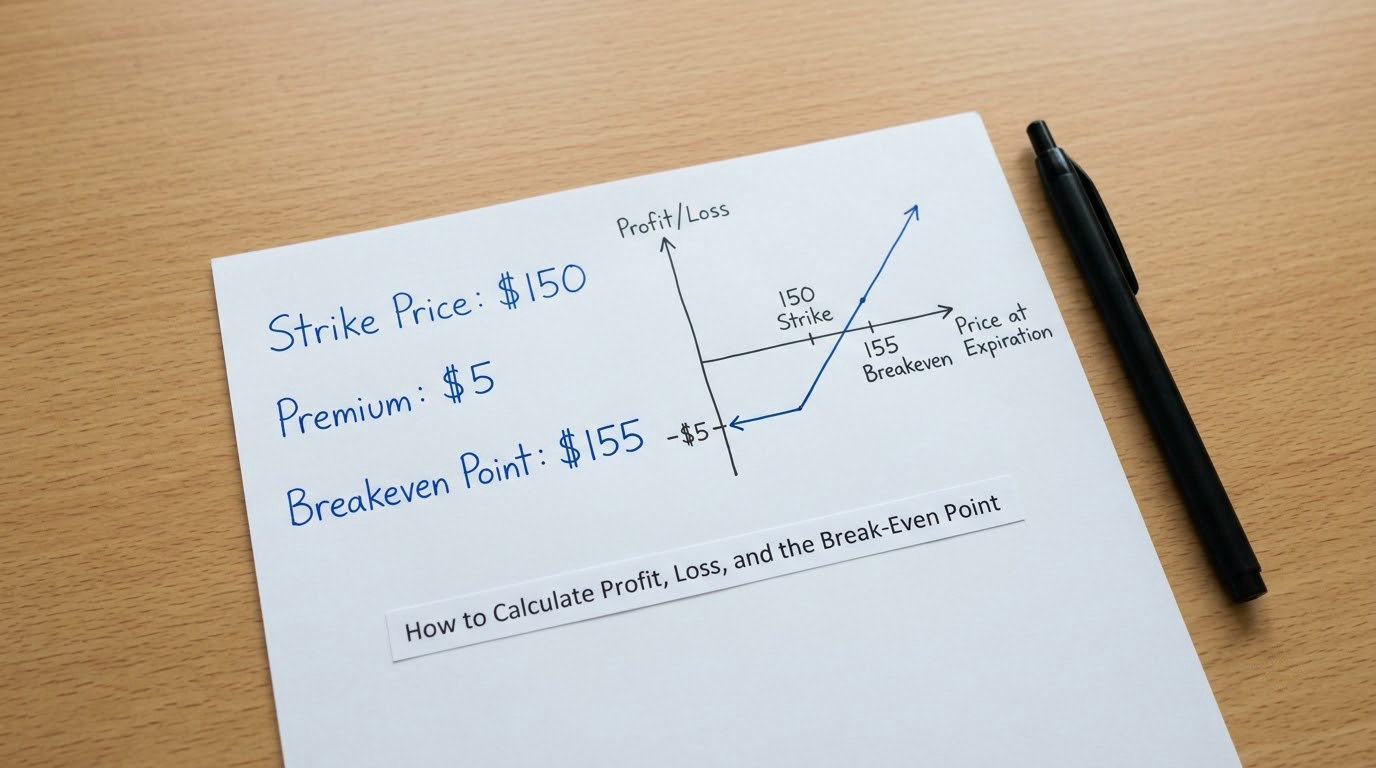
Every payoff question reduces to three numbers: the premium, the strike, and where the stock ends up. Start by converting the premium to a per-contract figure, since a quoted 2.50 is really 250.
Long call
Buy a 100 strike call for 2.50 per share, so 250 per contract.
- Maximum loss: 250, the premium, if the stock stays at or below 100.
- Break-even: strike plus premium, which is 100 + 2.50 = 102.50 at expiration.
- Profit at expiration: (stock price − 100 − 2.50) × 100. At 110, that is (10 − 2.50) × 100 = 750.
Long put
Buy a 100 strike put for 2.40 per share, so 240 per contract.
- Maximum loss: 240, the premium, if the stock stays at or above 100.
- Break-even: strike minus premium, which is 100 − 2.40 = 97.60 at expiration.
- Maximum profit: 7.60 per share, or 760, reached if the stock falls to zero.
Short put
Sell a 95 strike put and collect 1.20 per share, so 120 per contract.
- Maximum gain: 120, the premium, if the stock stays above 95.
- Break-even: 95 − 1.20 = 93.80 at expiration.
- Maximum loss: (95 − 1.20) × 100 = 9,380, if the stock falls to zero. Assignment at 95 is the realistic version of that outcome, and it means owning 100 shares.
The pattern is worth internalising rather than memorising. For a long call you need the stock above strike plus premium. For a long put you need it below strike minus premium. For a short put you need it above strike minus premium, or you accept being assigned at the strike. The premium is always the distance between the market price and the price you need.
Why an Option Can Expire With No Value
An option expires worthless when it is out of the money at expiration. For a call that means the stock finished at or below the strike. For a put it means the stock finished at or above the strike. At that point the right is worthless, nobody exercises, and the buyer’s premium is gone.
The more interesting question is how a contract gets there, and the answer is usually time. Here is the same 100 strike call, bought for 2.50, watched over its life while the stock barely moves.
| When | Stock price | Call value | Why |
|---|---|---|---|
| Purchase, 60 days out | 100 | 2.50 | All time value, no intrinsic value yet |
| 30 days out | 101 | 1.80 | A little intrinsic value, less time value |
| 7 days out | 100 | 0.35 | Most of the time value is gone |
| Expiration | 99 | 0.00 | Out of the money, the contract dies |
The stock finished below where it started, and the buyer was right about the direction being weak, and the contract still went to zero. That is the lesson worth taking before any strategy: an option needs the move to happen, and it needs to happen inside the window you paid for.
Owners who watch a contract bleed and refuse to close it add a second problem. Exiting earlier would have captured most of the 1.80, and holding to expiration captured nothing. A beginner with a plan for the exit rarely ends up in that spot, which is why the exit is worth deciding before the trade rather than after it.
Implied volatility makes a third path to zero. If the market was pricing in a big move and then the expected move quietly deflates, both calls and puts lose value even if the stock ends up where it started. That is why options can fall ahead of earnings and sometimes recover afterward, and why an options trader who only watches the stock price is looking at half the picture.
Main Risks Beginners Should Understand
Time decay is the first one, and the table above showed most of it. Every day of holding eats time value, and it eats fastest in the final week before expiration. Long-dated options decay more slowly, which is one reason experienced traders reach for them when direction is uncertain.
Volatility is the second. High implied volatility inflates premiums on both calls and puts, so you pay more and your contract needs a bigger move just to break even. Direction can be right and the trade still lose if the volatility you paid for never arrived.
Exposure is the third, and it is where beginners get into real trouble. The premium is small, but it controls 100 shares, so a modest percentage move in the stock produces a large percentage move in the contract. That is the source of the control-with-less-capital effect, and it is also the reason a position that felt affordable at entry can demand a margin increase from the broker a few days later.
Gaps are the fourth. Overnight news, earnings, and halt-resume events move a stock in one step, and an option holder has no chance to exit at the price they expected. Holding a position through an earnings date means accepting a two-sided, unhedgeable jump.
Assignment is the fifth, and it only applies if you are on the selling side. Short option holders can be assigned early under some conditions, and a short put assigned at the strike means buying 100 shares whether or not the broker asked. Automatic exercise settings determine what happens at expiration for in-the-money contracts, and the default settings are not always what a new account wants.
Finally, there is cost and liquidity. The bid-ask spread is a real cost on entry and exit, per-contract fees for exercise and assignment can apply depending on the broker, and thinly traded contracts are hard to exit near the quoted price. Add time decay and you have three separate ways for a correct idea to produce a losing account.
Buyer risk and writer risk are not the same list. The buyer’s worst realistic case is the premium, paid and gone. The writer’s worst case is unbounded or very large. Neither outcome is guaranteed, and past performance on a strategy says nothing reliable about the next one.
What to Check Before Buying or Selling an Option
Read the contract before you own it. It takes five minutes and it catches almost every beginner error I have seen.
- Symbol and underlying: confirm the exact company, the class of share where there is more than one, and that you are looking at the contract you think you are. Corporate actions rename and renumber contracts.
- Call or put: the first letter after the ticker. This is a self-inflicted error people make regularly, and the broker’s order screen is the last place to catch it.
- Strike price: the price you would transact at, not a forecast. Ask why this strike and not the next one.
- Expiration: the date, the time, and how far out it is. Weekly contracts give you a few days, LEAPS give you over a year, and the decay curve is nothing like the same in both.
- Premium and per-contract cost: the quoted price times 100, plus the bid-ask spread you will cross to get in and to get out.
- Liquidity: volume and open interest in the options chain. A contract with almost no volume will cost you more to exit than the chart suggests.
- Exercise style and assignment terms: American or European, and whether your account auto-exercises in-the-money positions at expiration.
- Maximum loss: stated in money. If you cannot name the number, the position is too large.
- The exit: the price or the condition that makes you close, decided now. Also decide in advance whether you will exercise or sell the contract back.
Those same fields are what you are reading in the options chain, the grid of strikes and expiries for one underlying. The strike column runs down the middle, calls on one side and puts on the other, with bid, ask, last price, volume, and open interest for each row, and a greyed-out strike marking at-the-money. Getting comfortable with that grid is the single most useful half hour you can spend before trading, and it is the part most beginner guides skip.
One last habit. Decide the size before the trade. Most beginners who get hurt had a position that was a larger share of the account than the plan allowed, usually because the contract felt cheap.
Frequently Asked Questions
Can I exercise an option at any time?
For US stock and ETF options, usually yes. American-style options can be exercised on any business day before expiration, including the expiration day itself. Index options and many European-style contracts can only be exercised on the expiration date. Check your broker’s exercise and auto-exercise settings before expiration, because a holder is often better off selling the contract back than exercising it.
Does an option buyer have to use the option?
No. That is the defining feature. The buyer pays the premium and keeps the right, not the obligation, so letting a contract expire worthless is a normal outcome rather than a failure. Most buyers close the position by selling the contract back to the market before expiration, which captures part of the time value that would otherwise decay away. The buyer’s real loss is capped at the premium paid.
Who assigns a short option, and when can that happen?
The option holder chooses to exercise, and the seller’s broker then assigns the obligation to that seller. Assignment can occur at any time on an American-style option, and it most often shows up when a short put is in the money at expiration. Being assigned on a 95 strike put means buying 100 shares at 95. Writers should confirm their account’s auto-exercise instructions in advance.
What is the difference between American and European exercise?
American-style options can be exercised on any business day up to and including the expiration date. European-style options can only be exercised on the expiration day itself. Most US stock and ETF options are American style, while many index options, including standard S and P 500 index options, are European. The difference matters most to option writers, since an early assignment on a short American option can happen before you intended.
Are all options physically settled with shares?
No. US stock and ETF options generally settle physically, so exercising or being assigned creates a real position of 100 shares in the account. Many index options, including standard S and P 500 contracts, are cash settled, meaning the difference between the strike and the settlement value is paid out with no shares changing hands. Some index products, known as European-style index options, are cash settled even when the exercise window is long.
Start With the Contract, Not the Prediction
The first step for anyone learning how options contracts work for beginners is not a strategy and not a ticker. It is one contract, written out in full: the underlying, call or put, strike, expiration, premium paid, maximum loss, and the price or condition that would make you close it.
If those seven items make sense on a piece of paper, the mechanics are understood. If they do not, no strategy built on top of them will help. A beginner who can state the maximum loss, the break-even, and the exit rule before entering has already avoided the mistakes that account for most of the losses beginners report.
Then practise without money for a few months, because a simulated account teaches the mechanics but not the feeling of a position moving against you. When the real thing arrives, start with a small defined-risk position, one contract, and write down what happened either way.
Everything here is general educational information about how contracts behave. Tax treatment, fees, and settlement rules differ by country, by state, and by broker, and none of this is individual financial advice or a promise of any result. Check your own broker’s documentation and a qualified professional before putting money behind it.