
Rental property cash flow is the money that stays in your bank account each month after rent comes in and every bill goes out, mortgage payment included. The whole calculation reduces to one line: monthly cash flow equals effective gross income, minus operating expenses, minus debt service, minus reserves. Get that line right and every other number in a rental analysis falls into place.
Most people learn this the hard way, after signing a pro forma that looked generous and then met a vacancy, a tax bill and a water heater in the same quarter. That is exactly what this guide is for: build the calculation yourself, line by line, with numbers you can defend.
The example that runs through the article is a three-bedroom single-family rental in a mid-cost US market. Every figure is monthly unless noted, and the whole thing is illustrative rather than a recommendation. Rent, taxes, insurance and repair costs vary enormously by county, so treat the numbers as a template and swap in real local quotes.
Table of Contents
- What Is Rental Property Cash Flow?
- The Core Rental Property Cash Flow Formula
- How to Calculate Monthly Rental Income
- Which Operating Expenses Belong in the Calculation?
- Why the 50% rule breaks down in expensive markets
- How to Account for Vacancy, Reserves, and Financing
- Rental Property Cash Flow Math Example
- How to Use NOI and the Capitalization Rate
- How to Find the Break-Even Rent and Cash-on-Cash Return
- Why Rental Property Cash Flow Estimates Change
- Frequently Asked Questions
- Should mortgage principal be included in rental property cash flow?
- Is rental property appreciation part of cash flow?
- What percentage should I use for vacancy and bad debt?
- How do I calculate the break-even rent for a rental property?
- What is a good cash-on-cash return for a rental property?
- Does the capitalization rate show the actual cash return?
- Conclusion
What Is Rental Property Cash Flow?
Rental property cash flow is what remains after every cash cost is subtracted from collected rent: the full mortgage payment, property taxes, insurance, maintenance, management fees and reserves. It is a monthly number, not an annual one, because that is how the money actually arrives and departs.
It is not the same as accounting profit, and the gap confuses more beginners than any other concept in this space. Two items show up in a tax return but never touch your bank account: depreciation, which is an accounting deduction for wear on the building, and principal, which moves from your account into the loan’s principal balance.
Interest is real cash leaving your account every month. Principal is also cash leaving, but it buys you an asset: a larger equity stake. Subtract principal and the property looks permanently worse while your net worth quietly rises, which is why some investors track cash flow before financing.
A property can also show positive accounting profit, driven by depreciation, while producing negative monthly cash flow. That combination is common in high-tax markets and it is why a tax return is a poor tool for judging whether a rental carries its own weight.
The Core Rental Property Cash Flow Formula
Here is the master equation, written out so it can be copied straight into a spreadsheet cell:
Monthly cash flow = effective gross income − operating expenses − debt service − reserves
Effective gross income (EGI) is gross rent plus any other recurring income, minus a vacancy and collection loss allowance. Operating expenses are the bills that come with running the property: taxes, insurance, utilities, management, repairs, dues and admin. Debt service is the whole mortgage payment, principal plus interest, sometimes with a mortgage insurance premium on top.
Reserves are the money you hold back rather than spend: a vacancy cushion, a maintenance allowance, and a capital reserve for big-ticket items like a roof or a furnace. Every one of those four terms is a subtotal you can build from smaller line items, which is what the next three sections do.
How to Calculate Monthly Rental Income
Start with gross potential rent: the rent you could charge if the place were occupied every month of the year, at the rent you believe the market will actually pay. Then add other recurring income, then subtract what you realistically lose to empty months and tenants who do not pay.
Other income is usually small but real: pet fees, laundry revenue, parking, storage, or an occasional month of Airbnb income. Include it in your gross number but keep it conservative, because it rarely survives a full year.
Use the current rent roll and a rental market analysis, not the seller’s list price and not a generic rent estimate site. If the home is currently rented, ask for the actual lease rent and the last 12 months of collection history before you assume a higher figure.
For the worked example: rent of 2,400 per month plus 90 of other income gives gross rental income of 2,490. Applying a 6 percent vacancy and credit loss allowance subtracts 149, so effective gross income is 2,341.
| Income line item | Monthly (USD) |
|---|---|
| Gross potential rent | 2,400 |
| Other income (pet fee, laundry) | 90 |
| Gross rental income | 2,490 |
| Less vacancy and credit loss (6%) | (149) |
| Effective gross income | 2,341 |
Which Operating Expenses Belong in the Calculation?
Operating expenses are the recurring costs of owning and running the unit that occur regardless of whether you have a mortgage. The line items below are the ones I would build into a first spreadsheet.
- Property taxes — pull the actual assessed amount and the millage, and remember taxes often rise with reassessment.
- Insurance — a landlord policy costs more than a homeowner policy; get a quote for the actual property before you close.
- Utilities the landlord pays — water, sewer, electric, trash, and sometimes gas and internet.
- Grounds and common charges — lawn care, snow removal, HOA or POA dues.
- Property management — commonly 8 to 10 percent of collected rent, with a minimum monthly fee that can hurt small rentals.
- Repairs and maintenance — a percentage allowance, not a guess at zero.
- Turnover and admin costs — listing fees, cleaning, minor repairs between tenants, small legal fees.
Three things are not operating expenses. Mortgage principal is debt paydown, not a cost of running the unit. Capital improvements such as a new roof or a re-pipe are capital expenditures, which belong in a reserve schedule rather than in monthly operating costs. And income tax is not an operating expense at all; some investors model it separately, others ignore it and stay consistent.
Why the 50% rule breaks down in expensive markets
The 50% rule says expenses should run about half of gross rent. It is a decent starting guess in a low-cost market and a poor one in a coastal or high-tax county, where property taxes, insurance and dues can eat two-thirds of the rent on their own.
The arithmetic that matters is simple: if half of gross rent, minus the mortgage payment, is not clearly positive, the deal does not work regardless of how the rule is worded. In the example above, expenses run 905 against an EGI of 2,341, which is 39 percent, and cash flow stays thin. That cushion is what a small vacancy or a bad insurance year eats first.
How to Account for Vacancy, Reserves, and Financing
Vacancy is the assumption most likely to make a spreadsheet lie to you. Turnover between tenants creates a gap even in a tight market, so a 5 percent allowance is the floor for a well-run single-family rental, 6 to 8 percent in a normal market, and higher if the property needs work between tenants.
On reserves, two lines are enough for a beginner model. A maintenance allowance of 5 to 8 percent of collected rent covers turnover and small repairs, and a capital reserve of roughly 5 percent of annual rent covers the eventual roof, furnace and water heater. BiggerPockets contributors push the same idea from the other direction: budget the uncomfortable items first, because a pro forma that excludes reserves is not a pro forma, it is a wish.
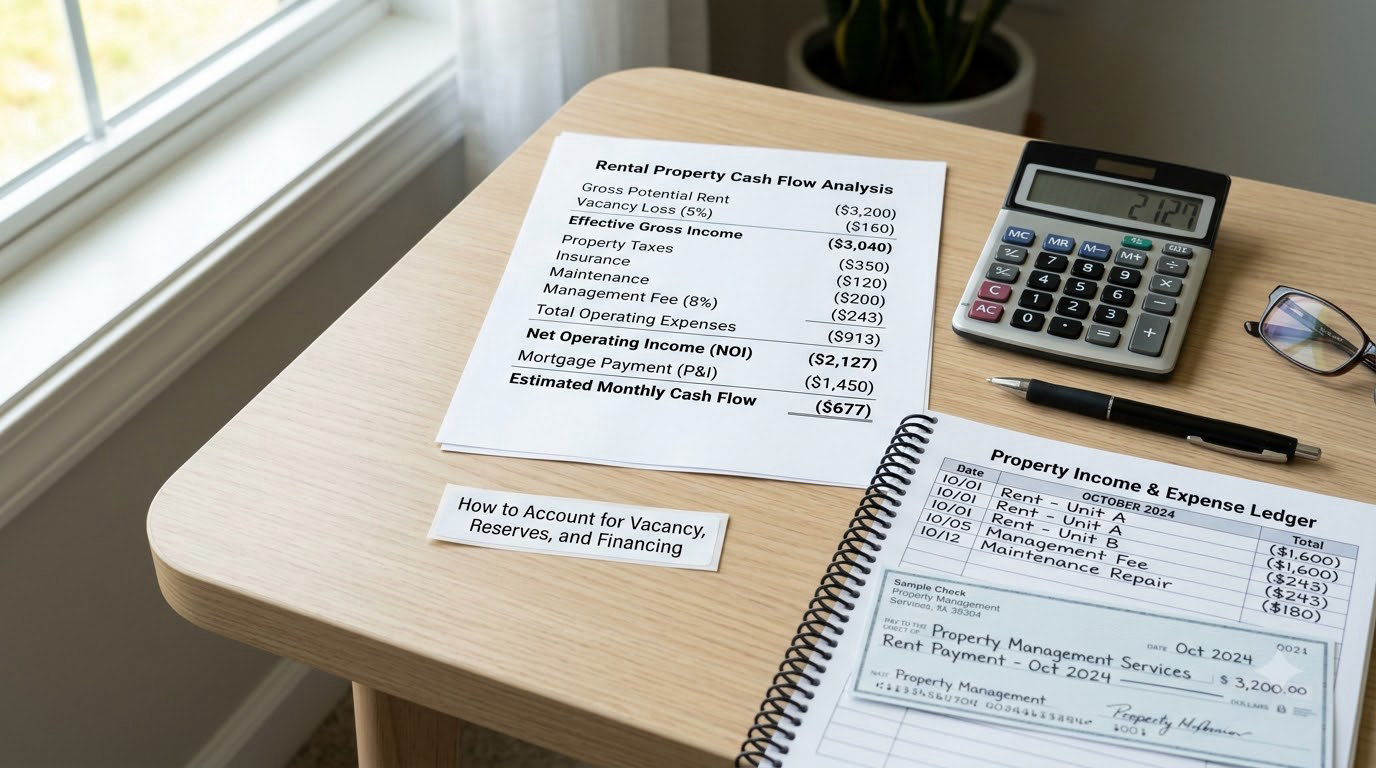
For financing, use the actual note: purchase price less down payment, the rate you are quoted rather than the one on a rate sheet, and the full amortization period. Add mortgage insurance if the loan carries it, and if you use a debt service coverage ratio loan, model the rate with the adjustment the lender will bake in.
Debt service coverage ratio (DSCR) is NOI divided by total debt service. Lenders often want 1.25 or higher, and many will underwrite at 75 percent of the appraised market rent rather than the rent a pro forma assumes, so check that assumption before you build your own numbers.
Rental Property Cash Flow Math Example
Here is the full monthly picture for the example property, a three-bedroom rental bought for 265,000 with 30 percent down, financed at 6.5 percent over 30 years. You will notice that principal is not broken out separately, because the mortgage line is the whole payment.
| Line item | Monthly (USD) |
|---|---|
| Gross potential rent | 2,400 |
| Other income | 90 |
| Less vacancy and credit loss | (149) |
| Effective gross income | 2,341 |
| Property taxes | (243) |
| Landlord insurance | (155) |
| Utilities landlord pays | (95) |
| Lawn and trash | (50) |
| Management fee (8% of EGI) | (187) |
| Repairs and maintenance (6% of EGI) | (140) |
| Admin, legal and turnover | (35) |
| Total operating expenses | (905) |
| Net operating income | 1,436 |
| Mortgage payment (185,500 loan, 6.5%, 30 yr) | (1,172) |
| Capital and replacement reserve | (140) |
| Pre-tax monthly cash flow | 124 |
Total cash invested is the down payment of 79,500 plus closing costs of about 7,950 plus roughly 2,000 in minor repairs, so about 89,450. Annual pre-tax cash flow is 124 times 12, or about 1,490, which puts cash-on-cash return near 1.7 percent.
Now run the sensitivity a beginner should always run: what if rent drops 10 percent? Rent falls to 2,160, effective gross income drops to 2,115, expenses fall only slightly because most of them are fixed, and monthly cash flow turns negative at roughly 71. One weak lease renewal undoes the entire annual gain.
Run the interest rate the same way. At 7 percent the payment rises to roughly 1,234 and cash flow drops to about 62 per month, and break-even sits near 7.5 percent. Above that rate this property goes negative without a single thing going wrong at the property itself, which makes the note rate one of the most useful numbers in the model if you ever plan to refinance.
How to Use NOI and the Capitalization Rate
Net operating income (NOI) is effective gross income minus operating expenses, before any financing. It describes what the property itself produces, which is why lenders and buyers use it to compare properties priced very differently.
The capitalization rate, or cap rate, is annual NOI divided by the property value or purchase price. In the example, 1,436 times 12 divided by 265,000 comes to about 6.5 percent. That is the yield an all-cash buyer earns on the asset before financing and before income tax.
Compare the two figures and the gap becomes obvious: a 6.5 percent cap rate alongside a 1.7 percent cash-on-cash return means financing consumes most of the yield in the early years. Cap rate ignores leverage, taxes and reserves, so it is a comparison tool rather than a measure of what you actually collect.
DSCR says the same thing from the lender’s side: 1,436 divided by 1,172 gives about 1.23, which is just under the 1.25 threshold most lenders want. On a deal this thin, an owner who takes a small rate increase or a two-month vacancy fails the same test the lender would.
How to Find the Break-Even Rent and Cash-on-Cash Return
Break-even rent is the rent at which cash flow equals zero. Set it up by taking your fixed costs, adding debt service and reserves, then dividing by the share of income that survives vacancy, management and repairs. In the example, fixed costs of 578 plus 1,172 of debt service plus 140 of reserves gives 1,890, and management plus repairs consume 14 percent of effective gross income, so you need about 2,198 of EGI, which works out to roughly 2,250 in monthly rent.
That is about 150 per month below the assumed 2,400 rent. A thin cushion, and it tells you how quickly a market that softens by 6 percent turns this deal into a monthly cost to you.
Break-even occupancy answers a different question: how much of the year must the place be rented before it covers the loan? Here required income sits at about 88 percent of gross potential income, so more than roughly a month and a half of vacancy in a year and the property stops paying for itself. In a college town or a market with seasonal turnover, that threshold may be the most important number on the page.
Cash-on-cash return is annual pre-tax cash flow divided by total cash invested, expressed as a percentage. Use it to compare two deals in the same market on the same day. Do not expect a large number at current rates: forum discussion among small landlords keeps circling back to long-term rentals rarely clearing 5 percent, while short-term rentals in the right markets target 7 percent or better.
One more stress test worth running: what rent drop makes the property cash-flow negative? Here it is about 6 percent, and most beginner models fail between 5 and 10 percent. If your deal only works when you assume zero vacancy and zero repairs, you have not underwritten a property, you have wished for one.
Why Rental Property Cash Flow Estimates Change
Every input in the model moves, and some move fast. Property taxes lag behind market values for years and then jump. Insurance costs rise with claims activity in your region regardless of your own claims history. Management contracts get renegotiated, and minimum monthly fees quietly erase the return on a small rental.
Local rent levels are the largest mover. A market that softens pushes your vacancy allowance and your rent at the same time, so the two assumptions are correlated and should be stressed together rather than one at a time. Interest rates work the same way through the mortgage line, which is why a property bought at 3 percent can flip negative at 7.5 percent without a single thing going wrong at the property.
The practical answer is to run three scenarios and keep them in the same spreadsheet. Conservative: higher vacancy, higher repairs, no rent growth for two years. Base: your best defensible assumptions. Optimistic: rent growth at 3 percent, vacancy at 3 percent, reserve spending at half the budgeted rate.
If the deal only works in the optimistic column, you are not underwriting, you are hoping. Most experienced buyers on BiggerPockets say the same thing from different angles: if the number is already negative before you add reserves, the real number is worse than your spreadsheet shows.
Frequently Asked Questions
Should mortgage principal be included in rental property cash flow?
Principal is cash leaving your account, but it is not a cost of running the property. It builds equity and it reduces the balance you owe, so many investors track cash flow before financing and treat the loan payment separately. In the monthly model, subtract the entire payment, principal and interest, because that is your actual bank outflow. Judge the property on both numbers.
Is rental property appreciation part of cash flow?
No. Appreciation is a change in value, not money in your account. You realize it only when you sell or refinance, and the gain is taxed as income. Some negative cash flow investors hold properties deliberately for appreciation, which can be rational, but the appreciation case needs its own underwriting: realistic local price trends, a long hold period and a purchase price low enough that a market dip does not force a loss.
What percentage should I use for vacancy and bad debt?
For a well-run single-family rental in a normal market, 5 to 8 percent of gross rent covers turnover months and tenants who do not pay. Tight university markets can justify 3 to 4 percent. Older or higher-maintenance properties, or any unit needing work between tenants, deserve 8 to 10 percent. Check the property’s actual collection history rather than the neighborhood average when you can.
How do I calculate the break-even rent for a rental property?
Add your fixed monthly expenses, the full mortgage payment and your reserve allowance. Then divide that total by the share of income left after vacancy, management and repairs, usually around 0.86 in a conservative model. Divide again by the occupancy you expect to rent at. The result is the rent at which cash flow equals zero, which tells you how much rent cushion your assumptions need.
What is a good cash-on-cash return for a rental property?
Long-term single-family rentals rarely clear 5 percent at current borrowing costs, and many prudent buyers accept less in exchange for lower leverage and better markets. Short-term rentals in strong tourism markets commonly target 7 percent or better. The more useful test is your own scenario: if a 10 percent rent drop flips the property negative, the return is thin even if the headline percentage looks respectable.
Does the capitalization rate show the actual cash return?
No. Cap rate is annual net operating income divided by property value, and it deliberately ignores financing, reserves and income tax. It is excellent for comparing two properties in the same market, because it strips out the loan and leaves the asset’s yield. Your actual return is closer to cash-on-cash, which factors in debt service and everything you did not spend. Treat cap rate as a comparison tool, never as a paycheck.
Conclusion
Rental property cash flow math, explained simply, is one subtraction performed carefully: effective gross income, minus operating expenses, minus debt service, minus reserves. Everything else in a rental analysis, from cap rate to break-even rent, is a variation on that one line.
Before you look at any property, open a spreadsheet and fill in five columns from real sources: current rent and collection history, a vacancy allowance, itemized operating expenses from tax records and an insurance quote, the full loan payment at your quoted rate, and your reserve allowance. If the resulting rental property cash flow number only works when vacancy, repairs and rates all behave, keep looking.
Rates, taxes and rules change by state and county, so treat the numbers here as a working example and verify every local figure before you commit to a purchase. This is general education, not individual investment advice.