
How short selling works is straightforward on paper: you borrow shares of stock from a broker, sell them in the open market, then buy the same number of shares back later at a lower price and hand them to the lender. Your profit is the difference between the two prices, and your risk is the mirror image: if the price climbs instead, the loss grows without a ceiling.
This is an explanation, not a recommendation. Short positions use borrowed money, and most beginners who try them learn more from one uncomfortable position than from a month of reading. Everything below is written for someone who does not yet have a margin account.
One thing to clear up before anything else, because search engines keep mixing these two up. Short selling is a stock-market trade. A short sale in real estate means selling a home for less than the mortgage balance, with the lender’s approval. They share a word and nothing else. If you landed here looking for the homeowner process, this page will not help you.

Table of Contents
- What Is Short Selling?
- How Short Selling Works Step by Step
- Why Investors Short Sell
- Short Selling Example: A Profitable Trade and a Losing Trade
- What Short Selling Costs and Risks
- How to Manage Risk When Short Selling
- How Short Selling Differs From Selling Stocks You Own
- Tax and Account Considerations for US Investors
- Frequently Asked Questions
- How does short selling make you money?
- Can a normal person short sell a stock?
- Is shorting basically gambling?
- Who loses money in short selling?
- How long can you keep a shorted stock?
- Conclusion
What Is Short Selling?
You do not need to own a stock to sell it short. Instead you borrow shares, sell them to whoever wants to buy them today, and promise the lender the same number of shares back later. Your bet is that the price falls before you have to make good on that promise.
The plainest analogy I know is a borrowed lawnmower. A neighbour lends you a good mower and you sell it for 100 dollars. Two months later you buy a replacement for 80 dollars and hand that to the neighbour. You pocket the 20 dollar difference, and the neighbour never owned a mower in the first place.
Every trade has two sides. When you sell short, the buyer on the other end is somebody who thinks the price is going up, often because they already own the stock or are building a position. That is why the answer to “who loses if I win” is simply the long buyer whose view turns out to be wrong.
| Short selling (stocks) | Short sale (real estate) |
|---|---|
| A trading strategy using borrowed shares | Selling a home below what you owe the lender |
| Profit if the share price falls | You still settle the full loan balance |
| Needs a margin account and a locate | Needs lender or servicer approval |
| Loss can exceed your deposit | Buyer pays your shortfall in cash |
How Short Selling Works Step by Step
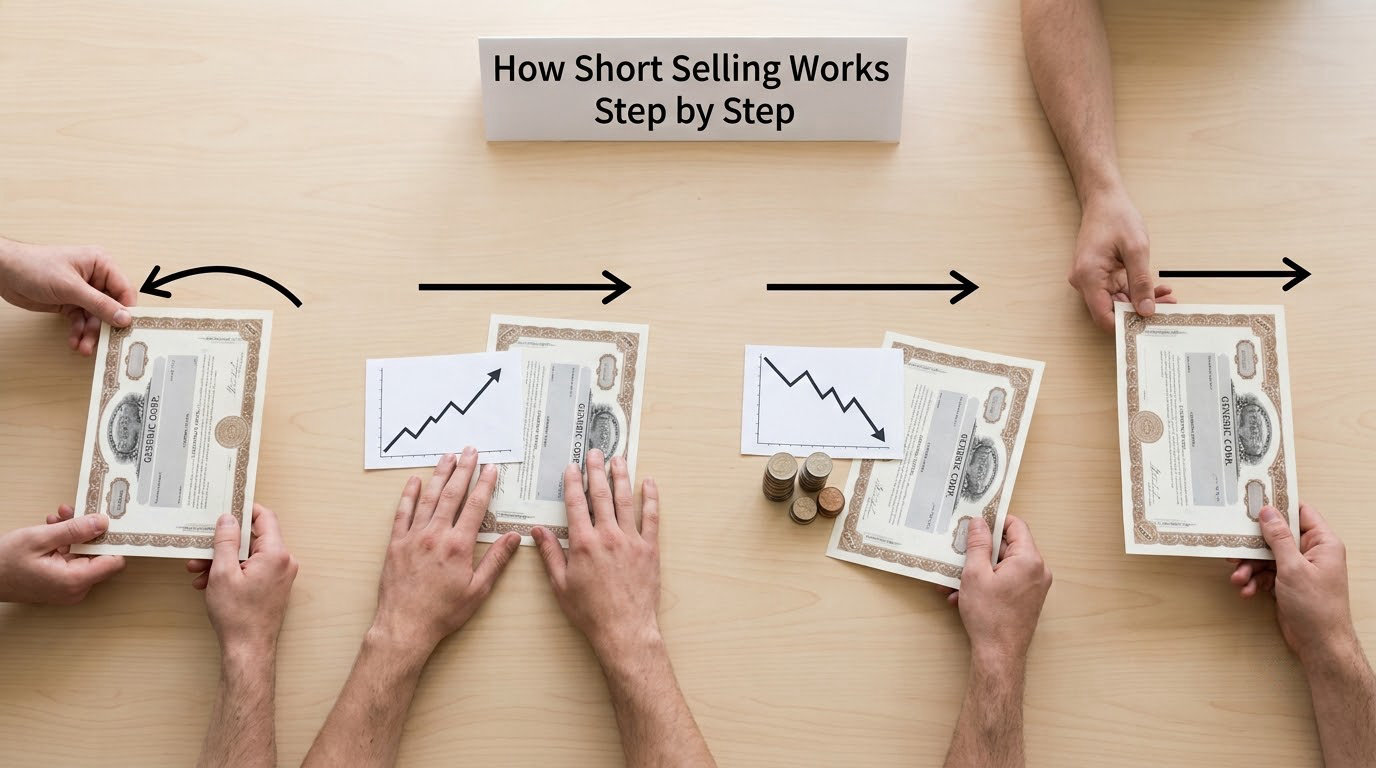
Here is the whole cycle in five moves. Once you have seen it once, the jargon stops being strange.
- Open a margin account. A standard cash brokerage account will not let you sell stock you do not own. Regulators and brokers require a margin agreement, usually signed up in the app or on a form, plus enough cash in the account to act as collateral.
- Choose a security and check it is borrowable. Most large-cap stocks are easy to borrow. Smaller and heavily shorted names can be “hard to borrow” or unavailable entirely, and your broker will simply refuse the order.
- Get a locate. Before the sale can execute, your broker has to confirm that shares are actually available in the lending pool. This confirmation is called a locate. Without one, the sale does not happen, which is why naked shorting, selling shares that have never been borrowed, is banned.
- Place a sell-short order and receive the proceeds. The shares you sold settle like any other sale, so the cash from the sale lands in your account. You now hold cash and an obligation, not a stock.
- Buy to cover, then return the shares. When the price moves your way, you buy the same number of shares in the market with an order labelled buy to cover. That closes the position, and your broker returns the shares to the lender.
On a real order ticket the wording is short: sell short, buy to cover. Nothing else changes. What most beginners find confusing is that the trade has two actions instead of one, so the position stays open until the second one happens.
Borrowed shares come from a chain, not from a friend. Shares sitting in other customers’ accounts at your broker get pooled, and anything left over comes out of institutional lenders’ own books. Your broker is the middleman, and it is the entity that owes you the shares back when you cover.
Why Investors Short Sell
The reason most people look into it is bearish speculation: they think a price is too high and want to profit if it corrects. That is the straightforward case, and the one the rest of this guide assumes.
Hedging is the more sensible use. If you hold a large amount of one stock or sector, buying a short position or a put against it can blunt the damage in a downturn without forcing you to sell the holdings you would rather keep.
Arbitrage and pair trades come next. If two companies trade at related prices and the relationship breaks, you can short the expensive one and buy the cheaper one, aiming for the gap to close rather than for direction.
Event-driven shorting targets a specific date rather than a vague feeling: an earnings report, a regulatory decision, a product recall, a financing round at bad terms. The timeline is known, which makes the holding period and its borrow costs predictable.
Lastly, some investors short to offset gains elsewhere so they can realise losses for tax purposes while keeping the position. The saving depends entirely on their country’s tax rules, and it is worth raising with an accountant rather than assuming.
Short Selling Example: A Profitable Trade and a Losing Trade
Say a stock trades at 100 dollars a share. You want a bearish view and can borrow the shares cheaply. You sell short 200 shares, which brings 20,000 dollars into your account and leaves you owing 200 borrowed shares. Your broker holds part of that cash as margin collateral.
The winning case. The price falls to 80 dollars over the next two months. You buy to cover 200 shares for 16,000 dollars and hand them back to the lender.
20,000 minus 16,000 is 4,000 dollars of gross profit. Now the costs: say 6 dollars of commissions across the four transactions, 80 dollars of borrow fee for the two months at a modest rate, and 90 dollars of margin interest on your collateral over the same period. Net profit lands around 3,824 dollars.
The losing case. Instead the price climbs to 125 dollars. Covering 200 shares now costs 25,000 dollars against 20,000 dollars received, so you are 5,000 dollars down before costs. Adding the same charges puts you near 5,176 dollars of loss, on a position you opened with a deposit far smaller than that.
That asymmetry is the whole story. A 20 percent rise creates a 25 percent loss on the notional value, and a 50 percent rise costs you 50 percent, and a rise to 1,000 dollars per share would cost you ten times the initial sale proceeds. There is no top end to a short position’s loss.
Use the same arithmetic for your own numbers: multiply shares by the sell price for the amount you received, multiply shares by the cover price for what you pay back, and subtract the second figure from the first. That difference, minus costs, is your result.
What Short Selling Costs and Risks
Costs are what turn an obvious-looking trade into a thin one, and beginners usually forget them until the position is already open.
- Stock borrow fee. Lenders charge a daily rate for lending shares, and it varies widely. It can be near zero on a heavily traded large company and jump into double-digit annual percentages on a name that everyone wants to short.
- Margin interest. The cash in your account is collateral, and brokers charge for the privilege of it supporting a borrowed position.
- Commissions and spread. Per-share commissions are small these days, but you trade twice to open and close, and you usually cross the spread on entry and exit.
- Dividends owed. If the company pays a dividend while you are short, the lender keeps it and you pay the equivalent to the lender. Income you never received still costs you money.
- Recall. A lender can demand the shares back at any time. Miss the deadline and your broker closes the position for you, at whatever price the market offers.
The risks go well past the invoice. A margin call arrives when your collateral falls below the maintenance requirement, typically 25 percent of the current market value of the short. Your broker demands more cash or closes the position for you, and the timing is their choice.
A short squeeze is the nastiest version of this. When a large share of a stock is already sold short, buyers pushing the price up trigger margin calls on every one of those positions. Each forced buyer adds to the rally, which triggers more calls. Volkswagen in 2008 and GameStop in 2021 both produced violent moves of this kind.
There is also gap risk. A company can announce a merger, a drug result or an accounting fraud before the market opens, and your stop order will not protect you. You buy back at the new price, whatever it is.
It is worth repeating the framing that shows up in most beginner trading forums: this is a leveraged position on something you do not own, in a direction with no floor. The mechanics are simple and the risk profile is not.
How to Manage Risk When Short Selling
Risk control matters more here than the trade idea, because the idea can be right and the account still end up liquidated. A few principles carry most of the weight.
Size the position against the loss, not the gain. Decide the maximum you are willing to lose if the trade goes fully against you, then size so that a large adverse move hits that number rather than your whole balance.
Set the exit before you enter. Know the price that proves you wrong and the price that banks the gain. A trader who picks both before opening does not have to think while the position is moving.
Keep the exit honest. Cancelling a stop because you dislike the loss converts a controlled risk into an open-ended one. That single habit ruins more short positions than bad analysis does.
Watch the borrow before the chart. A high borrow rate tells you the crowd is already leaning your way, and it eats the profit while you wait.
Avoid concentrating. Shorting one small, thinly traded company puts your position in the hands of whatever happens to be its next news item.
Check the account rules. Brokers set their own margin requirements above the regulatory minimum, they can change them without much notice, and some will not lend a particular name at all.
And have an exit for time. A thesis that was supposed to play out in a month and has not is costing you borrow fees and margin interest every day it stays open.
How Short Selling Differs From Selling Stocks You Own
Selling a stock you hold is the end of an ownership relationship. Shorting is the start of a debt relationship, and every other difference follows from that.
When you sell shares you own, you simply no longer hold them, the cash is yours to do as you like, and no one can call on you later. When you sell shares you borrowed, the cash is provisional, the shares are owed, and the loan can be recalled.
| Short position | Long position |
|---|---|
| You do not own the shares | You own the shares outright |
| Profit when the price falls | Profit when the price rises |
| Requires a margin account and a locate | Tradable in a cash account |
| Sale proceeds are collateral, not savings | Sale proceeds are yours |
| Must be bought back and returned | Nothing owed after the sale |
| Loss has no theoretical limit | Loss stops at what you paid |
| Borrow fee and margin interest accrue | No borrowing cost |
| Dividends paid to the lender instead | You receive dividends |
Settlement works the same way for both, which surprises some people. A sale settles on a set cycle after the trade, and short positions are no exception; your obligation to return shares exists from the moment the sale settles, not from the moment you choose to close.
Tax and Account Considerations for US Investors
US rules for short positions are specific enough that most self-directed investors need a tax professional at least once. The broad shape is this.
A short sale is not a sale of property you own, so it does not generate the usual gain-or-loss treatment at the point of the short sale. Instead the position is generally treated as open, and the outcome is settled when you cover it: the difference between what you sold for and what you paid to buy back determines whether you have a gain or a loss, and how long you held the position determines how it is taxed.
Because covering closes a position rather than opening one, holding periods work differently than most people expect, and the ordinary long-term versus short-term split does not map onto short sales the way it does onto normal investing. Many short positions are taxed at short-term rates. Futures and options contracts that qualify as section 1256 contracts are marked to market and taxed on a 60/40 basis, which is a different regime again.
Your broker reports this on Form 1099-B once the position is closed, and wash sale rules apply to the shares used to cover, so buying the same stock soon after covering can affect deductions you were expecting.
Account rules matter as much as tax ones. Regulators set the minimum initial margin for a short position at 50 percent of the sale value and the maintenance margin at 25 percent of the current value, while most retail brokers require more. Interest charged on margin above the required amount may be tax-deductible, and whether it is depends on how you use the account.
Rates and thresholds change, and none of this applies outside the US in the same form. Confirm your own treatment with a qualified tax adviser before filing.
Frequently Asked Questions
How does short selling make you money?
You borrow shares, sell them, and later buy the same number back to return to the lender. If the price has fallen in the meantime, you buy for less than you sold for and pocket the difference. Subtract the borrow fee, margin interest, commissions and any dividends you owed to the lender to see what you actually earned.
Can a normal person short sell a stock?
Yes, but not in a standard cash account. US rules require a margin account, which means signing a margin agreement and keeping enough cash in the account as collateral. You also need the broker to locate borrowable shares, and many names, especially small ones, are not available to borrow at all.
Is shorting basically gambling?
Not as a description of the odds, though the risk profile is harsher than most betting games. You are making an informed directional bet, and a correct thesis can still be closed out by a margin call or a bad overnight news gap. The difference from a casino is that the downside is genuinely open-ended while the upside is capped by the starting price.
Who loses money in short selling?
The long buyer on the other side of your trade. Every short sale has an offsetting buyer who expects the price to rise, so a short seller profits precisely when that view proves wrong. Losses can also land on the broker if it lends shares that get recalled at a bad moment, which is why lenders limit how much of a float they will supply.
How long can you keep a shorted stock?
There is no fixed limit in the rules, and some positions are held for years. What stops a short seller is economics rather than regulation: the borrow fee and margin interest accrue every day, and lenders can recall the shares at any time. A thesis that was supposed to resolve within weeks usually stops making sense once those running costs pile up.
Conclusion
In short, how short selling works comes down to four verbs: borrow, sell, buy back, return. You profit when the price falls enough to clear the borrow fee, the margin interest and the spread between the bid and the ask, and you lose without limit when it rises.
The first thing a beginner should do is not open a short position. It is read their own broker’s margin and short-selling disclosures end to end, so that the maintenance requirement, the fee schedule and the recall policy are familiar before any money is at stake.
This is general educational information about how a mechanism works. Rules, tax treatment and rates differ by country and state and change over time, so check current details with your broker and a tax professional before acting.