
A personal loan is a lump sum of money you borrow from a bank, credit union, or online lender and pay back in fixed monthly installments over a set term, usually one to seven years. Understanding how personal loans work means knowing what the lender checks, what APR really includes, and what your payment covers each month.
The short version: you apply, the lender reviews your finances, you sign the terms, the money lands in your account as one lump sum, and you repay it on a fixed schedule until the balance hits zero. Interest starts accruing after the funds are disbursed, not the day you apply.
Table of Contents
- What Is a Personal Loan?
- How Personal Loans Work From Application to Payment
- What the Lender Looks At Before Approving You
- Understanding Interest, APR, and Loan Fees
- Secured vs. Unsecured Personal Loans
- How to Calculate Your Monthly Payment
- What Happens If You Miss a Payment
- Personal Loans Compared With Other Borrowing Options
- Questions to Ask Before Signing a Loan Agreement
- Frequently Asked Questions
- Does taking a personal loan affect my credit score?
- Can I pay off a personal loan early without a penalty?
- How fast can I receive money from a personal loan?
- Do personal loan lenders report payments to the credit bureaus?
- Can I use a personal loan to pay off credit card debt?
- Conclusion
What Is a Personal Loan?
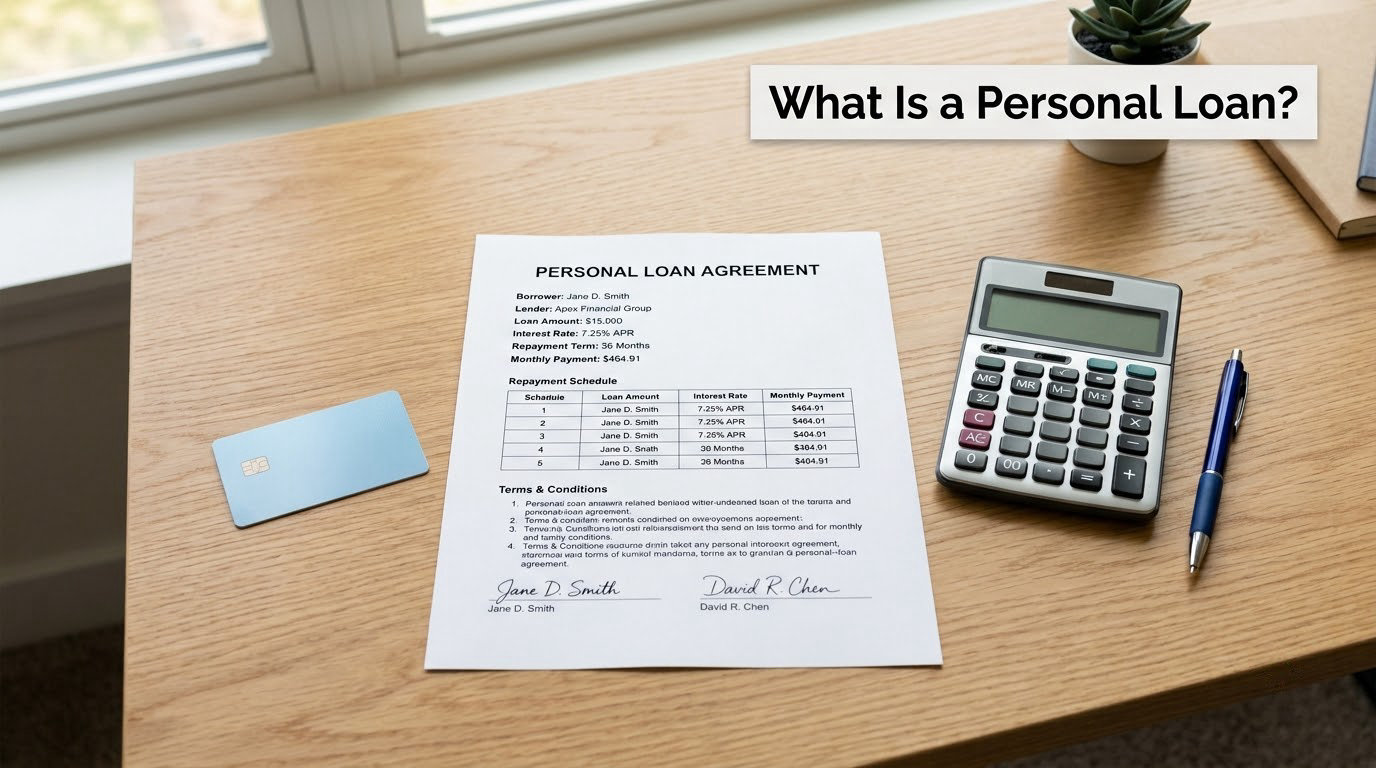
A personal loan is an installment loan. You receive a single amount, and you pay it back in equal payments that cover both principal and interest. There is no revolving balance, no monthly interest charge, and no penalty for paying early unless your agreement includes a prepayment penalty.
Most personal loans are unsecured, which means no collateral backs them. The lender is taking on risk, so it prices that risk into the rate. If you default, the lender has to pursue collection rather than simply repossess something.
That is the main difference from a credit card. A card is revolving credit: you get a limit, you borrow some or all of it, and interest compounds on the balance you carry. A personal loan is closed-end credit: a fixed amount, a fixed schedule, a defined end date. If you only need a few hundred dollars, a card or a small line of credit is usually a cheaper tool than opening an installment loan.
Common borrowers use the funds for debt consolidation, medical bills, home repairs, moving costs, funerals, major purchases, or smoothing out an uneven stretch of income. Payday-style loans solve a similar short-term problem but at radically higher cost: the Consumer Financial Protection Bureau has cited payday pricing that works out to roughly 400% APR on a two-week loan, where a personal loan typically lands in the single digits to low twenties.
How Personal Loans Work From Application to Payment
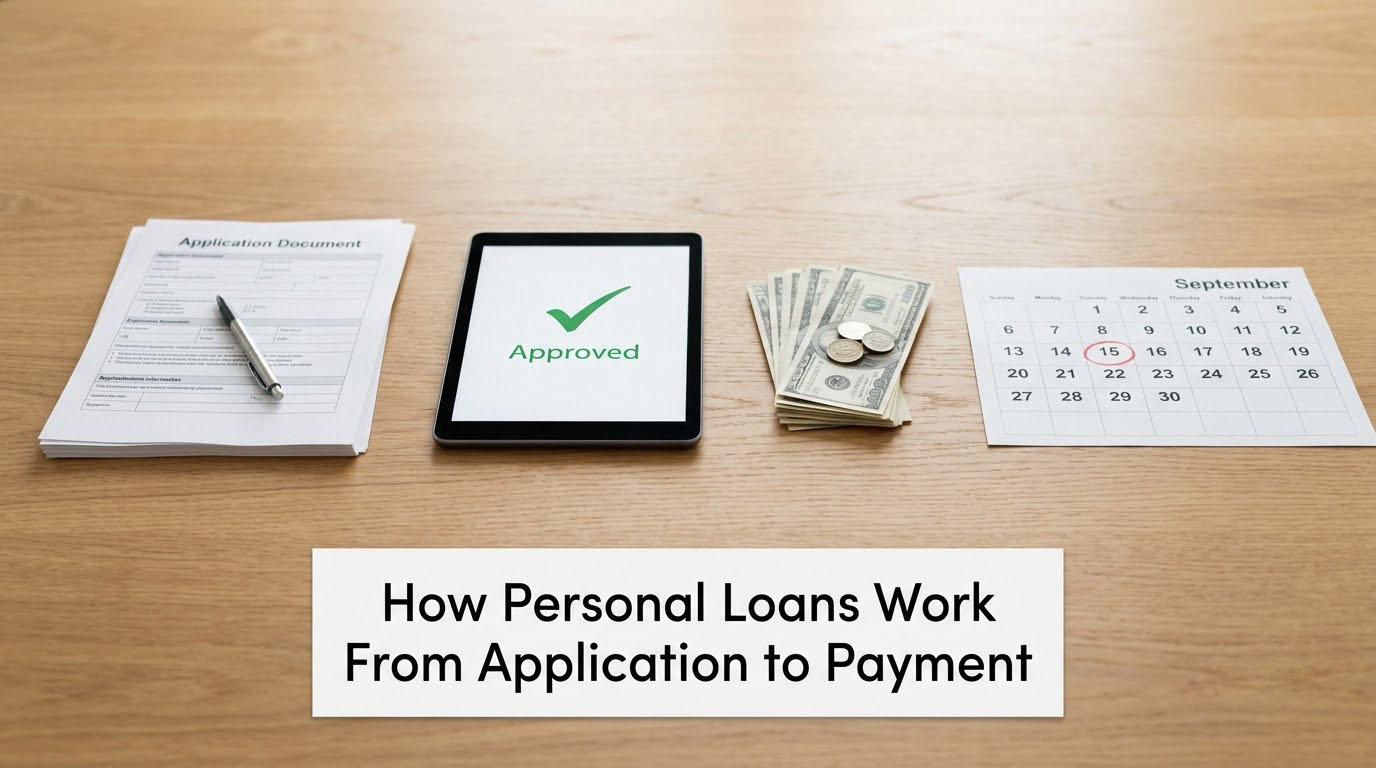
The lifecycle runs in four steps, and each one has a document or a decision attached to it.
- Apply. You submit an application with your income details, identification, and the amount and purpose of the loan.
- Qualify. The lender reviews your credit history, income, existing debts, and the amount you asked for, then decides whether to approve, decline, or counter with different terms.
- Get funds. Once you accept and sign, the lender disburse the money directly to your bank account, often the same or next business day.
- Repay. You make fixed monthly payments covering principal and interest until the loan is fully paid off.
One detail trips people up: interest does not start accruing while your application is being reviewed. It starts when the money is disbursed. If you are approved for 10,000 dollars and your agreement carries an origination fee of 5 percent, the amount that actually lands in your account is 9,500 dollars while your repayment is still calculated on 10,000.
What the Lender Looks At Before Approving You
Underwriting varies by lender, but six factors show up nearly every time.
- Credit history. Payment record on past and current accounts, length of those accounts, and any collections or public records. There is no universal minimum score; some lenders serve borrowers building thin files, and they price that risk higher.
- Income verification. Most lenders ask for recent paystubs and confirm employment directly with your employer. Self-employed borrowers usually submit tax returns and tax transcripts instead.
- Debt-to-income ratio. Your monthly required debt payments divided by your gross monthly income. The Consumer Financial Protection Bureau suggests keeping total obligations at or below roughly 36 percent of income, and approval gets difficult for many lenders once you pass 50 percent.
- Employment stability. How long you have worked for your current employer and how stable that industry is.
- Existing balances. Credit card utilization and whether you are already close to your limits.
- Amount and purpose. The size you request has to match your income, and some lenders restrict what the money may be used for, including education costs at certain institutions.
Prequalification uses a soft credit inquiry, which does not affect your score. The formal application triggers a hard inquiry. On r/personalfinance the most repeated concern was not the hard pull itself but not knowing which step caused it, so ask directly which check a lender is running before you submit anything.
Understanding Interest, APR, and Loan Fees
The interest rate is the price of borrowing the money. The annual percentage rate is that rate plus the cost of certain fees, expressed as a yearly percentage, and it is the only number you can compare across lenders honestly. A 6.5 percent loan with a 300 dollar origination fee on a 2,500 dollar loan is not a 6.5 percent deal.
Rates and terms vary by lender, your credit profile, your state, and where the market is that month. Advertised personal loan rates commonly sit somewhere around 8 to 36 percent APR, with the lowest rates going to borrowers with high scores and short credit histories.
Here is what common loan amounts actually cost per month, using an amortized repayment schedule with no extra fees.
| Loan amount (USD) | APR | Term | Monthly payment | Total repaid | Total interest |
|---|---|---|---|---|---|
| 5,000 | 8% | 3 years | 157 | 5,640 | 640 |
| 5,000 | 8% | 5 years | 101 | 6,083 | 1,083 |
| 5,000 | 12% | 3 years | 166 | 5,979 | 979 |
| 5,000 | 12% | 5 years | 111 | 6,673 | 1,673 |
| 5,000 | 18% | 3 years | 181 | 6,507 | 1,507 |
| 5,000 | 18% | 5 years | 127 | 7,618 | 2,618 |
| 10,000 | 8% | 3 years | 313 | 11,280 | 1,280 |
| 10,000 | 8% | 5 years | 203 | 12,166 | 2,166 |
| 10,000 | 12% | 3 years | 332 | 11,958 | 1,958 |
| 10,000 | 12% | 5 years | 222 | 13,346 | 3,346 |
| 10,000 | 18% | 3 years | 361 | 13,013 | 3,013 |
| 10,000 | 18% | 5 years | 254 | 15,235 | 5,235 |
| 30,000 | 8% | 3 years | 940 | 33,841 | 3,841 |
| 30,000 | 8% | 5 years | 608 | 36,497 | 6,497 |
| 30,000 | 12% | 3 years | 996 | 35,873 | 5,873 |
| 30,000 | 12% | 5 years | 667 | 40,039 | 10,039 |
| 30,000 | 18% | 3 years | 1,084 | 39,040 | 9,040 |
| 30,000 | 18% | 5 years | 762 | 45,706 | 15,706 |
Read the table by row, not column. A 10,000 dollar loan at 12 percent over five years costs 3,346 dollars in interest. Over three years it costs 1,958 dollars, a savings of roughly 1,388 dollars for 110 dollars more per month. Longer terms almost always mean more total interest, and lenders frequently quote a higher rate for the longer term anyway.
Three fees show up most often.
- Origination fee. Usually 1 to 8 percent of the loan, sometimes higher, and deducted from the amount disbursed. A 5 percent fee on a 10,000 dollar, 12 percent, five-year loan costs you 222 dollars a month but hands you only 9,500 dollars of usable money, which pushes the effective cost of the money you actually received to roughly 14.2 percent APR.
- Late payment fee. Often a flat amount plus a percentage of the payment, charged on any payment received after the due date.
- Prepayment penalty. A fee for paying the loan off early. Some lenders charge none, some charge a percentage of the balance, and some only penalize during a set introductory period.
Interest on a personal loan is generally not tax deductible. The narrow exception is interest on a refinanced student loan, treated separately under federal tax rules.
Secured vs. Unsecured Personal Loans
| Factor | Unsecured personal loan | Secured personal loan |
|---|---|---|
| Collateral | None | An asset you pledge, such as a vehicle or savings account |
| Interest rate | Higher, since the lender carries the risk | Lower, since the lender has recourse to the asset |
| Approval odds | Harder, credit and income carry more weight | Easier, the asset does much of the work |
| If you default | Collection efforts, possible judgment, wage garnishment | The lender can repossess or seize the pledged asset |
| Best suited for | Debt consolidation, medical bills, repairs, large purchases | Borrowers with limited credit who have a valuable asset to pledge |
| Approval amount | Often limited by income and debt-to-income | Often tied to the value of the collateral |
The practical consequence of unsecured borrowing is that defaulting does not hand the lender your car, but it does not mean nothing happens. Late payments get reported, balances get sold to collections agencies, and in some states a court judgment can lead to wage garnishment. Securing a loan lowers your rate at the cost of risking the asset.
How to Calculate Your Monthly Payment
Every installment loan is paid back using amortization. Your payment stays the same each month, but its internal split changes: early payments are mostly interest, later payments are mostly principal, and by the final payment you are paying almost entirely principal.
The formula divides the principal by a factor built from three inputs: the monthly interest rate, which is the APR divided by twelve; the number of payments, which is the term in months multiplied by twelve; and a discount applied across those payments. Most people never need the exact math. A payment calculator, a lender’s own estimator, or a spreadsheet with the PMT function does it in seconds.
Worked example: a 10,000 dollar loan at 12 percent APR over five years.
- Monthly rate is 1 percent, and the term is 60 payments.
- The payment comes to 222.44 dollars, so you repay 13,346 dollars in total.
- Total interest is 3,346 dollars over the life of the loan.
- Month one: about 100 dollars of interest and 122 dollars of principal. Month fifty-nine is almost entirely principal.
Paying extra principal cuts future interest rather than future interest rates. If you added 50 dollars a month to that same loan, you would retire it in about four years and save several hundred dollars in interest. Extra payments are usually applied to principal and future interest first, but some agreements restrict prepayment or charge a penalty, so check the prepayment clause before you start. Some lenders also require you to call and designate a payment as extra principal, otherwise it is applied to the next scheduled installment.
What Happens If You Miss a Payment
The consequences arrive in a rough order, and early action matters at each stage.
- Late fee. A flat charge or a percentage of the missed payment, usually assessed once the payment passes the due date. Many lenders also penalize a returned automatic payment.
- Credit reporting. A 30-day late payment can appear on your credit report, typically for seven years. One isolated late is damaging. A pattern of them is far worse.
- Default. After several missed payments or a breach of terms, the loan is in default. The lender may demand the full balance immediately, at which point the amount you owe can be much larger than your remaining installments because fees and interest have stacked up.
- Collection activity. The lender may sell the debt to a collections agency, which can contact you and report the account. Limits on what collectors may say and how often they may call are set by federal law.
- Legal action. In some states a lender can obtain a judgment, and a wage garnishment order or bank levy can follow.
If you are heading toward a missed payment, call the lender before the due date, not after. Restructuring, interest-only periods, a temporary forbearance after a job loss, or a revised term are all options some lenders offer, and whether they will offer one depends on the lender and your circumstances. Do not assume a refinance is available to you or that it will be cheaper.
Scam warning signs belong in this section because fraud targets exactly the people already stressed about money. Red flags include any upfront payment demanded before funds are released, guaranteed approval for anyone, a lender that will not name its fees, pressure to act immediately, and requests to wire money or pay in gift cards. Legitimate lenders do not charge you to give you a loan. Check whether the lender is licensed in your state and read its complaint record before you sign.
Personal Loans Compared With Other Borrowing Options
| Option | Collateral | Typical term | Payment structure | Credit impact | Main risk |
|---|---|---|---|---|---|
| Personal loan | Usually none | 1 to 7 years | Fixed monthly installment, closed at payoff | Hard inquiry plus on-time payment history | Total interest can run into thousands over five years |
| Credit card | None | Revolving, no set end | Minimum payment plus interest on the balance | Utilization and payment history drive the score | Interest compounds and revolving balances can persist |
| Auto loan | The vehicle, with a lien on the title | 3 to 7 years | Fixed monthly installment | Installment account builds payment history | You owe on a depreciating asset and repossession risk exists |
| Home equity loan or HELOC | Your home | 10 to 30 years, or a revolving draw period | Fixed installment or variable draw as needed | Treated like other installment debt on the report | The house secures the debt, and variable draws can climb |
| Payday-style loan | None, but a postdated check may be required | One to two weeks, renewable | One large payment covering fee plus principal | Short-term high-cost lending, often reported to bureaus | Extreme APRs and a debt spiral if it rolls over |
None of these is automatically better. A personal loan fits a mid-sized lump-sum need you want repaid and finished on a fixed date; a card fits smaller, flexible spending you can pay off in full; a HELOC fits ongoing home expenses; a payday loan fits almost nothing at a cost that punishes you for needing it.
Questions to Ask Before Signing a Loan Agreement
Work through this list with the lender before you accept anything. It takes five minutes and it is the difference between a good offer and an expensive one.
- What is the APR, and what fees are included in that number?
- Is the interest rate fixed or variable, and can the rate change during the term?
- What is the monthly payment, and what is the total amount I will repay in dollars?
- What fees apply: origination, late, returned payment, or early payoff?
- Is there a prepayment penalty, and does it expire after a set period?
- How long is the term, and what happens to the payment if the loan goes into default?
- Does the lender report to the credit bureaus, and how are late payments handled?
- Are extra payments applied to principal, or do I need to request that in writing?
- What is the total cost of borrowing in dollars, and how does it compare with my other offers?
- Is the lender licensed in my state, and what does its complaint history look like?
Two habits pay off more than anything else here. Prequalify with three to five lenders before you submit a full application, since prequalification usually uses a soft inquiry and costs nothing. And compare on APR plus total repayment, never on the monthly payment alone, because a lender can always make a loan look affordable by stretching the term.
Frequently Asked Questions
Does taking a personal loan affect my credit score?
Yes, but the effect is usually temporary and can end up positive. Applying causes a hard inquiry, which may dip your score slightly, and the new account lowers your credit utilization ratio, which can also push the score down for a few months. From there, every on-time payment builds history that a scorecard rewards, so many borrowers see their score climb above where it started within a year of repaying the loan. Missing payments reverses all of that quickly.
Can I pay off a personal loan early without a penalty?
It depends on your agreement. Many lenders charge no prepayment fee at all, some charge a percentage of the remaining balance, and others only charge during a set introductory period. Check the prepayment clause before you sign rather than after you have made extra payments. When there is no penalty, paying down principal early reduces the interest that accrues on the balance, so any extra dollars go straight toward cheaper borrowing.
How fast can I receive money from a personal loan?
It depends on the lender and how you apply. Online lenders that approve you automatically often fund the same business day or the next one, while a bank or credit union that requires branch verification or a mailed signature can take several business days. Interest starts accruing at disbursement, not at approval. The best way to keep it fast is to have identification, recent paystubs, and income details ready before you start the application.
Do personal loan lenders report payments to the credit bureaus?
Most do, and that reporting is the point of taking out the loan. On-time installment payments are reported as a positive payment history, which builds your credit over the life of the loan. Late payments of 30 days or more are also reported and stay on your credit report for about seven years. If a lender does not report, you gain nothing from the account itself, though you still benefit from having paid the debt off.
Can I use a personal loan to pay off credit card debt?
Yes, this is called debt consolidation and it is the most common use for personal loans. You take one lump sum, pay off the card balances, and make one fixed monthly payment instead of several. It helps most when the new rate is meaningfully lower than your card APR and you do not run the balance back up. It also costs less than most cards only if you pay the loan off, since the longer term can outweigh a lower rate.
Conclusion
How personal loans work comes down to three things: you get one lump sum, you repay it on a fixed schedule, and you pay interest plus fees for the privilege. Everything else, from underwriting to origination charges, is detail around those three facts.
Before you apply anywhere, get three to five prequalifications, then compare offers on APR, fees, term, and total repayment in dollars. Read the prepayment clause and the default section as carefully as the rate. And use a licensed lender that will name its fees up front, because any request for money before the funds arrive is a scam.
This is general information, not financial advice. Rates, rules, and protections differ by state and change over time, so confirm the specifics of any offer with the lender and with a qualified adviser before you sign.