
APR is what you pay to borrow money, with fees folded in. APY is what you earn on money you have saved or invested, with compounding folded in. When you compare loans, look at the APR; when you compare savings accounts, certificates of deposit or investment returns, look at the APY.
If you have ever compared two bank accounts by the small number in the fine print, you already know the trap. Both accounts advertise a rate, and the two rates are not measuring the same thing, which is why apr vs apy explained matters more than it sounds. One number tells you what leaves your account each year; the other tells you what arrives.
This guide covers what each rate includes, why the APY on a savings account is always at least as high as the rate printed above it, how to read a real disclosure line from a bank, and which figure to check before you sign anything. Rates change as the economy moves, so treat the numbers below as worked illustrations rather than quotes to shop on. Nothing here is personal financial advice.
Updated for 2026 to reflect current US disclosure conventions.
Table of Contents
- APR vs APY Explained at a Glance
- What Is APR?
- APR is not the same as the interest rate
- Where you will see an APR
- What Is APY?
- Why APY can sit above the rate printed next to it
- APR vs APY: What Is the Difference?
- Purpose and direction
- What gets counted
- Compounding, stated properly
- Which one wins for each job
- How APR Is Calculated
- A simple APR illustration
- How APY Is Calculated
- Why 1 percent a month is not 12 percent a year
- How to Read a Savings Account Disclosure Line
- APR vs APY Examples
- Example one: 10,000 dollars at 4 percent APY
- Example two: the same balance at two credit card APRs
- Example three: two personal loan offers
- What Counts as a Good APR or APY?
- Which Rate Should You Look At?
- APR and APY outside ordinary banking
- Frequently Asked Questions
- Why is APY usually higher than APR?
- Is APR or APY better for comparing savings accounts?
- Why does a credit card show an APR instead of an APY?
- Are APR and APY the same as interest rates?
- Does a higher APY always mean a savings account is better?
- Can APR or APY change after I open an account?
- The Key Difference to Remember
APR vs APY Explained at a Glance
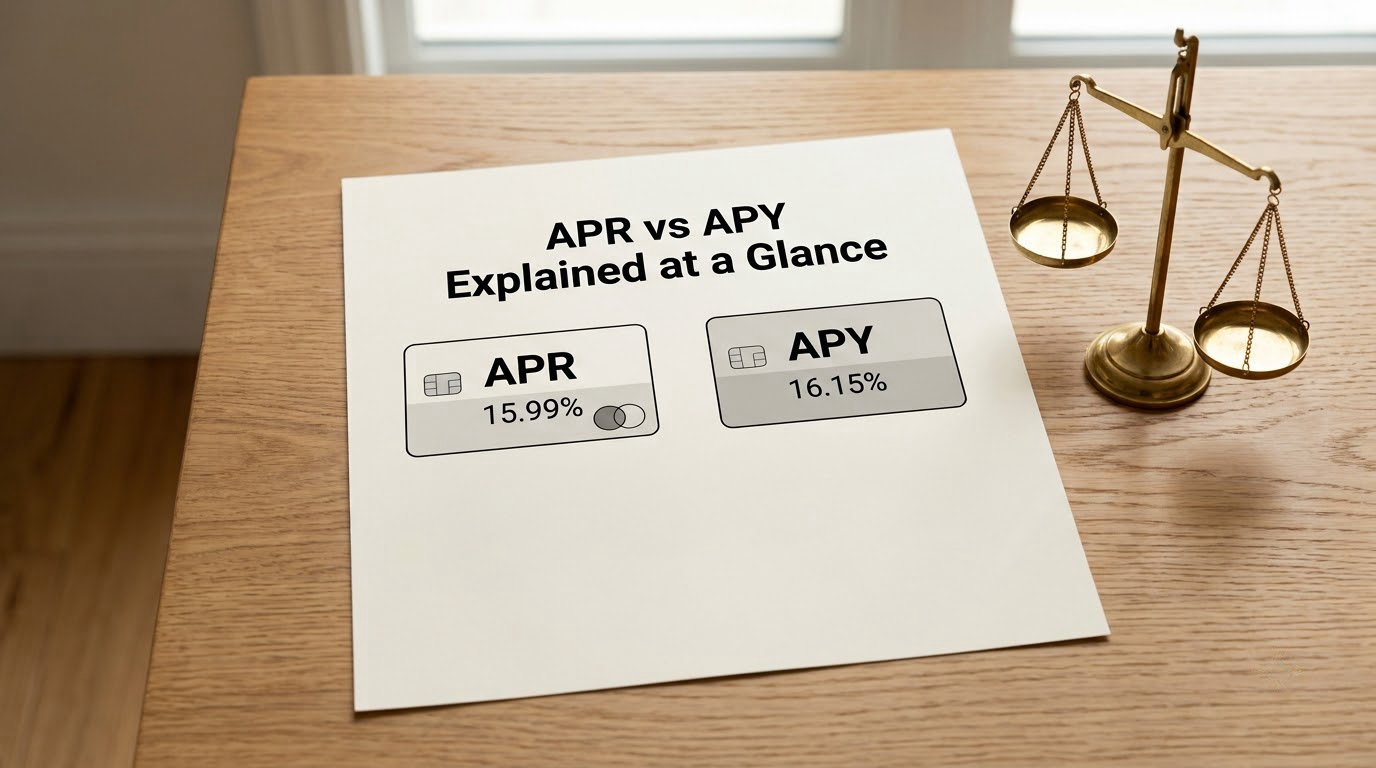
APR and APY are not two names for the same percentage. APR standardises the cost of borrowing, APY standardises the return on a deposit or an investment, and the two move in opposite directions from your point of view.
| What to compare | APR (annual percentage rate) | APY (annual percentage yield) |
|---|---|---|
| Direction of money | Leaves your account | Arrives in your account |
| What it measures | The yearly cost of borrowing | The yearly return on your balance |
| Fees included | Yes, certain mandatory fees such as origination or closing costs | No. Fees reduce the return and are not baked in |
| Compounding | Already built into the annual figure on most modern products | Always built in, which is why APY sits above the stated rate |
| Typical products | Credit cards, personal loans, auto loans, mortgages, HELOCs | Savings accounts, CDs, money market accounts, IRAs |
| Which direction is good | Lower is better | Higher is better |
| Common alias | Annualised cost of borrowing, note rate plus fees | Effective annual rate, or EAR |
The same difference shows up as four quick contrasts, and the framing matters more than the jargon.
- Direction of money: APR is money going out toward a lender. APY is money coming in from a bank or an investment.
- Fees included: APR folds in certain mandatory fees. APY does not fold in fees, so an account fee quietly cuts your real return below the advertised yield.
- Compounding interest: APY always reflects compounding. APR reflects it too on most modern consumer products, which is why the old claim that an APR simply ignores compounding is wrong.
- Which one to look at: Use APR when you compare two lenders. Use APY when you compare two places to park your savings.
What Is APR?
APR, the annual percentage rate, is the standardised yearly cost of borrowing money expressed as a percentage. It is designed so that two loans with different rates and different fees can be compared with one number, which is its entire purpose.
APR is not the same as the interest rate
A loan carries a note rate, sometimes called the interest rate, and that is the number applied to your balance to work out the interest. The APR is broader. It takes the note rate, annualises it across the loan term, and adds the fees the Truth in Lending Act requires lenders to count, such as origination charges, mortgage closing costs, points and some insurance or assumption fees.
Two loans can carry the same note rate and still land on different APRs. That gap is exactly what a lender comparison is supposed to expose.
Where you will see an APR
APR shows up on credit card statements, personal loan offers, auto loan disclosures and mortgage Loan Estimates. Credit card APRs are typically variable, so they can move with the prime rate after a promotional period ends. Promotional or teaser APRs, often 0 percent for a balance transfer or a purchase, last only for a stated window, and the regular APR applies to whatever remains when it ends. Reading only the promotional figure is one of the most expensive mistakes in personal finance.
Credit cards also have a grace period, which is the stretch at the end of your statement period during which you can pay the balance in full without interest. The grace period has nothing to do with the APR itself; it only determines whether that APR charges you at all on a given balance.
What Is APY?
APY, the annual percentage yield, is the standardised yearly return on a balance, expressed as a percentage. It tells you what your money actually earned over a year once compounding is counted, which is why the financial world also calls it the effective annual rate.
Every savings account disclosure in the US has to state an APY alongside the interest rate, and so does every certificate of deposit. Money market accounts and IRAs publish the same figure. That is not a marketing flourish. It is a regulatory promise that you can compare any two accounts on one honest scale.
Why APY can sit above the rate printed next to it
Compounding is the reason. When interest is added to your balance and then earns interest itself, your money starts working twice. The more often that happens, the more your effective return exceeds the simple rate. A bank that credits interest every day gives you a slightly higher APY than one that credits it once a month on the same stated rate.
That gap is small on a low-rate account and visible on a high-rate one, but it always points the same direction: the APY is equal to or higher than the nominal rate on the same account. Never lower, for a deposit. If you ever see an APY printed below the stated interest rate, that account charges you fees, and the APY is the honest number.
APR vs APY: What Is the Difference?
The difference is not really about mathematics. It is about which side of the transaction you sit on and which costs are counted inside the percentage.
Purpose and direction
APR exists to standardise borrowing costs so lenders can be compared. APY exists to standardise deposit earnings so banks can be compared. One is a cost line in your budget, the other is income in your budget.
What gets counted
APR counts the interest plus certain fees the law requires, which is why a loan with points or an origination fee can carry a higher APR than a nearly identical loan with no upfront charges. APY counts the interest and the compounding but not fees. Account maintenance fees, minimum balance shortfalls and withdrawal limits sit outside the APY and come straight out of what you keep.
Compounding, stated properly
A lot of older explainers say APR ignores compounding and APY includes it. The reality is narrower. APY always includes compounding by definition. APR for consumer credit cards and most modern instalment loans already builds in the periodic compounding, which is why a credit card APR is often higher than a bank note rate printed with the same digits. The quote you are more likely to see for a no-compounding figure is a bond yield or a Treasury bill discount rate, and that is a different instrument entirely.
Which one wins for each job
On a loan, APR wins because it is the number that accounts for the whole cost. On a deposit, APY wins because it is the number that accounts for the whole return. Comparing an APR to an APY tells you nothing except that one loan cost more than one account paid.
How APR Is Calculated
APR works in two stages. First the lender annualises the note rate across the whole term, because a rate quoted per month is not the same as a rate quoted per year. Then the lender spreads certain mandatory fees across that same term and folds them into the percentage.
Mortgage lenders do this with a standard formula set by federal regulation, and the result is printed on the Loan Estimate as a percentage in the three-payment row. Personal loan and auto lenders use comparable methods, though the fee items they are required to include are not identical across loan types. A lender can also round the figure, so two offers that differ by a fraction of a percent may be effectively the same.
A simple APR illustration
Take two personal loan offers, both for 10,000 dollars over three years. Offer A quotes a note rate of 6.50 percent with a 5 percent origination fee. Offer B quotes 7.25 percent with no origination fee and nothing else to add.
The monthly payment on Offer A comes to roughly 306 dollars, so you repay about 11,024 dollars across 36 payments. Subtract the 500 dollar fee and the real cost is closer to 1,524 dollars on 10,000 dollars borrowed, which puts the APR at approximately 6.6 percent. Offer B has no fees, so its APR is essentially its note rate of 7.25 percent.
The lower note rate carries the higher APR. Nobody is hiding anything here; both lenders are reporting exactly what the disclosure asks of them. If you had sorted these two offers by the small number, you would have picked the wrong loan.
How APY Is Calculated
APY starts from the periodic rate, which is the stated rate divided by the number of compounding periods in a year. It then applies that periodic rate across every period of a year, which is where compounding enters.
The relationship is written as APY equals one plus the periodic rate, raised to the number of periods in a year, minus one. Divide the stated rate by the number of compounding periods to get the periodic rate, then count the periods.
Daily compounding gives 365 periods. Monthly gives 12. Quarterly gives 4. Annually gives 1, and with one period the APY equals the stated rate exactly, because nothing has had time to compound.
Why 1 percent a month is not 12 percent a year
This is the question that trips people up most often, and it turns up constantly on personal finance forums. Take 1 percent of your balance every month, then compound that return for twelve months, and you end up with roughly 12.68 percent, not 12 percent. The extra 0.68 points come from the months where you earned interest on interest you had already earned.
Set it against a bank note rate of 3.3481 percent compounded daily, which is the rate that appears on the disclosure example below. The same periodic maths produces about 3.40 percent. That 0.05 point gap is not an error in the fine print. It is the whole point of the APY line.
How to Read a Savings Account Disclosure Line
A widely shared personal finance thread features a real disclosure line that confuses most readers: the interest rate on the account is 3.3481 percent with an annual percentage yield of 3.40 percent. The poster had no idea what either figure meant, and plenty of commenters did not either.
Here is how to decode it.
- Find the interest rate. This is the nominal or stated rate, expressed as a percentage. It is what the bank applies before compounding.
- Find the APY right next to it. This is the effective return, guaranteed by the Truth in Savings Act to be accurate.
- Check the compounding frequency. Look for a line such as daily, monthly or quarterly compounding. It explains the gap between the two numbers.
- Do the division. Here 3.3481 divided by 365 gives about 0.00917 percent a day, which compounded over a full year lands at roughly 3.40 percent.
- Look for fees below that. An APY above the stated rate is normal. An APY below it means fees are being subtracted.
Both numbers are correct and neither is a trick. The stated rate tells you how the bank does its math; the APY tells you what you ended up with.
APR vs APY Examples
Example one: 10,000 dollars at 4 percent APY
Put 10,000 dollars into an account paying 4 percent APY and leave it alone. The APY is already the compounded annual return, so growth is simply the previous balance multiplied by 1.04.
| Time | Balance | Interest earned |
|---|---|---|
| Year 1 | 10,407 dollars | 407 dollars |
| Year 2 | 10,831 dollars | 831 dollars |
| Year 3 | 11,273 dollars | 1,273 dollars |
| Year 5 | 12,210 dollars | 2,210 dollars |
| Year 10 | 14,908 dollars | 4,908 dollars |
Notice how the annual interest climbs while the balance stays untouched. In year one the account earns 407 dollars, and in year ten the same account earns about 598 dollars without a single extra deposit.
Example two: the same balance at two credit card APRs
Carry a 3,000 dollar card balance for a year with no payments. At a 15 percent APR, simple annual interest adds about 450 dollars. At a 20 percent APR it adds about 600 dollars. Same balance, same behaviour, roughly 150 dollars more owed at the higher rate.
Real issuers average your daily balance rather than charging on the full balance for the whole year, so the true figure lands a little under these round numbers. Credit card APRs already build in monthly compounding, which is why a card APR rarely looks like the simple annual rate you would calculate by hand.
Example three: two personal loan offers
The two-offer comparison above is the one worth remembering. Offer A had the lower note rate and the higher APR because of the origination fee. Offer B had the higher note rate and the lower effective cost because it carried nothing to add.
Across every product, the pattern is the same. Compare the whole cost, not the small printed number.
What Counts as a Good APR or APY?
Direction comes first: a lower APR is better for anything you borrow, and a higher APY is better for anything you save. Beyond that, benchmarks move with the interest rate environment, so a number that is generous one year can be mediocre the next. Comparing a personal loan APR with a credit card APR, for instance, is meaningless because the risk and the collateral are different.
On the borrowing side, your credit score does most of the work. A personal loan APR offered to a borrower with excellent credit typically lands several percentage points below what the same lender offers a borrower with fair credit. An auto loan APR can differ even more, because lenders reprice heavily on credit history. On a mortgage, points buy down the rate in exchange for cash up front, and the Loan Estimate APR is the only way to see whether that trade was worth it.
On the saving side, a high-yield savings account APY will beat a plain checking APY every time, but the account with the biggest headline APY is not automatically the right home for your money. Minimum balance requirements can push you out of the top tier and into a lower rate. Rates on promotional accounts reset at the end of the term. Withdrawal limits and monthly fees can quietly erase the advantage.
A few practical habits do more than rate-shopping. Automating deposits into an account paying compound interest beats optimising a rate you already have. Moving an old high-rate credit card balance to a lower APR card helps more than waiting for the perfect offer. And checking your existing accounts once a year catches fee changes and rate drops that arrive without announcement.
Which Rate Should You Look At?
Look at the APR when you compare credit cards, personal loans, auto loans, mortgages and HELOCs. Look at the APY when you compare savings accounts, certificates of deposit, money market accounts and retirement accounts. Comparing an APR to an APY tells you nothing useful, because one measures a cost and the other measures a return.
APR and APY outside ordinary banking
The same vocabulary turns up in places where the conventions differ, and knowing that saves confusion.
Treasury bills are quoted on a discount basis rather than as a yield. A 91 day bill with a 5 percent discount rate costs you 100 and pays 101.26 at maturity, a 1.26 percent return over 91 days, which works out to roughly 5.07 percent annualised. The headline number and the actual return are not the same figure, so do not compare a bill discount rate directly against a savings APY.
Bonds quote a yield that depends on whether you hold to maturity or sell early, which is why the yield on the screen is not a guaranteed return.
Crypto staking often quotes an APR that is a simple annualisation of rewards with no compounding, sometimes denominated in a token that can fall as fast as it accrues. Some platforms quote an APY instead, which at least folds in compounding, though it still says nothing about price risk. Treat those figures as marketing until you understand what backs them, and remember that staking income may carry tax obligations in the US.
Bank interest is generally reported to the IRS on a 1099-INT once you clear the reporting threshold, and it is taxed as ordinary income. Investment income has its own reporting forms. None of that changes which number to compare, but it does change what you keep after tax.
Frequently Asked Questions
Why is APY usually higher than APR?
Because they measure opposite things. APR is a borrowing cost that includes fees, and fees only push it up from the note rate. APY is a deposit return that includes compounding, and compounding only pushes it up from the stated rate. On a savings account, APY is always equal to or higher than the interest rate printed beside it.
Is APR or APY better for comparing savings accounts?
APY, every time. It is the only figure that reflects both compounding and the full year of earnings, and federal law requires banks to state it accurately. The interest rate next to it is the raw number before compounding, which is why an account can quote a slightly lower rate yet hand you more money. Compare APYs and then check the fees separately.
Why does a credit card show an APR instead of an APY?
Because a card is a place where money leaves. An APR standardises what a loan costs you, including the interest and any required fees, so lenders can be compared in one place. No credit card is going to quote you a yield on the money you spend. A promotional rate is also shown as an APR, so always check how long it lasts and what applies afterwards.
Are APR and APY the same as interest rates?
No. The interest rate is the raw percentage applied to your balance. APY is that rate plus the effect of compounding, which is why it is always at least as high on a deposit. APR is that rate annualised across the term with certain mandatory fees added, which is why it is usually higher than the note rate on a loan. Rates change over time, so check current figures.
Does a higher APY always mean a savings account is better?
No. A higher APY only describes the return on the balance, not the whole account. Minimum balance requirements, monthly maintenance fees, withdrawal limits and promotional rate resets all sit outside the advertised figure. Read the fee schedule and the tier structure before you open anything, then decide whether the rate advantage survives once the conditions do.
Can APR or APY change after I open an account?
It depends on the product. A credit card APR is usually variable and moves with the prime rate, and a promotional APR reverts to the standard rate when the offer ends. A savings APY can change at any time the bank chooses, though it cannot go below zero on a deposit account. Fixed-rate personal loans, auto loans and most CDs hold their rate for the full term.
The Key Difference to Remember
APY is what you earn on a balance, with compounding counted. APR is what you pay to borrow, with certain fees counted. One line is enough to remember, and it will keep you out of most bad decisions.
Do one thing first. Find the account where your emergency money sits and read the disclosure line: find the APY, find the fee schedule, and check whether a minimum balance or a promo reset is quietly moving the rate you thought you had. Then, the next time a lender sends you an offer, sort the list by APR rather than by the small printed rate.