
If you are working out how to decide between a 15 and 30 year mortgage, the honest answer is that the 15-year costs far less overall while the 30-year costs far less every month. Both are the same fixed-rate contract amortized over a different number of payments. The shorter term comes with a lower rate and a big monthly jump; the longer term keeps the payment manageable and adds roughly twice the interest.
This guide assumes US conventions: a fixed-rate mortgage, principal and interest only unless noted, and rates that vary by lender, borrower profile and state. All figures below are illustrative arithmetic, not quoted offers. Run your own numbers with a 15 vs 30 year mortgage calculator and then check real Loan Estimates before you commit.
Last updated: October 2026
Table of Contents
- How to Decide Between a 15 and 30 Year Mortgage at a Glance
- How the Two Mortgage Terms Work
- Monthly Payment Difference
- Total Interest and Total Cost
- How much lower does the 15-year rate need to be?
- Payment Shock and Refinancing Risk
- Which Mortgage Term Fits Your Situation?
- Frequently Asked Questions
- Is a 15-year mortgage always better than a 30-year mortgage?
- Can I pay off a 30-year mortgage early?
- How much more should I budget for a 15-year mortgage?
- Should I choose a 15-year mortgage if I have an emergency fund?
- Does a 30-year mortgage cost more in interest every time?
- Is refinancing a 30-year mortgage to a 15-year term worth it?
- Conclusion
How to Decide Between a 15 and 30 Year Mortgage at a Glance
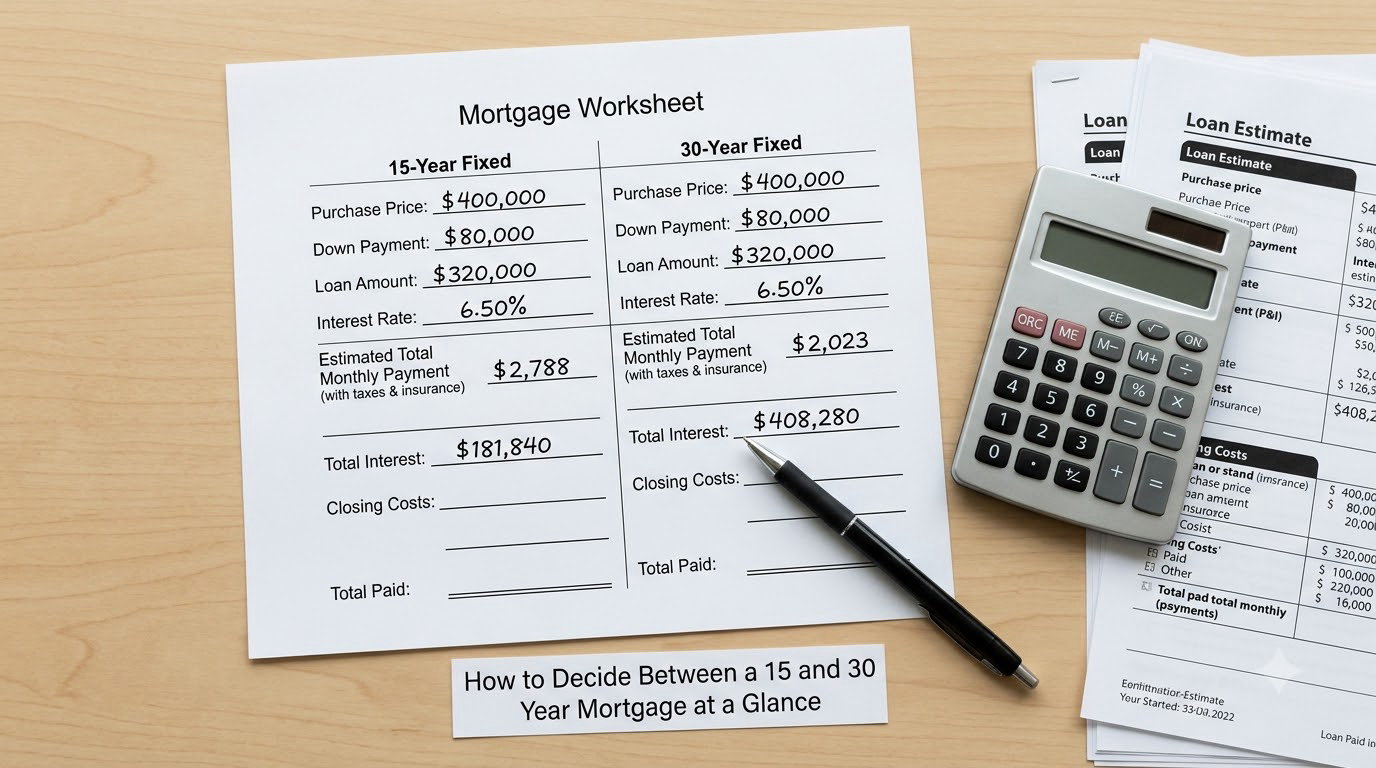
| Factor | 15-year fixed | 30-year fixed |
|---|---|---|
| Example rate on a 400000 loan | 5.50 percent | 6.00 percent |
| Monthly principal and interest | 3,268 | 2,398 |
| Extra per month versus the 30-year | 870 more | 870 less |
| Total interest over the term | about 188,000 | about 463,000 |
| Total paid to the lender | about 588,000 | about 863,000 |
| Principal paid in the first 5 years | about 99,000 | about 28,000 |
| Principal and interest as a share of take-home pay | Comfortable at 20 percent or below | Often lands between 12 and 20 percent |
| Payoff date | 15 years | 30 years, or earlier with extra principal |
| Best fit | Stable income, real reserves, long stay | Variable income, first purchase, uncertain exit |
Those numbers assume the same 400,000 loan at two different rates, which is the realistic way lenders quote it. Change the rate spread and the interest gap moves a lot; the payment gap does not.
Two more things worth knowing up front. First, the choice is not about the house price: a bigger down payment or a bigger loan changes the payment, not the term logic. Second, private mortgage insurance and closing costs are tied to your down payment and credit profile, not to the term. Do not let a lender bundle a term choice with a PMI waiver pitch.
How the Two Mortgage Terms Work
Every mortgage amortizes. Each payment covers interest on the outstanding balance plus a slice of principal, and that principal slice grows while the interest slice shrinks. The contract, the paperwork and the mechanics are identical for a 15-year and a 30-year.
Two things are actually different: the number of payments and the rate lenders charge for the shorter promise. That is why 15-year borrowers typically pay somewhere between a quarter of a point and about three quarters of a point less than 30-year borrowers.
Run the amortization on the example loan and the split explains everything. On the 30-year at 6 percent, the very first payment of 2,398 is mostly interest, with only a small amount going to principal. Five years in, roughly 28,000 of the balance has been retired.
On the 15-year at 5.50 percent, the first payment of 3,268 is already more weighted to principal, and five years in about 99,000 of the balance is gone. Same house, same down payment. The faster the balance shrinks, the less interest ever accrues on it.
Rates move daily and qualifying rules differ by lender and state, so treat every rate here as an example. Check the Freddie Mac Primary Mortgage Market Survey for a weekly benchmark rather than a number from an old article.
Monthly Payment Difference
The 15-year payment on our example runs 870 a month above the 30-year. That is a 36 percent jump on the principal and interest line, and it is the number that decides most of these choices before anyone talks about interest.
Now put it in the whole housing budget. On a 480,000 purchase with 20 percent down, add property tax, homeowners insurance, HOA dues if the community has them, utilities, maintenance and repairs. A sensible rule of thumb in much of the country is to keep all-in housing at or under roughly 30 percent of gross income, or closer to a third if you have no children and no student loans.
Compare the two options against that ceiling, not against the loan amount. The borrower who takes the 15-year and lands at 32 percent of gross has not saved money, they have just moved the risk to a thinner savings account and a more exposed budget. Lenders look at debt-to-income; your job is to look at what is left on payday.
Buyers with commission income, freelance work or a business that has lumpy months have an extra reason to keep the payment low. A 15-year locks a high fixed obligation into fifteen years of income you cannot fully predict. That fear is a legitimate input, not an excuse.
Total Interest and Total Cost
This is where the 30-year stops looking generous. At 6 percent, a 400,000 thirty-year loan carries about 463,000 of interest over its life. The 15-year at 5.50 percent carries about 188,000. On the same loan, roughly 275,000 of difference.
How much lower does the 15-year rate need to be?
The spread matters more than most guides admit. Hold both loans at the same 6 percent rate and the 15-year payment rises to about 3,566, and the interest difference lands near 220,000. At a half-point spread it grows to about 275,000. A wider spread grows it further, because more of the shorter loan’s time is spent on a high balance.
Readers on r/FinancialPlanning put the practical threshold around three quarters of a point at lower rate levels and closer to a point and a quarter when 30-year rates climb. Treat that as a rule of thumb to check against your own quotes, not gospel. The clean version: a 15-year is worth it when its rate is at least roughly 0.50 to 0.75 percent lower and you can fund the higher payment from income, not from savings.
One myth to retire while we are here. The claim that a 30-year costs twice as much is not accurate as stated. In dollar terms the interest is roughly 2.5 times larger on this example, but you are buying fifteen years of lower payments and flexibility, and dollar totals are not the same as value. Interest saved is money you no longer send to a lender; the question is what you do with it.
One US-specific wrinkle: mortgage interest has generally been deductible under IRS rules when the loan is secured by your primary residence and the balance is within the limit set by the IRS. Check the current rules in IRS Publication 970, since they change. A deduction slightly reduces the after-tax cost of both options, and it does not flip the arithmetic on a typical loan.
Payment Shock and Refinancing Risk
Both terms can be fixed-rate, and on a fixed loan the payment does not move for the life of the contract. That predictability is the strongest argument for the shorter term, and it is stronger than most people realize.
An adjustable-rate mortgage behaves differently. The rate on an ARM can reset on a schedule tied to an index, and a 15-year ARM can reset more often and more sharply than a 30-year ARM, because there is less time to amortize a jump. If your lender is offering you an adjustable product, compare the margin, the index and the caps, not just the starting rate.
Refinancing is a separate move and it is not free. Closing costs typically run into the low thousands, and they can be rolled into the new balance. The commonly cited 2 percent rule of thumb says refinancing is usually worth considering when the new rate is at least two points below the old one, which was a rule of thumb developed in a different rate environment. Test it against your actual numbers instead of trusting it blindly.
A 30-year does keep refinancing open to you for thirty years. But that flexibility is partly illusory if you prepay aggressively from day one, because a loan you retire in twelve years was never a real thirty-year loan. Be honest about which one you are actually buying.
The other risk to weigh is your exit timeline. If you might sell in five to seven years, you will not run a 15-year or a 30-year to completion. You will sell with a balance, pay a full loan amount at the table, and settle up. In that case the term choice is mostly about the payment fitting your budget, because the long tail of interest matters much less than the months you actually carry it.
Which Mortgage Term Fits Your Situation?
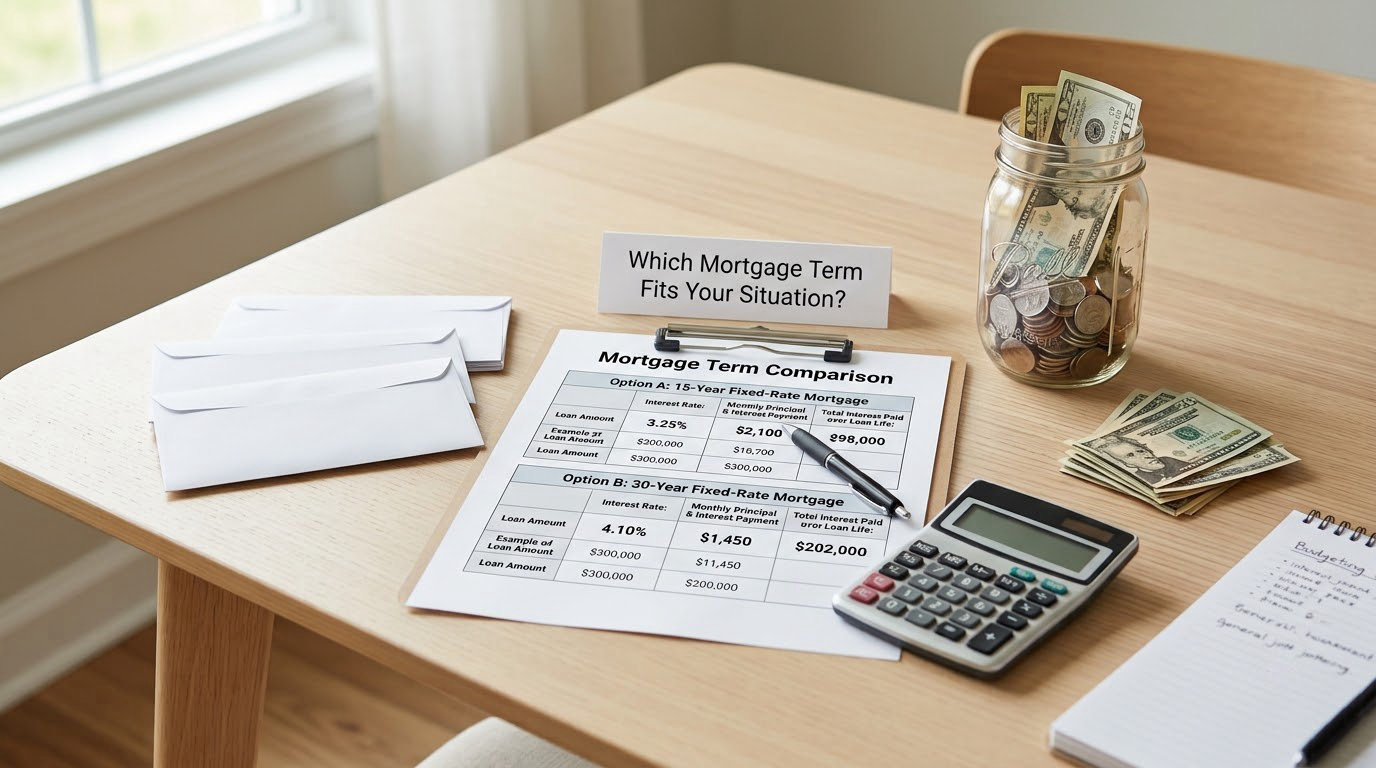
Six inputs decide this, and only the first two are about math.
1. Rate spread. Ask every lender for both terms in writing on the same day. A third of a point is thin, while a full point is a strong reason to lean short.
2. Payment headroom. Compare the principal and interest figure against your gross income, then add taxes, insurance and dues. If the 15-year pushes you past your ceiling without room for savings, the extra interest is not the real cost.
3. Emergency fund. Count the months of expenses you hold in cash. Three to six months of your own housing costs is a common target. If the bigger payment would empty that account, you have swapped a mortgage risk for a job-loss risk.
4. Time horizon. Fifteen years only pays off its lower rate if you keep the home. Moving in three years means the term barely matters beyond the payment.
5. Other debt. Student loans, car payments and a business line compete for the same cash. If you are carrying high-rate debt, prepaying that usually beats accelerating the mortgage.
6. Can the difference be invested instead? This is the real alternative, and serious readers on r/Fire argue it plainly: a 15-year can be an expensive decision if the monthly difference would otherwise compound in a tax-advantaged account. The math is below.
The 15-year tends to fit buyers with steady dual income, no consumer debt, a funded emergency reserve and a plan to stay at least a decade. The 30-year tends to fit first-time buyers, self-employed or commission earners, households raising kids on one income, and anyone whose next move is uncertain. Preserving that monthly breathing room is a feature, not a failure.
If neither fits cleanly, take the middle path most often recommended on r/Mortgages: take the 30-year and pay it on a 15-year schedule by making extra principal payments. On our example, paying 3,268 a month against the 30-year clears the balance in about 190 months, with roughly 221,000 of interest instead of 188,000. You give up around 33,000 of interest in exchange for the option to stop the extra payments in a bad year and keep the rest of the 30-year term intact.
That trade is the whole argument in miniature. It also shows why many 30-year holders with real extra-payment capacity end up in nearly the same place as 15-year borrowers anyway, which is a point raised often on r/Mortgages.
Frequently Asked Questions
Is a 15-year mortgage always better than a 30-year mortgage?
No, it is better only when two conditions hold: the 15-year rate is meaningfully lower, typically at least a quarter to three quarters of a point, and you can fund the higher payment from income while keeping reserves intact. If either condition fails, the interest savings come with real risk. The best term is the one you can carry through a bad month without touching savings.
Can I pay off a 30-year mortgage early?
Yes, and most lenders make it easy with extra principal payments, which reduce interest rather than extend the term. On a 400,000 loan at 6 percent, raising the payment from 2,398 to 3,268 a month clears the balance in about 190 months with roughly 221,000 of interest, against 463,000 if you pay only the minimum. Confirm there is no prepayment penalty in your loan documents first.
How much more should I budget for a 15-year mortgage?
On a 400,000 loan in our example, budget about 870 a month more in principal and interest, a 36 percent increase over the 30-year payment. On a larger or higher-rate loan the gap widens. Then add property tax, insurance, HOA dues and maintenance to either figure. Judge the result against all-in housing costs, not against the loan amount, and keep the total within the share of income you can carry.
Should I choose a 15-year mortgage if I have an emergency fund?
Having an emergency fund makes the 15-year safer, because you can pay the higher bill from income without dipping into reserves. A common target is three to six months of expenses, including your housing costs. The pairing matters most: a 15-year payment plus an empty savings account is a common way buyers end up forced to sell quickly at the wrong time, which is a much bigger cost than extra interest.
Does a 30-year mortgage cost more in interest every time?
Nearly always, and the gap depends on the rate spread. On a 400,000 loan, the 30-year at 6 percent carries about 463,000 of interest while the 15-year at 5.50 percent carries about 188,000. Hold both at the same 6 percent rate and the gap is still roughly 220,000. The rarer exceptions involve prepaying the 30-year aggressively, which narrows the gap without closing it.
Is refinancing a 30-year mortgage to a 15-year term worth it?
Only after closing costs. Refinancing resets the amortization schedule, but the new loan carries fees that often run into the low thousands and get added to the balance. Run the comparison over the number of months you actually expect to keep the loan, not the full 15 years. If you plan to move soon, the remaining interest is small and the refi rarely pays for itself.
Conclusion
Run both terms through the same assumptions: same purchase price, same down payment, same day, same lenders. Start with the payment your household can carry in a slow month without touching savings, then check whether the 15-year rate is low enough to make the shorter term worth roughly a quarter to three quarters of a point of savings.
If both answers come back comfortable, take the 15-year and be done with it. If either comes back tight, take the 30-year and decide in advance how much extra principal you will actually pay, because a 30-year you prepay heavily ends up looking a lot like a 15-year anyway.
Your first action is small: ask two or three lenders for written quotes on both terms on the same day, compare the Loan Estimates line by line, and rerun the 870-a-month difference through your own budget before you sign anything. Rates and rules change, so this is general information, not individualized financial advice.