
An initial public offering is the first time a private company sells its shares to the public on a major exchange, and it is also the only moment most individual investors get a chance to buy into that company at a price set before trading begins. Understanding how an IPO works for individual investors means following the money from the moment a company hires its underwriters through to your own allocation, your first trade, and the risks that follow. Below is that full path, described for a US retail investor with short notes where other markets work differently.
Nothing here recommends a particular company or offering. Rules, taxes, and access arrangements vary by country and change over time, so treat this as a mechanism walkthrough rather than advice.
Table of Contents
- What Is an IPO?
- What the shares you buy actually represent
- Where the money goes: primary versus secondary shares
- Why existing owners get diluted
- How an IPO Works for Individual Investors: Step by Step
- How the IPO Offer Price Is Set
- What bookbuilding actually does
- The greenshoe and why it changes day-one supply
- Can Individual Investors Buy IPO Shares?
- Three ways individual investors get in
- What your brokerage will ask you for
- How IPO Share Allocation Works
- How individual investors improve their odds of an allocation
- Why a full order does not produce a full allocation
- How to Buy IPO Shares as an Individual
- What Happens on the First Day of Trading?
- Key IPO Risks for Individual Investors
- What happens when the lock-up expires
- Taxes, Fees, and Other Practical Considerations
- What to Check Before Investing in an IPO
- Frequently Asked Questions
- Can I buy an IPO with any brokerage account?
- Why did I receive only part of an IPO order?
- What is the minimum amount needed to invest in an IPO?
- Can an IPO stock fall below its offering price?
- Should I buy an IPO on its first trading day or wait?
- Conclusion: What to Do First
What Is an IPO?
An initial public offering (IPO) is the first sale of a private company’s shares to the public. The company lists on an exchange such as the New York Stock Exchange or Nasdaq, files a public disclosure document, and receives money from the sale of newly created shares. After listing, those shares trade continuously between buyers and sellers on the open market.
Three reasons drive most companies to go public: raising capital, giving early investors and employees a way to convert private ownership into something tradable, and establishing a public market price for the business. Going public also brings ongoing reporting obligations, which is why some companies choose other routes instead.
What the shares you buy actually represent
Buying one share means owning a small slice of the company, voting on certain corporate matters and sharing in dividends if the board declares them. In an IPO, your shares come from the company’s total share count, not from a private owner selling you their piece, unless the offering includes a secondary component.
That distinction explains why shares outstanding grow at an IPO and why the company nets a chunk of cash. It also explains why your ownership percentage can shrink later if the company issues more shares.
Where the money goes: primary versus secondary shares
This is the single most confusing part of the process, and it has a clean answer. In a primary component, the company issues new shares and receives the proceeds, minus fees, before trading opens. In a secondary component, existing shareholders sell shares they already own and the money goes to them, not to the company.
Many offerings mix both. An illustrative example: a company sells 8 million newly created shares at $20 and existing holders sell 2 million shares at the same price. Gross proceeds are $200 million, the company receives the $160 million tied to its own shares, and the sellers bank the $40 million. The company also deducts the underwriting spread, the fee the bank charges for underwriting the offering, so the cash actually received is less than the headline figure.
Why existing owners get diluted
Issuing new shares expands the total share count, so each existing share represents a smaller slice of the company unless the new capital earns its keep. That is the dilution question readers ask most often, and the honest answer is that founders and early investors are diluted by the IPO itself. They accept it in exchange for cash, a public market price, and shares they can now sell.
It is not a trick or a hidden transfer of value from existing holders to new buyers. The company’s value rises alongside its cash balance, and the dilution only hurts if the new money is spent badly.
How an IPO Works for Individual Investors: Step by Step
The process runs from months of preparation to a single opening bell, and each stage has a clear owner and an observable output.
| Stage | Who acts | What the investor can observe |
|---|---|---|
| Pick underwriters | Company and its banks | Bank names appear in early coverage and filings |
| File the registration statement | Company, reviewed by regulators | The prospectus and S-1 become public documents |
| Roadshow and bookbuild | Underwriters market to investors | Analyst estimates and an indicative price range surface |
| Set the final price | Company and underwriters | The cut-off price is announced the evening before listing |
| Allocate shares | Underwriters, often pro rata | Your brokerage confirms an allocation or a refund |
| List and trade | Exchange and market makers | The first trades print at or near the offering price |
| Trade freely | Everyone | Prices move with news, sentiment, and results |
- Hire an underwriting syndicate. One or more investment banks take on the offering, assess demand, and help set terms. A group of banks often shares the risk.
- Prepare and file disclosure documents. In the US the company files an S-1 registration statement with the Securities and Exchange Commission. It contains audited financial statements, a business description, risk factors, and the use of proceeds.
- Market the offering. The syndicate runs a roadshow, meeting institutional investors and, increasingly, retail allocators, to gauge interest and answer questions.
- Build the order book. Investors submit non-binding indications of interest within an indicative price range. That book is the raw data behind the final price.
- Price and allocate. The company and banks choose a final offering price, then distribute shares. If demand exceeds supply, allocations are scaled.
- Confirm and settle. Your broker tells you how many shares you received and debits your account. Unfilled amounts are refunded.
- List and trade. The shares begin trading on the exchange, and from that point they are an ordinary publicly traded security.
How the IPO Offer Price Is Set
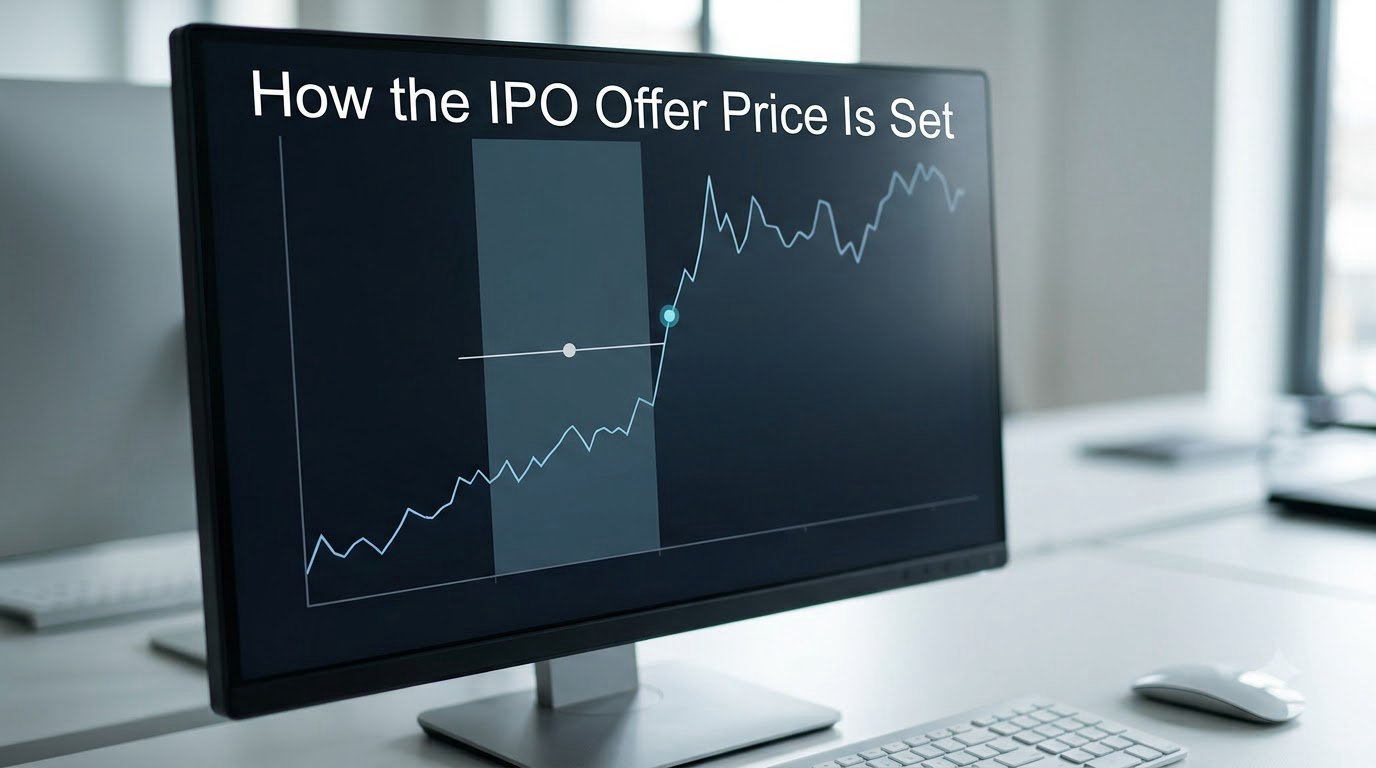
The offer price comes out of demand, not out of a formula. The company and its banks publish an indicative price range, collect orders across that range during bookbuilding, then set the final price at the level where the order book is best supported. That final number is sometimes called the cut-off price, and it is announced after the market closes the day before trading begins.
That explains why the first public trade can differ sharply from the offer price. Everyone who wanted shares submitted orders before the stock existed publicly, so the opening trade is the first time real buyers and sellers meet without that queue. When early trading prints well above the offer price, investors call it a first-day pop.
A pop is a fact about one session, not evidence that the shares are a good investment. Plenty of high-opening IPOs have fallen back toward or below their offer price within months.
What bookbuilding actually does
Bookbuilding is simply collecting bids in an organised way so the seller can see how much demand exists at each price. In a US-style deal, institutions submit large orders during the bookbuilding period, and many brokers collect conditional interest from retail clients. In some emerging markets, including India, retail applicants apply for a share count within a published price band, payment is blocked up front, and the allotment is computed by a formula when the issue is oversubscribed.
The two systems feel different to a retail investor but share one core mechanic: a fixed quantity of shares meets a variable number of buyers.
The greenshoe and why it changes day-one supply
Underwriters often take a greenshoe, also called an overallotment option, letting them buy up to roughly 15 percent more shares from the issuer at the offer price. If the stock trades strongly, the greenshoe is exercised and that extra supply absorbs demand. If it trades weakly, the option may lapse. Either way it tells you how much room the syndicate has to manage the first session.
Can Individual Investors Buy IPO Shares?
Yes, in most cases, but access depends on your brokerage rather than on a universal rule. There is no US legal minimum account size for buying shares in an IPO, and no requirement that you be an an accredited investor for the offering itself. What varies is whether your broker runs an IPO service, whether your account is eligible for it, and how many shares the deal has left for retail.
Two things routinely surprise first-timers. Demand from large institutions is generally reserved before most retail orders are considered, and the total shares set aside for retail are a small slice of the offering in a hot deal. You are bidding into a queue, not buying a supermarket shelf.
Three ways individual investors get in
- Direct participation through your broker. You express interest before the price is set and wait to be allocated. This gives you the offering price if you are allocated, and nothing if you are not.
- Buying on the open market afterwards. Once listed, the shares trade like any other security. You can buy at whatever the market asks, which may be higher or lower than the offer price, and you can trade during regular market hours.
- Indirect exposure through a fund. Some index funds and dedicated IPO-focused products absorb allocations and pass the exposure through to their holders. Some even receive a portion of the underwriting economics, which is the mechanism critics point to when the fund wins preferential access.
What your brokerage will ask you for
Expect a screen with an eligibility confirmation, an indication of the maximum number of shares you want, a maximum price you will accept, and a deadline that usually falls before the final price is set. In emerging markets you will also fund an account in advance, because the amount is blocked and then either converted into shares or refunded.
How IPO Share Allocation Works
Allocation happens after the price is fixed, and the basic rule is simple to state: when orders exceed the shares available, everyone who bid is scaled back in proportion to what they asked for. In practice the arithmetic is harsher, because the syndicate reserves a meaningful portion for anchor investors and long-only institutions before retail orders are divided among the remainder.
Use a fictional example to see it. A deal offers 10 million shares and receives orders for 50 million, so it is oversubscribed 5 times. An investor who bid for 1,000 shares would receive roughly 200 shares under a simple pro-rata scaling, and the remainder of the money is returned. Refunds usually appear within a few business days, though timing and currency conversion depend on the broker and the jurisdiction.
How individual investors improve their odds of an allocation
Nothing guarantees you shares, but a few habits help. Read the prospectus before submitting, because plenty of retail applicants bid into offerings without opening the document. Keep your account in good standing and check whether your broker requires any advance action, such as enabling the IPO service or acknowledging a risk disclosure. Submit before the stated deadline rather than in the final hour, and treat a partial allocation as the expected outcome rather than a disappointment.
Brokerage allocation policies vary. Some ration retail heavily on high-demand deals, some offer preferential treatment to larger clients or to clients who pay higher commission tiers, and some simply pass the pro-rata result through. Ask your broker directly rather than assuming.
Why a full order does not produce a full allocation
Your order is an expression of interest at a price, not a purchase. It becomes a purchase only if the syndicate allocates to you at the final price, and that allocation is a fraction of what you asked for when the deal is tight. If you bid a maximum price above the final price, your order simply participates at the lower clearing price.
If the deal is heavily oversubscribed, the same logic cuts the other way. If you bid too low to clear at the final price, you receive nothing at all, which is why the maximum-price field matters more than it looks.
How to Buy IPO Shares as an Individual
The sequence is straightforward once your broker supports it. Check first whether your account is eligible for the offering, since not every brokerage runs an IPO desk and some restrict the service by account type or region.
Next, read the offering document. Find the use of proceeds, the risk factors, the share count being sold versus newly created, and the dilution math. The prospectus is long, but the summary and risk sections carry most of the information a retail buyer needs.
Then submit your conditional request before the deadline, with the maximum share count you would actually want and a maximum price you are prepared to pay. Do not inflate the number as a strategy; a scaled allocation is the normal outcome anyway.
Finally, watch for the allocation notice and the subsequent debit or refund. Shares usually appear in your account around listing, and from that point the position behaves like any other holding.
One practical note: expressing interest and receiving shares are two separate events. Until the confirmation arrives, you have no position, no exposure, and no cost beyond any account fees your broker charges for the service.
What Happens on the First Day of Trading?
The first session is the least predictable part of the whole process. There is no long trading history to anchor valuation, early holders are evaluating whether to hold or sell, and news coverage is heavy, so trades can gap sharply against the offer price within minutes of the open.
Exchanges use price limits and, when a move is extreme, voluntary or mandatory trading halts that pause trading for a set window. Those halts are routine in heavily traded IPOs and are not a sign of fraud. Later sessions settle into whatever price the market is willing to pay, which may be far from both the offer price and the opening print.
Two behaviors show up repeatedly around listing day. Day-one flipping means selling allocated shares as soon as they trade, which captures a first-day pop if one appears and accepts a loss if one does not. Holding is the opposite bet on the business rather than the sentiment of a single session. Neither is a reliable edge, and the community consensus on long-horizon investing forums is blunt: buy the broad market and let a new company earn its eventual weight instead of concentrating a small sum into its first week.
Key IPO Risks for Individual Investors
The core risk is valuation. The offer price is set by underwriters to attract demand, so it is rarely the price at which an excellent business would be a bargain. You can like the company and still overpay for it.
The second risk is that there is almost no public history. There are no quarterly results, no dividend record, and no track record of how management communicates with shareholders. The prospectus describes an audited past, but a past under different conditions and often before the business scaled.
Third, aftermarket demand can be thin. If public investors decide the price was too high, the shares can drift lower for months without any new bad news, and there is no guarantee of daily liquidity in either direction.
Finally, position sizing matters more than conviction. Because a single new listing is a concentrated, unpredictable bet, treating it as a small speculative position capped at an amount you could lose entirely keeps a single bad outcome from damaging a diversified plan.
What happens when the lock-up expires
Insiders, founders, and early investors usually sign lock-up agreements committing them not to sell shares for a set window, commonly about 180 days. The prospectus discloses the schedule. When the lock-up ends, a large volume of shares can become available for sale at once, and that potential supply overhang often weighs on the price around the expiry date. If you plan to hold, check the lock-up expiry date before you decide, because it rarely appears in news coverage.
Taxes, Fees, and Other Practical Considerations
Brokerage fees for IPO participation are not standardised. Some firms charge nothing for the service, some charge per order or per allocated share, and some treat it as a way to qualify for a higher pricing tier, so read your own schedule rather than assuming.
Tax treatment of gains is jurisdiction-dependent and depends on your residence, your account type, and how long you hold. In the US, capital gains from the sale of shares are generally taxed differently depending on holding period, and retirement accounts treat sales differently again. Other countries apply entirely different rules, including withholding on the sale itself. This article cannot give you your answer; check current guidance from your own tax authority or a qualified professional in your jurisdiction.
Settlement timing also varies. Most markets now settle share sales shortly after the trade rather than the old multi-day cycle, and IPO allocations follow their own timetable set by the broker and the exchange. Restriction periods can apply to accounts opened very recently or to certain account types, so confirm eligibility before you assume you can participate.
What to Check Before Investing in an IPO
Run through this list before you submit anything.
- Read the prospectus summary and risk factors. If you will not read them, that is useful information about the position.
- Understand the business model. How does the company make money, and is revenue growth translating into cash?
- Check the financial statements. Look at profitability, free cash flow, debt, and how consistent results are across periods.
- Follow the use of proceeds. Money raised to repay debt or fund acquisitions is a different proposition from money raised to build growth, and the filing spells out the split.
- Work out the valuation. Compare the offer price to earnings, revenue, and cash flow, and compare those multiples with listed peers.
- Check the share structure. Note how many shares are newly created versus sold by existing holders, and whether there are dual-class voting rights that leave public holders with limited say.
- Find the lock-up and greenshoe details. Both affect supply in the months after listing.
- Ask whether it belongs in your plan at all. A diversified, low-cost approach has historically captured the return of companies like these without the risk of picking one at the wrong moment.
If a company does not clear that last question, a good answer is to pass. There will be another offering, and there is no penalty for sitting one out.
Frequently Asked Questions
Can I buy an IPO with any brokerage account?
No. Access depends on whether your broker runs an IPO participation service, whether your account type and region are eligible, and whether shares are left for retail after institutional allocations. Many brokers offer no direct participation at all, in which case you can still buy the shares on the open market once the company lists. Check your broker’s current rules before assuming you can bid.
Why did I receive only part of an IPO order?
Because your order is an expression of interest, not a purchase. When total orders exceed the shares available, the deal is oversubscribed and the syndicate scales everyone’s order down, usually in proportion to what each investor asked for. A 5 times oversubscribed deal can leave an applicant with about a fifth of the requested shares, and the unallocated portion is refunded.
What is the minimum amount needed to invest in an IPO?
In the US there is no legal minimum for buying IPO shares, and many brokerages let you express interest for as few as one share. The practical constraint is that hot deals are oversubscribed, so a very small bid may be scaled to zero. Some emerging markets require the full requested amount to be funded in advance, and that money is blocked until shares are allotted or the application is refunded.
Can an IPO stock fall below its offering price?
Yes. The offering price is set before public trading begins, and once the shares list they trade on supply and demand alone. Plenty of IPOs that opened well above their offer price have fallen back below it within days or months. Nothing in the offering guarantees a profit, and losses can be substantial if sentiment turns after the first-day enthusiasm fades.
Should I buy an IPO on its first trading day or wait?
Waiting for an aftermarket dip is one of the most common pieces of advice on long-term investing forums, and it often costs more than the offer price. Buying on the first day exposes you to the widest price swings and the temptation to flip shares quickly. Neither timing approach is reliably better, so decide based on your position size and time horizon rather than on the day’s headlines.
Conclusion: What to Do First
Start with the prospectus, because it is the only document that tells you what the company does, what the money funds, who sells how many shares, and what can go wrong. Then confirm that your brokerage actually offers IPO participation to your account and note the submission deadline.
After that, ask whether the position fits your plan at all. IPO access is optional, and treating it as a small capped experiment is a far better frame than treating it as a required move. If it does not clear your own bar, buy the broad market instead and let the company earn its place there over time.