
Time weighted vs money weighted returns is really a question about what you are measuring. A time-weighted return (TWR) strips out every deposit and withdrawal and measures how well the investments themselves performed. A money-weighted return (MWR), also called the dollar-weighted return or IRR, folds in the size and timing of every dollar you moved in and out.
Both numbers show up on the same brokerage or robo-advisor screen, and they rarely match. One r/wealthfront user checked an IRA with no deposits since 2020 and reported a three-year TWR of 8.66% against a money-weighted figure of 8.31%, then saw the one-year numbers run the other way: 5.66% time-weighted versus 8.13% money-weighted. Nothing about the portfolio changed. Only the measurement did.
What follows is the mechanics of both methods, two worked examples with every number shown, and a plain decision rule for which figure to trust. All examples are illustrative arithmetic, not real account or fund performance. Figures shown here are made up for teaching, and past results say nothing about what any investment will do next.
Table of Contents
- Time Weighted vs Money Weighted Returns at a Glance
- The four things worth remembering
- What Is Time Weighted Return?
- Three steps to calculate a time-weighted return
- How Time Weighted Return Handles Deposits and Withdrawals
- What actually counts as a cash flow
- What Is Money Weighted Return?
- Sign conventions that trip people up
- Two steps to calculate money-weighted return in Excel
- How Money Weighted Return Treats Large Contributions
- How timing alone decides the sign of the gap
- Time Weighted Return vs Money Weighted Return
- Why the two numbers diverge
- Why they diverge with zero external deposits
- The third method, and why it misleads
- Never compare one portfolio’s TWR with another’s MWR
- Which Return Measure Should You Use?
- Use time-weighted return when
- Use money-weighted return when
- Where each number shows up
- A quick audit checklist
- Frequently Asked Questions
- Should I look at time weighted or money weighted returns?
- What is the difference between time-weighted and dollar-weighted returns?
- Why do my time weighted and money weighted returns differ if I made no deposits?
- Is money weighted return the same as IRR?
- What is considered a good money weighted return?
- Conclusion
Time Weighted vs Money Weighted Returns at a Glance
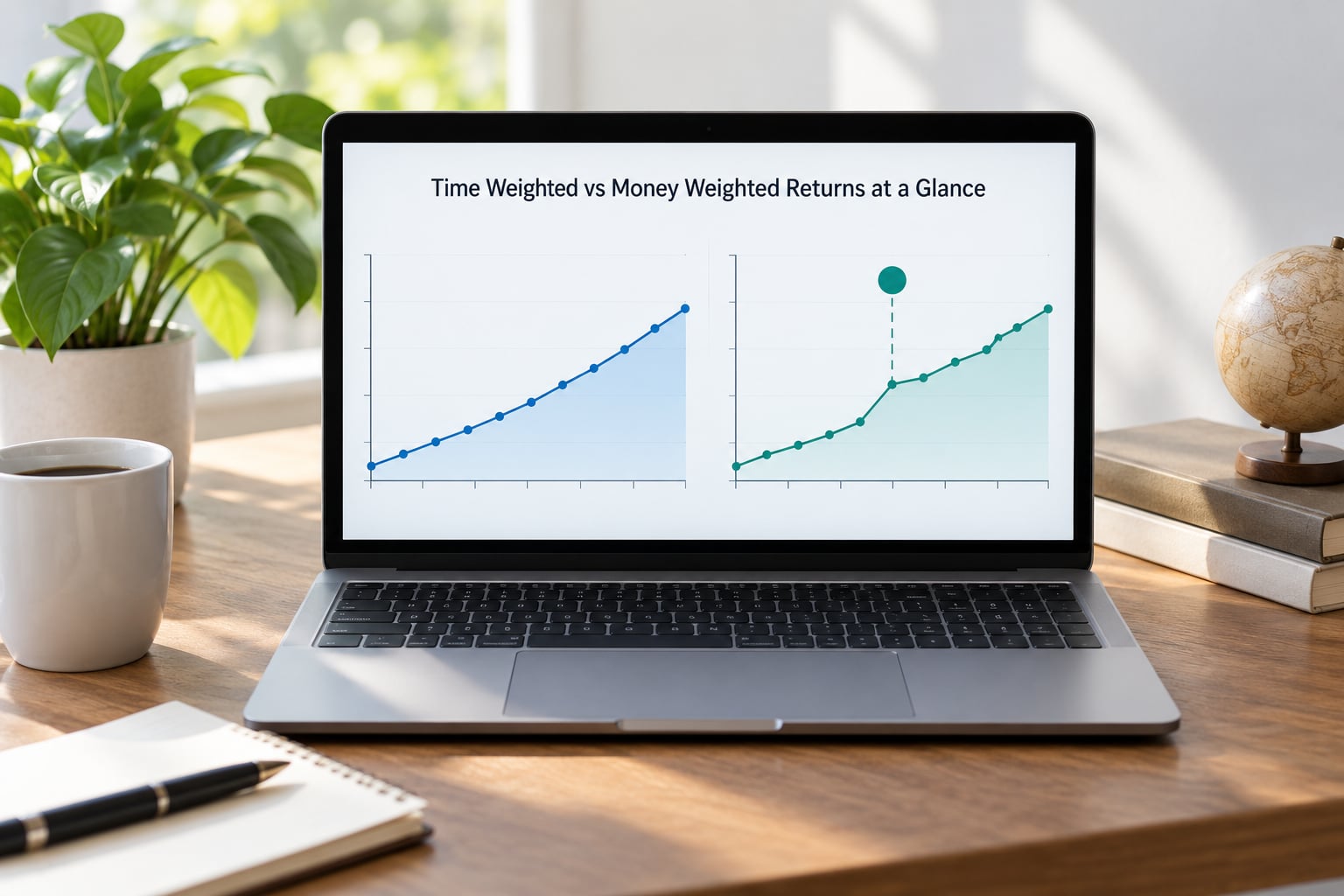
The short version before the detail: TWR answers “how did the investments do?” and MWR answers “how did my money do?” That single difference in question drives every other difference below.
| Criterion | Time-weighted return (TWR) | Money-weighted return (MWR) |
|---|---|---|
| What it measures | Performance of the holdings, independent of your cash flows | Return earned by your capital, given the size and timing of each cash flow |
| Effect of deposits and withdrawals | Removed. Each sub-period is measured on its own | Included. Every dollar is weighted by when it arrived and how much it was |
| Mathematical basis | Geometric linking of sub-period returns | IRR: the rate that sets the net present value of all cash flows to zero |
| Also called | Geometric mean return, geometric linked return | Dollar-weighted return, money-weighted rate of return (MWRR), IRR |
| When the two match | Identical to MWR whenever there are zero external cash flows in the period | Same condition, and in that case every method gives the same number |
| Best for | Funds, ETFs, asset managers, benchmark comparison, GIPS composites | Your own account, market-timing accountability, provider disclosure |
| How you calculate it | By hand with a sub-period table, no solver needed | A solver: Excel XIRR, a calculator, or the platform’s own engine |
The four things worth remembering
- TWR neutralises your behaviour, MWR prices it in. That is the whole argument in one line.
- Add or take out money and the TWR does not move. That is by design, not a glitch.
- The two are identical only when no money entered or left the account during the measured window.
- You can post a positive time-weighted return and still have lost dollars. Both statements are true at the same time.
Every example below uses the same pair of numbers so you can see exactly which method reacts to which cash flow.
What Is Time Weighted Return?

A time-weighted return measures compound growth by breaking the measurement period into sub-periods at the moment of each external cash flow, computing the return inside each sub-period, and linking those results geometrically. Because each sub-period is scored on its own, a large deposit cannot flatter the score and a withdrawal cannot penalise it.
Geometric linking means multiplying the growth factors, then subtracting one. If a portfolio grows 10 percent in one sub-period and falls 5 percent in the next, the linked return is 1.10 × 0.95, minus one, which is 4.50 percent. Add them and you get 5 percent, which is wrong because it pretends the loss was earned on the full balance.
Three steps to calculate a time-weighted return
- Split the period. Start a new sub-period at every deposit, withdrawal, or transfer in or out of the account. Record the portfolio value immediately before and immediately after each flow.
- Compute each sub-period return. Sub-period return equals the ending value divided by the beginning value, minus one. Both values must be taken before and after the cash flow so no new money is counted as a gain.
- Link geometrically. Multiply all of the growth factors together, then subtract one. That single number is the period TWR.
GIPS, the Global Investment Performance Standards, is the reason this method dominates professional reporting. Firms that claim to be GIPS compliant must report composite performance on a time-weighted basis, precisely so that a client who added or removed money mid-year still receives a comparable number. Private market pooled funds are the carve-out: when the manager controls when capital goes in and comes out, IRR is the required measure instead.
How Time Weighted Return Handles Deposits and Withdrawals
Here is the method in full. You start a brokerage account with 100,000 dollars. Six months later it is worth 110,000, a gain of 10 percent. You deposit another 50,000, bringing the balance to 160,000. Six months after that the balance is 144,000, which is 10 percent below 160,000.
Split at the deposit and you get two sub-period returns: plus 10 percent, then minus 10 percent. Linked, the time-weighted return over the full year is 1.10 × 0.90, minus one, which is minus 1.00 percent. The 50,000 dollars you added had no effect on that number at all, even though they were in the account for half the year.
| Period | Value at start | Cash flow | Value at end | Sub-period return |
|---|---|---|---|---|
| Months 1 to 6 | 100,000 | none | 110,000 | +10.00% |
| Months 7 to 12 | 160,000 (after a 50,000 deposit) | +50,000 | 144,000 | -10.00% |
| Full year, linked | 100,000 | +50,000 | 144,000 | -1.00% |
Now run three different people through that identical portfolio, which rises 10 percent in year one and falls 5 percent in year two. Every one of them earned the same time-weighted return of 4.50 percent. Their money-weighted returns are three different numbers, and the spread is entirely a story about when cash moved.
| Investor | What they did | TWR | MWR |
|---|---|---|---|
| A | Started with 100,000, added nothing, withdrew nothing | +4.50% | +4.50% |
| B | Started with 100,000, added 100,000 at the start of year two, just before the losing half | +4.50% | -0.17% |
| C | Started with 100,000, withdrew 80,000 at the start of year two, leaving little capital exposed to the decline | +4.50% | +6.71% |
Investor B’s deposit arrived one day before the losing half, so roughly 95 percent of B’s capital sat in the portfolio while it fell 5 percent, and B’s personal rate lands just under the fund’s. Investor C pulled most of the money out at the same moment, so C beat the fund purely through withdrawal timing.
What actually counts as a cash flow
Contributions and withdrawals are the obvious two. The list is longer, and getting it wrong is a common reason brokerage numbers look inconsistent:
- Contributions, withdrawals and lump-sum deposits into or out of the account.
- Transfers between your own accounts, including rollovers and account number changes.
- Cash dividends that leave the account, as distinct from dividends reinvested inside it.
- Proceeds from selling securities, if the cash sits outside the measured portfolio.
- Payments out of the account for fees, taxes or interest charges taken in cash.
- Shares received through stock-based compensation vesting or a company plan.
DRIP reinvestment is the one that causes the most argument. If dividends are reinvested inside the portfolio, most performance systems treat them as internal income rather than an external flow, and the time-weighted return absorbs them smoothly.
What Is Money Weighted Return?
A money-weighted return is the single annual rate that makes the net present value of every cash flow in the account, plus the final portfolio value, equal zero. Money-weighted return is a synonym for dollar-weighted return and, in portfolio reporting, for internal rate of return. The terminology matters because platform menus label the same figure three different ways.
The mental model is that the account is one big investment with a single yield. Every deposit is money invested at a known date, every withdrawal is money taken out at a known date, and the solver hunts for the rate that reconciles the two. Periods with more of your money count for more, which is exactly what TWR refuses to do.
Sign conventions that trip people up
- Money you put in is a negative number in a cash flow table, because it leaves your pocket.
- Money you take out is positive, because it comes back to you.
- The ending portfolio value is entered as a positive number on the final row.
- Dividends already reflected in the ending balance should not be added again as a separate inflow.
Two steps to calculate money-weighted return in Excel
Excel’s XIRR function does the solving for you. Lay the cash flows out in two columns, with real date values in the first column:
| Cell | Date | Cash flow |
|---|---|---|
| A2 / B2 | 01/01/2025 | -100,000 |
| A3 / B3 | 07/01/2025 | -50,000 |
| A4 / B4 | 01/01/2026 | +144,000 (ending value) |
| Result | Formula | =XIRR(B2:B4, A2:A4) returns about -4.79% |
That minus 4.79 percent is the money-weighted return on the same account that produced a time-weighted return of minus 1.00 percent. Same portfolio, same year, different question. If your own XIRR does not match a broker’s “personal rate of return,” the usual culprits are dates typed as text rather than real dates, the ending balance entered with the wrong sign, or the broker annualising across a different start and end date than you picked.
One more caution about XIRR: it always returns an annualised figure. A nine-month account gets stretched into a twelve-month rate, which is why side-by-side screenshots with different date ranges can look wrong.
How Money Weighted Return Treats Large Contributions
Now the case that confuses people most, because the two numbers do not merely differ, they point in opposite directions. You start with 10,000 dollars. Year one goes well and the account grows 50 percent to 15,000. You then deposit 100,000 dollars, a tenfold increase in capital, and the balance jumps to 115,000.
Year two is rough and the portfolio falls 10 percent, ending at 103,500 dollars. The time-weighted return is 1.50 × 0.90 minus one, which is plus 35.00 percent per year. Two strong years for the investments themselves.
Your money-weighted return tells a different story. You put 110,000 dollars in and took 103,500 dollars out, a loss of 6,500 dollars. Solving the IRR equation across those flows gives roughly minus 5.44 percent per year. Nothing went wrong with the portfolio. The money arrived right before the only bad period it experienced.
| Measure | Result | What it is telling you |
|---|---|---|
| Time-weighted return | +35.00% | The investments compounded well across both sub-periods |
| Money-weighted return | -5.44% | Your own capital lost 6,500 dollars, mostly because of deposit timing |
| Simple rate of return | -5.91% | Dollars in minus dollars out, ignoring when any of it happened |
Sharesight published a real-world version of this on its own site, where a client was down 500 dollars while the account showed plus 11.80 percent per year time-weighted and minus 12.77 percent per year money-weighted. Same shape, different numbers, same lesson.
How timing alone decides the sign of the gap
| What the investor does | TWR | MWR relative to TWR |
|---|---|---|
| Adds money before a strong period | Unchanged | Rises above it |
| Adds money before a weak period | Unchanged | Falls below it |
| Withdraws before a strong period | Unchanged | Falls below it |
| Withdraws before a weak period | Unchanged | Rises above it |
| Makes no external cash flows | Unchanged | Exactly equal |
Size only amplifies whatever timing did. A 50,000 dollar deposit moves the money-weighted number; a 500,000 dollar deposit moves it hard. Both leave the time-weighted number exactly where it was.
Time Weighted Return vs Money Weighted Return
Both methods are correct answers to different questions, and the disagreement between them is not an error in either calculation. It is the cash flow schedule showing through.
Why the two numbers diverge
Two mechanisms, one from each direction. Size effects come from periods where more of your money was at work than in others; the money-weighted calculation gives those periods more weight. Timing effects come from whether a contribution arrived ahead of gains or losses. The time-weighted method neutralises both, which is why it can be computed with a pocket calculator while the money-weighted method needs a solver.
Why they diverge with zero external deposits
This is the question behind the top-ranking thread on the main search results page: an IRA holder with no deposits since 2020 still saw a three-year time-weighted figure of 8.66 percent against 8.31 percent money-weighted. Several things create these phantom flows:
- Dividends or interest paid out in cash and later reinvested, which register as a withdrawal followed by a deposit on some systems.
- Internal transfers between accounts at the same institution, where the outgoing side is treated as a flow.
- Multiple custodians or a change of provider, where aggregated balances create flows that never touched your pocket.
- Currency conversion on unhedged foreign holdings, recorded as an outflow and inflow at the conversion date.
- Fee timing and short-term cash balances inside the account, especially around sweeps and money market lines.
- Stock-based compensation shares, 401(k) rollovers and Roth conversions, all of which add capital without a purchase decision.
Add to that the annualisation mismatch described earlier, and a two-number disagreement on an untouched IRA stops being a mystery.
The third method, and why it misleads
The simple rate of return divides the dollar change net of cash flows by the starting balance. In example one above it reads minus 6.00 percent against a time-weighted minus 1.00 percent. It ignores compounding inside the year and ignores when money arrived, so it drifts away from both other methods the longer or busier the period gets. Use it for a rough sanity check, never for a comparison.
Never compare one portfolio’s TWR with another’s MWR
The two measures are not on the same scale and cannot be ranked against each other. Comparing an ETF’s time-weighted return to a pension fund’s money-weighted return tells you about their cash flow policies, not their investment skill. If you need to compare two things, compare like with like, and match the period and the annualisation.
Which Return Measure Should You Use?
Start by naming the thing you are evaluating. That single question resolves almost every case.
Use time-weighted return when
- You are comparing an ETF, fund or portfolio against a benchmark index.
- You are deciding whether an asset manager or a robo-advisor is worth paying for.
- Your account has large or lumpy cash flows that have nothing to do with performance.
- You are reading a GIPS-compliant composite report, where time-weighted is the required basis.
Use money-weighted return when
- You want to know what your own capital actually earned.
- You contributed heavily near the end of a strong run and want to see what that cost you.
- You want an honest read on whether your deposit and withdrawal timing helped or hurt.
- A provider is required to disclose it, as Canadian dealers have been under CRM2 since 2016.
Where each number shows up
US brokerages typically label a personal account view “personal rate of return” or “your return,” which is the money-weighted figure, and many add a time-weighted figure in a performance report or a fund comparison screen. Fidelity, Vanguard and Schwab all publish both, though the placement moves around between desktop and mobile. Some robo-advisors show the money-weighted number by default and bury the time-weighted series behind a toggle.
A quick audit checklist
- Confirm the period and whether the figure is annualised or cumulative.
- Confirm whether dividends are modelled as external flows or internal income.
- Check whether the number is labelled as personal or money-weighted, or as fund or time-weighted.
- Compare the money-weighted figure against your own dollar gain or loss, since they should point in the same direction.
- Compare the time-weighted figure against the benchmark over the identical window.
Rules, reporting requirements and platform labels vary by country and change over time, so check the current wording on your own statements. Nothing here is personal investment advice.
Frequently Asked Questions
Should I look at time weighted or money weighted returns?
Use the time-weighted return to judge investments, funds or a manager, and the money-weighted return to judge your own account. If you are comparing a portfolio against a benchmark index, only the time-weighted figure is a fair comparison. If you want to know what your capital actually earned after your deposit and withdrawal timing, the money-weighted number is the honest one. Most investors should look at both for different jobs rather than picking a winner.
What is the difference between time-weighted and dollar-weighted returns?
They are two names for the second method. Dollar-weighted return, money-weighted return, money-weighted rate of return and internal rate of return all describe the same calculation: the rate that sets the net present value of every cash flow, plus the final value, to zero. The time-weighted return is a different calculation entirely, since it removes cash flows and links sub-period returns geometrically.
Why do my time weighted and money weighted returns differ if I made no deposits?
Because internal and administrative events act like cash flows on some systems. Dividends paid out then reinvested, transfers between your own accounts, currency conversion on foreign holdings, fee timing and shares received from stock compensation all create flow entries. A change of custodian can also create flows. Another common cause is comparing an annualised money-weighted figure against a cumulative time-weighted one over different date ranges.
Is money weighted return the same as IRR?
In portfolio performance reporting, yes. Money-weighted return is IRR applied to the dated cash flows of an investment account. Outside that context, IRR is used more loosely, for example on private equity deals where the manager controls the timing of capital calls and distributions. In Excel the calculation is XIRR, which solves for an annualised rate across irregularly spaced dates.
What is considered a good money weighted return?
There is no fixed number, because a money-weighted return is heavily shaped by your own cash flow timing. Judge it against two references instead: the dollar gain or loss you actually made, and a time-weighted return over the same window computed by adding hypothetical monthly contributions. If your money-weighted figure sits far below the time-weighted one, the gap is usually about deposit timing rather than investment quality.
Conclusion
Identify what you are measuring before you read the number. Judging a fund, an ETF or a manager against a benchmark means using the time-weighted return. Judging your own account and your own timing means using the money-weighted return. When the two disagree on an account you have not touched, check dividends, transfers and currency conversions before you assume the platform is wrong.