Market cap is the total value of every share a company has outstanding, worked out by multiplying one share’s price by the total number of shares in existence. It is the fastest way to size up a company and compare it with rivals. For new investors, understanding it is the first step toward reading a quote page without being fooled by a big number.
Updated for 2026. This is an educational explainer, not investment advice. Nothing here is a recommendation to buy or sell anything.
Table of Contents
- Market Cap Explained for New Investors
- What Does Market Cap Measure?
- How Is Market Cap Calculated?
- Where to find shares outstanding
- Market cap vs revenue: why the two can diverge wildly
- Why Does Market Cap Change?
- What Is Market Cap Explained for New Investors in Simple Terms?
- How Investors Classify Companies by Market Cap
- Is a Bigger Market Cap Better?
- Market Cap vs. Enterprise Value
- What Market Cap Does Not Tell You
- How to Use Market Cap When Researching Stocks
- Common Market Cap Mistakes to Avoid
- Frequently Asked Questions
- Is market cap the same as a company’s value?
- Why can a company with a low share price have a large market cap?
- Does market cap tell investors whether a stock is overvalued?
- How often should investors recalculate a company’s market cap?
- Should new investors favor large-cap or small-cap stocks?
- Conclusion: Start with Market Cap, Then Dig Deeper
Market Cap Explained for New Investors

Market capitalization, shortened to market cap, is what the stock market currently values a whole company at. You get it by multiplying the current share price by every outstanding share. That single number is why two companies with identical share prices can be wildly different sizes, and why a company trading at a few dollars a share is not automatically cheap.
Market cap is a size measure, not a valuation verdict. It tells you how big the company is in the eyes of the market today. Whether that size is priced sensibly is a completely separate question, and one this guide takes up in detail further down.
| Measure | What it measures | How you get it | What it does not tell you |
|---|---|---|---|
| Share price | The cost of one share right now | Read it off the quote page | Nothing about total size, because share counts differ wildly |
| Market cap | The market’s total value of the company’s equity | Share price multiplied by shares outstanding | Whether that value is fair, profitable, or burdened with debt |
| Revenue | Money earned from sales over a period | Income statement, trailing twelve months | Profit, cash, or what investors expect next year |
| Book value | Assets minus liabilities on the balance sheet | Total assets less total liabilities | What those assets are actually worth today |
| Enterprise value | The market’s value including debt, net of cash | Market cap plus debt minus cash | Whether the business model earns its cost of capital |
What Does Market Cap Measure?
Market cap measures the total market value of all outstanding shares of a company’s common equity. In plain terms, it answers one question: what would it cost right now to buy the entire company at market prices?
It gives you a fast, comparable yardstick. Two businesses in the same industry can be judged side by side on size without you digging through different accounting systems or currencies. It also decides which bucket a company falls into, which is how indexes and screeners sort them.
One refinement worth knowing early: free-float market cap. Some shares are held by founders, executives or restricted holders who cannot simply sell. Free-float cap counts only the shares genuinely available to trade, and it is the number some indexes prefer when they weight companies.
Market cap moves constantly. Every tick of the share price changes it, and so does any change in how many shares exist.
How Is Market Cap Calculated?
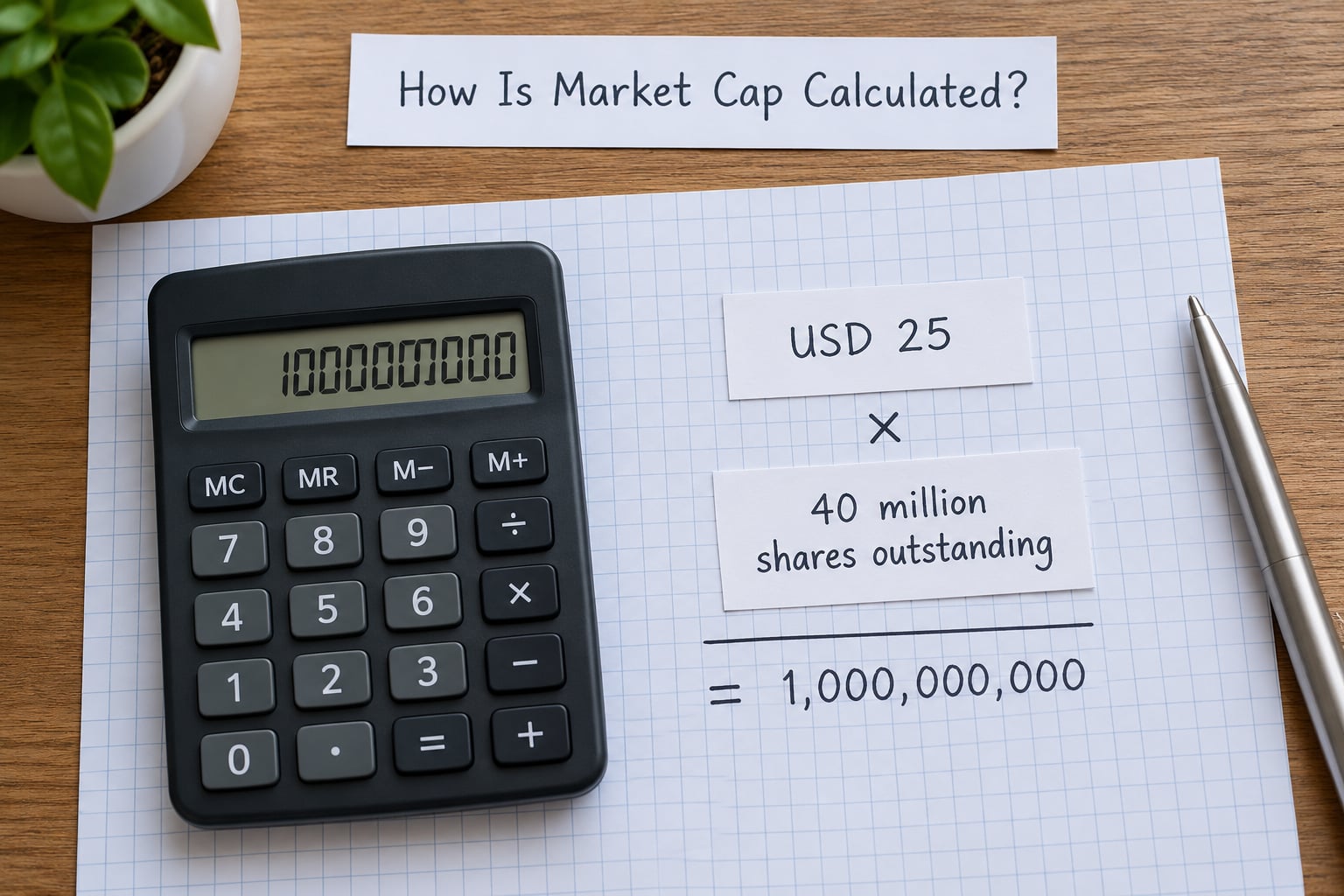
The formula is short enough to memorise after you see it once.
Market cap = share price multiplied by shares outstanding
Share price is the current market price of one common share. Shares outstanding is the total number of common shares the company has issued and that remain in circulation, excluding treasury shares. Multiply them and you have a live number that shifts with every quote.
Worked example one. A fictional company trades at USD 25 a share and has 40 million shares outstanding. Twenty-five multiplied by forty million gives one billion dollars. That company is a small-cap or lower mid-cap business depending on the sector and the day.
Worked example two. Another fictional company trades at USD 8 a share with 300 million shares outstanding. Eight multiplied by three hundred million gives two point four billion dollars, more than double the first company while the share price is less than a third as high. That gap is the whole point of the measure.
Where to find shares outstanding
The number is public, which means you never have to guess. The company’s annual report, filed with the US Securities and Exchange Commission as a Form 10-K, states the count of shares outstanding on its cover page as of a specific date. Most company investor relations pages also publish a share count, a basic and diluted share count, and a capital structure summary.
Brokerage and finance sites display market cap and shares outstanding on a statistics tab, usually for free. Two things to check there: how recent the share count is, and whether it is basic or fully diluted. Diluted share counts add in options, warrants and convertible securities, which is the fairer comparison for a company with a lot of them outstanding.
Market cap vs revenue: why the two can diverge wildly
This is the single most common confusion among beginners, and it comes up constantly on investing forums. Revenue measures what a business has already sold. Market cap measures what investors are willing to pay today for what they expect it to sell in the future.
The gap between them is a bet. An automaker with enormous annual sales can trade at a fraction of a software company with far smaller sales, if the market believes the automaker’s future is locked in and the software company’s future is enormous. Revenue tells you about the past and the present; market cap prices an opinion about the future.
People sometimes ask why a company doing huge volumes of business looks so small next to one with modest sales. The answer is margin, growth and duration of expected profits, not turnover.
Why Does Market Cap Change?
Two variables move market cap: the share price and the number of shares. Most of the movement you will ever see comes from the first one, and it moves every single trading day as buyers and sellers disagree about value.
The share count changes far less often, but when it moves it changes the total by itself. Here are the events that do it:
- Share price movement. A five percent move in the share price is a five percent move in market cap, instantly and automatically.
- Share issuance. When a company sells new shares to raise money, the count rises. Existing shareholders now own a smaller slice of the same business.
- Share buybacks. When a company buys and retires its own shares, the count falls and each remaining share represents a slightly larger piece. Market cap falls with it.
- Stock splits. A four-for-one split turns each share into four shares at a quarter of the price. Multiply four by a quarter and the market cap is unchanged. This is the one event that changes the price dramatically and the total not at all.
- Acquisitions. Buying another company with shares rather than cash adds the target’s share count to yours, and the combined market cap moves accordingly.
- Dilution from options and convertibles. As employees exercise options and bondholders convert, the fully diluted count can climb without any new capital being raised.
Beginners often watch a split and assume something exciting happened. Nothing did. The business is exactly the same size it was on Monday.
What Is Market Cap Explained for New Investors in Simple Terms?
Think of a company as a cake. The share price is what one slice costs at the market’s counter. The number of slices is the share count. Market cap is the price of the whole cake at today’s counter price.
A slice of cake is not a cheap cake. If a slice sells for two dollars and the cake was cut into ten thousand slices, the whole cake is worth twenty thousand dollars at the counter. Now imagine a slice of a different cake selling for two hundred dollars, with only fifty slices. That cake is worth ten thousand dollars.
Scale that up. One company at USD 10 billion has a very different profile from a company at USD 100 billion, regardless of what either share costs. The larger one is more likely to have deeper management teams, more product lines, broader supplier relationships and a longer record of surviving a downturn. The smaller one has more room to grow and a much rougher ride getting there.
How Investors Classify Companies by Market Cap
Investors sort companies into size bands. The boundaries below are the most widely cited ranges; individual data providers set their own, which is why two screens rarely agree exactly.
| Tier | Typical range | Profile | Volatility | Index examples |
|---|---|---|---|---|
| Mega-cap | 200 billion dollars and up | Global, diversified, deeply followed | Lower for the same sector | Dominant weight in the S&P 500 |
| Large-cap | 10 to 200 billion dollars | Established businesses with real scale | Moderate | Most of the S&P 500 |
| Mid-cap | 2 to 10 billion dollars | Proven firms still expanding | Moderate to high | S&P MidCap 400 |
| Small-cap | 300 million to 2 billion dollars | Younger, narrower, less seasoned | High | Russell 2000 |
| Micro-cap | Below roughly 300 million dollars | Very early, thinly followed | Extreme | Often outside major indexes |
Boundaries differ because there is no legal definition. One provider puts the mega-cap line at 200 billion, another at 300 billion. Nobody is wrong; they are sorting for different purposes.
More importantly, a classification tells you size and nothing else. It does not mean the company is safe, profitable, growing or cheap. It is a sorting label, not a rating.
Is a Bigger Market Cap Better?
Not automatically, and the honest answer splits by what you are worried about.
The case for larger companies is steadiness. They usually have diversified revenue, deeper balance sheets, access to cheaper borrowing and a longer track record. When markets fall hard, large caps tend to fall less. Many also pay dividends and have done so for years, which suits investors who want income rather than growth.
The case for smaller companies is opportunity. A small firm that grows into a large one delivers far more than a large firm that grows steadily. Small caps also carry more unpriced possibilities, because a handful of names can pull a whole segment higher. The cost of that is volatility: drawdowns are steeper, liquidity is thinner, and single-company news moves the price harder.
Nobody can tell you in advance which category a given company belongs to in five years. That is why most people hold a mix rather than picking a side.
Market Cap vs. Enterprise Value
Enterprise value is market cap adjusted for the balance sheet: you add total debt and subtract cash and cash equivalents. It estimates what it would cost to acquire the business and then clear its obligations.
A quick example. Company A has a market cap of USD 5 billion and 1 billion dollars of net cash. Company B has a market cap of USD 5 billion and 3 billion dollars of net debt. On market cap alone they are identical. On enterprise value, A is worth 4 billion and B is worth 8 billion, so B is twice as big an operation in the way that matters to an acquirer.
Use enterprise value whenever debt is substantial, especially across an industry where every player runs similar leverage. For a company with almost no debt, market cap and enterprise value sit close together.
What Market Cap Does Not Tell You
Market cap is one number, and it leaves out everything that actually determines whether a company earns a good return. Here is what it leaves out.
- Valuation. A market cap of 10 billion dollars is expensive if profits are thin and cheap if profits are enormous. The number alone cannot separate those cases.
- Profitability. Two companies of identical market cap can have very different margins, and the cheaper one on earnings is not obvious from size.
- Debt. Market cap ignores obligations. Enterprise value exists for this reason.
- Cash flow. Accounting profit and real cash generation diverge often, and market cap never sees either.
- Growth quality. A cap rising because revenue compounds says something different from a cap rising because sentiment turned.
- Dilution. A large count of new shares can be issued over time, quietly changing what each share is worth.
- Business risk. Concentration in one customer, one product or one regulator does not register in the size number at all.
- Physical size. A company with more employees and more sales is not automatically the company with the higher market cap. Retailers employ huge workforces on modest margins and often carry lower caps than software firms with few staff.
That last list is why experienced investors treat market cap as the first filter, never the last word.
How to Use Market Cap When Researching Stocks
Here is the sequence I would follow on any company before going further.
- Find the share count. The Form 10-K cover page or the investor relations capital structure table. Note the date and whether it is basic or diluted.
- Calculate the market cap. Multiply that count by the current share price. Write the result down with today’s date.
- Place it in a tier. Use the ranges above, and expect other sources to draw their lines slightly differently.
- Compare it with rivals in the same sector. A small cap means something entirely different in software than in utilities.
- Check valuation next. Price to earnings, price to sales, enterprise value to EBITDA and free cash flow yield tell you what you are paying relative to what the business produces.
- Read the share count again after corporate events. Splits, buybacks and acquisitions all change either the count or the price, and your original calculation goes stale.
Keep the calculation with the date next to it. A market cap with no timestamp is close to useless.
Common Market Cap Mistakes to Avoid
- Reading a high share price as a big company. The most persistent error there is. Share price means nothing about size until you know the share count.
- Confusing market cap with revenue. One is a market opinion about future profits; the other is a record of past sales. They measure different things.
- Treating a small cap as a bargain. Low market cap is a size, not a discount. Sometimes it reflects risk the market has already priced.
- Using a stale share count. A figure copied from an old article can be years out of date and quietly wrong.
- Assuming a falling share price makes a company cheap. If a company halves in price, its market cap halves too. Cheaper relative to earnings perhaps, but not cheaper in absolute terms than before.
- Ignoring free float. A cap built on founder and insider shares that will never trade overstates the size the public market can actually absorb.
- Relying on a crypto headline cap. Token “market cap” times circulating supply can differ sharply from fully diluted value, which includes tokens not yet issued.
- Comparing across time without adjusting. A cap from five years ago and one today say nothing about each other unless you also account for splits, buybacks and issuance.
Frequently Asked Questions
Is market cap the same as a company’s value?
No. Market cap is what the market currently pays for the company’s shares, and it moves every trading day. Actual value is a matter of judgement about future profits, and different analysts reach different conclusions about it. Market cap is a live price tag, not a verdict, which is why it pairs with valuation measures rather than replacing them.
Why can a company with a low share price have a large market cap?
Because market cap depends on how many shares exist, not just what one costs. A company at USD 5 a share with 4 billion shares outstanding is worth 20 billion dollars, while one at USD 500 a share with 10 million shares is worth 5 billion. Companies choose how many shares to issue for many reasons, so share price on its own carries no size information.
Does market cap tell investors whether a stock is overvalued?
No, and treating it as a valuation signal is one of the most common beginner mistakes. Market cap measures size only. Whether the price is fair depends on earnings, cash flow, debt, growth and how durable that growth looks. Two companies with the same market cap can be wildly different investments, which is why screener filters always pair a cap band with other figures.
How often should investors recalculate a company’s market cap?
Any time you look at the company, really, since the share price moves constantly. For research, recalculate whenever you revisit a name and note the date beside the figure. Then recalculate deliberately after a split, buyback, share issuance, acquisition or earnings report, because those events change the share count and make an old calculation wrong.
Should new investors favor large-cap or small-cap stocks?
Most learning material points new investors toward a diversified basket rather than a preference for either end. Large caps tend to be steadier and often pay dividends, while small caps offer more growth room with much sharper drawdowns. The size band you pick should follow your time horizon and tolerance for swings, not a hope of picking the winner early.
Conclusion: Start with Market Cap, Then Dig Deeper
Market cap is the first number to learn because it turns a share price into a company size, and size is the first question worth asking about any business. One multiplication: current share price times shares outstanding.
Do that much and you can sort companies into size bands, compare a firm with its actual rivals, and understand why a stock split changes nothing and a buyback does. Then keep going, because market cap deliberately ignores valuation, profitability, debt, cash flow and business risk. Calculate it first, date it, and use it as the doorway to the rest of the research rather than as the answer.