
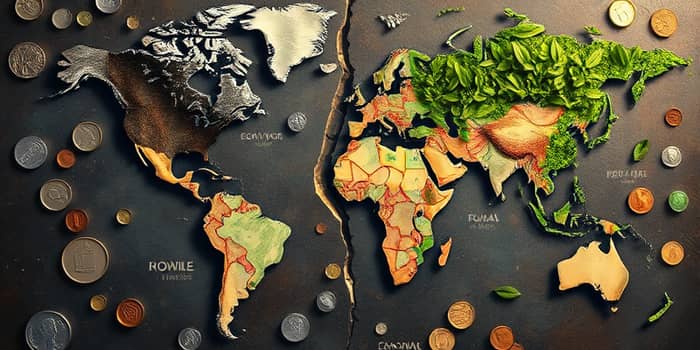
Every year, nations weigh the unseen toll of war against the promise of stability. While headlines capture battles and politics, the true cost of conflict extends far beyond battlefields.
From shattered infrastructure to soaring deficits, the economic burden of violence reshapes societies for decades. This article unveils the staggering figures, explores real-world examples, and highlights the urgent need for prevention.
Global Scale of Economic Costs
The Institute for Economics and Peace reports that violence and conflict cost the global economy $14.3 trillion in 2016, equivalent to 12.6% of global GDP. By 2017, those losses climbed to $14.8 trillion worldwide.
These figures encompass military expenditure, internal security, direct conflict losses, and criminal violence. Absent major conflict since 1960, experts estimate that the 2007 global economy would have been 15.7% larger.
Political conflicts rose from 278 in 2006 to 402 in 2016. Medium-intensity wars nearly doubled during that decade, underscoring a rising trend in turmoil.
Macroeconomic Impacts on Affected Economies
At the national level, war delivers a blow from which recovery is often elusive. Real gross domestic product typically falls 13% on average post-conflict, with no return to trend even a decade later.
Household consumption suffers an 11% decline during conflict, while exports contract by 13% and imports by 7%. Investment dries up as banks tighten credit, leading to an investment collapse of 14%.
Government budgets shift dramatically: revenues drop by 14% while expenditures remain flat but skew heavily toward military needs. Inflation often spikes by 50%, eroding purchasing power and depressing future investment.
Case Studies: Wars and Country Impacts
The Iraq War exemplifies unpredictable costs. Initial projections of $50–60 billion ballooned to over $3 trillion when veterans’ care and reconstruction were tallied.
Syria’s conflict has erased 67% of its GDP and displaced 12 million people. Prolonged fighting has left economic structures in ruins.
Between 1960 and 2007, China endured $4.8 trillion in conflict-related losses, India $2.9 trillion, and the United States $1.2 trillion. For Afghanistan, Sudan, and Israel, GDP could have more than doubled without persistent hostilities.
Ukraine’s recent struggles, with over 500,000 casualties by 2023, illustrate how large-scale war can instantly erase decades of growth.
Human Displacement and Humanitarian Costs
By the end of 2016, violent conflict had uprooted 65.6 million people—equivalent to the entire population of the United Kingdom.
This crisis strains host nations’ economies, overwhelming public services and infrastructure. Humanitarian aid becomes a major line item in budgets already stretched thin.
- Pakistan: 1.4 million refugees
- Lebanon: 1 million refugees
- Iran: 0.97 million refugees
- Uganda: 0.95 million refugees
Disparities, Winners and Losers
While war-zone countries endure devastation, some external actors benefit from increased military contracts and domestic employment.
On average, conflict losers see GDP per capita 28% lower ten years after onset. Winners experience minimal net loss, creating a stark economic divide.
Global inequality would be substantially lower in a conflict-free world, as developing nations bear the brunt of destruction and displaced populations.
Long-Term Legacy and the Value of Prevention
The legacy of conflict lingers through diminished growth trajectories, higher deficits, and persistent inflation. These effects compound, reducing convergence between rich and poor nations.
Research shows that every dollar invested in conflict prevention can save multiple dollars in reconstruction. A proactive approach—diplomatic engagement, early warning systems, and local peacebuilding—yields a substantial peace dividend.
Practical Steps for Building Economic Resilience
- Invest in community-based peace initiatives and dialogue forums
- Strengthen early warning and conflict monitoring mechanisms
- Support transparent budgeting to limit military overspending
- Promote economic diversification to reduce dependency on conflict-prone industries
- Encourage international cooperation on humanitarian and reconstruction funding
By understanding the full weight of conflict’s economic burden, we can shift the conversation from reaction to prevention. The true cost of peace is not merely the absence of war, but the active cultivation of stability, prosperity, and goodwill.
Only by investing in people, institutions, and sustainable development can societies realize the enduring benefits of peace and avert the heavy price tag of future conflicts.
References
- https://www.nber.org/papers/w34389
- https://www.weforum.org/stories/2018/01/conflict-costs-global-economy-14-trillion-a-year/
- https://www.hks.harvard.edu/publications/true-cost-iraq-war-3-trillion-and-beyond
- https://cepr.org/voxeu/columns/mapping-economic-costs-war
- https://www.visionofhumanity.org/surprising-economic-benefits-peace/
- https://insight.kellogg.northwestern.edu/article/the-economic-price-we-pay-for-war
- https://isdc.org/economic-burden-of-conflict/
- https://www.visionofhumanity.org/cost-global-violence-supports-peaceful-policies/
- https://gsdrc.org/document-library/assessing-the-economic-costs-of-war/
- https://costsofwar.watson.brown.edu/costs
- https://costsofwar.watson.brown.edu/costs/economic
- https://www.youtube.com/watch?v=vi3o6eQK8m8
- https://costsofwar.watson.brown.edu