
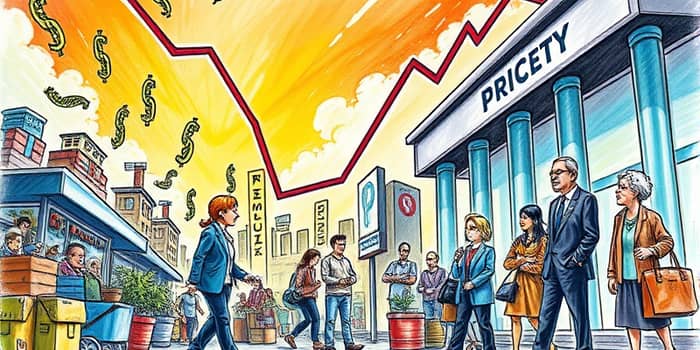
In recent years, high inflation has dominated headlines, but the shadow of deflation looms as a potential threat to global economies. As consumers and businesses adjust expectations, a decline in general price levels can spiral into stagnation, eroding confidence and stifling growth.
Understanding deflation is essential for policymakers, business leaders, and individuals alike. This article explores the root causes of deflation, its far-reaching risks, historical lessons, and concrete measures to prevent or address a deflationary downturn. Armed with knowledge, we can make informed choices to protect prosperity and livelihoods.
Understanding Deflation
Deflation is defined as a sustained decrease in price levels over time. Unlike a temporary dip in prices, true deflation persists, signaling deeper issues in demand and economic health that cannot be ignored.
Where inflation chips away at purchasing power, deflation rewards waiting and saving, as consumers anticipate even lower prices tomorrow. This shift in behavior can sap economic momentum and lead to prolonged downturns characterized by low growth and high unemployment.
Psychologically, deflation can erode business and consumer confidence. Surveys often show that when price declines become expected, spending dries up, and confidence indices fall, creating a self-reinforcing cycle that central banks find difficult to break.
For central bankers, deflation challenges conventional policy frameworks. When inflation rates dip below target, the risk of slipping into deflation triggers intense debate about the use of unconventional tools and the need for clear communication to manage expectations effectively.
Causes of Deflation
Several factors can trigger deflation, often in combination. Recognizing these causes helps in crafting responsive policies that restore equilibrium and prevent downward price spirals.
- Decreased aggregate spending due to consumer and business expectations of lower expected future prices, leading to postponement of purchases and investments.
- Resolution of supply chain disruptions or emergence of excess capacity in major sectors, such as manufacturing and commodities, driving producer prices down.
- Falling input costs raising higher real production costs when unit costs drop slower than overall price level, squeezing margins and prompting firms to cut output.
- Poor coordination of monetary and fiscal policy, which fails to support aggregate demand or sends mixed signals that undermine economic confidence.
When consumers expect persistent price declines, they may delay purchases of big-ticket items like cars or appliances, reducing demand. Businesses then cut back on hiring and capital expenditure, reinforcing the cycle of falling prices.
Excess capacity can emerge after investments in new factories or mines overshoot demand expectations. As output growth outpaces consumption, producers compete on price, fueling deflationary pressures that can take years to reverse.
Policy missteps, such as premature tightening of monetary policy or insufficient fiscal support during a downturn, can exacerbate deflation risks. Absent a timely response, deflationary expectations become entrenched, making recovery more difficult.
Economic Risks and Effects
Deflation can initiate a vicious cycle known as the deflationary spiral. As prices fall, consumers delay purchases, reducing revenues for businesses and forcing further price cuts.
This spiral manifests through several channels:
Delayed spending and weakened demand undermine investment plans and slow employment growth. Businesses postpone expansion, and households cut back on durable goods, affecting industries from automotive to housing.
Increased real debt burden hits borrowers hard. Fixed nominal debts grow in real terms when incomes and wages decline, leading to higher default risks, banking sector losses, and tighter credit conditions.
Higher real interest rates emerge even when nominal rates are at zero. For example, 0% nominal rates minus 2% deflation equals a 2% real borrowing cost, discouraging new loans and straining small and medium enterprises.
Monetary policy paralysis at zero bound leaves central banks with fewer tools to counteract downturns. Conventional rate cuts become impossible, and quantitative easing can have diminishing returns in a deflationary environment.
These dynamics keep growth subdued, push unemployment higher, and can increase inequality, as job losses weigh heaviest on vulnerable groups. Without intervention, a deflationary episode can last for years, as seen in Japan’s prolonged stagnation.
Moreover, deflationary environments tend to stifle innovation. With revenues under pressure, firms cut research and development budgets, slowing technological advancement and productivity gains over the long term.
Historical and Current Global Context
History offers stark warnings. Japan’s “lost decade” following the 1990 asset bubble collapse saw persistent deflation, sluggish growth, and repeated policy experiments that struggled to restore confidence. Unemployment peaked and productivity stagnated, leaving a generation wary of price declines.
Although global inflation remains above targets, pockets of deflation risk persist, notably in manufacturing hubs with ongoing capacity gluts or weak domestic demand, such as parts of China where producer prices have fallen.
The Great Depression offers another cautionary tale. Severe deflation in the 1930s led to massive unemployment, bank failures, and widespread hardship, underscoring the profound social costs of unchecked price declines.
Remedies and Policy Responses
Preventing deflation is more effective than attempting to cure it. The key lies in fostering credible expectations of moderate inflation and sustaining aggregate demand to avoid the trap of persistent price declines.
- Monetary policy tools: Central banks can lower rates, purchase government and private assets, or implement negative nominal rates to encourage lending and spending.
- Fiscal stimulus actions: Governments may cut taxes, increase transfer payments, or fund large-scale infrastructure projects to inject demand into the economy.
- Coordinated monetary and fiscal responses ensure policies reinforce each other, avoiding mixed signals that dampen business and consumer confidence.
Helicopter money—direct transfers to households financed by base money—remains a provocative but potent tool. Its use signals the urgency of combating deflation and can break entrenched expectations of falling prices.
Economist Paul Krugman noted, “The cure for deflation is a credible promise of future inflation,” highlighting the psychological aspect of policy effectiveness.
Business Strategies for Resilience
Even with proactive policy measures, businesses must prepare for potential deflationary pressures. Firms that adapt swiftly can weather downturns and emerge stronger when conditions improve.
- Enhance operational efficiency through automation, lean management, and digitalization, achieving cost cuts of 8–12% or more without sacrificing quality.
- Implement prudent debt management: refinance high-interest obligations, reduce leverage, and maintain healthy cash reserves to navigate tighter credit conditions.
- Pursue innovation in products and services, explore new markets, adjust pricing structures dynamically, and form strategic partnerships to boost market share.
Successful companies build flexibility into their supply chains, diversify revenue streams, and foster a culture of continuous improvement to sustain profitability even in challenging environments.
Outlook and Call to Action
Economic forecasts for 2026 project global core inflation easing toward 2.8%, with regions diverging. Some economies may slip toward disinflation or mild deflation if policy support wanes prematurely.
Policymakers must remain vigilant, ready to deploy bold and timely policy moves at the first sign of deflationary pressure. Delaying action risks entrenching negative expectations that are far harder to reverse.
For businesses and households, maintaining responsible spending and investment plans can help sustain demand and preserve confidence. Collective action by private and public sectors can ensure that economies do not succumb to the debilitating effects of falling prices.
Decoding deflation is not just an academic exercise—it is a practical necessity for anyone invested in a stable and thriving global economy. Through informed action, close coordination, and unwavering resolve, we can navigate these challenges and secure a brighter future for all.
References
- https://www.frbsf.org/research-and-insights/publications/doctor-econ/2003/05/deflation-risks/
- https://www.statista.com/statistics/256598/global-inflation-rate-compared-to-previous-year/
- https://www.ibisworld.com/blog/deflation-in-economics/99/1127/
- https://www.jpmorgan.com/insights/global-research/economy/global-inflation-forecast
- https://financialmodelslab.com/blogs/blog/deflation
- https://www.deloitte.com/us/en/insights/topics/economy/global-economic-outlook/weekly-update.html
- https://www.nber.org/papers/w9623
- https://tradingeconomics.com/country-list/inflation-rate
- https://data.worldbank.org/indicator/FP.CPI.TOTL.ZG
- https://www.imf.org/en/publications/weo
- https://www.empower.com/the-currency/money/deflation
- https://www.eiu.com/n/global-themes/global-inflation-trends/
- https://smartasset.com/investing/what-is-deflation