
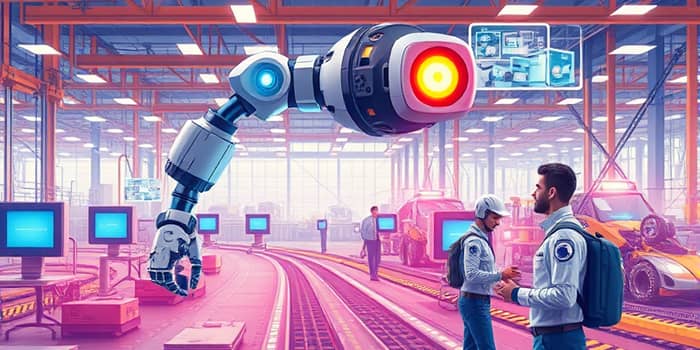
In an age defined by rapid technological evolution, the fusion of robotics and artificial intelligence is rewriting the rules of industrial production. Companies around the world are embracing automated solutions that promise higher output, improved safety, and unprecedented adaptability.
This article explores how cutting-edge innovations are reshaping manufacturing, logistics, construction, and beyond, offering inspiring insights and practical guidance for industry leaders and technology enthusiasts alike.
Market Size and Growth Projections
The global AI-powered industrial robot market reached USD 16.8 billion in 2025 and is projected to climb to USD 17.9 billion in 2026. Beyond these milestones, experts foresee sustained expansion through 2035, driven by demographic shifts and geopolitical considerations.
Persistent labor shortages in developed countries will fuel replacement of manual labor, while governments seek to onshore production and secure resilient supply chains. As a result, organizations that invest now stand to gain competitive advantage in an increasingly automated world.
Core Technological Transformations
Industrial automation is no longer confined to static, pre-programmed machinery. Today’s systems exhibit adaptability, perceptual intelligence, and autonomous decision-making—ushering in a new era of operational excellence.
Pre-programmed automation to autonomous agents represents a paradigm shift: where once robots followed rigid scripts, they now perceive, plan, and adjust on the fly.
- Perception: AI-driven vision for unstructured environments
- Decision-Making: adaptive strategies replace fixed algorithms
- Execution: real-time error recovery and online adaptation
Underpinning these capabilities are several key technologies that work in concert to enhance performance and reliability.
- Computer Vision: three-dimensional object recognition and tracking
- Machine Learning: continuous refinement through data-driven insights
- Time-Sensitive Networking integration with 5G for low-latency control
- Seamless connectivity from sensors to AGVs via IoT platforms
- Digital Twin Technology: virtual simulation for optimal planning
Industry-Specific Applications
Robotic and AI solutions are no longer theoretical—across multiple sectors they deliver measurable gains in productivity, quality, and safety.
Manufacturing: From automotive assembly to electronics production, robots handle complex tasks with sub-millimeter precision.
- Paint shop operations with consistent, even coatings
- Chassis line building featuring synchronized robotic cells
- Body assembly units performing high-speed welding
- Quality control using AI-powered object recognition
- Autonomous navigation of mobile platforms on factory floors
Next-generation systems are evolving into intelligent metrology platforms, ensuring every component meets exacting standards without human intervention.
Logistics and Automotive: Autonomous Mobile Robots (AMRs) streamline warehouse workflows, reducing dependency on fixed conveyors and manual pickers. In automotive plants, AI-guided robots enhance welding, painting, and inspection, boosting throughput and diminishing rework rates.
Heavy Industry and Construction: Pioneering projects in Denmark deploy mobile, adaptive systems to build ship hulls and modular construction components. These robots perceive changing surroundings, make split-second decisions, and navigate rugged sites, improving safety and minimizing material waste.
Operational Benefits
Across every application, robotics and AI unlock transformative advantages:
Enhanced Efficiency: Automated cycles run continuously with minimal variation, delivering consistent quality and higher output per shift.
Real-Time Decision-Making: Intelligent systems autonomously adjust production flows in response to sensor data, reducing delays and bottlenecks.
Cost Reduction: Emerging Robotics as a Service (RaaS) models lower the barrier to entry, enabling companies to adopt high-end automation without massive upfront investment.
Safety Improvements: Hazardous or repetitive tasks transition from humans to machines, decreasing workplace injuries and improving morale.
Precision and Agility: Advanced robots achieve tolerances and responsiveness previously unattainable, supporting customized production runs and rapid changeovers.
Market Drivers
Several converging forces are accelerating adoption of AI-enabled robotics:
Software-Defined Automation Innovations driving demand for flexible, upgradeable systems.
Strategic mergers and acquisitions are consolidating expertise and expanding technology portfolios. Decarbonization goals push industries to replace legacy equipment with efficient, electrified robots. At the same time, an aging workforce intensifies labor shortages in developed economies, prompting a shift to automated labor.
Key Industry Players and Initiatives
Leading organizations are shaping the future of intelligent automation:
FANUC Corporation collaborates with NVIDIA, integrating the ROS 2 platform to deliver ‘‘Physical AI’’ capabilities across diverse environments. Neural Foundry and NEURA Robotics embed cognitive functions into factory robots, enabling dynamic task planning. Boston Dynamics champions Robotics as a Service, while Siemens explores next-generation scenarios in its Tech Trends 2030 initiative. Recycling pioneer Novelis applies AI-driven robotics to streamline material recovery and manufacturing.
Implementation Challenges and Barriers
Despite widespread enthusiasm, deployment hurdles remain significant:
Data Quality concerns arise when training AI on limited or biased datasets, undermining performance. Integration of new robotic cells into legacy production lines demands specialized expertise and custom interfaces. Cybersecurity risks escalate as interconnected systems become more prevalent, requiring robust safeguards to prevent malicious interference.
Emerging Trends
Looking ahead, several innovations promise to further transform industrial robotics:
Independent decision-making capabilities in autonomous systems will grant robots higher autonomy and reduced human oversight. 3D vision-language models will allow seamless interpretation of visual and textual data. Tactile sensors will enhance dexterity for delicate assembly tasks. The RaaS business model will expand, democratizing access to advanced robotics. Open-source ecosystems like ROS 2 will foster broader community-driven development and rapid experimentation.
As these trends converge, robotics and AI will no longer be niche solutions—they will become integral to every stage of industrial production, driving resilience, sustainability, and innovation.
For businesses aiming to thrive in this new landscape, the time to invest in intelligent automation is now. By understanding the market dynamics, embracing core technologies, and preparing for emerging challenges, organizations can unlock new levels of performance and secure a leading position in the industries of tomorrow.
References
- https://newyork.theaisummit.com/latest-news/how-is-ai-and-robotics-are-helping-to-boosting-efficiency/
- https://www.oaepublish.com/articles/ir.2026.01
- https://trendsresearch.org/insight/ai-and-robotics-transforming-industrial-automation/
- https://www.deloitte.com/us/en/insights/industry/technology/technology-media-and-telecom-predictions/2026/ai-for-robots-drones.html
- https://www.weforum.org/stories/2025/05/robotics-heavy-industry-automation/
- https://www.youtube.com/watch?v=ew-XzmBsHNg
- https://www.gminsights.com/industry-analysis/ai-powered-industrial-robot-market
- https://www.siemens.com/en-us/company/insights/tech-trends-2030-next-era-industrial-robotics/
- https://www.youtube.com/watch?v=DjtFW4v9A_c
- https://www.assemblymag.com/articles/99828-ai-remains-the-hottest-trend-in-robotics
- https://www.youtube.com/watch?v=JUGgvmU27sQ
- https://www.newark.com/robotics-and-ai-integration-transforming-industrial-automation-trc-ar?ICID=I-LP-AI_HUB-FEARES-ARTICLE10-WF3767361
- https://www.automate.org/robotics/emerging-markets/emerging-markets-in-robotics