
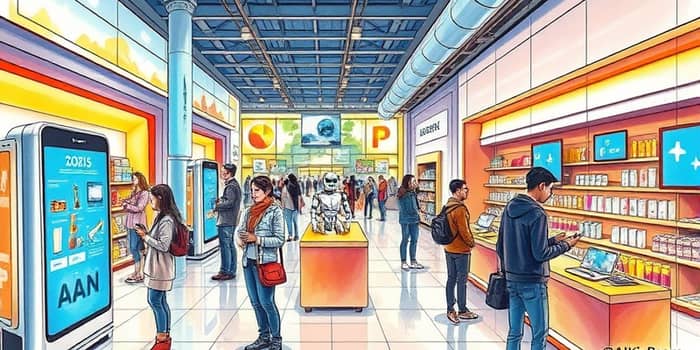
As digital commerce matures, retailers must shift from piling on new tools to forging a resilient, execution-driven foundation. 2026 marks a decisive moment where the integration of advanced technologies, operational rigor, and customer-centric strategies converge to define success. This next chapter in retail is not just about innovation for its own sake—it’s about mobilizing data and automation to deliver seamless omnichannel experiences that delight customers at every touchpoint.
Across industries, top performers are unifying their digital and physical ecosystems, leveraging AI at scale, and adopting sustainable practices that build trust. By learning from pioneers, retailers can craft a roadmap for growth that balances agility with execution excellence.
AI Revolution: Search, Discovery, and Conversational Commerce
At the forefront of this transformation is the explosion of AI-powered search, discovery, and commerce. Generative AI is redefining interactions, allowing consumers to speak in natural language and receive instant product recommendations without a single click.
Statistics illuminate the scale of this shift: 27% of consumers are excited by real-time deal comparisons, while 43% expect brands to use AI to enhance their shopping experiences. In fact, SEMrush forecasts that AI-driven search will surpass traditional methods by 2028, fundamentally altering the path to purchase.
Agentic AI—autonomous agents that research, compare, and even place orders—emerges as the next frontier. Retailers like Marriott’s Homes & Villas division have already deployed natural language AI search, simplifying vacation planning. Meanwhile, H&M’s RFID-and-AI connected fitting rooms blend digital insights with physical trials, boosting conversion and reducing returns.
Hyper-Personalization and Elevated Customer Experience
In a world saturated with choice, personalization has become a powerful loyalty driver. Consumers demand interactions that feel curated to their tastes and contexts. Research shows 67% of shoppers want hyper-personalized shopping interactions, and 71% expect tailored recommendations when exploring travel or dining options.
Leading retailers are investing heavily to meet these expectations. Target’s 2026 roadmap includes a $2 billion outlay—over $1 billion in capital expenditures and $1 billion in operations—to enhance AI-fueled personalization and trend-forward assortments. By predicting needs and anticipating life events, these systems craft dynamic offers that resonate on a one-to-one basis.
Omnichannel and Unified Commerce: One Data Source, Infinite Journeys
The lines between online and offline are blurring as unified commerce platforms integrate inventory, customer profiles, and fulfillment options into a single source of truth. Google Cloud’s partnership with Shopify exemplifies how data-driven, AI-enhanced tools can scale retailer operations globally.
Highlights from CES 2026 underscored this trend: AI-powered pop-up stores, content-to-commerce pipelines, and social shopping experiences are now mainstream topics. Sessions led by AWS, Target, and Walmart executives detailed strategies for crafting cohesive experiences, whether customers browse on Instagram, try on in-store, or purchase via voice assistants.
Social Commerce and the Creator Economy
Social media platforms are maturing into full-fledged retail channels. TikTok, Instagram, and YouTube enable in-app checkouts, live shopping events, and shoppable videos that spark instant sell-outs. User-generated content fuels authenticity, while creator partnerships drive community engagement.
Retail media networks, once a sidebar, are now central to growth strategies. By placing targeted ads alongside organic posts and curated livestreams, brands capture attention without disrupting the social experience.
Operational Backbone: Fulfillment, Transparency, and Sustainability
Behind every great customer experience lies a robust operational foundation. Reliable fulfillment, real-time inventory visibility, and connected supply chains are non-negotiable.
- Implement digital product passports to trace origins and materials.
- Apply AI-driven forecasting to minimize stockouts and overstocks.
- Embed ethical branding and sustainability metrics into every SKU.
Europe’s regulatory environment is catalyzing transparency, compelling brands to publish lifecycle data and adopt circular economy practices. As consumers become more eco-conscious, sustainability shifts from buzzword to brand imperative.
Emerging Tech Frontiers: AR/VR, Voice, and Beyond
Immersive technologies are reshaping product interaction. Augmented reality allows customers to preview furniture in their living rooms; virtual try-ons eliminate the guesswork of apparel shopping. Voice assistants handle simple reorders, while mobile wallets and subscription models streamline checkout.
As 5G expands, rich media experiences will load instantaneously, further blurring the line between digital demos and physical trials. Retailers who pilot these technologies today gain a competitive edge tomorrow.
Case Studies: Lessons from Industry Leaders
Target’s Beauty Studio integrates AI mirrors that analyze skin tone and suggest product matches in real time. H&M’s smart fitting rooms use RFID tags to recommend complementary styles. Marriott’s Homes & Villas employs generative AI to craft personalized travel itineraries based on subtle user inputs.
Each example illustrates a shared principle: technology must be purposeful, not ornamental. When AI addresses genuine pain points—speeding up decisions, reducing returns, enriching discovery—it elevates the entire brand experience.
Actionable Insights for Forward-Thinking Retailers
Adopting these trends requires a clear roadmap. Begin by strengthening data hygiene—clean, unified customer and inventory records are the bedrock of every AI initiative. Build cross-functional teams that align merchandising, marketing, and operations around shared KPIs.
- Audit existing technology stack and retire redundant systems.
- Invest in scalable, cloud-native platforms that support real-time data flows.
- Pilot generative AI for high-impact scenarios like customer service.
- Measure results rigorously and adjust strategies in iterative cycles.
Above all, maintain a culture of experimentation balanced by disciplined execution. The retailers who thrive in 2026 will be those who harness the power of AI and unified commerce without losing sight of operational excellence and social responsibility.
Looking Ahead: The Future of Retail is Human and Machine
As we move forward, the most successful retailers will be those that weave together technology, empathy, and sustainability into a coherent narrative. Agentic commerce, sustainable transparency, and immersive experiences will become table stakes, not luxuries.
By prioritizing customer delight, operational rigor, and ethical stewardship, brands can craft compelling journeys that foster loyalty and drive growth. The next chapter in retail is not written in code alone—it’s composed of every interaction, every delivery, and every moment of unexpected joy.
References
- https://distillery.com/blog/ecommerce-trends-to-watch-in-2026/
- https://www.ces.tech/press-releases/retailers-gather-at-ces-2026-to-discover-innovations-shaping-consumer-behavior
- https://www.coursera.org/articles/ecommerce-trends
- https://poweringthenextchapterinretail.cio.com
- https://www.publicissapient.com/resources/blog/future-ecommerce-trends
- https://corporate.target.com/press/release/2026/03/target-outlines-strategic-plan-for-a-new-chapter-of-growth-in-2026-and-beyond
- https://www.akeneo.com/blog/2026-ecommerce-trends/
- https://www.youtube.com/watch?v=dFT4kTvjPv0
- https://www.smartcommerce.com/whitepapers/the-2026-ecommerce-trends-report
- https://www.nexchapter.com/capabilities
- https://www.mollie.com/growth/biggest-ecommerce-trends
- https://www.nexchapter.com/aboutus
- https://tgmresearch.com/e-commerce-insights-2026.html
- https://podcasts.apple.com/us/podcast/the-future-of-retail-innovation/id1549753157?i=1000676899838