
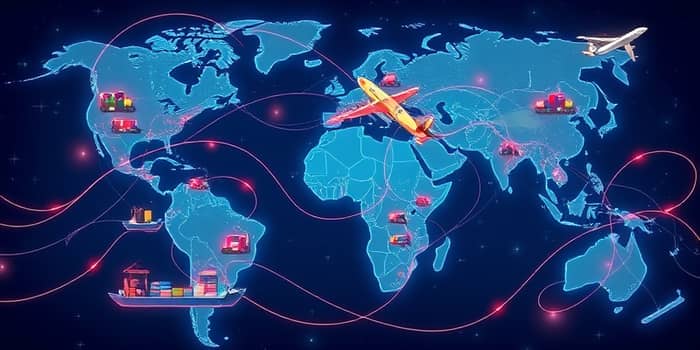
In 2025, global trade reached a record $35 trillion in 2025, defying the conventional wisdom that high tariffs and geopolitical tensions would stifle growth. Despite a complex web of protectionist measures and fragmented value chains, trade expanded by 7%, underscoring both resilience and underlying volatility in the world economy.
As we look ahead to 2026, growth is expected to moderate to around 2.2%, but the path forward will be shaped by strategic decisions, technological innovation, and the ability to adapt to shifting alliances. Businesses, policymakers, and communities alike must understand these dynamics to thrive in an ever-changing marketplace.
Understanding the Shifts in Global Trade
Two of the most powerful forces reshaping trade are tariffs and geopolitical realignment. Governments have increasingly adopted tariffs as strategic tools, targeting industries such as semiconductors, minerals, and automobiles. Meanwhile, firms are responding with geopolitical fragmentation and value chain reconfiguration, prioritizing resilience over pure cost efficiency.
The rapid rise of AI and digital technologies has proven a countervailing force. AI-related trade—particularly in semiconductors and data-center equipment—accounted for over one-third of all trade growth in 2025. This AI-related trade driving growth highlights the central role of innovation in sustaining expansion, even as traditional goods sectors face headwinds.
Market Winners and Losers in 2025–2026
Some economies and sectors have captured new opportunities, while others confront significant setbacks. Identifying these trends is essential for stakeholders aiming to harness emerging strengths or mitigate risks.
These shifts reflect a broader rebalancing: Asia’s emerging economies are expanding their manufacturing roles, while traditional exporters in Europe and North America face tougher competition and higher barriers. South-South trade, particularly between Africa and Latin America, offers a promising avenue for diversification.
Proven Strategies for Businesses
Companies that navigated the turbulence in 2025 successfully embraced agility, diversification, and digital transformation. To build on these lessons, consider the following approaches:
- Adopt nearshoring and diversification strategies to spread risk across multiple suppliers and regions.
- Invest in digital infrastructure and AI capabilities to capture growth in tech-driven segments.
- Monitor policy shifts closely, especially non-tariff measures like environmental and security-based controls.
- Forge strategic partnerships to access new markets, including South-South corridors and regional trade agreements.
- Enhance supply chain transparency to anticipate disruptions and ensure compliance with changing standards.
Building Resilience and Inclusivity
Resilience in global trade goes beyond corporate profit. Small and medium-sized enterprises (SMEs), developing economies, and local communities must find pathways to participate and benefit. By promoting flexible non-tariff measures, capacity-building programs, and targeted aid, stakeholders can foster inclusive trade partnerships that safeguard livelihoods and spur sustainable growth.
Policymakers should also prioritize stability by reducing policy volatility. Clear, predictable regulations encourage investment and innovation, while unpredictable swings in tariffs or export controls can derail long-term plans.
Practical Steps for Navigating the Future
As 2026 unfolds, businesses and governments can take concrete actions to stay ahead:
- Conduct scenario planning exercises to prepare for alternative tariff regimes and trade alliances.
- Leverage regional trade agreements to offset national barriers and tap into growing markets.
- Scale up digital trade by streamlining cross-border data flows and investing in secure infrastructure.
Looking Ahead: Embracing Change
The coming years will test the agility of markets and the vision of leaders. Fragmentation may generate short-term pain, but it also fosters innovation, new partnerships, and resilient ecosystems. By adopting a mindset of continuous adaptation and prioritizing both efficiency and resilience, stakeholders can transform challenges into opportunities.
Global trade is not a static arena but a living tapestry woven from policies, technologies, and human ingenuity. Let us embrace its dynamism, learn from the winners, support those under pressure, and forge a more connected, equitable, and thriving global economy.
References
- https://unctad.org/news/10-trends-shaping-global-trade-2026
- https://www.atlanticcouncil.org/dispatches/five-trends-to-watch-in-the-global-economy-in-2026/
- https://www.mckinsey.com/mgi/our-research/geopolitics-and-the-geometry-of-global-trade-2026-update
- https://www.un.org/en/desa-en/wesp-2026
- https://www.fibre2fashion.com/news/textile-news/us-tariff-shifts-create-new-trade-winners-losers-unctad-308393-newsdetails.htm
- https://internationalbanker.com/finance/global-trade-shifts-ahead-in-2026/
- https://www.youtube.com/watch?v=AbcfTAajDbY
- https://www.euronews.com/business/2026/03/26/the-biggest-winners-and-losers-of-the-tariff-war-as-ai-related-trade-skyrockets
- https://www.allianz-trade.com/en_SG/insights/risk-management/winners-vs-losers-which-sectors-are-vulnerable-in-2026.html