
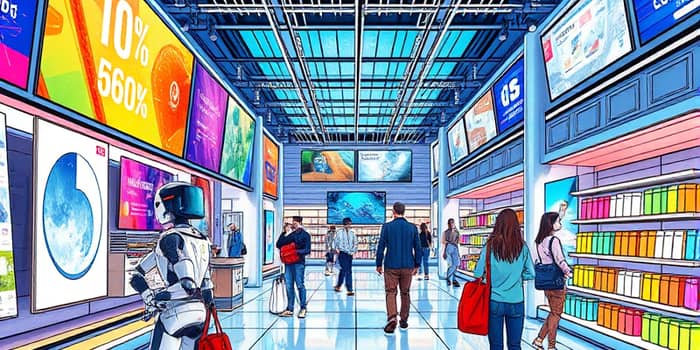
In an era of rapid innovation and shifting consumer demands, the retail landscape is transforming at an unprecedented pace. Data-driven insights are charting the course for retailers, guiding strategic investments and shaping tomorrow’s shopping experiences.
AI Adoption: The Engine of Modern Retail
Across the globe, retailers are investing heavily in artificial intelligence to power both front-line engagement and back-office efficiency. In 2025, 87% of retailers have already deployed AI in at least one business area, from merchandising to customer service.
These investments span multiple applications:
- Real-time inventory optimization and pricing to match supply with evolving demand.
- Chatbots and virtual assistants delivering instant support and product recommendations.
- Predictive analytics forecasting future trends and stocking requirements.
Looking ahead, Gartner projects that by 2026, 40% of enterprise apps will include task-specific AI agents. The emergence of “agentic AI” is reshaping supply chains into self-governing networks capable of dynamic decision-making.
Value-Seeking Consumers: A Structural Shift
Economic pressures and heightened deal sensitivity have driven a profound change in consumer behavior. Today, four in 10 Americans now demonstrate deal-driven habits, evaluating purchases not only on brand but on cost and overall value.
As a result, private-label brands are no longer relegated to generic offerings. By 2025, private-label sales are projected to hit $277 billion, driven by retailers like Walmart, which introduced BetterGoods, its largest private brand food launch in two decades.
Consumers are seeking differentiated flavor profiles and premium ingredients at lower price points. The private-label revolution is fostering new levels of brand loyalty based on quality and affordability rather than marquee names alone.
Mobile and E-Commerce: An Unstoppable Rise
E-commerce continues its meteoric ascent. Total online retail sales are expected to grow from $6.4 trillion in 2025 to $7.9 trillion by 2028. Mobile devices are driving much of this expansion.
During the 2025 peak season, 63% of total revenue originated from mobile devices—a 6% year-over-year increase. Shoppers increasingly prefer convenient, on-the-go purchasing, with mobile-first experiences integrated seamlessly into social media and chat platforms.
Big Data & Analytics: Retail’s New Backbone
Data analytics is transforming raw information into strategic advantage. Retailers deploy four key types of analytics:
- Descriptive analytics unveiling historical performance patterns.
- Diagnostic analytics explaining the reasons behind trends.
- Predictive analytics forecasting demand and consumer behavior.
- Prescriptive analytics recommending optimal pricing and inventory.
By leveraging data-driven personalization at scale, retailers can tailor recommendations, promotions, and communications to individual preferences, bolstering both conversion rates and customer loyalty.
The Physical Retail Renaissance
Despite the e-commerce surge, brick-and-mortar stores are experiencing a revival. Indoor malls saw a 1.8% increase in visits in the first half of 2025, and visit durations rose by 3.3% compared to 2024.
Retailers are reinventing physical spaces as experiential hubs. Walmart’s “Stores of the Future” initiative plans to remodel over 650 locations, incorporating QR code engagement, expanded curbside pickup, and in-store digital activations to create seamless omnichannel customer journeys.
Omnichannel: Bridging Worlds
The concept of “Phygital 2.0” underscores the dissolution of barriers between online and offline retail. Shoppers can research in-store, order online, and choose from delivery or in-store pickup with equal ease.
As retailers unite physical and digital shelves, the shopping journey becomes a continuous loop of discovery and fulfillment, unlocking new moments of engagement and revenue growth.
Economic Headwinds and Strategic Resilience
External pressures, including tariffs and immigration policy shifts, threaten to dampen consumer spending power. Inflationary pressures may compress margins and slow hiring growth.
Yet, optimism endures: 96% of global retail executives anticipate revenue growth in 2026, and 81% expect margin expansion. Massive investments in AI infrastructure and automation promise to bolster productivity, even in challenging macroeconomic conditions.
Looking Ahead: Future Trends
Key innovations on the horizon include:
- Invisible AI creating frictionless customer experiences behind the scenes.
- Searchless retail powered by generative engine optimization.
- Trust as a profit driver through radical transparency and contextualized care.
By embracing these trends, retailers can position themselves at the forefront of a dynamic, consumer-centric marketplace.
In an industry defined by change, data offers the compass that guides retailers toward profitable growth and lasting customer loyalty. By decoding these trends and acting decisively, businesses can craft inspiring experiences that resonate with the value-seeking, tech-savvy consumer of today and tomorrow.
References
- https://www.yellowfinbi.com/blog/data-analysis-for-the-retail-industry-part-1
- https://www.smurfitwestrock.com/blog/top-retail-trends-of-2026-what-to-expect
- https://resources.industrydive.com/2026-retail-trends
- https://www.deloitte.com/us/en/insights/industry/retail-distribution/retail-distribution-industry-outlook.html
- https://partnerize.com/resources/blog/decoding-peak-2025-key-retail-trends-from-october-1st-november-11th
- https://www.capgemini.com/us-en/insights/research-library/retail-trends-2026/
- https://us.moodmedia.com/blog/industry-lens/navigating-the-retail-landscape-in-2026/
- https://nrf.com/blog/10-trends-and-predictions-for-retail-in-2026
- https://www.youtube.com/watch?v=nhYq9vE6yog
- https://edited.com/blog/demystifying-data-and-analytics-a-guide-to-retail-insights-and-growth/
- https://www.salesforce.com/au/retail/retail-industry-trends/