
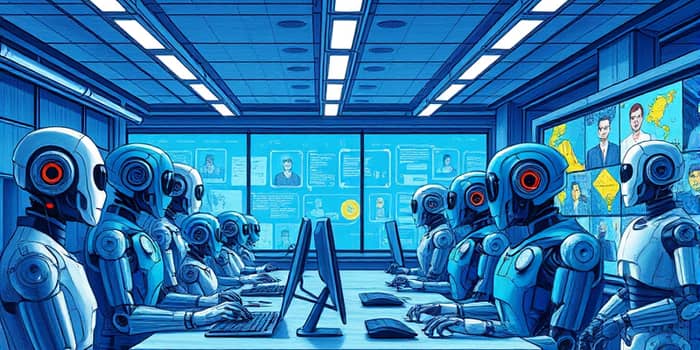
Today, organizations stand at the intersection of unprecedented technological advancement and shifting human expectations. As AI systems mature and remote work becomes embedded in corporate DNA, both opportunities and challenges emerge at an accelerated pace. In this in-depth exploration, we look at the forces reshaping jobs, skills, and market structures, and how individuals and firms can navigate these changes to thrive in a world defined by automation, flexibility, and human ingenuity.
Technological Transformations and the Rise of AI
By 2030, automation is projected to transform millions of roles, displacing routine positions while creating new pathways for knowledge work and machine supervision. AI will automate routine tasks across industries, from manufacturing lines to administrative offices. McKinsey compares this shift to past industrial revolutions, warning that pandemic-era acceleration has left 32–42% of lost jobs unlikely to return without strategic intervention.
Generative AI tools are scaling rapidly: Gartner forecasts that over 80% of enterprises will adopt such systems by 2026. At the same time, the World Economic Forum predicts that 50% of professions need reskilling by 2025, with millions of low-education workers at risk of job loss by the mid-2030s. These dual forces of innovation and vulnerability demand a balanced response from leaders.
Consider a retail cashier facing an automated checkout wave: by 2030 many will pivot from scanning items to troubleshooting kiosks, guiding customers, and managing inventory systems. Millions of workers must reinvent roles by embracing new tasks and collaborating with AI partners in real time.
The Evolution of Work Models
What began as a remote-work experiment during the pandemic has solidified into a lasting paradigm shift. Today, organizations embrace structured flexibility across work locations, blending in-office collaboration with offsite autonomy. This hybrid approach aims to capture the best of both worlds: spontaneous team innovation and personalized focus time.
- Remote-capable: 40% of employees can work entirely offsite
- Hybrid model: 27% split time between home and office
- Fully remote: 12% operate without an assigned office
Yet “hybrid creep” is on the rise: in-office days climbed to 4 per week for 34% of hybrid workers, up from 23% in 2023. As return-to-office mandates intensify, remote work has transformed from a cost-saving measure into a premium perk, becoming a key talent attractor amid global competition.
Reskilling, Upskilling, and Human-Centric Skills
The rapid pace of change underscores the imperative for continuous learning. WEF data shows that 50% of workers must develop new skill sets in the next five years to stay relevant. Employers and educators must partner to deliver accessible training pathways, from microcredentials to immersive apprenticeships.
Gen Z, the emerging majority in the workforce, prioritizes emotional intelligence and creative problem-solving over purely technical abilities. Organizations are responding by weaving “power skills” into job descriptions, recognizing that AI excels at calculation but cannot replicate genuine human connection or imaginative insight.
- Emotional intelligence
- Creativity
- Resilience
- Curiosity
Building these capabilities requires fostering safe environments for experimentation, feedback loops, and storytelling that highlights individual growth journeys.
Impacts on Market Dynamics
AI adoption correlates with tangible business gains. Research links intelligent automation to a 6% higher employment growth and a 9.5% increase in sales over five years. Firms embracing skills-based, outcome-focused work models often outrun competitors, reinvesting efficiency gains into innovation and workforce expansion.
However, the flip side includes wage polarization and income inequality, as high-cognitive roles command rising premiums while routine positions stagnate. Tax policies like the 2017 Tax Cuts and Jobs Act, which favor equipment depreciation over payroll expenses, have further fueled this divide.
As AI reshapes roles, labor shifts favor those with digital fluency and cross-functional experience. With AI-powered recruitment tools screening resumes, candidates must showcase tangible achievements to stand out. Continuous learning as daily rhythm will define the most resilient careers of tomorrow.
Strategies for Navigating the Future
Leading organizations are establishing AI governance frameworks, risk audits, and ethical guidelines to balance innovation with responsibility. Only 26% of executives report confidence in managing AI risks, underscoring the need for transparent oversight and stakeholder engagement.
- Implement AI governance frameworks
- Foster workplace wellbeing ecosystems
- Encourage apprenticeships and mentoring programs
Policymakers must also modernize tax structures and education incentives to support perennial learning and AI fluency. Public–private partnerships can underwrite reskilling initiatives, ensuring that displaced workers receive timely, relevant training.
Looking Ahead: A Human-Centered Future
The workplace of 2030 will feel both familiar and extraordinary. AI teammates will handle data synthesis while humans focus on strategic vision, relationship building, and creative leaps. Offices may evolve into wellbeing hubs, offering holistic support that nurtures mental, physical, and social health.
Ultimately, success in this new era hinges on embracing change with optimism and purpose. By investing in technology responsibly, cultivating human-centric skills, and designing equitable policies, we can forge a future where productivity gains uplift individuals and societies alike. The choices we make today will define the legacy of work for generations to come.
References
- https://www.mckinsey.com/featured-insights/future-of-work
- https://careerlaunchpad.arcadia.edu/blog/2026/01/23/2026-work-trends-10-experts-predict-the-future-of-work/
- https://hatchery.emory.edu/articles/future-work-automation.html
- https://leadershipcircle.com/blog/workplace-trends-2026/
- https://www.weforum.org/publications/the-future-of-jobs-report-2025/
- https://www.prsa.org/article/6-workplace-trends-shaping-2026-jan26
- https://mitsloan.mit.edu/ideas-made-to-matter/how-artificial-intelligence-impacts-us-labor-market
- https://www.youtube.com/watch?v=qulCIGxnTUs
- https://www.anthropic.com/research/labor-market-impacts
- https://www.gensler.com/blog/10-workplace-trends-for-2026-whats-in-and-whats-out
- https://www.exams.vnu.edu.tw/insights/Maximize-Earnings-with-DeFi-Strategies-and-Cross-Chain-Bridges-with-Stablecoin-F
- https://www.oecd.org/en/topics/future-of-work.html