An insurance policy declaration page is a one- or two-page summary that lists who is insured, what vehicles or property are covered, the limits and deductibles for each coverage, the policy period, the premium charged, and any endorsements attached. Reading it takes about fifteen minutes once you know the field order. This guide walks through that order, section by section.
The reason to bother is simple. An adjuster, lender, landlord or attorney starts with this page, not with the forty pages of policy text behind it. A wrong limit, a missing household driver or an expiration date that passed quietly while your mail kept coming can turn a covered loss into an expensive one.
What follows applies to personal auto, homeowners, renters and life policies, with a note at the end about umbrella coverage. Rules, forms and minimums vary by state and by carrier, so treat the field names as the standard and the wording on your own document as the final word. Nothing here is personal insurance advice. Last reviewed for 2026.
Table of Contents
- What You Need
- Step-by-Step: How to Read an Insurance Policy Declaration Page
- Start With the Policy Identification Section
- Confirm the Coverage Types and Effective Dates
- Read the Limits, Deductibles, and Coverage Amounts
- Check Exclusions, Riders, and Endorsements on the Declarations Page
- Verify Premiums, Discounts, and Payment Details
- Find the Claim Instructions and Contact Information
- Common Mistakes
- Frequently Asked Questions
- Can I use my declarations page as proof of insurance?
- Is a certificate of insurance the same as a declarations page?
- How do I get my declarations page if I only received an insurance card?
- How often do I get a new declarations page?
- Why did my premium change on renewal even though nothing changed?
- What should I do if I find an error on my declarations page?
- Conclusion
What You Need
Pull these together before you open anything. Ten quiet minutes with the right documents saves an hour of back-and-forth with the carrier later.
- The current declarations page. Usually a PDF in your carrier’s app or web portal, often tucked under a Documents tab. If all you have is an insurance card, you do not have the declarations page yet.
- The previous year’s declarations page. This is the single most useful item on the list. Renewal changes are almost impossible to spot without a side-by-side comparison.
- The full policy booklet. Most carriers deliver it as a PDF or a printed packet with the dec page stapled to the front.
- Other policies you hold. Auto, home, renters and umbrella coverages often coordinate, and limits on one page can be affected by a clause on another.
- A household list. Every licensed driver, every vehicle, and anything you insure for a specific value: boats, RVs, jewelry, bikes, instruments.
- A calculator and a pen. Deductible math and per-person versus per-occurrence arithmetic get confusing fast on screen.
- Contact details. Your agent’s name and phone number, the carrier’s claims line, and your state department of insurance complaint line.
One practical habit: save every dec page you receive as a dated PDF in a folder on your desktop. Claims are often disputed months after the fact, and insurers routinely reference the policy in force on the date of the incident rather than today’s policy.
Step-by-Step: How to Read an Insurance Policy Declaration Page
Read top to bottom, left to right, the way the document is laid out. If you follow the same path every time, you stop missing fields after the first policy.
Start With the Policy Identification Section
The header block identifies whose policy this is and when it runs. Read the named insured name character by character and compare it to your driver’s license or ID, since a middle initial or a misspelled surname can cause a claim to be questioned later.
Next, write down the policy number, the form and edition numbers, and the policy period. A policy period is written as two timestamps, often something like 12:01 AM on the effective date to 12:01 AM on the expiration date. The one-minute gap between the two periods is deliberate: your old policy ends at 12:01 AM and the new one picks up coverage at that same second, leaving no gap and no overlap.
Check the named insured address against where you actually live. Carriers use the address to set rating territory, apply municipal or ZIP-based surcharges, and determine which state statutes apply. A leftover previous address is common and usually harmless, but it is worth correcting if you have moved within the same state.
Contact the insurer straight away if the named insured is not you, the policy period does not cover the date you are worried about, the policy number does not match the one on your other documents, or the billing address belongs to someone else.
Confirm the Coverage Types and Effective Dates
The coverage section is the heart of the page. Each line names a coverage, its limit and the amount of premium allocated to it. Go down the list and confirm every line matches what you believe you bought.
On an auto policy you will normally see bodily injury liability, property damage liability, uninsured and underinsured motorist, medical payments or personal injury protection, collision, comprehensive, and sometimes rental reimbursement and roadside assistance. On a homeowners policy the familiar lines are Coverage A for the dwelling, Coverage B for other structures, Coverage C for personal property, and loss of use for additional living expenses. A renters policy is mostly Coverage C, since there is no dwelling to insure.
The premium figure next to each line is a clue. If comprehensive is listed at a suspiciously small allocation on a vehicle that has never been driven in a storm-prone area, ask about it. Some carriers fold optional coverages into a single bundle line, so a short list does not automatically mean thin coverage.
Note the dates where each coverage takes effect and where it ends. Mid-term changes, such as adding a newly purchased vehicle, usually produce a revised page with its own effective date. Watch specifically for a policy that starts in the future, which is what happens when you buy a policy online before a vehicle’s registration or a home’s closing date.
Read the Limits, Deductibles, and Coverage Amounts
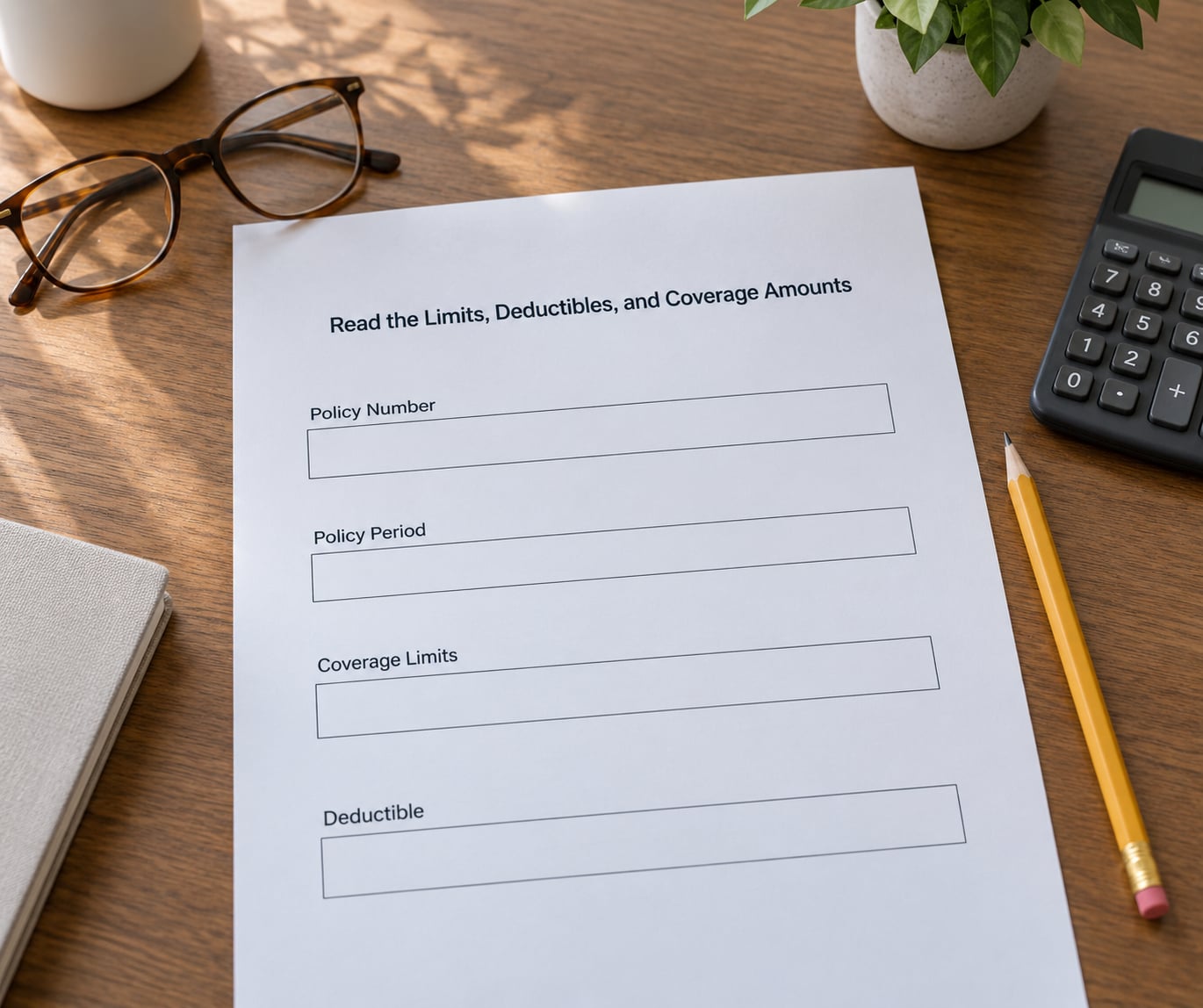
This is where policyholders get the most confused, so slow down here. Three different ideas wear the same clothes on this page: limits, deductibles, and coinsurance.
A coverage limit is the most the insurer will ever pay for that coverage, no matter what the loss costs. Liability limits are usually written as three numbers, and the notation is worth memorizing because it recurs everywhere in auto insurance.
Take 25/50/15. The first number is 25,000 per person for bodily injury to one individual. The second is 50,000 total per accident, which is the ceiling across all injured people in a single crash. The third is 15,000 for property damage to the other vehicle and its contents. The most common criticism of minimum limits is not the per-person figure but the per-accident ceiling: three people injured at 30,000 each produces a 90,000 claim against a 50,000 cap, and the injured party absorbs the difference.
Higher limits follow the same logic. A 100/300/100 policy pays up to 100,000 per person, 300,000 per accident, and 100,000 for property damage. Plenty of financially healthy households carry 250,000 or 500,000 per person, which is cheap relative to what a serious injury claim can reach.
Two more limit styles to recognize. Per occurrence means each separate event gets the full limit, so three separate accidents could each trigger the maximum. Aggregate means one maximum across the policy term, so the first large claim eats the room and the second gets nothing. Reading the word beside the number, not just the number, is the whole trick.
A deductible is the part of the loss you pay before coverage starts, and it applies to your own property, not to liability for damage you cause others. Auto policies often carry two different deductibles, one for collision and one for comprehensive, and they can differ. Home policies usually quote a percentage instead, such as 2 percent of Coverage A, which means the deductible rises or falls with the insured value of the building.
Work the arithmetic on a specific example rather than trusting the shape of the numbers. Say a home insured at 400,000 with a 2 percent deductible, where the tornado takes out the roof and interior. The deductible is 8,000. If the insurer’s estimate puts the repair at 62,000, your share is 8,000 and the insurer’s is 54,000, subject to whether your policy settles at replacement cost or the lower actual cash value.
Coinsurance is the percentage share you pay after the deductible, common in health plans, and it matters because it scales with the bill. Copays are flat amounts for a defined service. Maximum benefits are the hard ceiling on an entire policy period, often on medical payments or loss of use. Whatever the label, find the dollar figure, find the unit it attaches to, and find the time period it applies to.
Check Exclusions, Riders, and Endorsements on the Declarations Page
Here is the distinction that trips up new policyholders: the declarations page is a summary, not the contract. The contract is the policy booklet plus every endorsement attached to it. The dec page tells you that coverage exists and at what limit; the booklet and its riders say exactly what is covered, what is excluded and what conditions apply.
Endorsements matter because they cut both ways. One can broaden coverage, such as a rideshare endorsement, a home business endorsement, a flood endorsement, or scheduled coverage for a wedding ring. Another can narrow it, such as a waiver of collision deductible or an exclusion for a specific hazard. An exclusion means the carrier will not pay for that cause of loss, even though your other coverages remain in force.
The declarations page usually lists endorsements as coded printouts rather than titles. Expect a line such as FE09 or a form number and edition. Look those codes up against the form index in your policy booklet; the booklet identifies what each form does. If you cannot find a matching form, the endorsement may have been referenced but never actually issued, which is worth raising.
Read any additional insured, loss payable and mortgagee clauses on a homeowners page with care. A loss payable clause directs the settlement of a claim to a named party, usually the mortgage holder, so the check goes to them and they release it to you. That is normal on a mortgaged home and is not a sign that your coverage is weaker.
Verify Premiums, Discounts, and Payment Details
The billing block shows the total premium, how often it is due, and the payment method. Monthly installments usually add a small fee compared with paying the annual total, so the annual figure and the monthly figure are not simply divided by twelve.
Look at the discount lines. Safe driver, good student, multi-policy bundling, paperless, autopay, low mileage, professional occupation and membership discounts all commonly appear here, and they are easy to lose when you buy a policy online without an agent. If a discount you expected is missing, ask what the carrier needs to apply it.
Compare the total against your billing statement rather than against last year’s memory. A renewal that jumps by 150 to 200 dollars is often explained by one line item: a vehicle that changed drivers, a new vehicle added, a lapsed discount restored, or an address change that moved you into a higher rating territory. Without the old page side by side, that explanation is invisible.
What you should not do is accept an unfamiliar change passively. Ask your agent which factor moved the number, and ask for it in writing. If the answer is a rating-table change inside the carrier’s state filing rather than anything about you, that is worth knowing before you shop elsewhere.
Find the Claim Instructions and Contact Information
The footer of the declarations page is the least glamorous and the most useful part during an emergency. It carries the carrier’s 24-hour claims phone number, the online claims address, a mailing address for documents, and often a separate number for glass-only or roadside claims.
Note the notice requirements. Most policies ask you to report a loss promptly and in writing, and to cooperate with the adjuster by scheduling inspections and providing records. Some carriers allow a verbal notice by phone that is later confirmed in writing. Delay in reporting rarely voids an entire claim on its own, but it creates arguments, and state statutes vary on how long you have.
Ask what proof of loss they expect. A property claim typically requires a signed proof of loss form with an itemized inventory and receipts; an auto claim needs the police report number if one was issued. Keeping photographs of the damage from multiple angles, dated, is the cheapest preparation there is.
Two more things worth scanning the footer for: any subrogation waiver, which tells the insurer it cannot recover from the other party after paying you, and instructions about proof of insurance that a landlord, lender or car buyer may request. Many people need this document for a transaction rather than a claim, and the email address it lists is usually the fastest route to a PDF.
Common Mistakes

Most of the trouble I see in declarations pages comes from one of six habits. Each has a straightforward fix.
1. Treating the declarations page as the whole policy. It is a summary and a receipt, not the contract. Coverage that looks generous on the page can be narrowed by an exclusion you never opened. Fix: skim the exclusions and conditions section of the booklet once, so you know the shape of your own contract.
2. Ignoring the endorsement codes. Small print at the bottom or on page two frequently changes what the main page implies. Fix: look up each printed form number in the policy’s form index and read any that you cannot explain in one sentence.
3. Confusing limits with deductibles. A limit caps the insurer’s payment. A deductible is your share. They sit near each other on the page and do opposite jobs. Fix: say both out loud as you read, insurer pays up to X, you pay the first Y.
4. Ignoring effective and expiration dates. Policies issued for the future, lapses after a missed payment, and cancellation notices all hide in plain sight. Fix: confirm today’s date falls inside the policy period before you assume you are covered at all.
5. Leaving out a household driver. Many carriers require every licensed household member to be listed, and a permissive-use dispute over an unlisted driver is one of the most common reasons a claim gets contested. Fix: count the licensed drivers in your household and compare that count to the drivers listed.
6. Never comparing this year’s page to last year’s. This is the habit that pays for itself. Change the charges, limits, deductibles, drivers or vehicles on a printed list, mark the differences with a pen, and put the list in the folder with the PDFs.
One more habit, opposite in direction: reviewing only at renewal. If you buy a car, replace a roof, get a new driver in the house or move, ask for a revised page the same week. The gap between the event and the paperwork is where coverage problems hide.
Frequently Asked Questions
Can I use my declarations page as proof of insurance?
Usually yes, and the full declarations page is stronger evidence than an insurance card because it shows limits, deductibles and the policy period. Some landlords, lenders, car buyers and registrars ask for an insurance card specifically, so keep both. Send the declarations page when they ask for proof of coverage, and send the card when they ask for the card.
Is a certificate of insurance the same as a declarations page?
No, and they serve opposite sides of a transaction. Your declarations page describes your own coverage. A certificate of insurance is a document your insurer sends to a third party, such as a property manager or a general contractor, confirming that coverage exists and listing the limits being certified. You request a certificate; you do not read the third party’s.
How do I get my declarations page if I only received an insurance card?
Log in to your carrier’s website or mobile app and look for a Documents, Policy or Insurance Documents section, where declarations are usually stored as a dated PDF. If it is not there, ask your agent or the carrier in writing for the current declarations page. Insurers quote from the policy in force on the incident date, so ask for the page that was active then if a claim is already open.
How often do I get a new declarations page?
You get a fresh one at every renewal, and usually after any mid-term change such as adding a vehicle, changing a deductible, adjusting limits, adding a driver or moving. Auto policies commonly generate one to two pages, homeowners policies one to three. Some carriers also mail an abbreviated version when a claim closes, so expect a few per year rather than one.
Why did my premium change on renewal even though nothing changed?
Most increases come from factors outside your control: the carrier’s approved rate filing in your state, industry loss trends, repair cost inflation, or a change in your risk profile such as a new address, a new vehicle, a lapsed discount or a driving record update. Comparing the old and new declarations pages line by line usually isolates it. Your agent can tell you which filing and which line item produced the change.
What should I do if I find an error on my declarations page?
Contact your agent first, since they can often correct a name, address or vehicle detail the same day, and ask for a corrected page in writing. If the carrier cannot resolve it, file a complaint with your state department of insurance. If coverage is refused because of an alleged error, keep copies of every document you sent and received, and get independent advice about your options before signing anything.
Conclusion
Start with one action: open your carrier’s portal, download the current declarations page, and put last year’s next to it. Mark every line that moved, then call your agent about anything you cannot explain.
From there, use the header, coverage, limits, deductible, endorsement and claims sections as the checklist above. Your agent handles changes and pricing, the carrier handles claims, your state department of insurance handles complaints the carrier will not resolve, and an independent licensed professional is worth consulting before you sign anything that changes coverage in a way you did not ask for.