
A step-up in basis resets the cost basis of an inherited asset to its fair market value on the date the original owner died, so the capital gains that built up during that person’s ownership are never taxed to the heir. The rule comes from Internal Revenue Code Section 1014, and it applies to assets that pass at death, not assets you are given while someone is still alive. Here is how it works, what qualifies, and which records you need.
If you are sorting out an estate right now, the timing matters. People argue online about whether the step-up is automatic, and the short answer is that the tax rule is automatic but the paperwork is not.
Table of Contents
- What Is a Stepped-Up Basis?
- How Does Step Up in Basis Work for Inherited Assets?
- How Is the Stepped-Up Basis Amount Determined?
- What the alternate valuation date is really for
- How Step Up in Basis Works in a Simple Example
- Which Inherited Assets May Receive a Stepped-Up Basis?
- How Do Joint Accounts, Community Property, and Spousal Transfers Affect Basis?
- Can an Inherited Investment Have a Stepped-Up Basis but Still Produce a Loss?
- Why Do Heir Basis Records Matter?
- What Happens If the Heir Dies Before Selling the Asset?
- Frequently Asked Questions
- Does a stepped-up basis apply to every asset a person inherits?
- What happens if an inherited stock later loses value?
- Can the executor choose which inherited assets receive a step-up?
- Does receiving a step-up in basis reset the holding period?
- How do I find the cost basis of an inherited brokerage account?
- Does a beneficiary owe tax merely because an asset receives a step-up in basis?
- Conclusion
What Is a Stepped-Up Basis?
A stepped-up basis is a new cost basis equal to the asset’s value at the moment of death, replacing the lower amount the original owner paid. Everything the original owner gained but never sold for is erased from the heir’s tax history.
Cost basis is simply what you paid for an investment, plus commissions and certain fees, minus any amounts already deducted. An unrealized gain is money the market has handed you but you have not cashed in. Sell, and that gain becomes realized and taxable.
Without the step-up, a portfolio that tripled over forty years would hand the heir a bill for all of it. Section 1014 exists so the same economic gain is not taxed twice, once through the estate and again as a capital gain. That is why the provision reads as anti-double-taxation rather than a loophole, even though plenty of people call it that.
How Does Step Up in Basis Work for Inherited Assets?
The general rule covers property that transfers at death through an estate, a living trust, or a survivorship feature such as a beneficiary designation on a brokerage account or a payable-on-death bank account. The heir’s basis becomes fair market value on the date of death, or on the alternate valuation date if the estate makes that election.
Three common situations fall outside the general rule, and they cause most of the confusion:
- Gifts during life. A gift made while the owner is alive is not a death transfer. The recipient keeps the donor’s carryover basis, along with the donor’s holding period.
- IRAs, 401(k)s, and annuities. These pass by beneficiary designation, not by the estate, and carry no step-up at all.
- Transfers between spouses. A transfer to a surviving spouse does not create a new basis. The spouse generally carries over both basis and holding period, which is the flip side of the portability rules.
Some states also run their own estate or inheritance tax with a state-level valuation date, so the figure on your state return can differ from the federal one. That is a separate calculation from the income-tax basis.
How Is the Stepped-Up Basis Amount Determined?
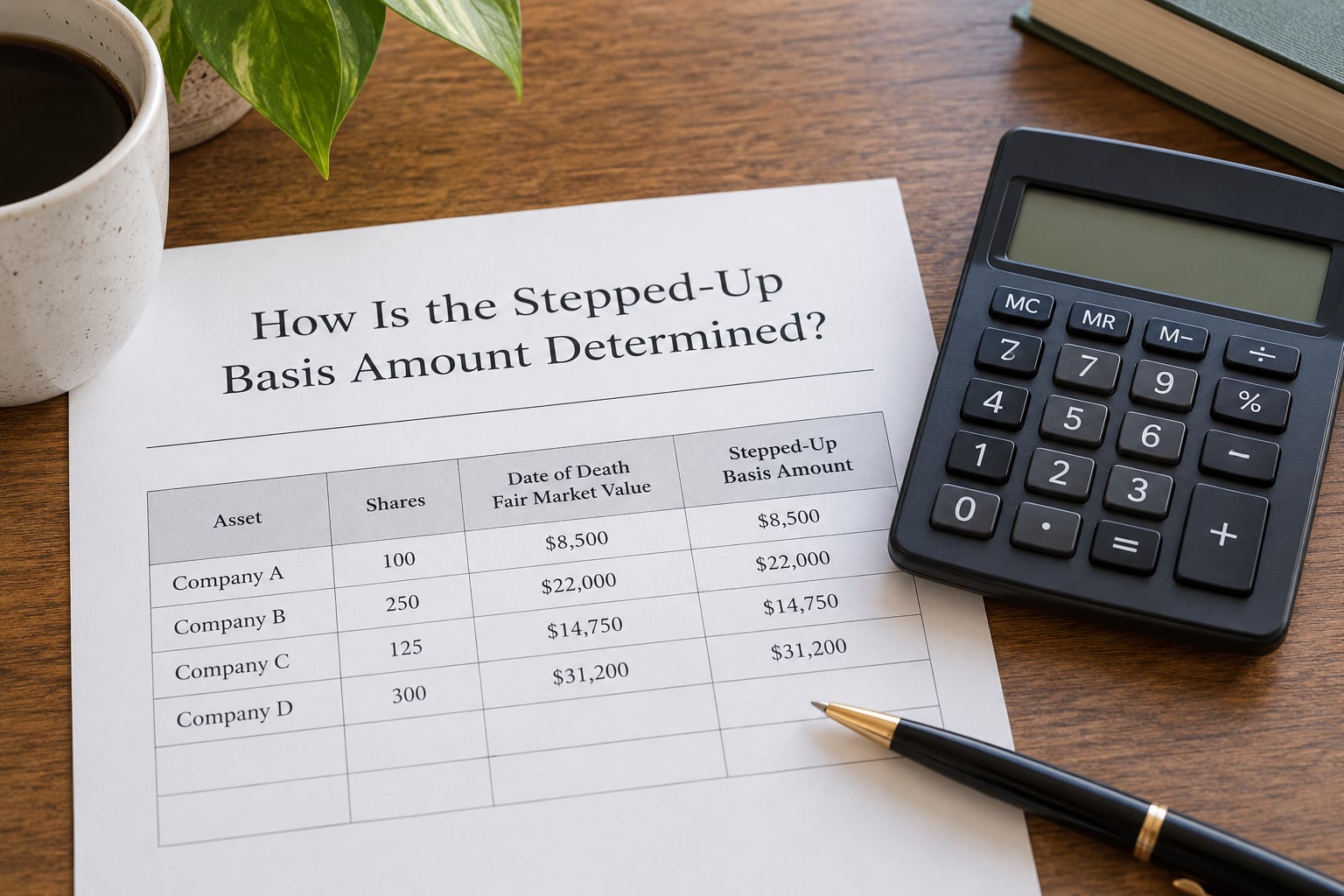
For most assets, the new basis is the fair market value on the date of death, and that number comes down to what a willing buyer would have paid a willing seller on that specific day. It is not today’s market price, and it is not the executor’s guess.
Two situations change the date. The first is the alternate valuation date, sometimes called the six-month rule, which lets an executor use values six months after death. The second is property the estate must value as a qualified use, where the estate may use the pre-death value.
There is an important limit on the six-month election: it is only available if the estate files a complete estate tax return, Form 706. It also generally only helps when values fell during that window, which is the opposite of the common assumption. On assets that rose after death, it produces a lower basis and a bigger eventual gain.
What the alternate valuation date is really for
It exists for estates that sell assets shortly after death, where waiting six months would be impractical. For a portfolio held for decades, the date-of-death value is almost always the better number, and paying for an estate tax return solely to get the election is rarely worth it.
How Step Up in Basis Works in a Simple Example
Say your mother bought 400 shares in 2026 at 125 each, a total outlay of 50,000. She never sold a share. On her date of death the shares are trading at 1,250, so the position is worth 500,000. You inherit all 400 shares, and your basis in each one is 1,250.
| Step | With a stepped-up basis | With carryover basis |
|---|---|---|
| Original cost | 50,000 | 50,000 |
| Value at date of death | 500,000 | 500,000 |
| Basis after inheritance | 500,000 | 50,000 |
| Sale price two years later | 525,000 | 525,000 |
| Taxable gain | 25,000 | 475,000 |
| Approximate federal tax at a 20 percent long-term rate | 5,000 | 95,000 |
Same shares, same sale, same rate. The entire difference comes from which number the IRS treats as your starting point. Add state income tax and any net investment income tax, and the gap widens.
One detail catches people: the price on the date of death, not the closing price the day after. If the market moved sharply in the days around a death, the estate and the beneficiary can end up with different figures, and that gap is a common source of disputes.
Which Inherited Assets May Receive a Stepped-Up Basis?
Stocks, ETFs, mutual funds, bonds, brokerage cash, real estate, vehicles, business interests, and digital assets all pass through the general rule. So do collectibles such as art, coins, and stamps, with one important difference: gains on collectibles are taxed at a higher federal rate, up to 28 percent, so the value of the reset is larger.
What does not get a step-up:
- IRAs, SEP IRAs, SIMPLE IRAs, 401(k)s, and 403(b)s
- Pensions and annuities, including those with a death benefit
- Life insurance proceeds paid to a beneficiary
- Assets transferred by gift during the owner’s lifetime
- Property the decedent owned in a trust that was revocable, in the situations where the trust itself never held legal title
That list is worth printing. A surprising share of the confusion in online threads comes from people expecting retirement accounts to reset the same way a brokerage account does.
How Do Joint Accounts, Community Property, and Spousal Transfers Affect Basis?
The step-up follows legal ownership at the moment of death, not the name on the account statement. A joint brokerage account with a surviving owner is where this gets argued most often.
In a community property state, each spouse is treated as owning half of the community assets, so when one spouse dies the heir receives a step-up on that half only. The surviving spouse’s own half carries over untouched. Nine states plus several opt-in states treat property this way, and the arithmetic is the same everywhere: step up the inherited fraction, carry over the rest.
In a common law property state, an asset titled jointly passes to the survivor by right of survivorship and is generally never part of the estate. That portion often gets no step-up at all, because it never reached the decedent’s estate. A joint account where the decedent was the contributor can raise an additional question about whether any of it was a gift.
Two habits reduce the arguments. Name beneficiaries on every account you can, even accounts you hold jointly, and keep a written record of contributions so the ownership split is provable later.
Spousal transfers get the opposite treatment, and it is worth being clear about. A transfer between spouses is not a realization event, so no gain is recognized and the surviving spouse carries over basis and holding period. Portability lets the first spouse to die use their unused exemption, and under federal rules the second spouse to die can then produce a second step-up on the same property. Practitioners often call it the double step-up, and it is the main reason a basis reset is described as an estate-planning decision rather than just a tax mechanic.
Can an Inherited Investment Have a Stepped-Up Basis but Still Produce a Loss?
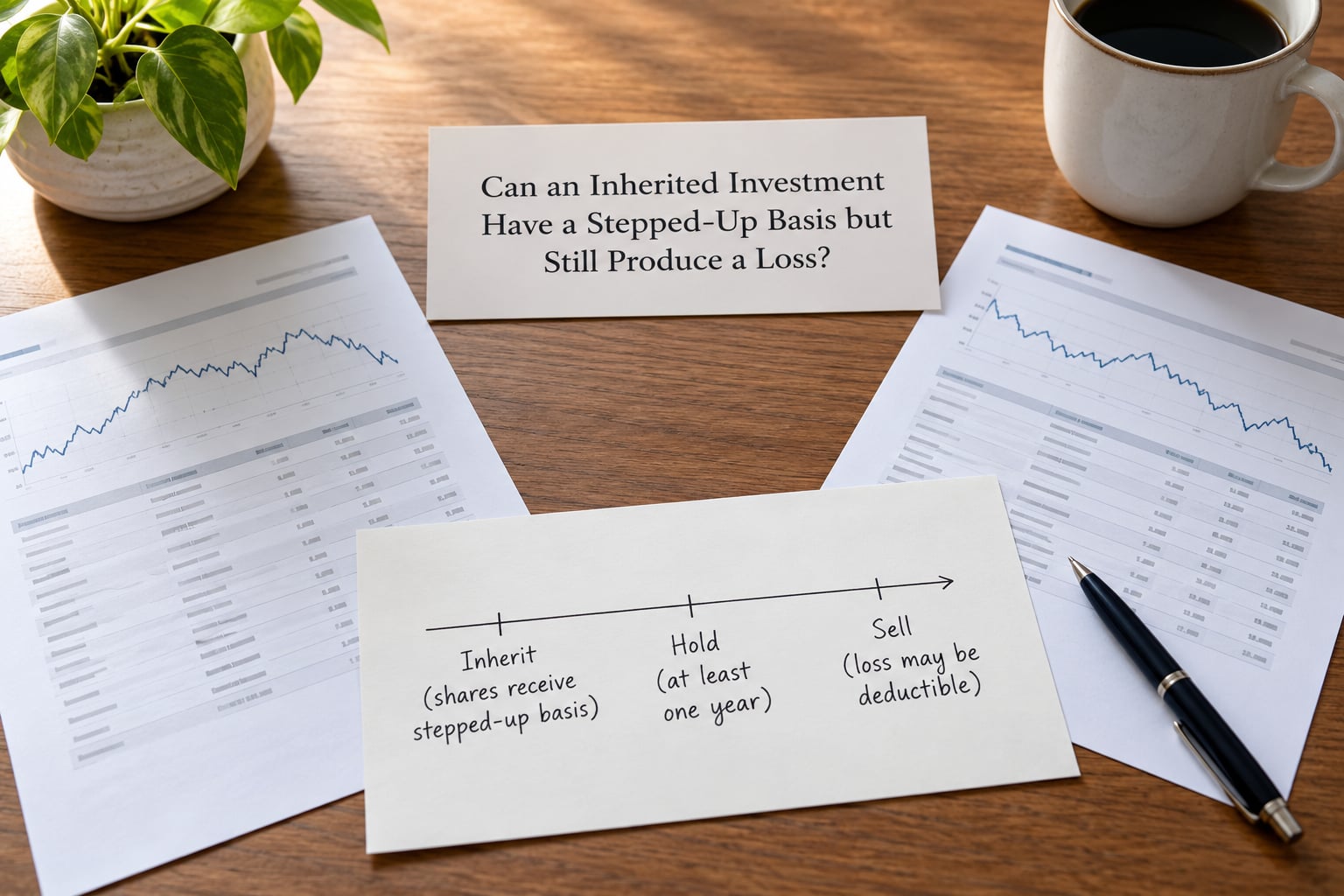
Yes, and it surprises people. If the market falls after death, you inherit the higher date-of-death basis, so a sale below that figure is a deductible capital loss rather than a gain.
The catch is timing. Under what is generally called the one-year rule, the holding period for an inherited asset begins on the day after the death, not on the day of it and not on the original purchase date. Any loss you realize within one year of the death is treated as short-term and cannot offset long-term gains. Hold past that one-year mark and the same loss becomes long-term.
The same reset drives the most useful feature of the rule. Because the holding period always starts fresh, an asset you sell years after an inheritance always qualifies for long-term rates. You never pay short-term rates on a position that has been in a family for decades.
Why Do Heir Basis Records Matter?
The tax rule does the work for you, but the paperwork does not. The number that ends up on your tax return comes from whatever documentation survives, so collect these before the estate files its return:
- The decedent’s brokerage statements and any original purchase confirmations, which establish what was paid.
- A date-of-death valuation statement for each account, ideally obtained from the custodian in the weeks after death rather than estimated later.
- Account titles, contribution histories, and beneficiary confirmations that show who legally owned what.
- The appraisal for real estate, business interests, and collectibles, prepared by a qualified appraiser.
- The estate’s file itself: the will, any living trust, and the executor’s correspondence.
Thread after thread on investing and tax forums describes the same problem: a brokerage transfers the account showing the original purchase price as basis, or shows nothing at all. On taxable accounts the reset should carry across on transfer, so the resolution is usually a documentation issue rather than a legal one. Ask the custodian for the date-of-death valuation in writing, submit it with the estate’s paperwork, and keep the response.
If the wrong figure reaches your Form 1099-B, report the basis you can document and attach the valuation statement. The same applies to lots you can no longer identify because of a corporate action or a fund merger.
What Happens If the Heir Dies Before Selling the Asset?
The stepped-up basis travels with the asset. If the beneficiary dies while still holding it, the next person in line inherits property whose basis is generally fair market value at that second death, not the first.
That is the mechanism behind the double step-up across spouses. A gain embedded in the asset at the first death is sheltered from income tax, and the same gain embedded at the second death is sheltered again. Portability of the estate and gift tax exemption is what makes the second one possible, and it is why keeping the original date-of-death valuation is not merely bookkeeping.
There is one warning worth knowing. An election made on the first estate tax return to value property at the alternate valuation date can affect how that property is treated later, including in the second estate. Executors make these elections with an eye down the road, not just to the current return.
Frequently Asked Questions
Does a stepped-up basis apply to every asset a person inherits?
No. Assets that pass at death through an estate, a revocable living trust, or a beneficiary designation such as a payable-on-death account generally receive fair market value as their new basis. Retirement accounts, annuities, pensions, and life insurance proceeds do not, and neither do assets transferred by gift while the owner was alive.
What happens if an inherited stock later loses value?
You can take a loss. Because your basis is the date-of-death value, a later sale below that figure produces a capital loss. The limit is timing: the holding period starts the day after the death, so a loss realized within one year is short-term and cannot offset long-term gains.
Can the executor choose which inherited assets receive a step-up?
No, not selectively. Section 1014 applies to the property in the decedent’s estate, and an executor may value that property on either the date of death or the alternate valuation date six months later. That choice is all-or-nothing for the estate, and it is only available when a complete estate tax return is filed.
Does receiving a step-up in basis reset the holding period?
In practice, yes. The holding period for inherited property begins on the day after the date of death, which is why an inherited asset always qualifies for long-term capital gains rates regardless of when the original owner bought it. That reset is also why a loss taken within the first year after the death is short-term.
How do I find the cost basis of an inherited brokerage account?
Ask the executor or custodian for a date-of-death valuation statement, then request that the brokerage record that value as your basis. If the account still shows the original purchase price, that is usually a documentation error on taxable accounts rather than a rule against the reset, and you can correct it with the valuation paperwork.
Does a beneficiary owe tax merely because an asset receives a step-up in basis?
No. A step-up is not itself a taxable event. Tax generally arises when you sell, exchange, or otherwise dispose of the asset, and then only on the gain above the date-of-death value. Receiving the asset and holding it produces no income tax on the appreciation that happened before you got it.
Conclusion
Start by locating the date-of-death valuation for each account, then confirm who legally owned each asset and how it was titled. Preserve that valuation and the decedent’s original purchase records together, because the two of them together are the only thing that proves the basis you are entitled to. Once that file is complete, talk with a tax professional about the estate return, the alternate valuation date, and any residence exclusion before you sell or transfer anything.
Rates, thresholds, and state rules change from year to year, so confirm the figures that apply to 2026 with the IRS or your adviser. IRS Publication 551 and the instructions for Form 706 are the two primary references, and this guide is general education rather than individual tax advice.