
Renters insurance is a contract, usually written on a form carriers call an HO-4, that pays to repair or replace your belongings when a listed peril damages them, covers your legal responsibility when you injure a guest or damage someone else’s property, and pays the extra cost of living somewhere else when a covered event makes your rental uninhabitable. Your landlord’s policy insures the building. Yours insures what you carry into it. How renters insurance works comes down to four coverage components, each with its own limit, its own deductible, and its own list of things it will not pay for.
The rest of this guide is current for 2026 and written for people who have never read a policy before. Rules vary by state and by lease, so treat the numbers here as typical rather than guaranteed.
Table of Contents
- Key takeaways
- How Renters Insurance Works at a Glance
- What Does Renters Insurance Cover?
- Personal property coverage pays for your belongings
- Your belongings are only fully covered at home
- Sub-limits decide the fate of high-value items
- Loss of use pays the bill for staying somewhere else
- Optional coverages fill real gaps
- What Renters Insurance Usually Does Not Cover
- Your landlord’s policy covers a different set of risks
- How Coverage Limits and Deductibles Affect Your Protection
- Actual cash value versus replacement cost
- The deductible works like a gate on every claim
- When your limit is lower than your stuff
- What Is Personal Liability Coverage?
- How renters insurance works when the damage is not yours
- How to Choose a Renters Insurance Policy
- How to Make a Renters Insurance Claim
- Why claims get denied
- What not to say to an insurance claim adjuster
- Frequently Asked Questions
- Is renters insurance required?
- Does renters insurance cover the building or the apartment itself?
- How much renters insurance coverage do I need?
- Does my roommate need a separate renters insurance policy?
- How long does a renters insurance claim take to get paid?
- Does renters insurance cover belongings stolen outside the home?
- Conclusion
Key takeaways
- A standard policy includes four main types of protection: personal property, personal liability, medical payments to others, and loss of use.
- Your landlord insures the structure. Your policy insures your contents, your liability, and your temporary housing costs.
- The coverage limit is a ceiling, not a promise. If you own more than your limit, the difference is yours to pay.
- Actual cash value pays depreciated amounts. Replacement cost pays to replace the item.
- Your belongings are only fully covered away from home up to a small sub-limit, usually around 10 percent of the property limit.
- Flood, earthquake, sewer backup, and damage to a roommate’s belongings are all outside a standard policy.
- A claim is a documented process: report it, show proof, then settle at your policy’s limit minus the deductible.
How Renters Insurance Works at a Glance
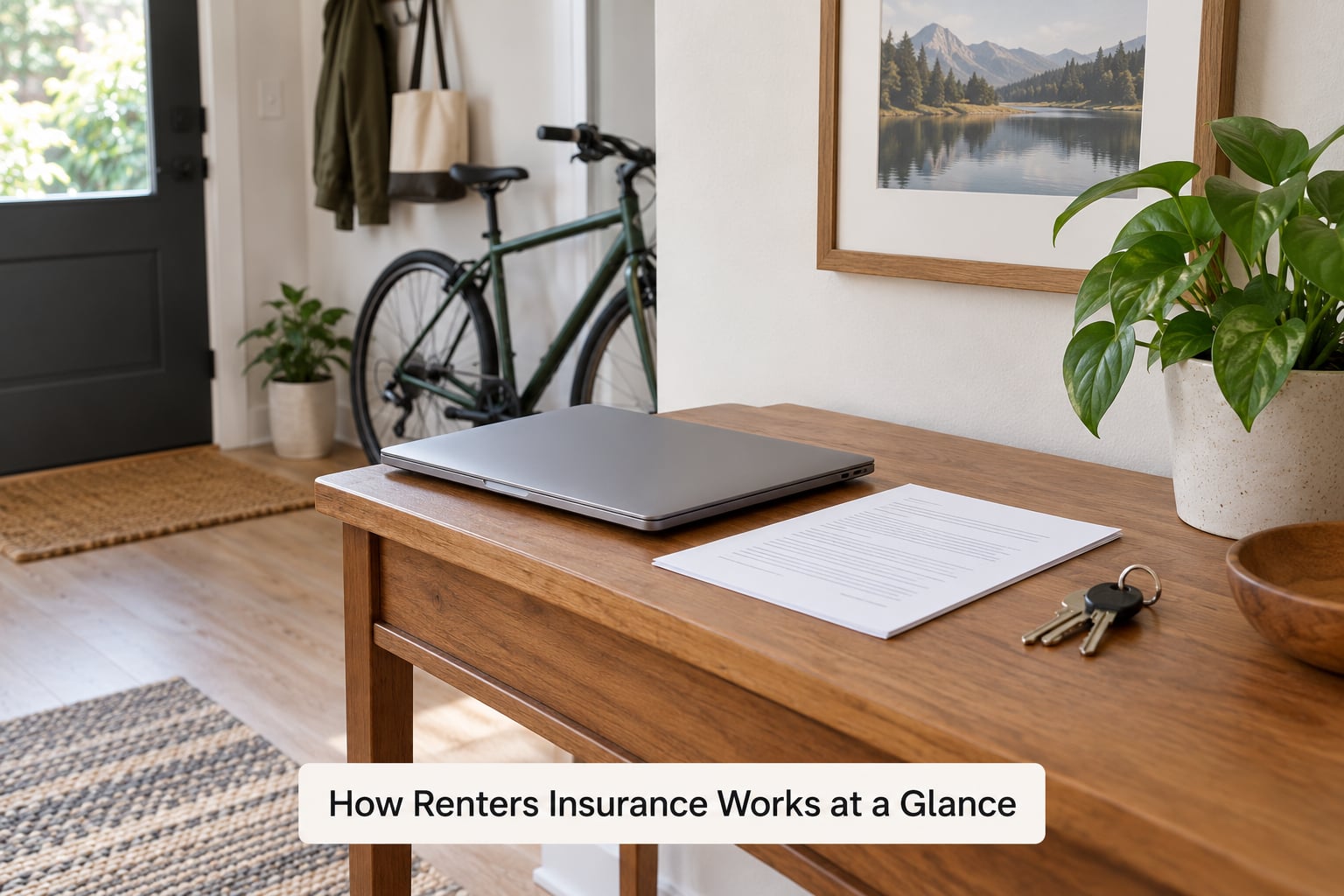
Everything below flows from one idea: the insurer pays for a listed cause of loss, up to a stated limit, after you meet a deductible. Change any one of those three pieces and the outcome changes.
| Coverage component | What it pays for | Typical limit | What triggers it |
|---|---|---|---|
| Personal property | Damage to or theft of your belongings, at actual cash value or replacement cost | Often 15,000 to 50,000 USD for a one or two bedroom unit | Fire, smoke, theft, vandalism, a sudden water leak, windstorm, or falling object |
| Personal liability | Legal costs and judgements if you injure someone or damage their property | 100,000 to 300,000 USD, sometimes 500,000 USD | A guest slips in your unit, your dog bites someone, or your appliance leaks into the apartment below |
| Medical payments to others | Immediate medical bills for someone hurt in your home, regardless of fault | Usually 1,000 to 10,000 USD | Any injury to a guest or visitor inside your unit |
| Loss of use, also called additional living expenses | The extra cost of living elsewhere while your unit is being repaired | Often 20 to 30 percent of the property limit | A covered event renders the covered residence unlivable |
Those four labels are the ones carriers use on the declarations page, and they are the labels you should look for when comparing quotes. A policy can also carry exclusions and endorsements, which are the fine print that decides whether a specific loss is paid at all.
Here is how each piece works in the wild. A fire in your kitchen damages a laptop. Personal property responds, up to your limit, at either cash value or replacement cost, after your deductible. A guest breaks an ankle on the same night. Personal liability covers their medical bills and legal costs, and medical payments to others responds quickly without anyone arguing about fault. If the fire means you cannot live there for two months, loss of use pays the hotel and the extra cost of eating away from home.
That is how renters insurance works when everything goes wrong at once: four separate parts, four separate limits, one policy.
What Does Renters Insurance Cover?
Personal property coverage pays for your belongings
Personal property covers the contents of your covered residence: furniture, clothing, appliances, books, kitchenware, sports gear, and electronics. It responds to named perils, which is the term for the specific events the form lists. If fire, smoke, lightning, windstorm, hail, vandalism, malicious mischief, theft, and a sudden water leak are on that list, you are in the covered world for those events.
Sudden matters. A pipe that bursts overnight and floods the floor is covered. A pipe that seeps slowly behind the wall for four months and rots the drywall is usually not, because that reads as a gradual loss rather than a single accident. Same idea with ice dams and slow drips under a sink.
Your belongings are only fully covered at home
This is the rule that surprises people most, and it turns up constantly in forum threads. Off-premises coverage, meaning your property while it is away from the covered residence, is capped at a sub-limit that is usually around 10 percent of your personal property limit. Read that arithmetic carefully, because it is the number that decides whether you are protected.
Say your personal property limit is 30,000 USD. Your off-premises ceiling is about 3,000 USD. A laptop worth 2,800 USD stolen from your car falls under that cap. A laptop worth 4,500 USD stolen from the same car does not, and the 1,500 USD gap is yours. The same limit governs items you store in a self-storage unit or leave in a hotel room, which is why travelers should check the declarations page before a long trip.
There is one exception many renters are glad to know. An item the policy describes as usually kept at the covered residence, such as a laptop that lives in your bedroom, is generally covered without the off-premises sub-limit applying, even if it is stolen from a vehicle. That is why a camera and a laptop in the car usually fare better than a couch stored in a garage.
Sub-limits decide the fate of high-value items
Even inside your home, individual categories have their own caps. Jewelry, furs, cameras, musical instruments, silverware, and collectibles usually share a sub-limit of around 1,000 to 5,000 USD per item or per category. Electronics can carry their own separate cap. A wedding ring worth 12,000 USD sitting in a standard policy with a 2,000 USD jewelry sub-limit is a 10,000 USD out-of-pocket loss after your deductible.
The fix is a scheduled personal property endorsement, sometimes called a rider, where you list a specific valuable and agree to insure it for a stated amount. The insurer then has no room left for a low cap. Photographed receipts and appraisals usually go in the file with the schedule.
Loss of use pays the bill for staying somewhere else
Loss of use, printed on many forms as additional living expenses, kicks in when a covered peril makes your unit unlivable. It covers the reasonable extra cost of living elsewhere: a hotel, an apartment while repairs run, meals beyond what you would have spent at home, laundry service, pet boarding, and sometimes storage and transportation.
Two details trip people up. First, the limit is a percentage of your personal property limit rather than a separate large number, commonly 20 to 30 percent, so a 30,000 USD property limit gives you roughly 6,000 to 9,000 USD of extra living expenses. Second, the coverage tracks the period you are actually displaced. Renters report getting a hotel and a short-term rental paid and then hearing the claim was closed while the apartment was still not ready, which is why you should keep receipts for every expense and keep asking whether additional amounts remain available.
Optional coverages fill real gaps
A standard form is a starting point, not the ceiling. Water backup endorsement covers a sewer or drain backup that a standard policy excludes. An earthquake endorsement covers ground shaking. Flood insurance usually comes separately, most often through the National Flood Insurance Program, because no standard renters policy carries it. Pet liability coverage extends the liability part to bites and injuries caused by your animal, which many carriers now include but not all. A personal umbrella policy stacks on top of the liability limit for people who carry especially high limits elsewhere.
What Renters Insurance Usually Does Not Cover
Three exclusions come up in almost every search for what renters insurance does not cover, and they are worth learning by heart. The building itself is the first: the walls, roof, windows, fixtures, and the landlord’s appliances belong to a landlord policy. Flood and earthquake damage is the second. Your roommate’s belongings is the third.
Here is the fuller list of what a standard policy normally leaves to you:
- The structure. The apartment, its permanent parts, and any building-level damage.
- Flood from rising surface water, and earthquake shaking, unless added by endorsement.
- Sewer and water backup damage, which needs the water backup endorsement.
- Wear and tear, mold from a long-standing leak, and damage from gradual water intrusion.
- Intentional damage or damage you caused on purpose.
- Damage caused by neglect. A pipe you knew was dripping and never fixed is a frequent denial.
- Property belonging to a roommate, unless they are listed on your policy.
- Pets themselves. Liability for bites and injuries can be covered; the animal’s own veterinary bills usually are not.
- Items above your limit, or above a sub-limit, once the cap is reached.
- Lost or stolen property with no proof it ever existed and no proof you owned it.
- High-risk locations for stored property, such as an unattended vehicle for a long period.
- Intentional acts and some illegal activity, which appear as standard policy wording.
Knowing these gaps is more useful than it sounds, because each one has a known fix. Flood through the National Flood Insurance Program, earthquake and sewer backup through endorsements, a roommate through their own policy, high-value items through a schedule, and a neglected leak through calling a plumber before the ceiling falls in.
Your landlord’s policy covers a different set of risks
The most common confusion in this whole topic is whether the landlord’s insurance reaches your things. It does not. A landlord insures the structure and their own liability as a building owner. Your furniture is not on that policy, and neither is your own liability to visitors.
| Item at stake | Landlord’s policy | Your renters policy |
|---|---|---|
| The apartment structure, roof, windows, building systems | Covers it | Never covers it |
| Your furniture, clothing, electronics, appliances | Does not cover it | Covers it, up to your limit |
| A guest injured in your unit | Not your liability | Your liability coverage responds |
| Damage you cause to the unit below | Covers the building’s damage | Covers your legal responsibility for it |
| Loss of use if the unit becomes unlivable | Sometimes covers the tenant’s relocation cost | Covers your extra living expenses, within your limit |
| A roommate’s belongings | No | No, unless they are listed on your policy |
When both policies respond to one event, they usually pay different pieces of the same loss. A burst supply line in your unit damages your floor and the ceiling of the apartment below. The landlord’s policy covers the building damage to the unit below. Your policy covers your belongings and, if the leak was your fault, your liability to the neighbour. Separating the two invoices is the adjuster’s job, and it is a good reason to keep your own damage photos.
How Coverage Limits and Deductibles Affect Your Protection
Limits and deductibles are the two numbers that decide what you actually receive. The limit is the most the insurer will ever pay for that coverage. The deductible is the amount you pay first. Both are set on your declarations page, and both are yours to choose.
Actual cash value versus replacement cost
Actual cash value pays what an item was worth on the day of the loss, which is replacement cost minus depreciation. Replacement cost pays what it costs to buy the same item new today. On a laptop you paid 1,400 USD for three years ago, a 30 percent depreciation assumption puts actual cash value near 980 USD. Same laptop, same loss, and a 420 USD gap depending purely on which settlement basis your form uses.
Replacement cost policies usually pay the replacement amount first and then recover the depreciated difference after you buy or repair the item, provided you keep the receipt. Actual cash value policies pay once and stop. Forum posts about feeling shortchanged are almost always this distinction rather than a coverage dispute.
The deductible works like a gate on every claim
A 500 USD deductible means the insurer’s payment begins at 501 USD of covered loss. On a 1,200 USD covered repair, you receive 700 USD. Raise the deductible to 1,000 USD and the same repair leaves you 200 USD out of pocket. Deductibles commonly run 250 to 1,000 USD on renters policies, and the premium falls as the deductible rises.
When your limit is lower than your stuff
Here is the arithmetic that catches people. You own about 25,000 USD of belongings and buy the cheapest policy on the shelf, which carries a 10,000 USD property limit. A fire takes everything. The insurer pays 10,000 USD minus your deductible, and roughly 15,000 USD stays with you. No adjuster changes that number, because the limit is the contract.
The same logic runs through liability. If a guest sues for 250,000 USD of damages and your policy carries a 100,000 USD liability limit, your exposure above that cap depends entirely on your own assets. This is the reason people raise liability limits well past the lease minimum and, if they have other liability policies, buy an umbrella to stack on top.
What Is Personal Liability Coverage?
Personal liability is the part renters buy and then rarely think about again. It is also the part that can produce the largest bill. It responds when you are legally responsible for injuring a person or damaging their property, and it pays three things: the medical bills and repair costs of the damage, any judgement or settlement awarded against you, and the legal defence costs incurred along the way.
A few situations where it does real work:
- A guest falls on a wet floor. If you are found negligent, liability pays their medical bills and your legal costs.
- Your dog bites a neighbor. Pet-related injury and property damage fall under this coverage unless your lease or the policy excludes the breed.
- Your appliance leaks into the unit below. Water damage to the neighbour’s ceiling and belongings is your legal responsibility even when the pipe was old.
- You are sued for a fall at a friend’s party. The defence cost alone can run into five figures, which is why liability limits matter more than the property limit to many renters.
How renters insurance works when the damage is not yours
Liability coverage pays when you are at fault, not when a loss happens near you. If a tree falls on your car from a neighbour’s property, your policy is not the one being called. But if a fire in your apartment damages the unit above you, both policies engage: the landlord’s covers the building, yours covers your liability to that tenant. The two claims run on separate tracks and settle separately.
Medical payments to others sits beside liability but works differently. It pays first-responder medical bills for an injury inside your home without anyone proving fault, which is why a visitor who trips over your rug can have their ambulance bill and X-ray covered even if nobody sues.
How to Choose a Renters Insurance Policy
Comparing renters insurance quotes is less mysterious than the sales pitch suggests, because every policy is built from the same template. Put the policies side by side on these points.
- Inventory your belongings first. Walk room by room and write down replacement cost, not what you paid years ago. A camera, a bike, a decent monitor, and a wardrobe add up faster than people expect.
- Set the property limit above that total. A limit equal to your inventory is the floor. Many carriers cap it at a multiple of the premium, and a small gap in the limit costs far less than a 15,000 USD shortfall after a fire.
- Pay for replacement cost, not cash value. The difference shows up exactly when you most need the money.
- Choose the liability limit generously. 100,000 USD is common, 300,000 USD is cheap relative to the exposure, and a lease minimum is a starting point rather than a recommendation.
- Read the sub-limits. Jewelry, firearms, electronics, and collectibles all have their own ceilings. Schedule anything that would hurt to replace.
- Compare the deductible against what you could comfortably pay out of pocket in one go.
- Check the exclusions for the coverages you actually care about, especially flood, water backup, and theft away from home.
- Ask about discounts for security systems, smoke alarms, deadbolts, and bundling with another policy. These are routine, not favors.
- Look at claims service rather than brand. Online filing speed, a reachable phone number, and a local adjuster matter more at claim time than a marketing slogan.
- Check what your landlord requires. Leases commonly ask for 100,000 to 300,000 USD of liability and a certificate of insurance within a set number of days. Most carriers issue a certificate the same day.
Two details worth knowing beyond that list. Standard renters coverage usually cannot be purchased on a home you own outright, since that calls for a homeowners policy instead. And the policy follows the person, not the address, so move it when you move.
How to Make a Renters Insurance Claim
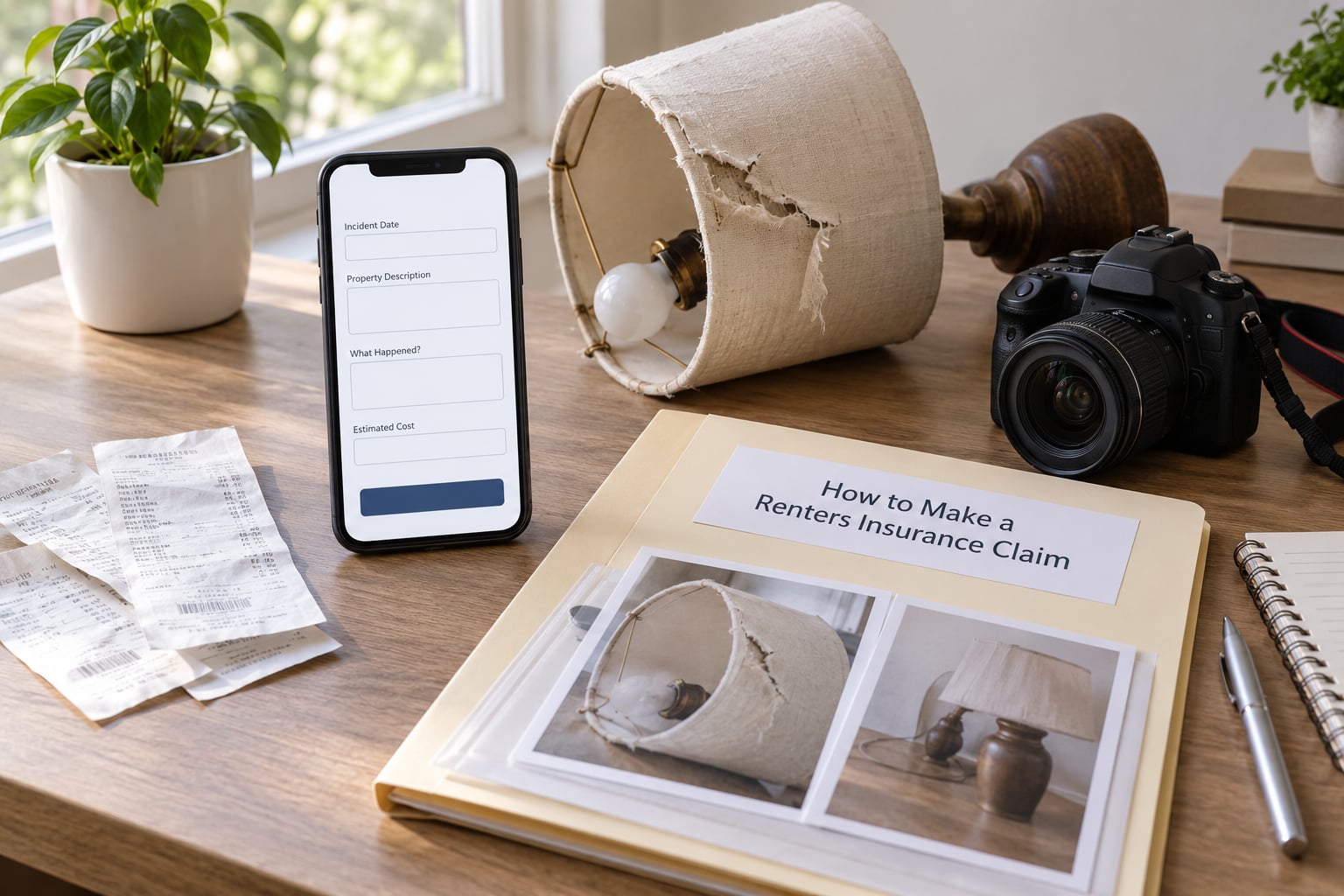
The claim is the part nobody explains well. Six steps, in order:
- The covered event happens. Fire, a burst pipe, a break-in, a windstorm, a falling tree. Anything not caused by a named peril will not qualify, so the cause matters more than the damage.
- You notify the carrier quickly. Most policies require prompt notice, and every carrier has a claims phone line and an online or app-based reporting path. Tell them the date, time, cause, and what is damaged.
- An adjuster is assigned, or you submit proof of loss yourself for smaller claims. The adjuster inspects, photographs, and asks for a statement.
- You supply documentation. This is where claims are won or stalled: photos of the damage, receipts and proof of ownership, invoices for temporary housing, and a signed proof-of-loss statement listing each item and what it would cost to replace.
- The insurer applies the policy. It checks the cause of loss against the named perils, subtracts any depreciation if you are on actual cash value, subtracts your deductible, and caps payment at your coverage limit.
- Payment arrives and the claim closes. Simple claims are often handled without an adjuster visit. Larger or disputed ones can take weeks, and you can send a supplement with additional losses or request a review of the settlement.
Most carriers publish claim payment timelines in their own service standards rather than in the policy, and those vary by claim size. A clean, well-documented small claim is the fastest path through this process.
Why claims get denied
Denials almost always come down to one of a handful of reasons:
- The cause of loss is not a named peril, such as a slow leak rather than a sudden burst.
- The loss is excluded: flood, earthquake, sewer backup, or intentional damage.
- The damage existed before the event or came from wear and tear or a long-standing problem.
- You could not prove ownership or value, with no receipt, serial number, or photo behind the claim.
- The item exceeded a sub-limit, which is a partial payment, not technically a denial.
- The policy had lapsed, or the claim was reported outside the deadline.
- Your deductible was higher than the covered loss, so there is simply nothing left to pay.
What not to say to an insurance claim adjuster
This one gets asked constantly, so here is the short answer. Do not speculate about the cause, do not guess at the value of an item you cannot price, and do not volunteer admissions like “I probably should have fixed that a while back” unless it is genuinely true. Do tell the adjuster what you saw, keep a copy of anything you sign, and ask for the settlement calculation in writing.
Claimants worry that a claim will raise their premium or follow them around. In most cases a single water damage or theft claim does not raise your premium at renewal the way a series of claims would, though it varies by carrier and record. Reporting promptly is usually the better trade.
Frequently Asked Questions
Is renters insurance required?
Most US states do not require renters insurance, so the answer usually comes from your lease rather than the law. Landlords commonly require minimum liability limits, often 100,000 to 300,000 USD, plus proof such as a certificate of insurance. Some buildings, student housing, and employers require it as well. Check your lease before assuming you are exempt, because a missing certificate can put your deposit at risk.
Does renters insurance cover the building or the apartment itself?
No. A renters policy covers the contents of the unit, your liability, medical payments, and temporary housing costs. The structure, walls, roof, windows, and building systems belong to the landlord’s property policy, which is why you should not try to claim repair costs through your own carrier. If the building itself is damaged, the landlord files that claim.
How much renters insurance coverage do I need?
Add up the replacement cost of everything you own, then buy a personal property limit above that figure. Most one and two bedroom policies sit between 15,000 and 50,000 USD. For liability, choose at least 100,000 USD and consider 300,000 USD, since a guest injury claim can exceed the minimum. Check your lease for its required limits before you shop.
Does my roommate need a separate renters insurance policy?
Almost always yes. A standard policy covers the named insured and their belongings, not a roommate’s things. Shared policies exist and can be cheaper, but everyone on the policy shares a claims history and a claim by one person can affect everyone’s renewal. Make sure both of you appear by name on the declarations page rather than assuming coverage transfers.
How long does a renters insurance claim take to get paid?
A documented claim with receipts, photos, and a clear cause of loss is often settled within days to a few weeks, and some small claims are paid by phone without an adjuster visit. Larger losses, disputed causes, and anything involving a liability claim can take much longer because an adjuster has to investigate who is responsible. Report the loss as soon as possible and keep every receipt, since gaps in documentation are the main reason payments stall.
Does renters insurance cover belongings stolen outside the home?
Partly. Property away from your covered residence is usually capped at about 10 percent of your personal property limit, so a 30,000 USD policy gives you roughly 3,000 USD of protection off-premises. Items that normally live at the covered residence, like a laptop or camera, are usually covered at full value. Items in storage units and expensive travel gear are the ones most often underprotected.
Conclusion
Start by writing down what you own and what it would cost to replace. That single exercise sets your personal property limit, and it takes an evening with a phone camera and a spreadsheet. Then compare quotes on the four numbers that matter: property limit, replacement cost versus actual cash value, liability limit, and deductible. Read the sub-limits and exclusions once more than feels necessary, schedule anything valuable, and give your landlord a certificate the same day you sign the lease.