
A fixed-rate mortgage locks in your interest rate and your principal-and-interest payment for the whole loan term, while an adjustable-rate mortgage (ARM) charges a lower rate for an introductory period and then resets periodically to a market index plus a fixed margin, within annual and lifetime caps. Most buyers who stay in a home more than seven years are better served by the fixed rate. An ARM makes more sense when the move date is documented and near.
Rates quoted in this article are illustrative examples rather than live offers, and rules differ by lender and state. Check your Loan Estimate and ask a loan officer or a HUD-approved counselor before you sign anything.
Table of Contents
- Fixed Rate vs Adjustable Rate Mortgage at a Glance
- How Interest Rates and Monthly Payments Differ
- Fixed Rate vs Adjustable Rate Mortgage: What Happens to the Rate?
- Which Mortgage Is More Affordable to Qualify For?
- How Much Payment Risk Are You Comfortable Taking?
- What Are the Costs of Refinancing an ARM?
- Which Loan Fits Your Time in the Home?
- Which Should You Choose?
- Frequently Asked Questions
- Is it better to get a fixed-rate or adjustable-rate mortgage?
- Can an adjustable-rate mortgage payment increase every year?
- What happens to an ARM when interest rates fall?
- How much would it cost to refinance an adjustable-rate mortgage into a fixed rate?
- Should I choose an ARM based on its introductory rate?
- What documents should I compare before choosing a mortgage?
Fixed Rate vs Adjustable Rate Mortgage at a Glance
This table is the whole argument in one view. The two loan types differ on rate behavior, predictability, and what they demand of you later on.
| Criterion | Fixed rate | Adjustable rate (ARM) |
|---|---|---|
| Initial interest rate | Higher than the ARM equivalent in most markets | Lower, because it is discounted to price in later resets |
| Payment predictability | Same principal and interest every month until you refinance or pay extra | Constant only for the introductory period, then changes at each reset |
| When the payment changes | Never on its own | Every six months after the fixed period, on the reset schedule |
| Rate caps | Not applicable | Initial, periodic, and lifetime caps limit how far the rate can move |
| Refinancing exposure | Needed only to capture falling rates, and it costs closing fees | Often needed to escape a reset, on the lender’s or your timeline |
| Qualification | Based on the payment that will actually last | Often based on the teaser payment, which may not be the one you keep |
| Best suited to | Long stays, tight budgets, variable or uncertain income | Short documented stays, healthy reserves, willingness to absorb a reset |
How Interest Rates and Monthly Payments Differ
On a fixed-rate loan, the rate never moves, so the principal-and-interest portion of your bill is the same in month one and month 360. Taxes, insurance and utilities still move, so your total housing cost is never truly flat, but the part you negotiated is.
On an ARM, the rate moves at scheduled reset dates. Because a payment is just a rate applied to a balance that is slowly shrinking, a higher rate means a higher payment on the same remaining balance.
Here is the difference in practice. Take a 400,000 loan on a 30-year amortization.
- Fixed at 6.25%: principal and interest of about 2,463 a month, every month for 30 years.
- 5/6 ARM starting at 5.50%: about 2,271 a month for five years, roughly 192 less. After the first reset on a 369,800 balance, a new rate of 8.00% puts the payment near 2,855. At the same loan’s lifetime cap the payment reaches about 3,492.
The introductory rate is real money, 11,520 of it over five years if you actually stay five years and pay nothing extra. The question is whether you want to be at the mercy of a market index in year six.
Fixed Rate vs Adjustable Rate Mortgage: What Happens to the Rate?
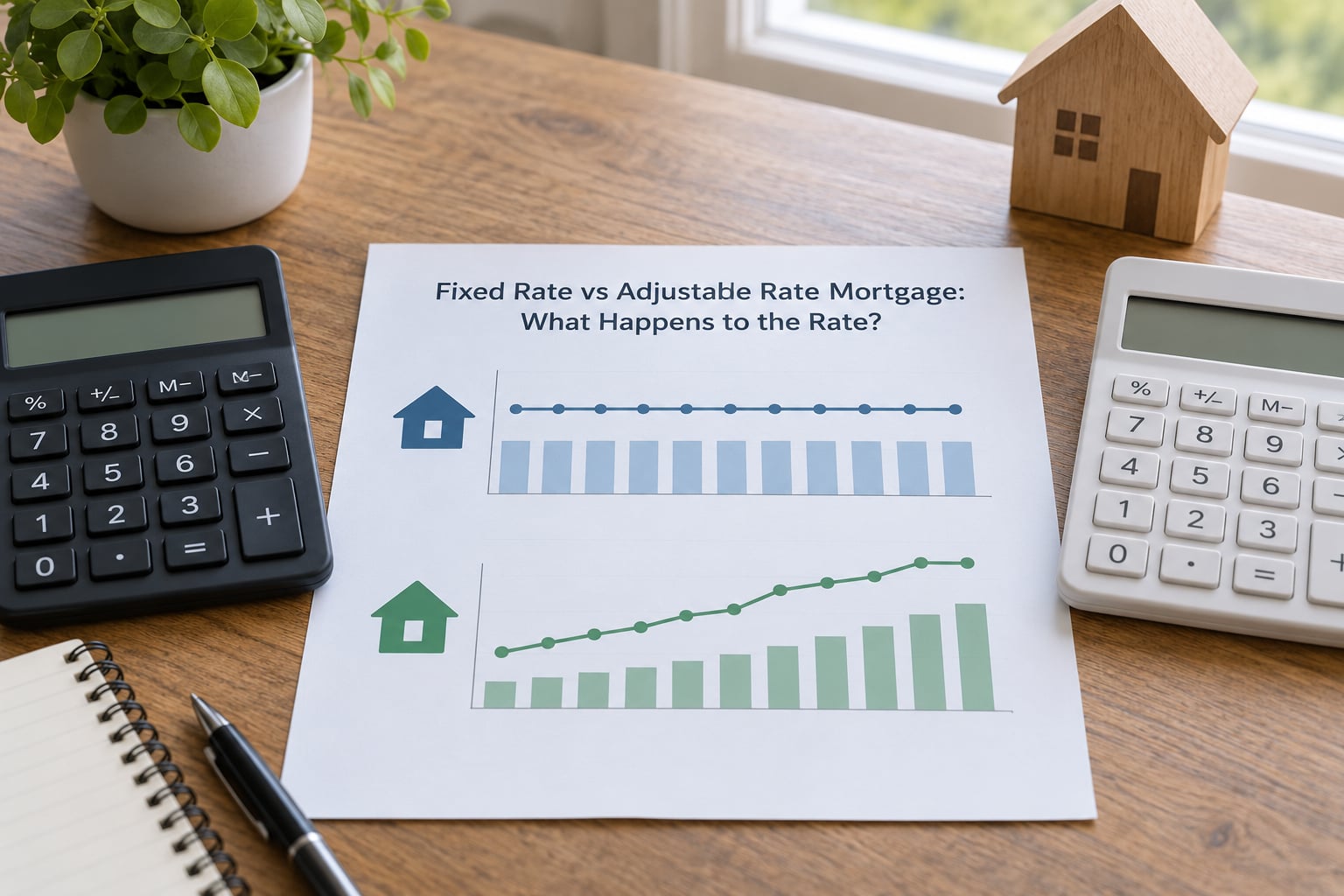
An ARM rate is rebuilt at each reset from two numbers: the index, usually SOFR, plus a margin the lender sets and does not change. Your note tells you both, and the margin matters as much as the index over a long hold.
Three caps limit the movement. The initial cap limits the first adjustment, often by two percentage points. The periodic cap limits each later adjustment, commonly one or two points. The lifetime cap limits the total climb from your starting rate, commonly five points. On a 5/6 ARM with 2/2/5 caps, the worst contractual rate is your 5.50% start plus five points, or 10.50%.
The naming convention tells you the schedule. A 5/6 ARM holds its rate for five years and adjusts every six months after that. A 7/6 holds for seven years. Most conforming ARMs are now 5/6 or 7/6, and the 3/6 has largely disappeared because its fixed period was too short to be useful.
One thing worth understanding: when an ARM quotes below the fixed equivalent, that discount is the market pricing in expected rate increases. If lenders expected rates to fall, the ARM would not need to be cheaper to win your business.
Which Mortgage Is More Affordable to Qualify For?
On paper the ARM is more affordable, because a 5.50% start produces a smaller payment than a 6.25% fixed rate on the same loan. Lenders often qualify you on that teaser payment, which can let you qualify for a larger loan than the fixed rate would allow.
That is where it gets uncomfortable. Ask a lender to run the same loan at the fully indexed rate, the index plus margin with no teaser discount, and see whether you still qualify. If you do not, you are one rate cycle away from a payment you cannot carry, and the loan you were approved for is not the loan you can afford.
Some ARM products go further and let the payment stay level while the balance grows when the rate rises. That is negative amortization, and it is worth avoiding unless you understand exactly how it unwinds. Watch the note for prepayment penalties too; some portfolio ARMs charge a fee if you pay off or refinance during the introductory period.
How Much Payment Risk Are You Comfortable Taking?

Caps are a ceiling, not a promise. They limit how bad it gets, but they do not tell you whether it gets bad. Here is how the same 400,000 ARM payment behaves under four index paths, assuming 5/6 with 2/2/5 caps and a 369,800 balance at the first reset.
| Scenario | Rate after reset | Monthly payment | Compared with the 6.25% fixed payment |
|---|---|---|---|
| Index falls | 5.25% | about 2,210 | 253 less |
| Index holds near today | 6.25% | about 2,440 | 23 less |
| Index rises moderately | 8.00% | about 2,855 | 392 more |
| Rises to the lifetime cap | 10.50% | about 3,492 | 1,029 more |
Run the same loan over its full life and the shape changes. Stay five years, then have the index return to 6.25%: total P&I runs roughly 18,000 below the fixed loan. Reset to 8.00% and you pay about 106,000 more in interest over the life of the loan. The break-even is not a date, it is a rate.
So the real question is comfort. A fixed rate suits anyone whose budget is tight, whose income varies, or who simply does not want to think about a reset. An ARM suits a buyer who has priced the worst realistic case and can absorb it.
What Are the Costs of Refinancing an ARM?
Converting an adjustable loan into a fixed one is a full refinance: new underwriting, a new application, an appraisal in most cases, title work, and closing costs that commonly run into the thousands. Interest rates on the new note are today’s rates, not the ones you had. A refinance also resets the amortization clock, so a 10-year-old ARM becomes a new 30-year loan unless you buy down the term.
Two things can raise the bill. Prepayment penalties on some portfolio ARMs apply if you pay off or refinance within the fixed period. Rate-lock extension fees apply if the closing drags, and those tend to land on the same borrowers who hit snags, because those buyers have the thinner file.
Refinancing offsets a reset when the fully indexed rate is high enough that the new fixed payment, plus closing costs amortized over your remaining years, still beats the post-reset ARM payment. Run that comparison on a refinance calculator at a 6.00% fixed rate with 2,000 of costs. If the answer is no, you are better off absorbing the adjustment, budgeting for it, or paying extra principal to shorten the balance.
Which Loan Fits Your Time in the Home?
Hold period is the variable that decides most of this. Under roughly five years, an ARM’s introductory rate can win outright, because the reset may never arrive before you sell. Past seven to ten years, the fixed rate’s cost of certainty is usually worth paying, and the risk window gets wide.
The failure mode borrowers describe is not the rate, it is the timeline. On mortgage forums, the recurring story is a buyer who planned to sell in five years, changed jobs or had a child, and then met the reset with no plan and no cash for closing costs. Treat a projected move date as a hope, not a fact.
Three other inputs matter. Home-price expectations: in a flat or slow market, a rising ARM payment is harder to refinance away. Reserves: closing costs for the refinance that may save you sit somewhere other than the payment. And tolerance for uncertainty, which is the hardest to qualify on a loan application and the easiest to under-estimate.
One workable middle path: take the ARM only if you will pay extra principal during the fixed period, so the reset lands on a smaller balance, and treat that as a deliberate payoff plan rather than a savings plan.
Which Should You Choose?
Choose a fixed rate if you expect to stay more than seven years, if your income or expenses vary, if the housing payment is a large share of your budget, or if you would rather not track an index. Choose an ARM mainly if you have a documented, near move or refinance date inside the fixed period, several months of reserves beyond closing costs, and a written plan for what happens if the date slips.
There is no universally better answer here. Both answers can be right depending on your hold period and your tolerance for a payment change, and the popular version of this debate rarely says that. This is general information about how US mortgages work, not individual financial advice.
Frequently Asked Questions
Is it better to get a fixed-rate or adjustable-rate mortgage?
A fixed rate is usually better if you expect to stay more than seven years, because your payment will not change and you avoid refinancing costs to escape a reset. An ARM can be better if you have a documented move or refinance date inside its fixed period, plus reserves for closing costs. Treat the shorter of your expected stay and five years as the real deadline.
Can an adjustable-rate mortgage payment increase every year?
No. An ARM adjusts on a schedule, typically every six months after the introductory period, not annually. Periodic caps limit how much the rate can rise at each adjustment, often by one or two percentage points, and a lifetime cap limits the total increase over the life of the loan. A payment can still rise in several consecutive steps until the lifetime cap is reached.
What happens to an ARM when interest rates fall?
Your rate resets to the index plus your margin at each scheduled date, so a falling index lowers your rate and your payment. The catch is timing: if the index moves after your reset, you wait for the next one. A fixed-rate borrower cannot benefit from falling rates without refinancing, which means new underwriting and closing costs.
How much would it cost to refinance an adjustable-rate mortgage into a fixed rate?
It costs roughly what any refinance costs: closing fees, appraisal, title and recordation, often several thousand dollars in total, and it restarts the amortization on the new term. Prepayment penalties apply on some portfolio ARMs if you refinance during the fixed period, and rate-lock extension fees can add more if closing is delayed.
Should I choose an ARM based on its introductory rate?
The introductory rate is only one part of the offer. Read the index, the margin, the initial cap, the periodic cap and the lifetime cap, then compute your payment at the fully indexed rate with no discount. If that payment is more than you can comfortably carry, the teaser rate is not your real loan. The margin tells you more about the long run than the start rate does.
What documents should I compare before choosing a mortgage?
Compare Loan Estimates from at least three lenders side by side, checking APR, the principal-and-interest payment, the rate lock terms, and for an ARM the index, margin, caps, adjustment schedule and any prepayment penalty. Read the Closing Disclosure before signing. A HUD-approved housing counselor or a CFPB tool can review the estimates with you at no cost.
Start with one number: your payment at the fully indexed rate, not the teaser rate. Get Loan Estimates from three lenders, compare APR and total costs over your actual expected stay, and check the ARM terms line by line if one is in the running. A HUD-approved counselor can read them with you free of charge.