
Your HSA belongs to you, not to your employer, and it survives retirement intact. There are no required minimum distributions at any age, and once you turn 65 you can withdraw the balance for any reason with ordinary income tax and no penalty.
The account itself is the least of the changes. What retirement actually alters is your ability to keep contributing, the timing of Medicare enrollment, and the bills your money can legally pay. Get those three right and an HSA can cover the bulk of your healthcare costs for the rest of your life.
I have gone through this with clients who came in panicked about losing a balance and who left with a spending plan instead. What follows is the same checklist I walk them through, written out.
Table of Contents
- Can You Keep and Use Your HSA After Retirement? At a Glance
- Do You Have to Close or Use Your HSA When You Retire?
- Do not confuse an HSA with an FSA or an HRA
- How Is Your HSA Balance Taxed After You Retire?
- Which account should you draw from first?
- What Happens to Your HSA When You Retire If You Have Medical Expenses?
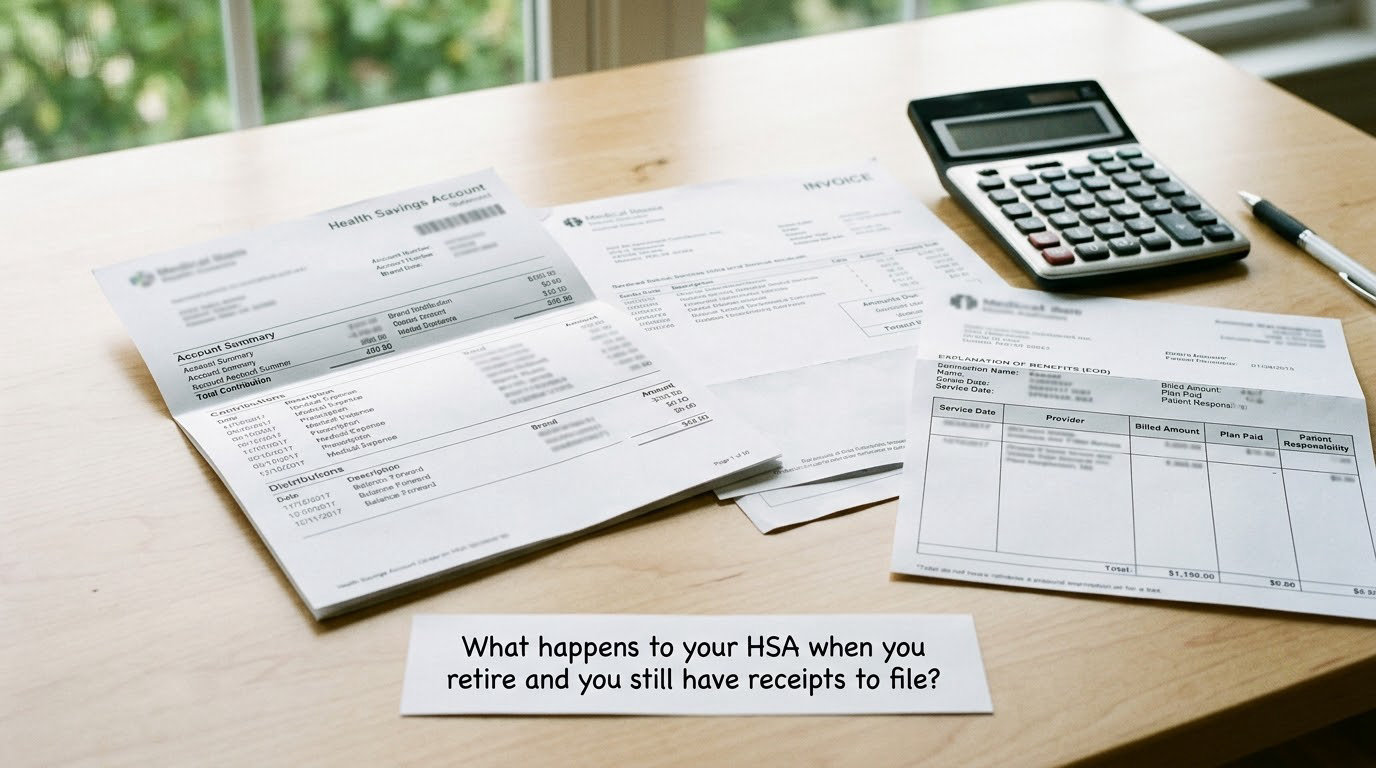
- What happens to your HSA when you retire and you still have receipts to file?
- Can You Keep Contributing to Your HSA During Retirement?
- The first-day-of-the-month rule
- The Medicare cutoff, and why the month matters more than the application date
- The last-month rule and the testing period
- When one spouse retires and the other keeps working
- Limits, catch-up contributions, and fixing an excess
- Can You Still Invest the Money in Your HSA?
- Can You Use HSA Money for Medicare Premiums and Other Retirement Costs?
- Should You Use Your HSA for Medical Costs or Save It for Retirement?
- What Should You Do With Your HSA Before and After Retiring?
- Frequently Asked Questions
- What happens to your HSA when you retire with no employer coverage?
- Can I roll my HSA into an IRA or another retirement account?
- Do HSA withdrawals count against my Social Security or Medicare benefits?
- What is the HSA catch-up contribution if I am 55 or older?
- Can I pay my spouse’s medical expenses from my HSA after retirement?
- Conclusion: What to Do First
Can You Keep and Use Your HSA After Retirement? At a Glance
Short version: nothing is taken from you, nothing expires, and nothing is required. Six rules cover almost every question people bring to this table.
| Question | The rule after retirement |
|---|---|
| Who owns the account? | You do. It is yours individually and it is portable to any HSA-eligible custodian you choose. |
| Are there required minimum distributions? | None. No RMD at any age, including age 75 and beyond. |
| Can you still contribute? | Yes, if you are an eligible individual and you are covered by a qualifying high-deductible health plan, and not covered by Medicare. |
| Medical withdrawals | Tax-free at any age when the expense is qualified and incurred after the HSA was opened. |
| Non-medical withdrawals before 65 | Taxed as ordinary income plus a 20% additional tax, unless you are disabled. |
| Non-medical withdrawals at 65 and after | Taxed as ordinary income only. No additional tax, no penalty. |
| Investment options | Many custodians let you hold mutual funds or ETFs once the balance crosses a set threshold. |
| What happens at death | A spouse inherits it tax-free. A non-spouse is treated as receiving taxable income. |
These are federal rules. Your state may treat an HSA differently for state income tax purposes, and a handful of states deviate from the federal treatment, so check where you live before you assume a state tax consequence.
Do You Have to Close or Use Your HSA When You Retire?
You do not have to close it, and you do not have to use it. That is the whole point of the account, and it is the piece most retirees misunderstand on day one.
An HSA is established in your name with your own money and your own Social Security number. Your employer set it up and may have seeded it, but that seeding changes nothing about ownership. When the paycheck stops, the balance and every investment inside it stay exactly where they are.
You have three practical routes after employment ends:
- Leave it in place. Most custodians hold accounts open with no employer involvement at all. This is the simplest option and requires nothing from you.
- Transfer it. A direct trustee-to-trustee transfer to a different HSA custodian lets you consolidate accounts from old jobs. Do not simply withdraw and redeposit; a withdrawal followed by a contribution is treated as a non-medical distribution with all the tax consequences attached.
- Keep the employer plan open if you can. Some employers let you retain the account after you leave, and the money stays yours either way.
Do not confuse an HSA with an FSA or an HRA
The three accounts often sit in the same benefits portal and behave nothing alike. An HSA is yours. A limited-purpose or general-purpose flexible spending account belongs to your employer, is limited to an amount set by the IRS each year, is subject to a use-it-or-lose-it rule with a small carryover window, and cannot be invested. A health reimbursement arrangement is an employer promise that can be revoked and forfeited if you leave.
If your old benefits page blurred those together, this is the moment to read the plan documents again.
How Is Your HSA Balance Taxed After You Retire?
An HSA is one of the few accounts that never forces a distribution. What it does is give you a tax-free pot for qualified healthcare costs, then behave like a traditional IRA once you reach 65.
| Withdrawal type | Federal tax treatment |
|---|---|
| Qualified medical expense, any age | Not taxed. Must be incurred after the HSA was opened and not reimbursed elsewhere. |
| Medicare premiums (Part B, Part D, Medicare Advantage) | Not taxed, treated as qualified medical expenses. |
| Long-term care, dental, vision, hearing | Not taxed, subject to qualified expense definitions. |
| Non-medical withdrawal before 65 | Ordinary income tax plus a 20% additional tax. Waived for a tax return certifying disability. |
| Non-medical withdrawal at 65 or after | Ordinary income tax only. No additional tax, no penalty, no requirement to report medical costs. |
| Investment growth | Not taxed while it stays inside the account. Taxed as ordinary income once withdrawn. |
Growth earned inside the account is never taxed as it accumulates. That is the part retirees underestimate: a balance that sat in cash for years and a balance that sat in a diversified fund can produce very different totals by the time you are 70.
Two details catch people. First, you cannot reimburse yourself for medical expenses you incurred before the HSA was opened. Second, keep every receipt, because the burden of proof sits with you, not with the custodian.
You file Form 8889 with your federal return to report contributions and the distributions that qualify for the tax-free treatment. If you reimburse yourself in a later year for expenses from an earlier year, that distribution is reported on that later year’s Schedule 1.
Which account should you draw from first?
For retirees under 65, most planners sequence the HSA ahead of taxable accounts and traditional IRAs, because the HSA is the only one of the three with penalty-free access after 65. After 65 the ordering gets more flexible, since a non-medical HSA withdrawal costs only income tax. Traditional balances are generally worth draining before you do, because those withdrawals are already taxed as income.
What Happens to Your HSA When You Retire If You Have Medical Expenses?
Qualified medical expenses can be paid from your HSA tax-free at any age. Retirement does not change that. The expenses that open up in retirement are the retiree-specific ones: Medicare premiums, Medicare deductibles and copays, Medicare Advantage plan premiums, dental, vision, hearing, and long-term care.
Dental, vision and hearing are the most underused qualified categories I see. A set of hearing aids, a crown, or a pair of glasses is a perfectly ordinary HSA expense, and many retirees assume those are out of bounds. They are not.
What happens to your HSA when you retire and you still have receipts to file?
You can reimburse yourself for any qualified expense incurred after the account opened, whenever you want to and in whatever year you want to. There is no deadline and no window that closes. A receipt from 2016 is just as usable as one from last month.
The recordkeeping is the part that makes people nervous, and rightly so. What works in practice: scan receipts on the day you receive them, name the file with the date and provider, and store them somewhere that is not the same device you will lose. A plain folder of PDFs plus an annual backup does it.
One reimbursement trap: if the same expense was already reimbursed by insurance or any other source, you cannot double-dip. Deductibles, copays, coinsurance, and coins for services your plan does not cover are the standard categories that work.
Retirement does change one thing here. Once you are on Medicare, the private insurance premium exception that applied while you were working mostly disappears, because employer and marketplace premiums stop being qualified expenses. Coverage choices after retirement are therefore worth comparing properly rather than rolling forward by inertia.
Can You Keep Contributing to Your HSA During Retirement?
Yes, but contributing depends on two separate things: being an eligible individual, and being covered by a qualifying high-deductible health plan for the months in question. Employment status is not one of the criteria. A retired person on a family HDHP can contribute; an employed person whose spouse is on Medicare may not.
The first-day-of-the-month rule
Eligibility is tested on the first day of each month. If you are covered by a qualifying HDHP on the first of the month, you are eligible to contribute for that whole month, even if the coverage ends on the fifteenth. The same logic works in reverse: coverage that begins mid-month makes you ineligible for that month.
The Medicare cutoff, and why the month matters more than the application date
You become ineligible to contribute for any month you are covered by Medicare. That includes Part A, Part B, or Part D. The trap is that Part A coverage can be retroactive up to six months if you were eligible and applied during or after your Initial Enrollment Period. That is exactly how a retiree ends up with excess contributions they did not know they made.
The safe move is to watch the effective date, not the date you mailed the application. Signing up in July for coverage that began in January means January through June were months you should not have been funding.
The last-month rule and the testing period
If you are eligible on December 1, you may fund a full year’s contribution for that year. The catch is the testing period, which runs from January 1 of the following year through December 31 of the year after that. If you lose HDHP coverage during the testing period, the full-year contribution becomes an excess contribution and you have to correct it.
Planners therefore advise funding the full year and keeping cash in an accessible place, or just funding month by month. Both are fine. What is not fine is funding a full year while assuming the rule is unconditional.
When one spouse retires and the other keeps working
Each spouse has a separate HSA with a separate contribution limit. The one who enrolls in Medicare stops contributing; the one still working on an HDHP does not. This is a routine situation and it does not disqualify either account, but it is easy to get wrong because the household looks like one unit on a benefits screen.
Limits, catch-up contributions, and fixing an excess
The IRS sets contribution limits each year and publishes them in a revenue procedure, with a separate limit for self-only coverage, a higher limit for family coverage, and an additional catch-up amount once you turn 55. Those figures are adjusted regularly and are not something to read off a two-year-old blog page. Verify the current-year numbers at IRS.gov, and read IRS Publication 969 for the detail.
If you do end up over-contributing, the fix is mechanical: withdraw the excess plus any attributed earnings before the due date of your tax return for that year. Retain it and it is subject to a 6% excise tax for the year and every year it stays there. Users who discovered this only at tax time, mostly after a coverage mix-up during a job transition, say contacting the custodian directly is what resolved it fastest.
Can You Still Invest the Money in Your HSA?
Yes. Retirement is arguably the best time to invest an HSA balance, because the money you are not going to spend for years has time to compound tax-free, and the withdrawals you do make after 65 are the ones least likely to be at the wrong moment.
Most custodians start you in a cash equivalent and let you switch to mutual funds or ETFs once the balance passes a threshold, often a few thousand dollars. Some employers run their own investment menu. You choose, and you can change your mind without leaving the account.

The risks are the ordinary ones. A portfolio that drops 20 percent in your first retirement year hurts much more than the same drop at 60, which is the sequence-of-returns problem in its practical form. Fees matter too, because they compound against you for decades. A broadly diversified stock and bond mix suited to your retirement horizon is the usual starting point, not a sector bet.
A common middle path is to hold enough in cash to cover a year or two of known near-term medical spending and keep the rest invested. That way the next bill never forces a sale on a bad day.
Two cautions. Nothing about investing an HSA is protected by the FDIC, and no one can promise a return. And the moment you retire is the worst possible time to become enthusiastic about a new fund. Diversification, fees and time horizon deserve more thought than they usually get before you change anything in a tax-advantaged account.
Can You Use HSA Money for Medicare Premiums and Other Retirement Costs?
Yes for the premiums that count as qualified medical expenses, and the details matter more than most people expect. Original Medicare Part B premiums qualify. Medicare Part D premiums qualify. Medicare Advantage plan premiums qualify. Medigap or Medicare supplement premiums are qualified expenses under the annual out-of-pocket threshold rules.
Medicare Advantage is the one to get right, because the product is sold as a health plan but the premium behaves like a medical expense. Paying an Advantage premium from your HSA is fine; paying a stand-alone commercial health insurance premium for an under-65 spouse generally is not.
The Part D redesign changed what Part D looks like and how premium costs are structured, so read your plan’s own material rather than relying on a summary written years ago. Medicare.gov is the place to confirm.
| Expense | Qualified for your HSA? |
|---|---|
| Medicare Part A, Part B and Part D premiums | Yes |
| Medicare Advantage plan premiums | Yes |
| Medigap premiums, once you meet the annual out-of-pocket threshold | Yes |
| Deductibles, copays and coinsurance under Medicare | Yes |
| Dental, vision and hearing care | Yes |
| Long-term care, including a private nursing home room and LTC insurance premiums | Yes |
| COBRA premiums | Yes, including for months before Medicare coverage begins |
| Premiums paid while receiving unemployment compensation after losing coverage | Yes |
| A private health insurance premium for a non-Medicare spouse under 65 | Generally no |
| ACA marketplace plan premiums | No |
| Gym membership, cosmetic procedures, general-purpose vitamins | No |
What you cannot do is fund ordinary retirement life from the HSA. Travel, a new roof, groceries and gifts are all non-qualified, which is fine after 65 as a matter of tax rather than eligibility. Before 65 the same withdrawal carries the 20% additional tax unless you certify disability on your return.
Should You Use Your HSA for Medical Costs or Save It for Retirement?
Spend it or save it is the wrong frame. The better question is which dollars you are spending and which ones you are investing.
Near-term money is money you expect to pay out within a few years: upcoming dental work, a planned procedure, the first year of Medicare premiums. Keep that portion in cash so the bill is easy to pay and no sale is needed.
Long-term money is everything beyond that horizon. It belongs invested, because tax-free compounding over twenty or thirty years is the entire reason an HSA is worth having.
A hybrid approach is what most retirees end up with. Reimburse the current year’s qualified expenses as receipts arrive, keep a cash buffer, and leave the remainder invested for the expensive decades at the end of life, when long-term care becomes the dominant cost. The funding target that falls out of this is easier to answer honestly than a formula would: estimate your Medicare premiums plus out-of-pocket costs plus a plausible long-term care need, then fund toward that. A common rough benchmark people use is enough to cover several years of premium and out-of-pocket spending in cash, with the balance aimed at the long-term care question.
Three factors should shift that plan. Your health and family history tell you how much of the long-term care risk is real for you. Your coverage choice tells you how much the HSA has to absorb versus a plan that covers more of it. And your tolerance for watching a balance fall 20 percent tells you how much of it you keep in cash. Get the drawdown sequence written down, because a plan you cannot follow in year three is not a plan.
What Should You Do With Your HSA Before and After Retiring?
The order matters more than the individual tactics. Work through these before you leave the job, because most of them are much harder once the plan portal is gone.
- Confirm the balance, the custodian, and the beneficiaries. You need a named beneficiary who is not your estate wherever possible, and the forms filed years ago may be out of date.
- Map your coverage months. Write down the exact months of HDHP coverage and the exact months of Medicare coverage. This single page of dates prevents the excess-contribution problem later.
- Note your Part B effective date and check whether Part A was backdated.
- Set up the withdrawal habit early. Reimburse the current year’s qualified expenses as receipts arrive so the recordkeeping is not a backlog.
- Decide the cash and investment split before you need the money.
- Ask about bridge coverage if you are under 65. COBRA premiums are HSA-qualified, an ACA marketplace plan generally is not, and signing up for Medicare at 65 needs a plan if you are still working.
- Verify the current-year limits at IRS.gov before funding anything, and re-read your plan’s Part D material.
Common mistakes to avoid: contributing during a month you were covered by Medicare; assuming COBRA always keeps you HSA eligible; spending the balance early instead of investing it; assuming private insurance premiums are qualified when they usually are not; and leaving the beneficiary form blank.
A note on figures. Contribution limits, catch-up amounts and Medicare premiums are all set or adjusted regularly. Verify the current-year numbers at IRS.gov and at Medicare.gov before you rely on any figure, including the ones in this article. Rules change, and this is educational information rather than individualised tax or investment advice.
Frequently Asked Questions
What happens to your HSA when you retire with no employer coverage?
Nothing happens to it. The account stays open, the balance and its investments remain yours, and there is no required minimum distribution at any age. You do not need employer coverage to keep or invest it. You do need qualifying high-deductible health coverage and no Medicare coverage if you want to keep contributing. Many retirees move the account to a custodian of their choice or simply leave it where it is.
Can I roll my HSA into an IRA or another retirement account?
No. A direct transfer to an IRA is not permitted, and no tax-free rollover path exists out of an HSA. Withdrawing the money and contributing it elsewhere produces a non-medical distribution taxed as ordinary income, plus the 20% additional tax if you are under 65. Transfers between two HSAs are the exception, and those are done trustee to trustee without touching your balance.
Do HSA withdrawals count against my Social Security or Medicare benefits?
No. Withdrawals from an HSA are not taxable Social Security benefits and are not counted as income for Medicare premium purposes. The same is not true of other retirement withdrawals. Required minimum distributions from traditional accounts can push your modified adjusted gross income up and increase the income-related Part B and Part D premiums. Keeping the HSA as your funding source lets you control that lever.
What is the HSA catch-up contribution if I am 55 or older?
The IRS allows an additional catch-up amount once you reach 55, and you qualify for the whole calendar year in which you turn 55, not just the months after your birthday. There is also a separate larger limit for family coverage. Both figures are set by a yearly IRS revenue procedure and are adjusted over time, so check the current-year amounts at IRS.gov and confirm them in IRS Publication 969.
Can I pay my spouse’s medical expenses from my HSA after retirement?
Yes, generally. You can reimburse an HSA-eligible adult child or spouse for qualified expenses they incurred after you became eligible to contribute, as long as the expense would have been qualified for you. Keep the receipts. You cannot, however, use the money for a private health insurance premium for an under-65 spouse, or for a spouse’s ACA marketplace plan, since those premiums generally are not qualified expenses.
Conclusion: What to Do First
Retirement does not close your HSA, drain it, or start a clock on it. The account, the balance and the investments are yours, there are no required minimum distributions, and from 65 the money is available for any purpose with income tax and nothing else.
So the first action is small: before you leave the job, write down the months of HDHP coverage and the months of Medicare coverage, and check the current-year contribution limits at IRS.gov. That one page prevents the most common and most expensive retirement mistake, which is an excess contribution discovered at tax time.
After that, decide how much of the balance is near-term spending and keep that in cash, leave the rest invested, and reimburse the current year’s qualified expenses as the receipts arrive. If your situation involves a backdated Part A, an early retirement, or a complicated household, take the specifics to a qualified tax professional rather than working them out from general guidance.