Most people miss a payment during a bank switch because they close the old account too early, not because moving money is difficult. How to switch banks without missing payments comes down to one rule: never close the old account until your paycheck and every recurring bill have already posted from the new one. The work itself is bookkeeping, roughly three to four hours spread over six to eight weeks.
I am not a bank and this guide earns no referral fee, which is worth saying plainly because most pages on this topic are written by the bank trying to win your business. Consumer Reports research, cited in several banks’ own switching guides, put the figure at about 63 percent of would-be switchers naming the move of automatic payments as their sticking point. In practice, most people who slow down and work through it in order report that it is much easier than they expected.
Table of Contents
- What You Need
- Step-by-Step
- How to switch banks without missing payments by comparing the new account
- Open the new account and verify its details
- Redirect income and deposits
- Move bills, subscriptions, and scheduled payments
- Monthly and near-monthly bills
- Quarterly, semiannual and annual charges
- Where your old account number is stored behind the scenes
- Test the switch and monitor pending transactions
- Close the old account and keep records
- Common mistakes that cause missed payments
- Tips for a low-risk transition
- Frequently Asked Questions
- How long does it take to switch banks for direct deposit?
- Will I get paid twice if I change my direct deposit mid-pay-cycle?
- What happens to automatic payments when I close my old account?
- How long should I keep both bank accounts open?
- What do I do if a payment bounces after I switch banks?
- Does switching banks affect my credit score?
What You Need

Gather everything before you change a single setting. Half of the anxiety in a bank switch comes from discovering mid-way that you cannot remember which account a payment was coming out of.
- Online login for your old account, plus the mobile app on a phone you actually have in your hand.
- Account number and routing number for both checking and savings, and whether they are the same digits for each. Plenty of banks use a different routing number for savings than for checking, so check before you hand them out.
- Three to six months of statements, paper or PDF. This is the single most useful item in the whole process because it reveals charges that only fire once a quarter or once a year.
- A list of every payee, roughly, with the amount and the day it debits: rent or mortgage, utilities, insurance, card autopay, loan payments, subscriptions.
- Direct deposit details, meaning your employer’s payroll address or HR contact, or the form your benefit agency asks for.
- Contact details for anyone sharing the account, joint owners and authorized signers, since they may hold autopay instructions you cannot see.
- The new bank’s account and routing numbers, written on paper as well as saved, once the account is open.
- Two-factor authentication set up on the new account before you move any money into it, so you are not relying on a code sent to a phone number still tied to the old bank.
Step-by-Step
Understanding how to switch banks without missing payments is mostly a question of order. Open first, redirect second, test third, close last. Skipping ahead is what produces the bouncing payments people read about in forums.
How to switch banks without missing payments by comparing the new account
Compare candidates on the things that generate a surprise charge, not on the headline rate. A great APY is worthless if the checking account quietly overdrafts you on a Tuesday.
- Monthly maintenance fee and its waiver, including the exact balance that avoids it and whether the waiver needs a qualifying direct deposit.
- Overdraft behaviour. Some banks decline an overdraft, others cover it and charge you later. Also look at how many overdraft fees you can be hit with in a single day.
- Bill pay mechanics. Some banks send paper checks that take several days to arrive, others push electronic payments that clear faster. Ask whether bill pay can pull from an account at a different bank, which matters if you keep a second bank on purpose.
- ATM access and fee reimbursement, counted against where you actually live and work rather than a national network’s marketing.
- How you can deposit cash. Online-only banks often lack a branch, so you may be stuck using a retail cash kiosk with its own limits and fees. People switching for better rates hit this wall more often than they expect.
- Savings rate, transfer limits between your own accounts, and support hours, particularly whether you can reach a real person before a Friday evening deadline.
- Deposit insurance. Banks are insured by the FDIC, credit unions by the NCUA, and the coverage limits apply per depositor per insured institution.
Open the new account and verify its details
Open the account online or in branch, then confirm the numbers before anything depends on them. A transfer to a mistyped digit is awkward to unwind, and a wrong account type can mean the deposit lands somewhere you did not intend.
Verify in three ways: read the routing and account numbers off the confirmation screen, match them against the bank website rather than the email alone, and make one small deposit of your own to see it post. Set up mobile check deposit and your alerts while you are logged in the first time.
Your debit card will not arrive immediately, usually within about a week, so plan the overlap around card access rather than around the account opening date. Until it arrives, the routing and account number are what move payments, and those work the same day.
Redirect income and deposits
Give your employer the new account details in writing, even if you also tell them verbally. Then keep the old account open and usable, because a payment can arrive there during the transition.
Allow one to two pay cycles for payroll to change, and expect a split along the way: many employers pay one more deposit to the old account before the switch takes effect, which is normal and not a mistake. Government benefit deposits such as Social Security can take a month or more to move to the new details, so start that request early in the process rather than at the end.
Do the same for anything that pays you rather than bills you: refunds from merchants, insurance reimbursements, payouts from a side job, recurring transfers from another account you own. Search your last two months of statements for inbound transfers that are not your paycheck, because those are the ones people forget and discover only when a payment fails months later.
Move bills, subscriptions, and scheduled payments
Work through your statements one payee at a time. Update a biller only after you have saved the new details and can confirm the change, and never delete the old payment instruction in the same sitting.
Most readers catch the big monthly items without trouble. Rent, utilities, the card autopay and the phone bill all announce themselves. The failures come from three quieter groups.
Monthly and near-monthly bills
- Rent or mortgage, property tax and homeowners insurance, which often debits from a different account than the mortgage itself.
- Utilities: electric, gas, water, trash, internet, phone and mobile.
- Auto loan, student loan and credit card autopay, where a missed card payment is the one most likely to reach a credit bureau.
- Childcare, after-school care, tutoring and school lunch accounts.
Quarterly, semiannual and annual charges
This is the group most guides skip, and the reason some readers discover a failure months after the switch. Pull these from your statements rather than trying to remember them:
- HOA or condo dues, pest control, lawn care, septic and well service.
- Renters and auto insurance premiums billed annually or every six months.
- Gym memberships with annual plans, storage unit rent, and background check subscriptions.
- Domain names, hosting renewals, professional licences and membership fees that bill once a year.
- Estimated tax payments and quarterly tax instalments if you make them.
Where your old account number is stored behind the scenes
Some merchants never take your new details because you never tell them directly. They charge a card or bank account you set up once, years ago, through an intermediary. Log into each of these and replace the old bank details with the new ones, or attach the new card instead:
- PayPal and Venmo, under wallet, payment methods or banks, where a linked bank is often the actual funding source for a subscription.
- Apple Pay and Google Wallet, where an account can sit in the wallet under your old bank rather than a card.
- Amazon and other big retailers, which keep a default payment method used by subscriptions, digital media and marketplace orders.
- Streaming services, gaming stores and crowdfunding or donation platforms, which each hold their own stored account.
- Charities, political giving and any local membership you joined once and forgot.
Autopay rules are where the trap sits. Some companies charge from your bank account as a backup if a card fails, so a card update alone may not be enough. Read the autopay setting on the account page rather than the payment screen, and confirm the funding source.
Some banks and third-party switch services can move a batch of these for you. They work by the service collecting your old account number, the routing numbers of the outgoing banks, and your signed authorization, then sending notices to participating billers. Check what is actually included before you assume it covers your landlord or your card issuer, because participation varies and the notices still take days to arrive.
Whichever route you take, write down each payee, the old details, the new routing and account number, the date you changed it and the date the first payment should come from the new account. That single line per bill is what turns a switch into something you can verify rather than something you hope.
Test the switch and monitor pending transactions
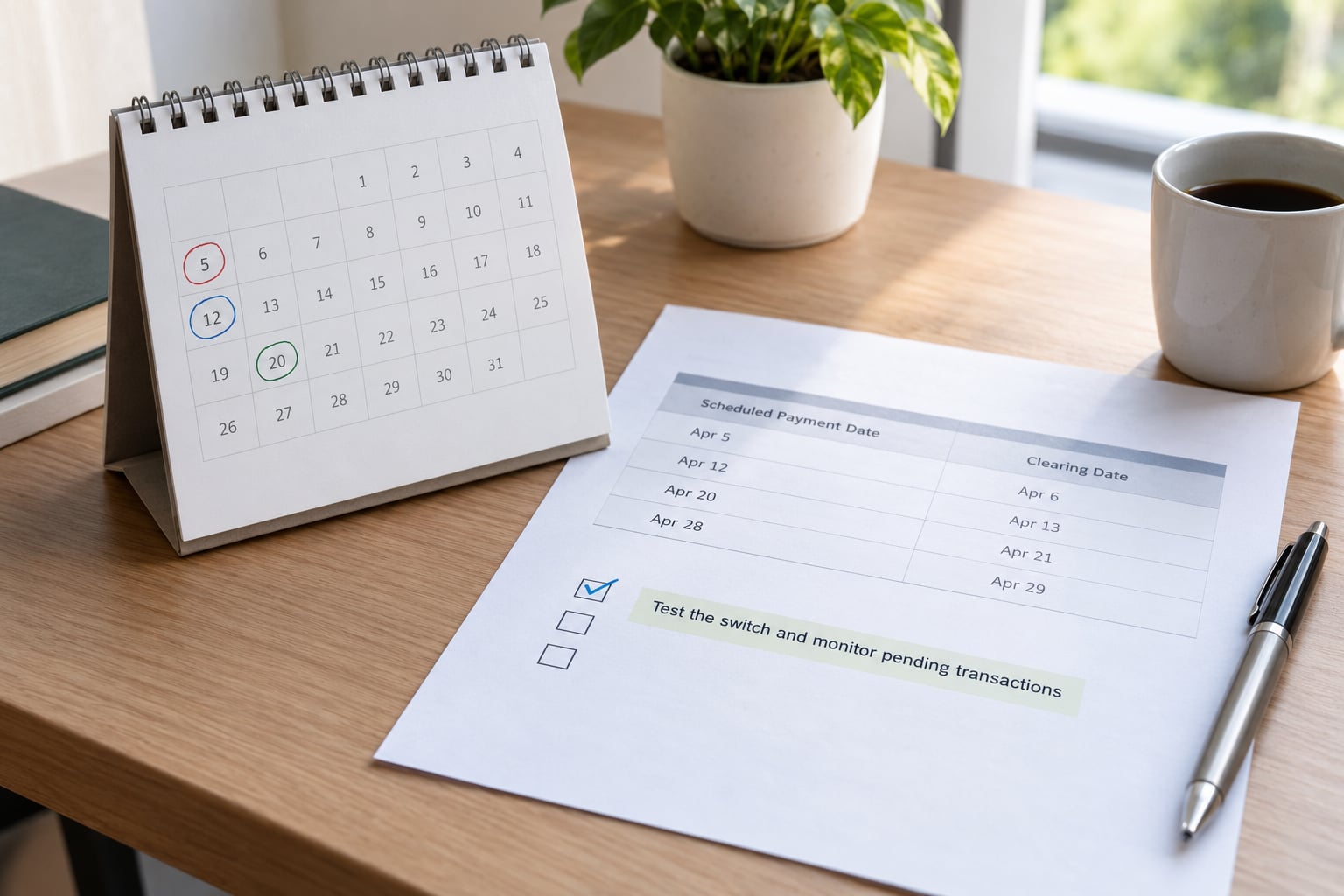
Before you trust the setup, run it. Place one small test payment, keep both accounts open, and read two full statements from each side, line by line, looking for anything still pointing at the old account.
Turn on low-balance and failed-payment alerts on both accounts, and check the available balance rather than the current balance, since pending card authorisations and deposited checks can take a few business days to clear. Automated bill pay entries commonly take several days to be delivered, so a payment you changed on Monday may still be in transit the following week.
Watch for a deposit that arrives after you believed everything had moved. Refunds, reimbursements and adjusted payments can reference the original account and will bounce if it is gone.
If a payment bounces, work through this in order. Call the payee the same day and pay by another method to stop the late fee and any service suspension. Ask your old bank whether the returned item was re-presented, because a re-presented debit takes a second bite at your balance. Then correct the payment method at the merchant, not just at the bank, so the same failure cannot repeat next month.
Close the old account and keep records
Only close once the new account has paid your bills and received your income for a full cycle with nothing missing. Then move the remaining balance out, leave nothing behind, and close in writing or in branch rather than by phone alone.
Ask what remains pending before you confirm closure. A check written before closure can clear afterward and push the account negative, and a returned item arriving late can trigger fees or, in some cases, reactivate the account. Once it is closed, get written confirmation with a date and keep it with your final statements, because that is what you will need if anything disputed shows up months later.
Keep your final statements, the closure confirmation and any interest summary you received for that tax year. Cancel the old debit card, destroy any unused checks, and update the address you have on file so the closure notice reaches you.
Common mistakes that cause missed payments
Nearly every complaint I have read about failed payments traces back to one of these.
- Closing the old account too early. The overlap window is not optional. It exists to catch the payment that was already in transit when you changed the details.
- Assuming a merchant updates itself. Nobody at your gym, streaming service or landlord is tracking your switch. Every merchant needs to be told separately.
- Missing quarterly and annual charges. HOA dues, annual insurance premiums, domain renewals, pest control, storage units and yearly gym plans are the payments that fail quietly, because most people only search their statements for monthly items.
- Overlooking shared access. A joint owner or authorized signer may have autopay instructions set up that you never see, and a pending card on the old account can still decline a purchase after closure.
- Changing payroll too late in the cycle. Update payroll early in a pay period rather than the day before, so the split cycle cannot leave you short.
- Leaving a bare balance behind. A small remaining balance is fine during the overlap; an empty account with a pending item is how overdraft fees appear out of nowhere.
Tips for a low-risk transition
A few habits turn this from a stressful project into a checklist.
- Keep a modest buffer in the old account through the whole overlap period, enough to cover any straggling charge rather than every bill.
- Keep a paper list of each payee, its debit date, and confirmation that you changed it. Paper sounds old-fashioned and is exactly what you want when a payment fails at 6pm.
- Change one biller at a time and confirm each one before moving to the next, so a mistake has exactly one suspect.
- Check the old account for activity even after you think nothing is left on it. Silence is the point of the audit.
- For anything that cannot be changed online, such as a payment instruction held by a property manager, call during business hours and get a reference number.
- Keep logins to the old account active until the closure confirmation arrives, then close the app and remove the card from your wallet.
Frequently Asked Questions
How long does it take to switch banks for direct deposit?
For an employer payroll deposit, allow one to two pay cycles after you submit the new details, and expect a split deposit during the transition. Government benefit deposits such as Social Security can take a month or longer to move. That is why the old account stays open and usable for 60 to 90 days.
Will I get paid twice if I change my direct deposit mid-pay-cycle?
Usually not. Most employers either pay one more deposit to the old account and then move, or send the whole payment to the new one from the next cycle. A genuine double payment is rare and comes from two employers or an incorrect payroll entry, so check your statement before treating it as a windfall.
What happens to automatic payments when I close my old account?
Any payment still keyed to the closed account fails. Bills may be assessed a late fee, subscriptions can be suspended or cancelled, and the returned items may be re-presented against your balance at the old bank. Close only after a full cycle has passed with every payment posted from the new account.
How long should I keep both bank accounts open?
Sixty to ninety days is a reasonable window, and three months is safer. That covers two full payment cycles, quarterly charges and any payment that was already in transit when you changed the details. If your account carries a minimum balance fee, keep just enough to satisfy it during the overlap.
What do I do if a payment bounces after I switch banks?
Contact the payee the same day and settle the bill another way, then fix the payment method with the merchant rather than only at the bank. Ask the old bank whether the item was re-presented, since a returned payment can be resubmitted later. Keep the confirmation until the payee shows the account as current.
Does switching banks affect my credit score?
Moving a checking account does not, on its own, change your credit score. What affects your credit is behaviour: a missed payment reported to a bureau, a collection for an unpaid balance, or a returned payment that runs long. Clearing everything on time during the transition keeps that risk low.
Start with the statements, not the application. Print three months from the old account, mark every recurring debit including the quarterly ones, and open the new account only after you know the full list of what has to move.
The rest is a matter of resisting the urge to be tidy. Everything gets pointed at the new account, both accounts stay open for a couple of months, and the closure happens last, once nothing has bounced. Follow that order and the missed payment you are worried about never happens.