
If you’re searching for what percentage of your portfolio should be bonds, the honest answer is that there isn’t one number that fits everybody. Roughly 40% is the classic mid-career 60/40 split, about 20-30% works in the decade before retirement, and a long-horizon investor with 20+ years and no near-term spending needs can often hold 5-10%.
The percentage that actually suits you comes from one question: how much of this money does someone need to spend, and when. Everything else — age formulas, risk questionnaires, celebrity allocation rules — is a rough shortcut for answering that.
Below you’ll find ranges that real investors use, the four factors that move the number, and a practical way to rebalance once you’ve picked one. This is general education, not individual advice; rules, tax treatment and account types differ by country and state, and change over time.
Table of Contents
- What Percentage of Your Portfolio Should Be Bonds?
- What Determines the Right Bond Allocation?
- What percentage of your portfolio should be bonds at your age?
- How long until the money is needed
- How much a drawdown you could actually live with
- Income needs and existing liabilities
- Cash reserves and portfolio size
- How Much Should Bonds Be in a Portfolio by Investor Type?
- How Do Stocks and Bonds Work Together in a Portfolio?
- Should You Hold Treasury Bonds, Corporate Bonds, or Bond Funds?
- How Do You Rebalance Your Bond Percentage?
- Frequently Asked Questions
- How much of my portfolio should be in bonds if I am retired?
- Are individual bonds or bond funds better for diversification?
- Does the percentage of bonds in my portfolio change when interest rates rise?
- How many bonds should a beginner investor own?
- Should I keep bonds in my emergency fund?
- What is a reasonable bond allocation for a 25-year-old investing for retirement?
- What to Do First
What Percentage of Your Portfolio Should Be Bonds?
Most people land somewhere between 20% and 40% bonds, and that range is where the debate stops being abstract. Below 10% you’re effectively running an all-stock portfolio with a cash buffer. Above 60% you’re closer to a capital preservation account that will struggle to keep pace with inflation over a 30-year retirement.
Some common starting points:
- 40% bonds — the classic 60/40 portfolio, a reasonable default for someone mid-career with 15-25 years left and moderate tolerance for a bad year.
- 20-30% bonds — typical once retirement is inside ten years or you’re already drawing withdrawals.
- 10-15% bonds — a short sleeve, often short-term Treasuries, used to fund the next two or three years of spending while the rest stays in stocks.
- 5-10% bonds — defensible for an under-40 investor with 20+ years of runway, no dependents depending on the money, and steady income outside the portfolio.
- 50-60% bonds — retirees who want the portfolio to fund spending and hold up if stocks fall for a decade.
Three formulas you’ll hear repeated, and how they hold up:
100 minus age. A stock percentage equal to 100 minus your age, so 65 at 35 and 35 at 65. It’s simple, it self-corrects as you age, and it fails for anyone whose money doesn’t map neatly onto a retirement date — a 35-year-old with two kids in private school, or a 62-year-old still working.
110 minus age adds roughly ten points of equities to cover longevity and to keep some growth compounding after withdrawals start. Jack Bogle leaned this way, and for many retirees it’s the more sensible version.
120 minus age is aggressive. At 40 that means 100% stocks, which is fine right up until the first real drawdown and no income cushion. The more extreme the age rule, the more it’s really telling you to guess your own risk tolerance well.
Warren Buffett’s oft-quoted 90/10 splits are a different idea entirely: they treat bonds as a small stabilizer for people with very long horizons, which is closer to a young saver’s profile than to a retiree’s.
None of these are wrong. They’re just compressed answers to a question you can answer more accurately yourself.
What Determines the Right Bond Allocation?
Four variables do most of the work. Work through them in order and the percentage tends to fall out on its own.
What percentage of your portfolio should be bonds at your age?
Age matters only because it proxies for time remaining. If you have 22 years until you need the money, a bad market in year three is noise. If you have four years, the same market decline hits the money you were counting on spending next spring. Judge age by the horizon it stands in for, not the calendar.
How long until the money is needed
This is the factor people skip, and it’s the most important one. Take every dollar you plan to spend in the next five years — the roof, the tuition bill, the first two years of retirement — and count it as money that should not be exposed to a stock market decline. Everything beyond that horizon is money that needs decades to compound.
Bonds belong mostly on the first pile. That’s the standard early retirement playbook: cover several years of expenses in short-term bonds or cash so a crash can’t force a sale, then leave the remainder in stocks.
How much a drawdown you could actually live with
Risk tolerance isn’t a preference, it’s a constraint. Ask what percentage loss would make you sell everything and stop investing. If the honest answer is 15%, a 60/40 portfolio is too risky for you, because its worst stretches have taken far deeper than that. If the answer is 45%, an all-stock portfolio may be fine.
Income needs and existing liabilities
Cash flow changes the calculation. A retiree drawing 4% a year needs bonds to produce that income, because selling stocks in a down market to fund withdrawals is how portfolios get damaged. Someone still accumulating with a salary doesn’t need that income stream.
Known liabilities count too: a mortgage, a private-school bill, a parent’s care. Money earmarked for a fixed future bill belongs closer to bonds, since a bond maturing near that date can be matched to it.
Cash reserves and portfolio size
An emergency fund is not a bond allocation, and mixing the two causes trouble. Keep three to six months of expenses in cash so you’re never selling a falling stock to cover a car repair. Then allocate the rest.
Portfolio size matters mostly because small accounts get crushed by fees and minimums. Under roughly $10,000, a two- or three-fund portfolio — or a target-date fund — beats trying to run a bond ladder and a stock sleeve separately.
How Much Should Bonds Be in a Portfolio by Investor Type?
The table below is illustrative rather than prescriptive. Treat each row as a starting point and adjust for your own horizon.
| Investor profile | Bonds | Stocks | What it assumes |
|---|---|---|---|
| Retiree, currently withdrawing | 50-60% | 40-50% | Needs 3-5 years of spending covered by bonds, wants the portfolio to survive a long flat stretch in stocks |
| Within 10 years of retirement | 30-40% | 60-70% | Still accumulating but wants less volatility as the target date approaches |
| Working adult, moderate risk tolerance | 30-40% | 60-70% | Salary covers expenses, horizon 15+ years, plan is to shift toward bonds over time |
| Long-term growth investor | 5-15% | 85-95% | 25+ years, no near-term goal, high tolerance for a 50% drawdown, emergency fund already in cash |
| Saving for a goal within 5-10 years | 60-80% | 20-40% | Home, college or a business purchase where the date is fixed and the amount matters |
| Early retiree (FIRE) | 20-40% | 60-80% | Portfolio must fund a low withdrawal rate for 30+ years; longevity risk drives the bond share |
A note on FIRE portfolios specifically. The bond sleeve there is usually a cash-flow coverage device rather than a return driver: five to eight years of expenses in short-duration bonds or cash, everything else in equities. That way a market decline in your first two retirement years doesn’t shrink the portfolio you plan to draw from for three decades.
How Do Stocks and Bonds Work Together in a Portfolio?
Stocks provide growth. Over long periods they’ve outpaced inflation, and no bond portfolio replicates that. What they can’t do is show up consistently, and the timing of when they show up is the part you don’t control.
Bonds provide two things stocks don’t: contractual interest, and a maturity date. A bond bought at issue pays you back a known amount on a known day, which is why retirees can build spending schedules around them. Their price moves with interest rates — longer maturities swing harder — but a portfolio’s bond sleeve is doing its job when it stabilizes the whole, not when it earns a big return on its own.
The mechanism that matters is sequence-of-returns risk. If stocks fall early in your retirement, you sell more shares to fund the same spending, and the damage compounds over every remaining year. A bond sleeve that covers several years of withdrawals removes exactly that scenario, which is why the bond percentage in retirement isn’t about the return on the bonds.
Mixing the two also creates the rebalancing effect. In a strong stock year you trim back; in a weak one you add. That’s forced buying at lower prices, and over decades it’s a modest but real contributor to returns.
The tradeoff is straightforward: more bonds means a smoother ride and a smaller expected return. More stocks means more growth and more stomach required. There’s no version of this where you get the smooth ride and the growth, and anyone offering one is selling something.
Should You Hold Treasury Bonds, Corporate Bonds, or Bond Funds?
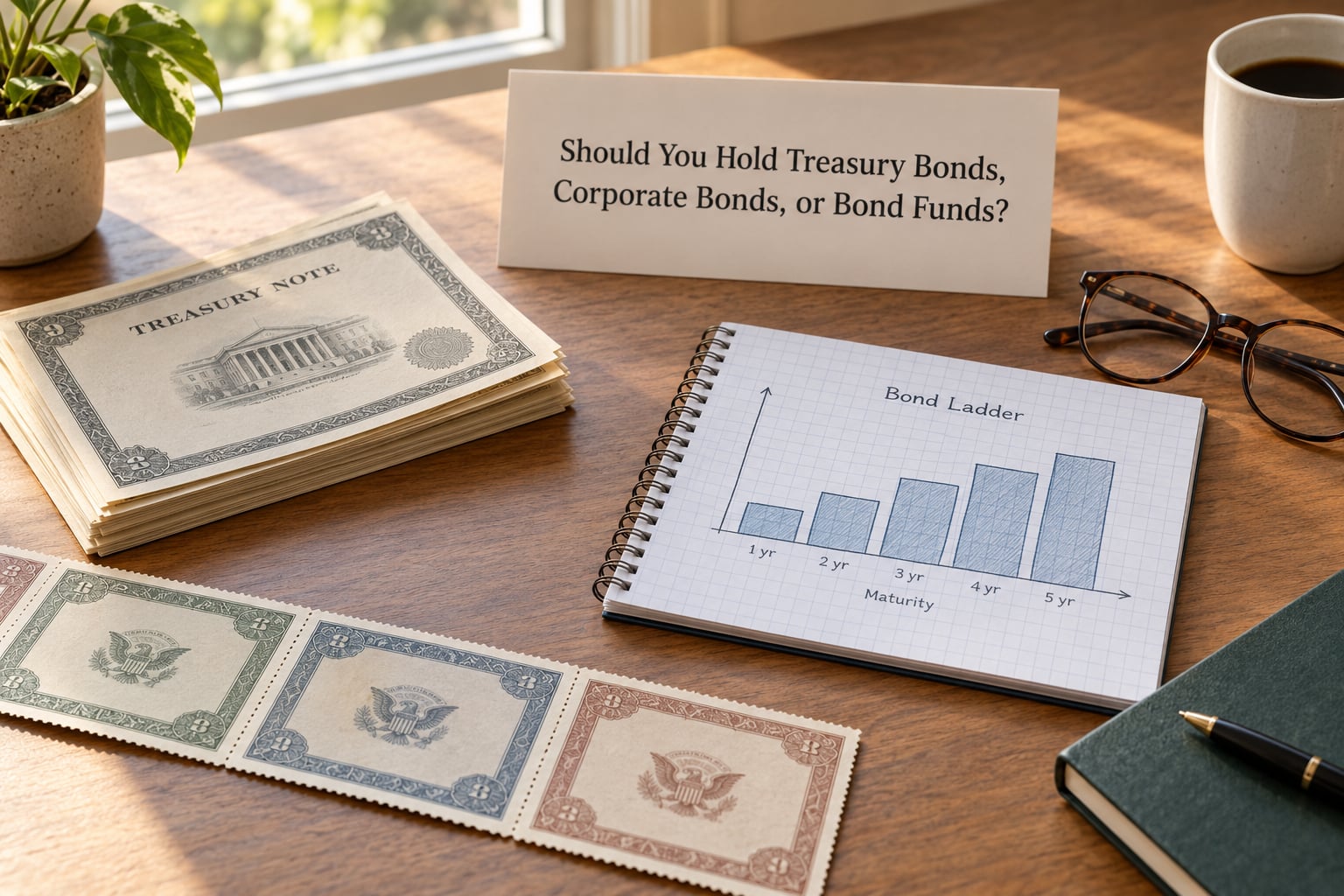
Your bond percentage is one decision. What fills that sleeve is a separate one, and it changes how much rate risk you’re actually taking.
| Option | Rate exposure | Main tradeoff |
|---|---|---|
| Individual Treasury notes | Fixed to maturity; predictable | Ladder takes work to maintain, each maturity is small unless you buy a lot |
| Treasury bonds held to maturity | Fixed to maturity | Long maturities swing hard in price before they mature, but paying out at par if you hold |
| Bills and money-market funds | Very low | Good for near-term spending; reinvestment risk if rates fall |
| Total bond market index fund | Broad, moderate duration | One-ticket diversification, price moves with rates |
| Bond ladder | Predictable, if held to each rung’s date | Reinvesting rung by rung as rates change; a bit of work each year |
| TIPS | Inflation-adjusted principal | Useful when spending is far out; awkward for short goals |
| Municipal bond funds | Moderate | Tax-exempt interest in a taxable account, but higher credit risk and thinner funds |
| Corporate and high-yield funds | Moderate to high | More income and credit risk; high-yield has added default risk |
Bond ladders are the option most guides skip, and they’re worth understanding because they answer a real question: when do you get your money back. Instead of one fund, you hold bonds maturing in successive years, so a rung comes due exactly when you need to spend. Predictability goes up, and reinvestment risk — having to put money back into a much lower rate environment — goes down.
The cost is admin and a slightly lower starting yield than a fund, plus you lose the diversification a fund gives you for free. For a retiree drawing predictable income, that trade is usually worth it. For a 28-year-old with 30 years to go, it’s not.
Where the bonds sit matters as much as which ones. Bond and Treasury interest is taxed as ordinary income federally, so keeping that sleeve in a traditional IRA or 401(k) inside your higher brackets can be more efficient than holding the same fund in a taxable account. Qualified municipal bond interest is exempt from federal tax, which sometimes makes a muni fund a better fit in taxable. Roth accounts are a poor home for ordinary-income bonds right now, since withdrawals would be taxed as income plus the qualified-distribution penalty if you’re under 59½. Compare current rates and rules before you move money, since both change.
How Do You Rebalance Your Bond Percentage?
Pick a target, write it down, then stay near it. The mechanics are less interesting than resisting the urge to change the target every time markets move.
Choose the target and the horizon together. Write both on one line: “40% bonds, shifting to 50% within five years of my target retirement date.” Target-date funds automate that glide path if you’d rather not manage it.
Check on a schedule or a threshold. Most people pick one of two: once a year on an anniversary, or whenever a sleeve drifts more than five percentage points from target. Calendar-based is simpler. Threshold-based does fewer transactions but needs a bit more attention. Either is defensible; mixing both usually means you rebalance too often.
Use contributions first. Direct new money to whichever sleeve is short. If bonds fell and they’re now 4 points under target, a monthly contribution that goes mostly to bonds restores the mix without a single taxable sale.
Sell only when contributions can’t cover the gap. If you’re retired and taking withdrawals, set withdrawals to hit the overweight sleeve first. That’s the cheapest rebalance there is, and it’s fully available in retirement accounts.
Drift is the quiet risk here, not a crash. A year of strong stock returns can add six or seven points to your equity share without you deciding anything, and if you never look, your allocation quietly became something you didn’t choose.
Change the target when something real changes: a new job, a child, a move to a higher tax bracket, a health event, or a retirement date that moved. Don’t change it because the last twelve months were uncomfortable. That’s the one rebalancing trigger worth ignoring.
A five-question check before you settle: How many years until this money is needed? What drop would make me sell? Is my emergency fund in cash already? Do I have income liabilities in the next decade? Would I still make this choice if the market dropped 30% next month? If the answers point at 10% bonds, take 10%.
Frequently Asked Questions
How much of my portfolio should be in bonds if I am retired?
Most retirees land between 50% and 60% in bonds, and the reason is sequence of returns rather than income alone. Bonds covering three to five years of spending means a bad first decade for stocks never forces you to sell shares at a loss. Short and intermediate maturities usually do the covering; long bonds are better used for growth of the overall pot. Combine the bond sleeve with your cash reserve, and check the mix annually.
Are individual bonds or bond funds better for diversification?
Bond funds are easier and cheaper for almost everyone. One total bond market index fund holds thousands of issues, so a single issuer or sector default barely moves it, and the expense ratio is typically a fraction of a percent. Individual bonds add control over exactly when principal returns and what you reinvest at, which helps a retiree matching spending to maturities. Funds suit long horizons; ladders suit predictable near-term cash flow.
Does the percentage of bonds in my portfolio change when interest rates rise?
Higher rates do not require a different target percentage, but they change what a given percentage buys you. Rising rates push bond prices down, so existing funds lose value before higher yields work through. That loss is temporary for funds you hold, and irrelevant for individual bonds you keep to maturity. Higher starting yields also make a larger bond sleeve more attractive for retirees who need income, since reinvestment happens at better rates.
How many bonds should a beginner investor own?
Zero, if you use a fund. One broad total bond market index fund gives you thousands of issues in a single holding and keeps the cost low. Individual bonds only become worth the effort once the amount justifies the minimum purchases and you have a clear maturity plan, often at account sizes well above what most beginners hold. A bond ladder of five to ten rungs is plenty for most households covering a few years of spending.
Should I keep bonds in my emergency fund?
Keep emergency money separate from your bond sleeve, in cash or a money market fund. An emergency fund has to be available the week you lose your job, and bond funds can be down several percent in a rate shock, which is a poor time to be liquidating. Three to six months of expenses is the usual target. Your bond allocation handles money with a known future date; the emergency fund handles everything else.
What is a reasonable bond allocation for a 25-year-old investing for retirement?
Ten to fifteen percent is a reasonable starting point, held in short-term bonds or a broad bond fund, with the rest in stocks. At 25 the horizon is long enough that a downturn barely matters, so bonds are there mainly for the near-term goals and the near-term nerves rather than for return. Revisit the split roughly every five years, and step it up gradually as the target date approaches.
What to Do First
Write down the date the biggest chunk of this money gets spent, then count how much you need between now and then. That number, plus whatever you need for spending in the first few years of retirement, is roughly your bond allocation for now. Check it once a year, add new contributions to the short sleeve first, and revisit the number when your life changes rather than when the market does.
Updated for 2026. Allocation ranges shift as rates and account rules change, so confirm the details before you move money.