
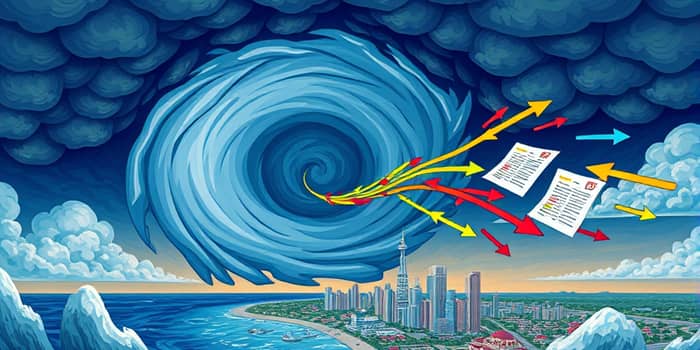
The world of insurance and finance converges when catastrophic events strike. Catastrophe bonds, commonly called cat bonds, provide a transformative mechanism for transferring predefined disaster risks from insurers to investors. By channeling capital through special purpose vehicles, they create a lifeline for companies and communities facing extreme weather or seismic upheaval.
The Core Mechanics of Catastrophe Bonds
Catastrophe bonds operate through a carefully structured process that mitigates insurer exposure and offers investors attractive returns. At the heart of this model lies an SPV, or special purpose vehicle, which isolates the risk and collateral to protect both sponsor and investor.
- SPV/Trust Setup: Principal is collected and invested in low-risk assets such as U.S. Treasury money market funds or supranational notes.
- Maturity Period: Typically spans one to five years, with three years being most common; principal returns at maturity if no trigger occurs.
- Trigger Mechanisms: Defined conditions that cause a payout include indemnity, industry loss, parametric, and modeled loss triggers.
These triggers determine when investors forego some or all of their principal to compensate the insurer. For instance, an industry loss trigger may activate payouts when aggregate losses exceed a threshold of $825 million in U.S. thunderstorm or tornado insured losses.
Historical Evolution and Market Growth
The concept of catastrophe bonds emerged after the devastation of Hurricane Andrew in 1992, which exposed the limited capacity of traditional reinsurers. Innovators in the insurance-linked securities market saw an opportunity to crowd-source reinsurance capital and reduce reliance on insurer reserves.
Over the decades, issuance volumes have soared. By the first half of 2025, annual cat bond issuance reached a record $17.8 billion, surpassing previous full-year highs. Average deal sizes climbed from $190.3 million in 2024 to $240.7 million in 2025, reflecting heightened insurer demand and robust investor appetite.
Risk Assessment and Performance Metrics
Investors rely on sophisticated models—often combining vendor platforms with in-house expertise—to evaluate catastrophe risk. These assessments hinge on three primary metrics:
These metrics support clear pricing and allow comparability across offerings. Conservative modeling enhances investor confidence, while transparent disclosure in offering documents helps minimize disputes over parameter definitions.
Returns, Compensation Structure, and Comparison to Traditional Assets
Cat bonds deliver compensation through coupons composed of two elements: collateral yield and risk spread. The risk spread premium compensates investors for bearing event-specific tail risk, while collateral yield reflects returns from safe investments.
For example, a three-year cat bond offering $100 million in principal might provide a 6.25% annual coupon. This could break down into a 1.5% collateral yield plus a 4.75% risk spread, funded by sponsor premiums paid to the SPV.
This comparison highlights why institutions view cat bonds as a compelling alternative. In periods of tightening credit spreads and low Treasury yields, catastrophe bonds have delivered double-digit returns, outperforming many hedge fund strategies in 2023 and 2024.
Diversification Benefits and Broader Impacts
One of the most attractive features of cat bonds is their low correlation to stocks and bonds. Because payouts hinge on natural disasters rather than economic cycles, they often act as a buffer when traditional markets falter.
For insurers, multi-year cat bonds offer stability beyond the single-year contracts typical in reinsurance. Clear trigger definitions and upfront collateralization reduce counterparty risk and earnings volatility.
Investors also appreciate the positive social impact. By transferring weather and seismic risks to global capital markets, cat bonds facilitate faster recovery and reconstruction, particularly in emerging economies supported by World Bank-sponsored issuances.
Future Outlook and Key Challenges
Climate change projections and increasing natural catastrophe losses—estimated at $107 billion in 2025—are driving further market expansion. Parametric triggers are gaining traction for their speed and transparency, especially in developing regions that require rapid payouts.
However, challenges persist. Basis risk, where modelled parameters may not perfectly match actual losses, can create mismatches between investor expectations and sponsor needs. Illiquidity in secondary markets and potential disputes over trigger definitions require ongoing attention.
Despite these hurdles, the outlook remains strong. Continued innovation in modeling, expanded investor education, and evolving regulatory frameworks are likely to sustain growth. As global awareness of climate and disaster risk intensifies, cat bonds stand poised to play a critical role in bolstering resilience and channeling capital where it is needed most.
By combining insurance expertise with capital market efficiency, catastrophe bonds represent a powerful tool for managing extreme risks. They offer investors a unique opportunity to earn attractive yields while supporting communities in their most vulnerable moments. As this market matures, its ability to absorb larger risks and drive positive social outcomes will only strengthen, reaffirming the vital intersection of finance and risk management.
References
- https://www.chicagofed.org/publications/chicago-fed-letter/2018/405
- https://www.irmi.com/articles/expert-commentary/reinsurance-and-catastrophe-bond-trends
- https://www.schroders.com/en-us/us/institutional/insights/taking-a-house-view-risk-analysis-in-catastrophe-bonds/
- https://www.franklintempleton.lu/articles/2024/multi-asset/an-introduction-to-catastrophe-bonds
- https://www.ftinstitutional.com/forms-literature/download/FTISU-CATBD
- https://agentsync.io/blog/insurance-101/understanding-cat-bonds
- https://www.man.com/insights/bonds-investing-with-impact
- https://www.weforum.org/stories/2025/12/catastrophe-bond-insurance-climate-crisis/
- https://www.youtube.com/watch?v=vBADNz5ASAU