
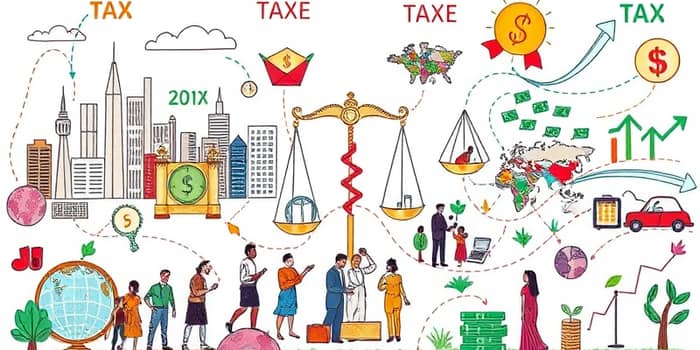
Tax policy lies at the heart of economic performance and social equity. By adjusting rates, broadening bases, and enforcing compliance, governments influence incentives for work, saving, and innovation, while also shaping the distribution of wealth.
This article examines historical U.S. trends, global reforms in 2024–2025, growth mechanisms, wealth taxes, and policy designs that balance efficiency and fairness.
Historical U.S. Trends and Their Legacy
Beginning in the 1980s, post-1980 tax cuts for top earners aimed to stimulate investment and growth. Instead, research shows that reductions in marginal income and capital gains rates correlated with a sharp rise in income inequality.
The top 1% saw their share of national income surge, while unequal capital distribution and wealth concentration eroded public revenue for infrastructure and education, slowing broad-based growth.
Empirical studies find no significant link between upper-income tax cuts and higher GDP growth, contradicting neoclassical models that ignore inequality’s drag on dynamism.
Global Tax Policy Shifts in 2024–2025
Facing mounting debt, aging populations, and climate challenges, over 86 OECD and G20 jurisdictions adopted reforms in 2024, touching income, corporate, consumption, property, and environmental taxes.
- Transparency and digital reporting increased scrutiny on multinational profit shifting.
- OECD Pillar Two introduced a global minimum corporate tax rate of 15% to curb tax competition.
- Environmental levies and digital service taxes broadened the base while funding green transitions.
These changes reflect five powerful forces: AI-driven tax enforcement, fiscal strain, geopolitical fragmentation, populist demands for elite taxation, and the imperative of climate transition.
Mechanisms Shaping Economic Growth
Tax cuts lower marginal rates, creating substitution effects that can boost work and saving. However, income effects from higher after-tax wages may reduce labor supply, leaving net growth ambiguous without offsetting spending cuts.
- Deficits from rate cuts push up interest rates, crowding out private investment.
- Base-broadening reforms aim to eliminate loopholes, theoretically improving efficiency but often raising effective rates.
- Pro-growth criteria emphasize strong substitution effects, minimal deficits, and low distortionary costs.
Consensus suggests that taxes on property and consumption are least harmful, while high marginal income and corporate rates impose the greatest burdens on economic activity.
Wealth Taxes: Promise and Pitfalls
Wealth levies promise to curb concentration and generate revenue, but experience shows chronic shortfalls. High-net-worth migration shrinks the base, and sub-threshold taxpayers follow suit, creating unintended losses.
Behavioral surveys and revenue projections highlight behavioral responses and migration risks that can undermine collections. Critics warn that wealth taxes may deter entrepreneurship and slow job creation.
Yet proponents argue that properly designed levies reduce extremities of wealth without stifling innovation, suggesting that thresholds and exemptions must be calibrated to minimize distortions.
Designing Pro-Growth, Inclusive Tax Systems
An inclusive growth framework balances efficiency and equity. Progressive income taxes fund human capital investments, while consumption levies provide stable revenue streams.
- Anti-avoidance rules and digital reporting ensure stronger compliance and fairness.
- Targeted incentives for research and development foster entrepreneurship.
- Environmental taxes align revenue goals with sustainability objectives.
International coordination, notably through OECD Pillars One and Two, reallocates taxing rights and reduces harmful competition, though developing nations seek alternative UN frameworks to safeguard their interests.
Programs like the World Bank’s Global Tax Program, with over $90 million invested across 85 countries, demonstrate the importance of technical assistance and capacity building for domestic resource mobilization.
Policy Implications and Future Directions
To foster both growth and equity, policymakers should:
- Adopt broad bases with moderate rates to limit distortions.
- Ensure fiscal sustainability by aligning tax reforms with spending priorities.
- Strengthen international cooperation to address profit shifting and tax competition.
By crafting systems that reward productive activity while investing in public goods, nations can mitigate inequality and sustain long-term prosperity.
Conclusion
Taxation trends carry profound consequences for economic growth and wealth distribution. Historical lessons from U.S. tax cuts underscore the risks of exacerbating inequality without boosting output, while global reforms highlight the need for balanced, cooperative approaches.
Ultimately, effective tax policy requires a nuanced blend of incentives, equity considerations, and international alignment to ensure that both prosperity and fairness advance together.
References
- https://equitablegrowth.org/the-relationship-between-taxation-and-u-s-economic-growth/
- https://www.deloitte.com/global/en/services/tax/services/global-tax-policy.html
- https://www.brookings.edu/articles/effects-of-income-tax-changes-on-economic-growth/
- https://www.pwc.com/gx/en/services/tax/new-tax-order.html
- https://familyenterpriseusa.com/family-businesses/new-research-wealth-taxes-may-cost-more-than-they-raise/
- https://www.worldbank.org/en/programs/the-global-tax-program
- https://academic.oup.com/ser/article/20/2/539/6500315
- https://www.oecd.org/en/publications/tax-policy-reforms-2025_de648d27-en/full-report/tax-policy-reforms_c57e058c.html
- https://taxpolicycenter.org/briefing-book/how-do-taxes-affect-economy-long-run
- https://www.oecd.org/en/topics/policy-issues/tax-policy.html
- https://www.redw.com/the-rise-of-wealth-taxes-understanding-the-impact-on-individuals-and-businesses/
- https://www.cato.org/blog/wealth-taxes-raise-less-revenue-you-think
- https://www.whitehouse.gov/presidential-actions/2025/01/the-organization-for-economic-co-operation-and-development-oecd-global-tax-deal-global-tax-deal/
- https://www.economicsobservatory.com/which-taxes-are-best-and-worst-for-growth