
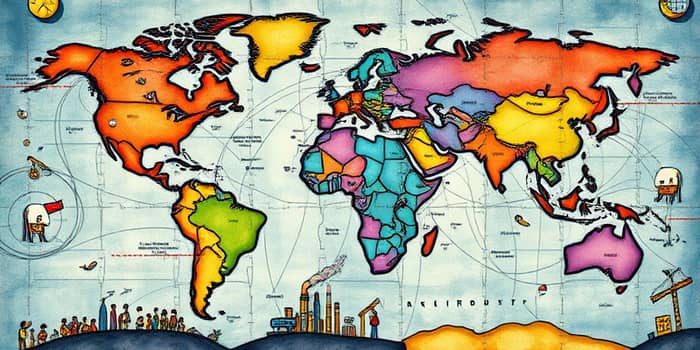
Globalization has shaped the modern world through the exchange of goods, ideas and technology across borders. Yet in recent years, a profound backlash has emerged, challenging the established deep global interdependence and growth fostered since World War II. This movement is reshaping economic alliances, policies and the very fabric of international trade.
Historical Evolution from Post War Boom to Early Backlashes
In the aftermath of World War II, the Bretton Woods system laid the foundation for a US led order, characterized by stable currencies and expanding multilateral institutions. Trade grew from 3.5 trillion dollars to over 17 trillion by 2020, driven by reduced trade barriers and tariffs and the rise of consumerism.
However, globalization has faced resistance before. In the early twentieth century, protectionist policies and immigration restrictions rolled back cross border flows, contributing to economic fragmentation before both world wars. These historical episodes offer lessons on the fragility of openness when national interests collide.
Triggers of a New Backlash
The recent surge in economic nationalism stems from multiple shocks that revealed vulnerabilities in the global model.
- 2008 Financial Crisis exposed systemic risks and fueled populist sentiments
- Covid-19 Pandemic highlighted fractures in global supply chains
- Russia Ukraine War underscored energy and commodity dependencies
- China’s rapid ascent challenged US economic dominance
- Middle East tensions disrupted key shipping corridors
- Rising income and social disparities left many communities behind
These events created fertile ground for rhetoric emphasizing sovereignty over cooperation, and for policies favoring domestic producers.
Causal Analysis: Crises, Inequality and Geopolitics
Economic distress and rising inequality have amplified calls for protectionism. While trade lifts overall living standards, it can also produce rising income and social disparities that erode public support. Workers in industries exposed to foreign competition often feel abandoned by policymakers.
Geopolitical rivalries have added layers of complexity. The US China competition, formation of BRICS and regional ambitions in Europe and Asia have all contributed to shifting geoeconomic contours and alliances. Governments now balance the benefits of openness against perceived strategic risks.
Case Studies: Policies and Political Manifestations
Across the globe, governments have adopted measures reflecting the backlash.
In the US, bipartisan support for industrial subsidies under the Inflation Reduction Act and tariffs first imposed under the Trump administration remains strong, signaling a shift toward a modern industrial and innovation strategy.
Economic Impacts and Public Opinion
Protectionist measures have tangible costs. Tariffs on imports raise grocery and household prices, contributing to survey findings where 60 percent of Americans approve of Supreme Court rulings against new levies, while 70 percent blame those same tariffs for rising consumer costs.
Yet abstract support for economic nationalism often fades when faced with immediate price hikes. Voters across the political spectrum increasingly prioritize secure and resilient supply chains and affordability over long term industrial policies, challenging the staying power of protectionist agendas.
Future Outlook and Strategies for Cooperation
The trajectory of globalization will depend on how governments balance national interests with global challenges. Risks include a descent into a zero-sum world of fragmentation, where rival blocs build walls rather than bridges, but opportunities remain for creative solutions.
- Design compensation schemes for workers displaced by trade shocks
- Strengthen multilateral institutions to address climate and health crises
- Promote joint investments in critical technologies and infrastructure
- Encourage regional cooperation on supply chain resilience
Successful frameworks will likely combine targeted industrial support with safeguards for consumers and workers, mitigating inequality and restoring faith in open markets. Governments must also anticipate unintended consequences and new risks when erecting barriers too rapidly.
Policy Recommendations and Closing Thoughts
As policymakers navigate this pivotal moment, three guiding principles can help chart a balanced path:
- Adopt long-term compensation for vulnerable industries to ease transitions
- Foster cooperative governance beyond trade wars to tackle shared global threats
- Invest in education and training to prepare workforces for technological change
Globalization is neither an irreversible tide nor a simple zero-sum game. By learning from past backlashes and implementing nuanced strategies that combine openness with social protection, the international community can forge a resilient economic order that uplifts all participants. The challenge ahead is to ensure that integration delivers shared prosperity, rather than leaving future generations to confront new divides and distrust.
References
- https://www.youtube.com/watch?v=RhvkvTJdbl8
- https://www.schoolofpublicpolicy.sk.ca/research-ideas/publications-and-policy-insight/policy-brief/economic-nationalism.php
- https://jfrieden.scholars.harvard.edu/file_url/307
- https://www.hks.harvard.edu/centers/mrcbg/programs/growthpolicy/rise-economic-nationalism
- https://www.piie.com/commentary/speeches-papers/backlash-against-globalization
- https://www.liberalpatriot.com/p/is-economic-nationalism-fading-among
- https://asiatimes.com/2026/02/economic-nationalism-giving-rise-to-a-zero-sum-world/
- https://www.annualreviews.org/content/journals/10.1146/annurev-polisci-041719-102405
- https://www.youtube.com/watch?v=dIMhGmrTnWE
- https://niehaus.princeton.edu/backlash-against-globalization-what%E2%80%99s-next
- https://www.weforum.org/meetings/world-economic-forum-annual-meeting-2025/sessions/the-rise-of-economic-nationalism/
- https://siepr.stanford.edu/news/globalization-making-sense-backlash
- https://www.intereconomics.eu/contents/year/2025/number/5/article/beyond-trade-wars-and-economic-nationalism-towards-a-cooperative-global-governance.html
- https://iwonder.com/titles/the-globalization-backlash-a-new-world-economic-o-f4c4eb9e267d4e618ae97ab0fef5d029