The world’s economic landscape is undergoing a profound transformation, as rising nations challenge the traditional dominance of long-standing superpowers. From shifting centres of gravity to the emergence of dynamic middle powers, this era demands fresh perspectives, bold strategies, and unwavering adaptability. This article explores the data, narratives, and practical insights needed to understand—and thrive—in this new reality.
A New Economic Hierarchy
In 2026, the global leaderboard of economies reveals both continuity and change. The United States remains first with a nominal GDP near $30 trillion, while China holds a strong second place at about $20 trillion. However, when measured by purchasing power parity, China leads by roughly $11.7 trillion. Germany and India follow in third and fourth positions respectively.
The table below highlights key figures and growth rates shaping today’s superpower contest.
Despite the gap between the two largest economies, both exhibit narrowing economic gap between giants, driven by higher Chinese growth and incremental U.S. innovation.
Asia’s Eastward Surge
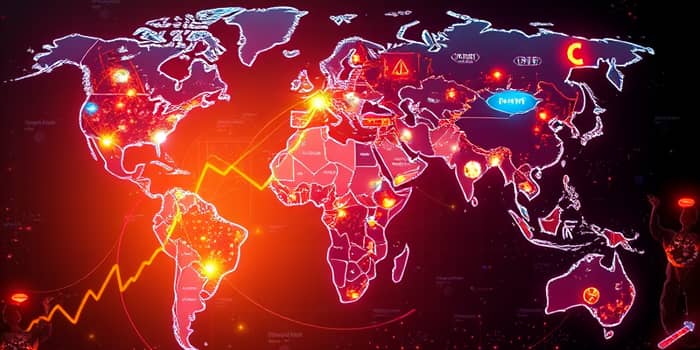
The world’s economic center of gravity has shifted eastward at an unprecedented pace—approximately 140 kilometers per year since the 1980s—returning toward its ancient roots. By 2025, this centre sat near the Russia-China-Mongolia border, underscoring Asia’s central role.
China’s manufacturing prowess, expanded domestic consumption, and international initiatives like the Belt and Road have solidified its lead. India, too, is ascending rapidly, poised to surpass Japan as the fourth-largest economy in 2026 with a growth rate above 6%.
This unprecedented eastward shift of power suggests that by 2030, Asia may eclipse North America and Europe combined, fueled by massive populations, tech investment, and rising military capacities.
The Resilient Middle Powers
Beyond the headline superpowers, a constellation of middle powers is reconfiguring the global order. Nations such as the UAE, Indonesia, and Türkiye are leveraging strategic diplomacy and economic diversification to punch above their weight.
Meanwhile, groups like the Next Eleven—spanning Bangladesh to Vietnam—are on track to outspeed traditional blocs. Collectively, they could surpass the EU-27 in influence by 2030, reflecting a deeper structural power rebalancing among nations.
India stands out as the only great power expanding its global footprint, driven by a potent mix of demographic advantages and infrastructure investment. This demographic dividend and digital transformation presents both opportunities and responsibilities for its policymakers and business communities.
Driving Forces Behind Economic Clout
Several competitive advantages underpin each superpower’s staying power. The United States benefits from its reserve currency status, robust capital markets, and leadership in AI and advanced materials. China’s integrated supply chains and vast infrastructure projects support sustained expansion. Germany remains Europe’s high-value manufacturing hub, while India’s youthful population and growing digital economy accelerate its rise.
Understanding these drivers is crucial for stakeholders seeking to align strategies with long-term trends.
Navigating the New Global Economy
As economic power disperses, individuals and organizations must adapt. Practical steps include:
- Investing in skills such as data analytics, renewable energy, and emerging technologies
- Building cross-border partnerships and supply chain resilience
- Adopting sustainable and inclusive growth strategies to meet evolving regulatory and social expectations
- Monitoring geopolitical shifts and diversifying market exposure
Looking Ahead: Opportunities and Challenges
The splintering of economic power brings both promise and peril. Rising economies offer new consumer markets and innovation hubs, while intensifying competition and fragmentation risk disrupting global trade and cooperation. To navigate this complexity, leaders must embrace agility, foster international collaboration, and commit to long-term vision.
Ultimately, the shifting contours of global influence challenge us to rethink established institutions and forge a collective future that balances national interests with shared prosperity. By harnessing insight, innovation, and empathy, stakeholders at every level can thrive in this transformative era.
References
- https://www.realclearworld.com/articles/2023/09/13/superpowers_in_shifting_the_global_economy_979239.html
- https://researchfdi.com/global-gdp-largest-country-ranking-2026/
- https://knowledge4policy.ec.europa.eu/foresight/topic/expanding-influence-east-south/power-shifts_en
- https://statisticstimes.com/economy/projected-world-gdp-ranking.php
- https://www.visionofhumanity.org/middle-powers-reshape-global-order-in-post-superpower-era/
- https://www.litefinance.org/blog/for-beginners/top-strongest-economies-in-the-world/
- https://www.futureagenda.org/foresights/shifting-power-and-influence/
- https://www.imf.org/external/datamapper/index.php
- https://www.gisreportsonline.com/r/globalization-superpowers/
- https://en.wikipedia.org/wiki/List_of_countries_by_GDP_(nominal)
- https://insights.som.yale.edu/insights/how-nations-use-economic-power-to-shape-the-world-order
- https://www.worldeconomics.com/Rankings/Economies-By-Size.aspx
- https://www.youtube.com/watch?v=uiUPD-z9DTg