
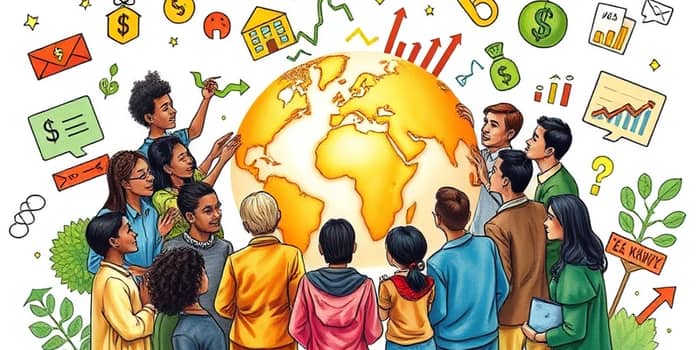
Economic exclusion affects billions worldwide, but through collaboration, innovation, and targeted policies, we can unlock prosperity for all. This article explores proven strategies, data-driven frameworks, and inspiring examples to guide communities, governments, and organizations toward transformative and inclusive growth outcomes.
Understanding Economic Inclusion
At its core, economic inclusion means creating equitable access to financial resources and support systems for marginalized individuals and communities. Roughly 4.7 billion people live below a $12-per-day purchasing power benchmark—nearly 60 percent of humanity—and nearly half of those in sub-Saharan Africa and India struggle with exclusion.
Growth fuels inclusion by generating jobs, raising incomes, and promoting labor-friendly policies. Yet, to achieve universal empowerment alongside net-zero targets by 2050, the world must invest about 8 percent of global GDP annually through 2030.
Key Challenges and Urgent Risks
Persistent barriers hinder progress. Extreme poverty programs reach over 90 million individuals in 75 countries, but crises, displacement, and systemic inequities continue to block access. Gender disparities, ageing workforces, and disability gaps contribute to a global GDP loss of $1.37–1.94 trillion each year.
As climate shocks and economic downturns intensify, resilient solutions must integrate community development and resilience to safeguard vulnerable populations and ensure sustained progress.
Strategies from Social Enterprises and Leadership
Social enterprises and visionary leaders drive change through purposeful partnerships and innovative models. The AV Playbook outlines five pillars for impact:
- Forge strategic partnerships with governments, NGOs and private sector actors using tools like the AIM Canvas to define roles and conduct needs assessments.
- Design inclusive business models tailored to marginalized groups, iterating based on community feedback to ensure relevance and uptake.
- Invest in community development through education, skills training, and resource distribution, measuring impact for continuous scaling.
- Implement innovative financial models such as microloans, savings groups, insurance schemes, and fintech collaborations, accompanied by financial education and awareness.
- Measure impact through robust data analytics to track outcomes, maintain accountability, and foster iterative improvement.
These pillars, rooted in McKinsey and AIM principles, deliver sustainable change by aligning stakeholder incentives and centering community voices.
Community-Centered Approaches that Work
Place-based, multidisciplinary initiatives embed economic inclusion at the grassroots. Brookings and LISC spotlight transformative sub-geographies like Everett, WA; Oakland, CA; and Charlotte, NC. Key action steps include:
- Selecting high-impact areas through data-driven mapping and stakeholder partnerships to pinpoint systemic barriers.
- Leveraging investments in economic ecosystems, built infrastructure, and civic networks to uplift existing residents and small businesses without displacement.
- Shifting power dynamics by involving community leaders in decision-making and resource allocation.
By integrating workforce development, capacity building, and local leadership, these efforts dismantle inequities and lay the foundation for lasting prosperity.
Government and Private Sector Interventions
Governments, development banks, and private finance play complementary roles. The World Bank’s 405 economic inclusion programs across 88 countries now reach over 70 million people, with governments covering up to 93 percent of beneficiaries.
- Safety nets and livelihood programs to protect extreme poor populations during crises and recovery phases.
- Skills and employment access initiatives prioritized by the EBRD to bridge disability and aging workforce gaps.
- Consumer and community outcome focus adopted by FDIC strategies, ensuring safe, affordable financial products.
Collaborations between public institutions and private enterprises amplify reach, mobilize resources, and ignite market-driven solutions for inclusive growth.
Measuring Success and Scaling Impact
Rigorous evaluation frameworks underpin sustainable change. The UNCTAD Inclusive Growth Index covers 134 countries, assessing living conditions, equality, education, and employment. Developed economies score a median of 89.3 versus 46.4 for developing counterparts.
Monitoring tools highlight top performers—Luxembourg, Norway, Denmark—in advanced regions and standouts like Singapore, UAE, Chile, China, Thailand, and Uruguay in the developing world. Continuous data collection and transparent reporting foster adaptability.
Embedding measurement from inception to scale ensures resources are optimized and lessons are institutionalized for future initiatives.
Bringing It All Together: Action Steps for Change
Economic inclusion is both a moral imperative and an economic necessity. To bridge the gap, stakeholders should:
- Champion cross-sector collaboration and shared accountability among governments, NGOs, businesses, and communities.
- Customize interventions to local contexts, focusing on gender equity, disability inclusion, and climate resilience.
- Invest in data systems and impact measurement to drive evidence-based policy and program design.
- Foster community leadership and co-creation to ensure that solutions reflect lived experiences and local priorities.
By aligning innovation, partnership, and rigorous evaluation, we can unlock the potential of 4.7 billion people and build economies that serve every citizen. Let us seize this moment of urgency to forge a world where equitable opportunity becomes the standard, not the exception.
References
- https://avplaybook.com/empowering-economic-inclusion-20ca096594fc
- https://openknowledge.worldbank.org/entities/publication/e7d7c0e7-7885-479f-86da-42d0f4f1b65e
- https://www.mckinsey.com/featured-insights/mckinsey-explainers/what-is-economic-inclusion
- https://openknowledge.worldbank.org/server/api/core/bitstreams/2f14fe0a-9451-490b-81c1-37a9a7126a9f/content
- https://www.brookings.edu/articles/community-centered-economic-inclusion-a-strategic-action-playbook/
- https://unctad.org/news/beyond-gdp-new-data-reveals-persistent-gaps-progress-inclusive-growth
- https://naacp.org/issues/inclusive-economy
- https://www.weforum.org/stories/2025/01/resilient-inclusive-economies-diversity-equity-inclusion/
- https://www.fdic.gov/consumer-resource-center/fdic-economic-inclusion-strategic-plan
- https://www.oecd.org/en/topics/policy-issues/inclusion-and-equality.html
- https://www.lisc.org/our-resources/resource/three-models-inclusive-community-led-economic-development-without-displacement/
- https://www.aspeninstitute.org/blog-posts/how-to-create-an-inclusive-economy-and-why-its-urgent/
- https://oxford-review.com/the-oxford-review-dei-diversity-equity-and-inclusion-dictionary/economic-inclusion-definition-and-explanation/
- https://openknowledge.worldbank.org/entities/publication/e9e06f43-15b0-5e02-a9b7-d4a5df00f825