
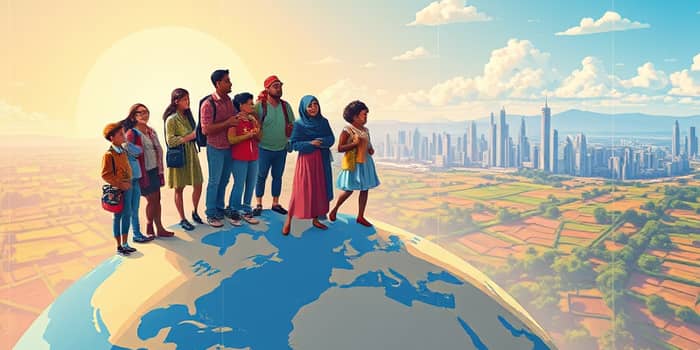
The global population is undergoing a profound transformation. From rapid growth to a slowing pace and eventual decline in many regions, these shifts carry seismic implications for economies worldwide. Understanding these demographic currents is vital for policymakers, business leaders, and communities striving to align destiny with opportunity.
The Demographic Transition
Over the past century, humanity experienced an unprecedented surge in numbers. Today, forecasts indicate the world will reach 9.2 billion people by 2040, up by 1.4 billion from current levels. Yet this aggregate figure masks a stark unevenness: while some regions expand rapidly, others face stagnation or decline.
Global growth has slowed markedly since its peak in the late 20th century. The share of the working-age population—those aged 15 to 64—peaked in 2012. Thereafter, it began a steady descent, setting the stage for aging societies and tighter labor markets in many developed nations.
- Sub-Saharan Africa and South Asia will drive almost all population increase by 2040.
- India is projected to surpass China as the most populous country around 2027.
- Japan, Russia, and numerous European states will encounter population decline before mid-century.
Regional Divergence
Regional trajectories diverge sharply. In rapidly growing Sub-Saharan Africa, urban centers swell, testing infrastructure and service delivery. Conversely, Europe and East Asia confront shrinking, aging populations that threaten productivity and strain social safety nets.
By 2040, median ages will soar: over 53 in Japan, above 47 in Europe. Meanwhile, South Asia’s median age remains in the mid-30s, offering a potential demographic dividend if harnessed through employment and education.
The Workforce Question
A robust labor force underpins economic vitality. Yet with a declining share of working-age adults in rich economies, nations must grapple with slower growth and rising dependency ratios. More income will be diverted to pensions, healthcare, and elder support.
In contrast, South Asia, Latin America, and the Middle East boast rising proportions of working-age residents. South Asia’s share could reach 68% by 2040, up from 66% in 2020. These regions face a window of opportunity: the so-called demographic dividend. Realizing it depends on quality education and job creation.
Middle Class Dynamics
The expansion of the global middle class between 2000 and 2020 was remarkable, rising from 23% to 36% of the world’s population. Key drivers included rapid income gains in China, Brazil, Turkey, and India. However, this momentum is unlikely to continue at the same pace.
The middle-income migration window—annual incomes between $4,000 and $12,000—peaked around 2010 in many regions. Sub-Saharan Africa remains an exception, with growth in this cohort projected to persist. Yet without matching improvements in infrastructure and governance, progress may be fragile.
Critical Success Factors
Demographics alone do not dictate economic fortunes. Historical and contemporary examples reveal that institutions and policies drive outcomes. The following factors determine whether demographic potential becomes economic reality:
- Education systems that equip youth with skills for modern industries.
- Infrastructure investments in transport, energy, and digital connectivity.
- Innovation ecosystems fostering entrepreneurship and technological adoption.
China’s meteoric rise in manufacturing and India’s ascent in information technology illustrate how strategic policy choices unlock human capital. Conversely, nations with weak governance often fail to convert demographic strength into growth.
Migration as Solution and Tension
Migration emerges as both a remedy and a flashpoint. Aging nations in Europe and East Asia may welcome skilled workers to bolster labor forces. At the same time, youth in fast-growing regions seek opportunities abroad amid limited domestic prospects.
Climate change, conflict, and economic disparity will intensify these flows. Managing them requires careful policy design: balancing the needs of aging societies with the rights and aspirations of migrants.
Regional Economic Disparities
A glaring disparity persists between the world’s richest and poorest regions. North America, with just under 5% of global population, generates nearly 28% of world GDP. Africa, home to 17% of humanity, accounted for only 2.8% of global output in 2020.
Without faster growth in Sub-Saharan Africa, its rising population risks exacerbating poverty, unemployment, and social strain. Nigeria exemplifies this challenge: its booming young population outpaces job creation, straining infrastructure and public services.
The Sustainability Paradox
Economic development often coincides with falling fertility and aging populations—a demographic sustainability paradox. The very growth that lifts living standards can erode the population base that supports future prosperity. The 2023 U.N. report warns that unchecked decline may imperil societal stability.
Nations must therefore balance policies: incentivize sustainable family formation while planning for aging societies. Flexible retirement ages, lifelong learning, and health investments offer partial solutions.
Geopolitical Implications
As demographics reshape labor pools and consumer markets, they also alter geopolitical landscapes. Countries with youthful, growing populations may gain influence, while those contracting face strategic vulnerabilities. Migration patterns will redraw alliances and fuel debate over borders and identity.
Ultimately, the decisive factors lie in policy choices. Nations that adapt institutions, invest in people, and embrace cooperation can transform demographic trends into engines of shared prosperity.
Demographics may set the stage, but destiny depends on action. By understanding the forces at play and crafting forward-looking strategies, societies can harness population shifts to build vibrant, resilient economies for generations to come.
References
- https://www.worldbank.org/en/publication/global-monitoring-report/development-trends-and-economic-development
- https://oikosinstitut.org/the-impact-of-population-size-on-economic-development/
- https://www.dni.gov/index.php/gt2040-home/gt2040-structural-forces/demographics-and-human-development
- https://pmc.ncbi.nlm.nih.gov/articles/PMC8967589/
- https://www.cbo.gov/publication/61994
- https://www.brookings.edu/articles/growing-to-extinction-balancing-economic-and-demographic-sustainability/
- https://www.imf.org/en/publications/fandd/issues/2020/03/changing-demographics-and-economic-growth-bloom
- https://www.un.org/development/desa/pd/content/global-population-growth
- https://www.csis.org/analysis/demographic-trends-and-realities
- https://education.cfr.org/learn/reading/global-population-growth-slowing-down
- https://www.pwc.com/us/en/industries/financial-services/asset-wealth-management/real-estate/emerging-trends-in-real-estate-pwc-uli/trends/demographics-define-demand.html
- https://ijeponline.org/index.php/journal/article/download/950/895/1150