
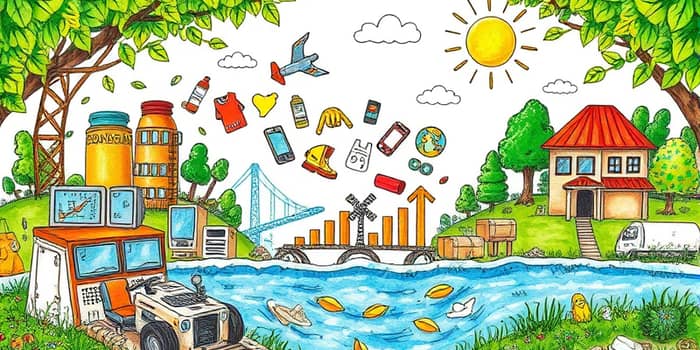
In a world struggling with rampant resource depletion and mounting waste, the concept of a circular economy offers a transformative path forward. Instead of the traditional linear model of "take-make-dispose," this innovative approach emphasizes resource efficiency, resilience, and regeneration. By rethinking how we design, use, and recover products, individuals, businesses, and governments can unlock lasting environmental, social, and economic value.
Understanding the Circular Economy
The circular economy is built on three interdependent pillars: designing out waste and pollution, keeping products and materials in continuous use, and regenerating natural systems. At its core, this model aims to move beyond short-lived consumption and toward a restorative cycle.
First, products must be conceived with end-of-life in mind. Engineers and designers prioritize modularity, repairability, and recycled content. By eliminating waste by reusing critical components, manufacturers reduce reliance on virgin resources and avoid creating new pollution.
Second, robust systems for maintenance, refurbishment, and remanufacturing ensure that items remain in circulation far longer than in a linear paradigm. A laptop, for example, may serve multiple users over a decade rather than being discarded after a few years.
Finally, the circular economy actively regenerates living systems by returning nutrients to soil, protecting biodiversity, and preserving ecosystems. Agricultural byproducts become compost, while biological materials are reintegrated into natural cycles, slowing landscape degradation.
Environmental and Health Benefits
Adopting circular strategies can dramatically reduce greenhouse gas emissions, cut waste volumes, and safeguard public health. Studies indicate that systemic implementation could cut greenhouse gas emissions by up to 39%, equivalent to nearly 23 billion tonnes of CO2 annually.
Waste reduction projections are equally impressive. Municipal solid waste could fall from over 4.5 billion tonnes per year today to under 2 billion tonnes by 2050. Landfill waste would drop by more than 40%, while uncontrolled dumping and open burning could be virtually eliminated.
Beyond environmental gains, public health benefits are profound. An estimated 9 million premature deaths each year result from air, water, and soil pollution. By closing resource loops and reducing toxic discharges, communities experience cleaner surroundings, lower disease rates, and reduced healthcare costs.
Economic Opportunities and Market Growth
The circular economy is not just an ecological imperative; it represents a vast economic frontier. Projections show a compound annual growth rate of 23.5% in circular markets between 2026 and 2035. Collectively, the global opportunity could exceed $4.5 trillion by driving innovation in materials, services, and business models.
- Reduced dependency on raw materials lowers supply chain risks and price volatility.
- Service-based offerings—like product-as-a-service—generate recurrent income streams and foster customer loyalty.
- Unlocking massive economic opportunity spurs new industries in repair, remanufacturing, and resource recovery.
Practical Steps for Businesses and Consumers
- Design products for repair and refurbishment: adopt modular architectures and standardized components.
- Increase recycled content: prioritize suppliers who use post-consumer materials and establish take-back schemes.
- Embrace sharing and leasing models: develop platforms for swapping, renting, and sharing goods.
- Educate teams and customers: raise awareness of circular principles and showcase success stories internally and externally.
Consumers can also play a pivotal role by choosing durable products, supporting brands with transparent circular practices, and participating in local recycling or repair networks. Every action contributes to a resilient system that benefits society as a whole.
Policy and Systemic Change
To transition at scale, governments must set robust targets, revise tax and regulatory frameworks, and provide incentives for circular innovation. In 2023, circular economy-related taxes generated $152 billion in the OECD—demonstrating fiscal viability and political momentum.
Global collaboration is equally vital. The Circularity Gap Report 2025 employs 11 indicators to measure progress and reveal where resources remain underutilized, such as building stock, biomass flows, and renewable materials. These insights guide policymakers, businesses, and civil society toward coordinated action.
However, recycling alone cannot solve the triple planetary crisis. Even perfect recycling would raise global circularity from 6.9% to just 25%, underscoring the need for deep fundamental systemic change in consumption patterns, product design, and waste management.
Ultimately, every stakeholder has a role to play. Businesses must innovate, investors must direct capital toward circular ventures, policymakers must enact supportive legislation, and consumers must choose wisely. By working together, we can create an economy that does more with less, protects our planet, and ensures prosperity for generations to come.
References
- https://www.circularity-gap.world/updates-collection/global-circularity-rate-fell-to-6-9---despite-growing-recycling
- https://rheaply.com/go/circular-economy-benefits/
- https://www.insightaceanalytic.com/report/circular-economy-market/2214
- https://www.eddisonsassets.com/insights/what-are-the-benefits-of-a-circular-economy
- https://www.oecd.org/en/publications/environment-at-a-glance-indicators_ac4b8b89-en/full-report/component-5.html
- https://www.europarl.europa.eu/topics/en/article/20151201STO05603/circular-economy-definition-importance-and-benefits
- https://www.wri.org/insights/circular-economy-global-progress
- https://www.wri.org/insights/5-opportunities-circular-economy
- https://www.weforum.org/stories/2024/04/circular-economy-waste-management-unep/
- https://councilgreatlakesregion.org/8-ways-the-circular-economy-will-transform-how-business-is-done/
- https://www.ellenmacarthurfoundation.org/topics/circular-economy-introduction/overview
- https://climatepromise.undp.org/news-and-stories/what-is-circular-economy-and-how-it-helps-fight-climate-change
- https://www.ingrammicrolifecycle.com/blog/circular-economy-benefits
- https://www.epa.gov/circulareconomy/what-circular-economy