
A mortgage amortization schedule is the lender’s table showing, for every payment in the life of your loan, how much goes to interest, how much reduces what you owe, and what balance is left afterward. Each month the lender charges you interest on the balance you still have, then applies whatever is left of your fixed payment to principal, so the next month’s interest is charged on a smaller number.
The schedule is the single clearest picture of what a mortgage really costs. Once you know how a mortgage amortization schedule works, you can see when your equity starts building, how much total interest you will pay, and what an extra payment would do to your payoff date.
Table of Contents
- What Is a Mortgage Amortization Schedule?
- The Key Parts of an Amortization Schedule
- How a Mortgage Amortization Schedule Works Step by Step
- Why Principal and Interest Change Over Time
- Worked Example: A 30-Year Fixed Mortgage
- How Extra Mortgage Payments Change the Schedule
- How to Read and Check Your Mortgage Statement
- Frequently Asked Questions
- Is a mortgage amortization schedule the same thing as a payment schedule?
- Does the mortgage amortization schedule include property taxes and insurance?
- Why does my principal and interest payment change during the loan?
- How do lump-sum mortgage payments affect amortization?
- Why is the balance on my mortgage statement different from the balance on my amortization schedule?
- What to Do First
What Is a Mortgage Amortization Schedule?
Amortization is simply the process of paying a loan off in scheduled installments, where each installment covers some interest and some principal. A fully amortized mortgage is one that reaches a zero balance at the end of its term, and the schedule is the row-by-row map of that journey.
Every row is one payment. The one constant is your payment amount; what changes is the split between interest and principal and the balance that follows.
One thing the schedule does not include is escrow. Property taxes, homeowners insurance, HOA dues and flood insurance are collected by your servicer and paid out on your behalf, usually from an escrow account. They are not amortized, they do not reduce your loan balance, and they change year to year.
That distinction trips up a lot of borrowers. If you see a total payment on your statement higher than the principal-and-interest figure from your note, the difference is almost always escrow, not interest.
The Key Parts of an Amortization Schedule
Formats vary by servicer, but the fields are consistent. Here is what each one means and where it comes from.
| Column | What it shows |
|---|---|
| Payment number | Which installment this row is, from 1 to 360 on a 30-year loan. |
| Payment date | When the payment is due. Interest accrues from the previous date to this one. |
| Scheduled payment | Your fixed principal-and-interest amount, before escrow is added. |
| Principal paid | The part of the payment that reduces what you owe. |
| Interest paid | The part of the payment that pays the lender for borrowing the money. |
| Cumulative interest | Running total of interest paid from payment one through this row. |
| Remaining balance | What you still owe after this payment is applied. |
How a Mortgage Amortization Schedule Works Step by Step
Each row is produced by the same three calculations, repeated 360 times:
- Interest = opening balance x annual rate / 12. Interest is always charged on the balance you started the month with, never the balance you end with.
- Principal = scheduled payment – interest. Whatever the interest does not use is applied to the balance. This is why the two numbers move in opposite directions.
- New balance = opening balance – principal. That smaller balance is the starting point for next month’s interest.
Because the balance falls, next month’s interest is lower by a little, so next month’s principal is higher by that same little. The same fixed payment does a different job every single month.
Why Principal and Interest Change Over Time
Early payments lean on interest. On a 30-year loan the balance barely moves in the first year, so most of each payment is covering the cost of the money rather than the money itself. The schedule is back-loaded: the interest-heavy rows come first, and the principal-heavy rows arrive near the end.
On a 300,000 dollar loan at 6.5 percent over 30 years, principal does not exceed interest until roughly payment 232, about year 20. Only then is more than half of each payment building equity. That crossover point is the number most borrowers find surprising, and it is the single most useful line on the whole table.
The balance also falls in a straight, predictable line. There is no cliff where the loan suddenly gets easier, just a slow steady shift in what each dollar does.
Worked Example: A 30-Year Fixed Mortgage
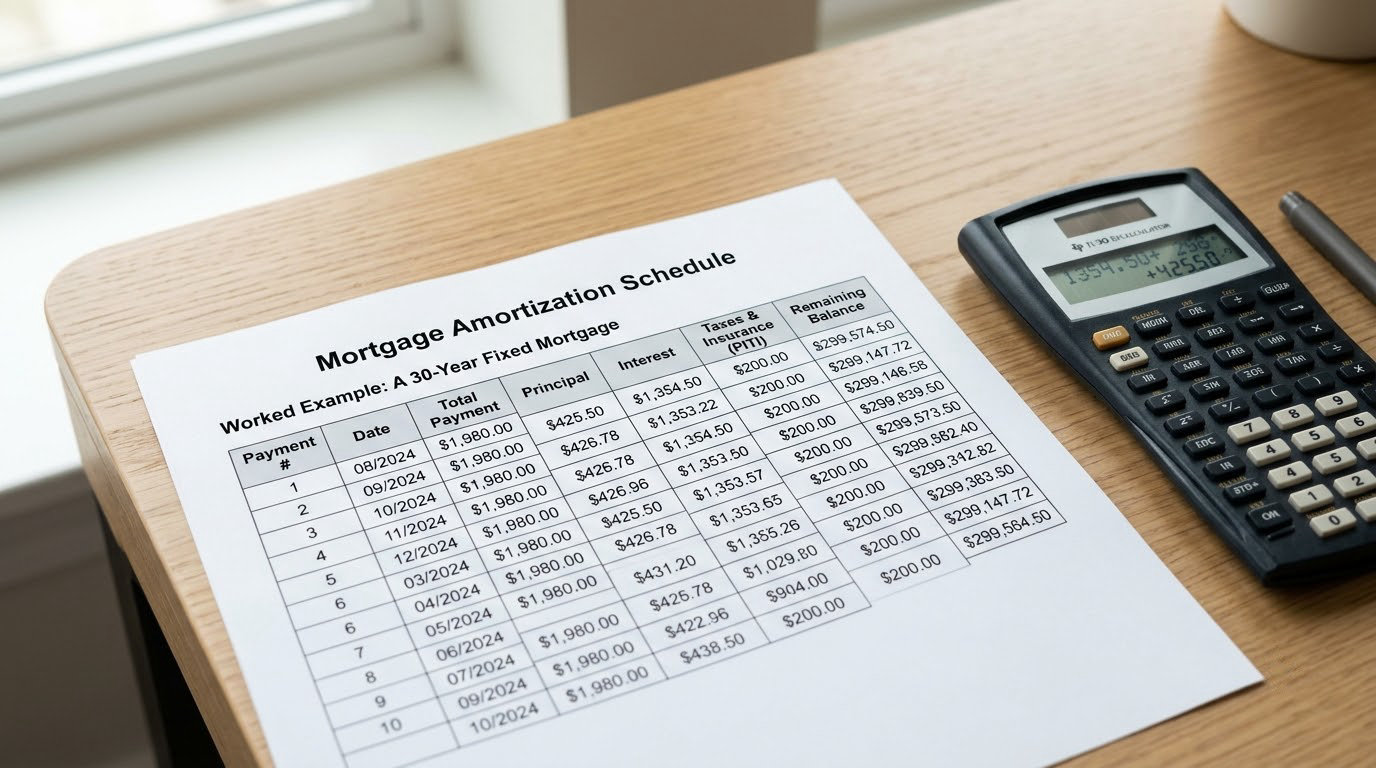
Everything below uses the same loan: 300,000 dollars borrowed at 6.5 percent with a 30-year term. The monthly principal-and-interest payment is 1,896.18. You can reproduce every figure on this page with a pocket calculator.
Here are the first three rows, rounded to the cent.
| Payment | Opening balance | Interest | Principal | New balance |
|---|---|---|---|---|
| 1 | 300,000.00 | 1,625.00 | 271.18 | 299,728.82 |
| 2 | 299,728.82 | 1,623.53 | 272.65 | 299,456.17 |
| 3 | 299,456.17 | 1,622.05 | 274.13 | 299,182.04 |
Check row one by hand: 300,000 x 0.065 / 12 = 1,625.00 of interest. Subtract that from the 1,896.18 payment and you get 271.18 of principal. The balance drops to 299,728.82, and row two starts from there.
In the first year of this loan you pay about 22,754 in principal and interest, of which roughly 19,401 is interest. You end year one with a balance near 296,646 and only about 3,354 of equity.
Now add escrow. Say property taxes run 6,000 a year and homeowners insurance runs 1,800. Those come to 650 a month, are not part of amortization, and leave your actual out-of-house payment closer to 2,546.18 than 1,896.18.
Over the full 30 years, this loan costs about 382,625 in interest. You pay roughly 1.28 dollars of interest for every dollar of principal you repay.
Here is how the balance and the interest picture look at bigger intervals.
| Year | Approx. balance | Principal paid that year | Note |
|---|---|---|---|
| 1 | 296,646 | 3,354 | Interest dominates |
| 5 | 280,846 | 3,982 | Interest still wins |
| 10 | 254,343 | 5,324 | Gap is narrowing |
| 15 | 217,075 | 7,452 | Principal gains ground |
| 20 | 166,554 | 10,104 | Crossover around here |
| 25 | 96,866 | 13,977 | Equity builds fast |
| 30 | 0 | 19,909 | Paid off |
The term itself is a payment trade-off, not a savings decision. The same 300,000 dollars at 6.5 percent over 15 years comes to about 2,613.42 a month and roughly 170,416 in total interest. You pay about 212,000 less interest across the life of the loan, and you build equity far sooner, in exchange for a monthly payment roughly 38 percent higher.
How Extra Mortgage Payments Change the Schedule
Extra money changes the schedule only if it reaches principal. Payments applied to principal shrink the balance, and a smaller balance means less interest the following month, which means more of your regular payment goes to principal. The effect compounds over time.
On the worked loan, adding 200 dollars a month to principal cuts the payoff from payment 360 to payment 277. That is just under seven years early, and it removes roughly 102,000 of lifetime interest. Nothing about the loan changes on paper, but the amortization table ends 83 rows sooner.
Different approaches get you there in different ways:
- Lump sums. An inheritance, a bonus, money freed up from selling a car. The strongest single lever, because it hits principal with no waiting.
- Voluntary extra principal each month. Boring, predictable, and easy to keep going because it rides the normal payment schedule.
- Biweekly payments. Half the monthly payment every two weeks means 26 payments a year instead of 12 monthly ones. The extra payment only counts if your servicer applies it entirely to principal, so confirm that in writing first.
- Recasting. The servicer re-amortizes the remaining balance over the same term at the same rate, producing a lower payment. No new loan, no credit check, usually a fee.
- Refinancing. A new loan at whatever today’s rate is. Worth it when you can cut the rate meaningfully or drop to a shorter term, and risky when you pay closing costs for a small rate change.
Two cautions. Confirm in advance how lump sums and biweekly payments will be applied, because some servicers treat an overpayment as a payment in advance rather than principal. And note that on an adjustable-rate mortgage the whole schedule re-prices at each reset, so any amortization you built around a fixed rate needs recalculating.
If a payment is smaller than the interest due that month, the loan can grow instead of shrink. That is negative amortization, and it usually requires a specific election in writing. Ask about it by name if a servicer ever proposes it.
How to Read and Check Your Mortgage Statement
Knowing how a mortgage amortization schedule works matters most when you check it against real paperwork. Your lender’s schedule should match the note you signed at closing. Open both and compare the loan amount, the annual interest rate, the term in months, and the scheduled principal-and-interest payment. If any line differs, ask the servicer which document is controlling before you assume your payment changed.
The schedule should also reconcile with the Loan Estimate and Closing Disclosure you received when the loan closed, including the annual percentage rate. Where the schedule shows a monthly payment, the Closing Disclosure is where the fees that got folded into that rate live.
Common reasons a balance looks different from what you expect:
- Escrow payments are included in your total but not in the amortization balance.
- Curious or late fees added to a payment get applied to interest first.
- An extra payment was held in an escrow suspense account rather than applied to principal that same month.
- Taxes or insurance were reassessed and the escrow amount changed, which changes your total payment without touching the loan.
When you are close to paying the loan off, the final figure comes from a payoff statement, often called a Notice of Payoff, which states the exact amount good through a specific date along with any per-diem interest after it. Use that figure rather than the schedule’s last row, because accrued daily interest and any fees you owe will move it slightly.
Rates, tax rules and escrow practices differ by state and change over time, so treat these mechanics as a framework and confirm the specifics against your own loan documents.
Frequently Asked Questions
Is a mortgage amortization schedule the same thing as a payment schedule?
No. A payment schedule just tells you when money is due and how much. An amortization schedule goes further and splits every payment into its interest and principal parts, shows the running interest total, and tracks the remaining balance after each installment. That balance line is what makes it an amortization table rather than a simple billing calendar.
Does the mortgage amortization schedule include property taxes and insurance?
No. Amortization covers principal and interest only. Property taxes, homeowners insurance, flood insurance and HOA dues are escrow items your servicer collects and pays for you, usually in monthly installments based on an annual estimate. Your statement total will be higher than the schedule’s payment because escrow is layered on top.
Why does my principal and interest payment change during the loan?
On a fixed-rate loan the scheduled principal-and-interest payment stays constant; only the split inside it moves, since interest falls as the balance falls. Your total out-of-house amount can still change because escrow is recalculated each year for taxes and insurance. On an adjustable-rate loan the payment itself changes at each reset.
How do lump-sum mortgage payments affect amortization?
A lump sum applied to principal reduces the outstanding balance immediately, which cuts the interest charged the following month and lets more of your regular payment reach principal. On a 300,000 dollar loan at 6.5 percent over 30 years, adding 200 dollars a month ends the loan around payment 277 instead of 360 and saves roughly 102,000 dollars in interest.
Why is the balance on my mortgage statement different from the balance on my amortization schedule?
Most often the statement total includes escrow, which is not part of the loan balance. Fees added to a payment, or an extra payment sitting in a suspense account instead of being applied that month, also create small gaps. Compare the principal balance on the statement to the remaining balance row on the schedule, and ask the servicer to explain any difference.
What to Do First
Ask your servicer for the current amortization schedule, not the original one from closing. Then check one line: the scheduled principal-and-interest payment should match the note, and everything above it should be escrow.
Once you have it, find the row where principal passes interest. That single date tells you more about your mortgage than anything else on the page.