An overdraft fee is a charge your bank adds when it pays out more than your checking account holds. You end up with a negative balance, the bank treats it as a short term loan, and you pay a fee plus interest if you do not clear it quickly. Most of those fees are avoidable once you know what triggers them.
Understanding how overdraft fees work and how to avoid them matters because a single 4 dollar coffee purchase can turn into a 35 dollar charge if it is the third transaction of the day to clear against a thin balance. Add another subscription that renews the same evening and the math gets ugly fast.
Below is the whole picture, from the moment a card is swiped to the moment a fee lands on your statement, plus the steps that stop it from happening. Rules and rates vary by bank and state and change over time, so treat the figures here as typical US ranges rather than a quote for your account.
Table of Contents
- What Is an Overdraft Fee?
- How Overdraft Fees Work and How to Avoid Them
- What Counts as an Overdraft?
- Overdraft Fee vs NSF Fee: What Is the Difference?
- Why Banks Charge Overdraft Fees
- The Opt In Rule and Why You May Already Be Covered
- What Overdraft Fees Look Like at US Banks
- How Much Can an Overdraft Fee Cost?
- What Happens If You Do Not Pay an Overdraft Fee
- How to Avoid Overdraft Fees
- What to Do If a Fee Already Appeared on Your Account
- Common Overdraft Mistakes
- Frequently Asked Questions
- Can you overdraft a debit card?
- How many overdraft fees can a bank charge in one day?
- Do pending transactions affect my available balance?
- Will closing my account stop overdraft fees?
- What happens if I do not pay an overdraft fee?
- How do I get an overdraft fee waived?
- Conclusion
What Is an Overdraft Fee?
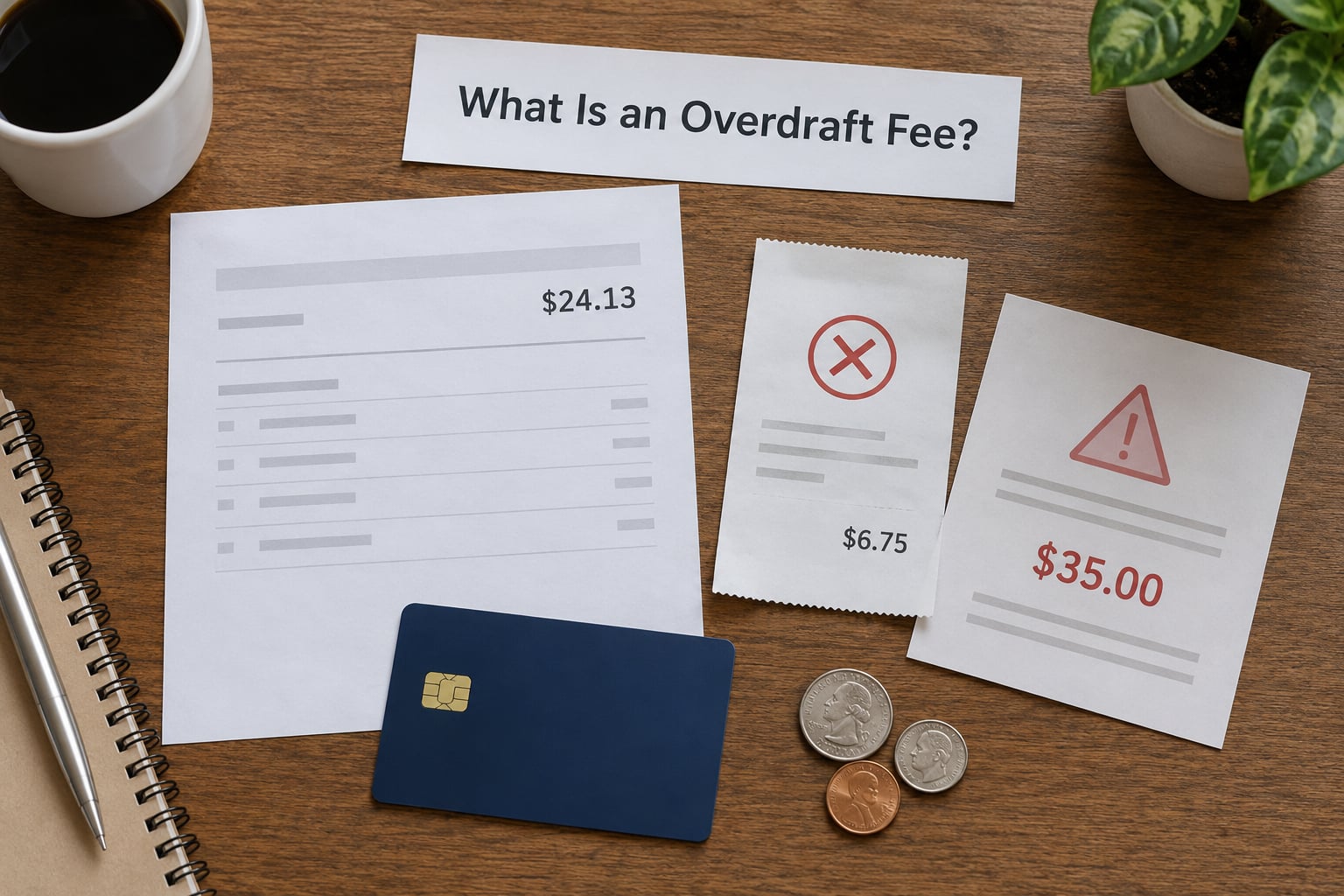
An overdraft fee is what your bank charges when it pays a transaction that takes your account below zero. The bank covered the difference for a few days, and it charges you for doing it. The fee usually lands on your statement the next business day, and the borrowed amount comes out of your next deposit or transfer.
It is not the same thing as an insufficient funds fee. An insufficient funds fee, often called an NSF fee, is charged when the bank refuses a transaction because the money is not there. An overdraft fee means the bank said yes anyway. Both can appear on the same day for the same underlying money problem.
Most large US banks publish a schedule of charges that lists the overdraft item fee, any daily limit on repeat fees, and what the bank does with a balance that stays negative. Your account agreement points to that schedule, and it is usually a page or two of small print inside the app or on the bank website.
How Overdraft Fees Work and How to Avoid Them
Four things have to line up before a fee appears: your account is set to pay for overdrafts, a transaction clears while your available balance is short, the bank does not stop the payment, and the account stays below zero when the day ends. Take away any one of those and the fee usually does not happen.
Timing is the part most people get wrong. A debit purchase does not hit your balance the second you tap the card. The merchant sends the authorization, your bank holds a small amount, and the real charge settles a day or two later. Checks and direct deposits move in their own order. So a balance that looks fine at 8am can be gone by the time three charges clear at 4pm the next day.
Your app usually shows two numbers. The current balance is what is actually posted. The available balance is what is left after pending authorizations and holds. The available balance is the one that decides whether the next transaction gets paid or refused, and it is usually the lower of the two.
| What usually triggers a fee | Typical US range | What to watch for |
|---|---|---|
| Overdraft item fee, charged once per item | 10 to 35 dollars | Some banks count the fee as part of the overdraft, so the balance stays negative longer |
| Daily limit on repeat item fees | Often capped at 2 to 3 charges per day | Check whether the cap is per day, per item, or both |
| Extended overdraft fee | Several dollars per day after about 5 to 7 days | Charged while the balance stays below zero, sometimes stopping without notice |
| Overdraft transfer from a linked savings account | 5 to 12 dollars per transfer | Cheaper than a loan, but it still costs money and drains your savings |
| Line of credit overdraft advance | Interest on the borrowed amount | The cheapest route is a small credit line with a lower rate than a card cash advance |
Bank policies shift, so treat the ranges above as a map rather than a price list. Your own schedule of charges is the only document that tells you what you would actually be charged.
What Counts as an Overdraft?
Almost anything can put a checking account below zero. A debit card purchase at a store, a recurring subscription renewal, an automatic bill payment, a monthly transfer to another bank, an ATM withdrawal, a check you wrote, and a gym membership that bills quietly every month are the usual suspects.
Bank of America customers are not alone here. Anyone with a subscription, a streaming plan, or a utility autopay has the same exposure, and the accumulation is what turns one small miss into a cascade of charges.
Two categories are worth separating. Transactions the bank authorizes and settles anyway, which is what creates an overdraft. And transactions the bank blocks at authorization, which create an NSF fee or a declined purchase instead. Reviewers on banking forums describe the first group as the expensive one, because the money actually left the account and the fee got added on top.
Out of order clearing is the sneaky one. If your paycheck posts after a rent autopay that the bank pulled early, you can overdraft even though the money was in the account the whole time.
Overdraft Fee vs NSF Fee: What Is the Difference?
An overdraft fee means the bank chose to cover the shortfall and let you keep the money. An NSF fee means the bank stopped the payment and handed the problem back to the merchant or the biller, which often adds a returned payment charge on top.
The distinction matters for the opt in rule. Debit card and ATM overdraft coverage requires your consent, so an NSF return is more common on those. Checks, ACH autopay, and debit card purchases can all produce an overdraft charge under a standard overdraft setting, and the regulation you want to read is Regulation E, tracked as 12 CFR 1005.17, which is the part that governs consent for debit card overdraft service.
Both fees are the same size at most large banks, which is why a day with a decline and a paid transaction can leave you out two charges of 35 dollars rather than one.
Why Banks Charge Overdraft Fees
Banks charge for a straightforward reason, which is that covering a short term balance is a small loan and a small loan costs money to make. Beyond that, the fee depends almost entirely on your account settings and on when transactions clear.
Your overdraft setting is the first switch. A positive setting means the bank declines transactions that would take the account below zero. A negative setting means every transaction is allowed and each one costs a fee. An automatic setting, which is common on student and youth accounts, pays out of a linked savings account first and declines the transaction only if that account is also short.
Second switch is the coverage you chose, if any. An overdraft transfer from a savings account costs a flat fee per transfer. An overdraft line of credit charges interest on the amount you borrow. A small cushion, sometimes offered free if you set up direct deposit, absorbs small overdrafts at no cost until you use it up.
The Opt In Rule and Why You May Already Be Covered
Under Regulation E, a bank may not give you debit card overdraft coverage unless you agree to it in writing or through an online or telephone request that meets specific rules about what you were told. If you never opted in, the card transaction should be declined, not covered, and an NSF fee is the more likely result.
Consent can be bundled in a way that is easy to miss. A checking account agreement that mentions overdraft protection, a card enrollment step buried in a branch script, or a student account opened with coverage switched on all count as consent in the eyes of the regulation. If you have had a card for years and never remember choosing overdraft coverage, assume you have it and check the account terms.
Regulation E does not apply the same way to checks and ACH payments, which is why overdraft charges on autopay bills show up so often without anyone asking first.
What Overdraft Fees Look Like at US Banks
The spread between banks is wider than most people assume. Some of the largest checking accounts in the country charge no overdraft fee at all and simply decline the transaction, while others charge 34 or 35 dollars per item with repeat fees until the balance is brought positive.
| Account type | Overdraft fee structure | Daily cap | Note |
|---|---|---|---|
| Large banks that eliminated overdraft fees, including Capital One, Discover, Ally and SoFi | No overdraft fee charged | Not applicable | Transactions are declined instead, so you feel it immediately rather than a week later |
| Large banks that still charge, including Chase, Bank of America and Wells Fargo | Typically 34 to 35 dollars per item | Usually a limit on repeat item fees per day | Optional overdraft coverage must be accepted under Regulation E for debit and ATM use |
| Neobank style apps such as Chime | SpotMe advance, up to 200 dollars on eligible accounts | Advance limit per pay cycle | Eligibility and limits vary and are set by the app |
| Local credit unions | Varies widely, often 15 to 25 dollars | Varies | Small banks tend to be more flexible about first time waivers |
Fees, caps, and eligibility rules change, so verify anything here against your bank’s current schedule of charges before you act on it. This is a description of common structures, not a recommendation to move your money anywhere.
How Much Can an Overdraft Fee Cost?
One overdraft rarely costs just one fee. The realistic total is the item fee, plus any additional item fees for the rest of that day, plus a daily extended fee if the balance stays negative for several days, plus whatever the bank charges to move the money or lend it to you.
Here is how a single small overdraft turns into a real bill. You buy coffee with 1 dollar left in the account, so you are 4 dollars short. A 35 dollar item fee puts you 39 dollars down. Two more subscriptions clear the next morning, adding 70 dollars and putting you 109 dollars down. The account stays in the red, so extended fees start on day six. By the end of the second week you have paid more than 150 dollars on a purchase that cost under 5 dollars.
The Consumer Financial Protection Bureau has reported that a large share of consumers charged an overdraft or NSF fee did not expect it, which is why the timing, not the amount, is the main thing to manage.
What Happens If You Do Not Pay an Overdraft Fee
If the balance stays negative, most banks charge an extended overdraft fee each day, typically starting around day five to seven, and many give themselves the right to close the account after a period of days with a returned payment. Account closure is the point at which the problem stops being about money and starts being about access.
Then there is the ChexSystems reporting distinction, which confuses people constantly. ChexSystems and the other consumer reporting companies track checking account history, and a pattern of overdrafts can make it hard to open a new checking account later. A negative balance or an account closed for overdraft is the kind of record that shows up. This is separate from your credit score, and a returned NSF item in most cases is not reported to the three credit bureaus at all.
Federal rules limit how long a bank can keep reporting a closed account for an overdraft as a negative, and the Consumer Financial Protection Bureau and the FDIC both publish plain language guidance on your rights if you think something is wrong. If a bank sells the debt to a collections agency, that is a different situation and can eventually reach a credit report, so paying or disputing promptly is the safer route.
How to Avoid Overdraft Fees
Prevention is mostly boring account setup work done once, plus a habit of reading the available balance instead of the current one. Here is the order I would work through it.
- Read your schedule of charges. Find the overdraft item fee, the daily cap, the extended fee, and the transfer fee. Most account agreements link to it directly. You cannot manage a rule you have not read.
- Decide whether you want coverage at all. If a declined transaction is easier for you to live with than a 35 dollar charge, choose the positive setting or opt out of overdraft coverage. In most apps this is under account settings, overdraft options, or card settings.
- Turn on low balance alerts. Set one threshold below your real floor, not at it. Alerts do not prevent a fee, but they give you time to move money before the next settlement batch.
- Keep a buffer in the account. Even a small cushion absorbs the charge that would otherwise be a fee. A direct deposit into the same account often qualifies you for one, depending on the bank.
- Read the pending transactions list. The available balance already subtracts pending authorizations, but adding your own notes for what clears tomorrow prevents the surprise. Subscriptions are the usual blind spot.
- Schedule autopay for the day after income lands. A bill pulled two days early is the single most common cause of a paycheck to paycheck overdraft. Moving the date is free.
- Call before a payment is due when money is short. Banks can often move a due date, split a payment, or offer a short extension. A request before the charge is far easier to accommodate than a waiver after.
Two of these do most of the work in practice. Reviewers on banking forums repeatedly say the combination that solved it for them was a low balance alert set a little below their floor plus moving autopay dates off the day their paycheck posts.
What to Do If a Fee Already Appeared on Your Account
Call the number on the back of your card and ask for the fee to be reviewed. The single most useful piece of information is your account history, so mention your tenure and your normal balance before you explain the problem.
A script that works more often than not sounds like this: I have been a customer for years, my account has never gone negative before, this was a one time thing caused by a bill clearing early, and I would like the 35 dollar fee reviewed for a courtesy waiver. That is a request, not a demand, and it gives the representative something to approve.
If the first person says no, ask to speak with a supervisor and ask them to note the request on the account. Reviewers on Reddit report success in a good share of cases, while others report that their bank had stopped waiving at all, so treat the call as worth making rather than a guarantee.
If the bank refuses and you believe the fee was charged in error, the Consumer Financial Protection Bureau and the FDIC both have complaint processes, and states often have them as well. A complaint with documentation attached is a different conversation from a phone request.
Common Overdraft Mistakes
Watching the current balance instead of the available balance. The current balance ignores pending card authorizations and pending deposits, so it flatters you. Fix: build the habit of reading available balance only, and give it a two day haircut before you commit to a purchase.
Forgetting that a subscription is still billing. Streaming, gym, cloud storage, and app subscriptions renew quietly and cluster on the same date. Fix: list every recurring charge once a quarter and cancel what you do not use.
Assuming a transfer is instant. A transfer from savings scheduled for the next day is not money you can spend tonight, and a card purchase made before it lands can still overdraft. Fix: only count transfers that have actually posted.
Leaving autopay on the same day your paycheck lands. The deposit and the pull are not simultaneous, and the pull can win. Fix: shift autopay to two days after the deposit and confirm the change in writing.
Opting into overdraft coverage without reading what it does. It sounds like free insurance, and it can be, but a default transfer fee or a line of credit turns a small dip into a recurring cost. Fix: read the coverage terms and pick the option whose worst case you can afford.
Doing nothing after the first fee. A first overdraft is a signal, not a disaster, but a pattern of returned items is what appears in consumer reporting. Fix: call the bank, ask for a review, and change one thing about your setup the same day.
Frequently Asked Questions
Can you overdraft a debit card?
Yes, but only if you have agreed to overdraft coverage for that card. Regulation E requires affirmative consent before a bank can pay a debit card purchase that overdraws your account, so a transaction on a card you never opted in on is normally declined and may bring an insufficient funds fee instead. If you are not sure what you signed up for, check the overdraft or card settings in your app, or ask the bank whether debit card overdraft service is active on your account.
How many overdraft fees can a bank charge in one day?
Most large US banks cap repeat overdraft item fees, commonly at two or three per day, even when several transactions go through on the same day. A bank may also cap the total in dollars, and some count fees toward a limit that spans a day and a night rather than resetting at midnight. Your schedule of charges states both the number and the dollar cap, and those limits are the ones that decide what you actually pay.
Do pending transactions affect my available balance?
They usually do. A card authorization reduces your available balance as soon as the merchant sends it, and the real charge settles later, sometimes days later. That gap is why a balance that looks comfortable can still be short when the charges post. Some banks also place holds on deposits before they clear. Read the available balance, and remember that a pending deposit in your favor may not be included yet.
Will closing my account stop overdraft fees?
Not right away. An overdraft fee is assessed on the account and can continue to be charged while the balance stays negative, even during the closing process. Some banks also charge an account closure fee once the account has been negative for a stated number of days. If you are closing an account you should ask, in writing, for the exact closing date, the final amount owed, and confirmation that extended overdraft fees have stopped.
What happens if I do not pay an overdraft fee?
The balance stays negative, extended overdraft fees usually begin after about five to seven days, and the bank may close the account and send it to collections. Repeated returned items can also reach ChexSystems, which is a consumer reporting system for checking accounts, separate from the three credit bureaus. That can make opening a new checking account harder later. Paying or disputing the amount promptly keeps the problem from growing, and the CFPB and FDIC publish guidance on both.
How do I get an overdraft fee waived?
Call the bank, state your account history first, then explain the one time cause and ask for a courtesy review. Tell them how long you have been a customer, that the account has never gone negative before, and that a bill cleared earlier than expected. Ask for the request to be noted on the account, and if it is refused, ask for a supervisor. If the charge was genuinely wrong, file a complaint with the Consumer Financial Protection Bureau and keep a copy.
Conclusion
Start with three things today. Open your account settings and see whether overdraft coverage is switched on, and whether you want it on. Set a low balance alert a little below the floor you actually need. Then check the available balance rather than the current one before your next tap.
If a fee has already landed, call the bank and ask for a review before you pay it. Knowing how overdraft fees work and how to avoid them costs nothing, and it is the difference between a 5 dollar mistake and a 150 dollar month.