
An employee stock purchase plan (ESPP) is a company-run program that lets eligible employees buy shares of their employer at a discount, funded by automatic payroll deductions taken after tax over a set period. That is how employee stock purchase plans work in a nutshell: you enroll, cash is withheld from each paycheck, and on a scheduled purchase date that cash automatically buys shares at the discounted price, usually between 5% and 15% below market.
The discount is not free money. It comes out of your after-tax paycheck, it is taxed as ordinary income the moment you buy, and it only becomes a capital gains rate if you hold past the second anniversary of the purchase. Below is the full cycle, then the tax rules and a checklist for deciding whether it fits your situation.
Table of Contents
- How employee stock purchase plans work
- What is the employee stock purchase plan discount?
- How employee stock purchase plans work in practice
- What are the eligibility and enrollment rules?
- What taxes apply to employee stock purchase plan shares?
- What are the benefits and risks of an employee stock purchase plan?
- The upside
- What can go wrong
- How should you decide whether to participate?
- Frequently Asked Questions
- Do employee stock purchase plans make money automatically?
- Is an ESPP discount taxable?
- What happens to ESPP shares if I leave my job?
- Can I sell employee stock purchase plan shares immediately?
- What is the difference between an ESPP and stock options?
- How much can I contribute to an employee stock purchase plan?
- Conclusion
How employee stock purchase plans work
Most employers that offer equity compensation run an ESPP with four fixed stages. They repeat on a schedule, often every three or six months, and you can set the percentage you contribute each time a new period opens.
- Enroll during the open enrollment window. You pick a contribution rate, usually a percentage of your paycheck or a fixed dollar amount per pay period. Elections usually take effect with the next offering period, so you cannot usually join halfway through one.
- Contribute through the offering period. Money is withheld from every paycheck. This comes out of after-tax pay, which surprises a lot of first-time participants. A 10% election does not reduce your taxable wages by 10%.
- The purchase happens automatically on the purchase date. At the end of the offering period, the accumulated cash buys whole shares at the purchase price. If the total does not reach the price of one share, most plans refund the balance or buy nothing.
- You own the shares. They land in your company-sponsored brokerage account, usually a few days or weeks after the purchase date. From there you can hold them, sell them, or transfer them out once the plan allows.
Offering periods range from about three months to two years, and some plans let you buy more than once a year. Every plan ships with a summary plan description, usually a few pages of dense legal text, and it answers the questions below in more detail than any general guide can.
What is the employee stock purchase plan discount?
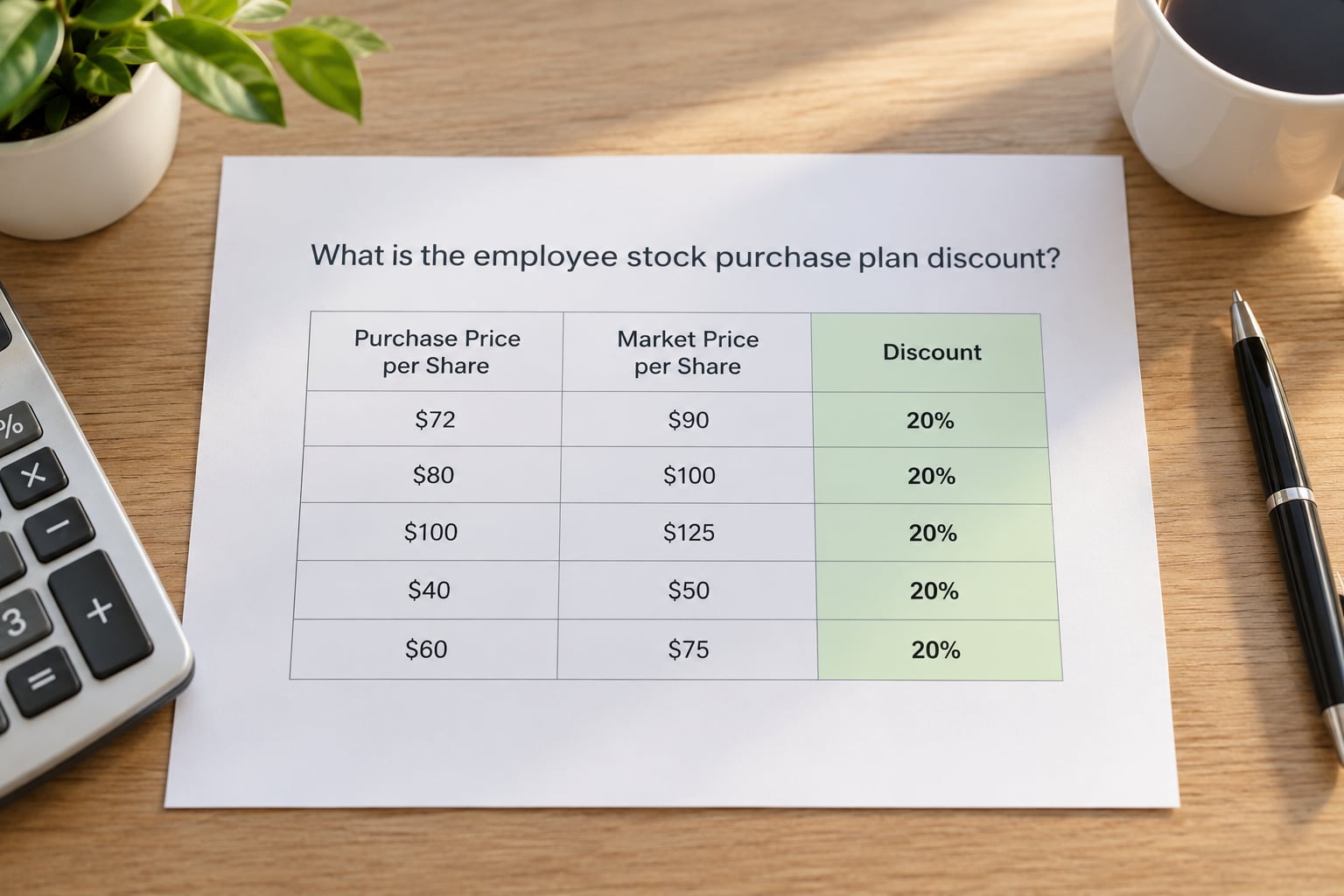
The discount is the percentage the plan knocks off the price you pay, and the price you pay is not simply today’s market price. It is the lower of two values multiplied by one minus the discount.
Those two values are the fair market value on the offering date, also called the grant date, and the fair market value on the purchase date. Take a plan with a 15% discount. If the offering-date price is 100.00 and the purchase-date price is 110.00, you buy at 85.00, the lower price less the discount. If the stock falls to 90.00 by the purchase date, you buy at 76.50 instead, because the lower price is now the purchase-date price.
The lookback provision is what makes that second case possible, and it is the feature to look for when you compare plans. Without a lookback, the purchase price is set from the offering-date value alone. With one, the lower-price rule applies and a falling stock actually makes your entry price better, not worse.
That discount also converts into a guaranteed percentage return at the moment you buy. Pay 85.00 and receive shares worth 100.00 on the purchase date, and your return is 100 divided by 0.85, or about 17.6%. A 15% discount is a 17.6% instant return, and a 5% discount is about a 5.3% instant return. This holds only if the stock sits at the higher price at the end of the period; if the company has collapsed, the arithmetic still works but the value does not.
| Plan feature | What it does | Why it matters |
|---|---|---|
| Discount rate, typically 5% to 15% | Reduces the purchase price below market | A 15% discount equals roughly a 17.6% instant return at purchase |
| Offering period | The window during which payroll deductions are taken | Shorter periods mean cash comes back faster but fewer purchase dates per year |
| Lookback provision | Sets the price from the lower of the offering-date and purchase-date values | Protects you when the stock falls during the period |
| Purchase periods per year | How often shares are actually bought | A quarterly plan gives you four chances to buy a year, not one |
| Annual IRS cap | Value of shares purchasable per calendar year is limited to USD 25,000 | Plans stop deducting once you hit it, so a high election may not run all year |
How employee stock purchase plans work in practice
Here is a full cycle with round numbers. You earn 60,000 a year, elect 10%, and your plan runs a six-month offering period with payroll deductions of 300.00. Over 24 paychecks that is 7,200.00 accumulated. At the purchase date your company’s stock is valued at 50.00 and the offering-date value was 55.00, so the lower price is 50.00. With a 15% discount, the purchase price is 42.50 and you receive 169 shares, with the balance refunded.
Those 169 shares show up in your brokerage account at the purchase date. If you sell them right away at 50.00, the IRS treats the difference between 50.00 and 42.50 as ordinary income added to your W-2 wages, and the rest is a capital gain or loss measured from the 42.50 cost basis. If the stock climbs to 62.00 instead, the same 169 shares are worth about 10,478.00 for an outlay of 7,200.00, and the whole 3,278.00 gain is capital gains rather than pay.
What are the eligibility and enrollment rules?
Eligibility is set by the employer, not by the IRS. Full-time employees usually qualify after a waiting period of days or weeks, part-time staff sometimes qualify on a different schedule, and some plans exclude employees above a salary threshold or people who own more than a set percentage of the company already.
Enrollment runs through a window, commonly in the last few weeks of the prior offering period, and elections can often be changed during the window. Once the offering period starts, most plans let you lower or stop future deductions but not retroactively change what was already withheld.
Two rules catch new participants. First, deductions come from payroll only. There is no lump-sum buy-in the way there is with a 401(k), which is the piece first-time participants miss most often. Second, contributions can usually be withdrawn before the purchase date. If you need the money for a car repair in month four, most plans refund the accumulated deductions rather than forcing you to hold cash hostage until the purchase date. Read your own plan document, because refund timing and eligibility rules vary.
If you leave the company mid-period, deductions stop. Most plans refund what has been withheld within a set window, and shares already purchased stay in your account as your own property. Leaving also breaks the holding-period clock for shares you are holding, which turns a qualified disposition into a disqualified one. That tax consequence is the part people regret, not the shares themselves.
What taxes apply to employee stock purchase plan shares?
Most US employer plans are written as Internal Revenue Code Section 423 plans, and the tax has two legs. The first leg is set at purchase: the spread between the fair market value on the purchase date and the price you actually paid is compensation, taxed as ordinary income in the year of purchase.
The second leg is set at sale, and its rate depends on how long you hold. Sell more than two years after the purchase date and the gain or loss is long-term capital gains. Sell between one and two years and you still get long-term capital gains treatment, but the disposition is not qualified, so the rule is worth double-checking in your own plan. Sell inside the first year and any gain or loss is ordinary income, which is called a disqualified disposition. Many plans also treat leaving the company during those windows as a disqualifying event, even if you keep the shares.
| When you sell | How the gain is taxed | What you give up |
|---|---|---|
| Less than one year after purchase, or after leaving the company early | Ordinary income rates, treated as compensation | Everything above the discounted cost basis |
| Between one and two years after purchase | Long-term capital gains rates, but not a qualified disposition | The preferred qualified disposition treatment |
| More than two years after purchase | Long-term capital gains rates | Nothing, if nothing else changed |
That is the whole argument behind selling immediately: you convert the discount into an instant, taxable event and move the money elsewhere. The argument for holding is that you keep the same shares but pay the lower long-term rate. Both are defensible. Neither is automatic, and the answer changes with your tax bracket, your cash needs, and your view on the company.
Two forms do the reporting. Your W-2 shows the ordinary income from the discount spread, while Form 1099-B shows the sale proceeds and the basis the brokerage recorded. When those disagree, usually because the broker used a different price date, your plan administrator may also issue Form 3922 to show the statutory purchase price, and that form is the one to follow. Rules, rates, and form handling vary by country and state, and non-US employees usually face a different regime entirely, so read your plan’s tax section and talk to a tax professional about your own return.
What are the benefits and risks of an employee stock purchase plan?
The upside
The discount is available to insiders and nobody else, which is why the feature exists at all. Payroll deductions make it automatic, so the purchase happens without you timing anything, and a lookback provision removes most of the risk of buying into a dip. Contributions also come out of each paycheck rather than in one lump sum, which is why the plan doubles as a forced savings habit.
What can go wrong
Concentration risk is the big one. Your salary, your benefits, and now a chunk of your savings all point at one company, and a bad quarter hits all three at once. The contribution is after-tax, so unlike a 401(k) you cannot reduce your current-year tax bill with the money going in. The shares are equity with no floor, and a 15% discount is a rounding error next to a 60% decline.
Then there is the administration: blackout windows that limit when you can trade, holding periods that can turn a good tax outcome into a bad one the day you resign, and plan-specific rules that quietly differ between employers. A plan with a 5% discount and no lookback is a much weaker deal than a 15% discount with one, and the two are often discussed as if they were identical.
How should you decide whether to participate?
Start with the order of operations, because it settles most of the argument. Build or confirm an emergency fund, then take the full match in your 401(k) if one is offered, then consider the ESPP, then fill remaining tax-advantaged space. An ESPP sits after the match because a match is free money and a discount is not.
Then work through the plan document itself rather than a general guide. You want the discount rate, whether there is a lookback, how many purchase periods you get each year, the withdrawal rules before the purchase date, the holding periods that count as qualified, and what happens to accumulated deductions if you leave. Those seven details decide whether the plan is a good deal for you.
Finally, size the contribution so you can live without it. A common range is somewhere between 5% and 15% of pay, and plenty of participants contribute far less on purpose. Ask yourself what the deduction does to your monthly cash flow during the offering period, whether the money is coming from a savings balance you would rather keep, and how large your employer-stock exposure already is once RSUs, options, and your own holdings are counted.
A useful discipline is to decide in advance what you will do with the shares, then fund the deduction from cash you have already set aside rather than from the paycheck itself. Some participants pull from savings during the six-month window and replenish the savings after the sale. It works, but only if the cash is there on day one. Nothing here is personalised financial or tax advice, so confirm the specifics with your plan administrator, a tax professional, or a fee-only adviser before you commit money.
Frequently Asked Questions
Do employee stock purchase plans make money automatically?
No. The discount guarantees you buy below the applicable market price on the purchase date, which is an instant gain of roughly 17.6% on a 15% discount, but only if the stock sits at or above that price. After that it is an ordinary equity investment. If the company falls 40%, the discount will not save you. The automatic part is the purchase, not the profit.
Is an ESPP discount taxable?
Yes, and this surprises most first-time participants. On a Section 423 plan the spread between the purchase-date fair market value and the discounted price you paid is compensation, added to your W-2 wages and taxed at your ordinary income rate in the year you buy. Only the portion above the cost basis is treated as a capital gain or loss when you sell.
What happens to ESPP shares if I leave my job?
The shares you already bought remain yours, usually in a brokerage account you can roll into an independent one. What changes is the tax clock: most plans treat leaving inside the one or two year windows as a disqualifying event, so a sale soon after you resign can be taxed as ordinary income instead of capital gains. Unvested payroll deductions stop and are typically refunded within a set period.
Can I sell employee stock purchase plan shares immediately?
Usually yes, once the shares have settled in your account. There is no lock-up on shares that have already been purchased. The plan may impose blackout or trading windows shortly before earnings, and some plans restrict activity while you are employed. Selling right away locks in the discount but exposes the full amount to ordinary income rates, since a sale inside one year is a disqualified disposition.
What is the difference between an ESPP and stock options?
An ESPP lets you buy shares at a discounted market price using payroll deductions, and the price is set by the market rather than by a grant. A stock option gives you the right to buy shares later at a fixed strike price agreed when you were granted it. Options can be far more valuable but also expire worthless, while ESPP shares simply follow the share price once you own them.
How much can I contribute to an employee stock purchase plan?
Two limits apply. Your elected payroll deduction is whatever percentage of pay the plan allows, often 1% to 15%, and you can usually change it at the next period. Separately, the IRS caps the value of shares you can purchase in a calendar year at USD 25,000. Once you reach that cap the plan stops deducting, so a high election may not run for the full year.
Conclusion
Start with the plan document, not the discount headline. Read the discount rate, the lookback rule, the withdrawal terms, and the qualified holding period, then decide whether the deduction fits your cash flow without touching your emergency fund or your 401(k) match. If it does, the discount is a real, repeatable return, and knowing how employee stock purchase plans work is the part that makes it work for you.