
Learning how to lower your taxable income comes down to three levers: which income lands in the tax year, which deductions reduce it, and which credits cut the tax computed on what remains. Most filers only ever pull the middle one. Pull all three in the right order and the same income can produce a noticeably smaller tax bill. This guide lays out a nine-step review you can do yourself over a couple of evenings, and it is written for U.S. filers as general information rather than individual tax advice. Rules and rates vary by state and change from year to year, so confirm the current figures against IRS guidance for the 2026 filing season.
Table of Contents
- What You Need Before You Start
- Step-by-Step: How to Lower Your Taxable Income in 9 Steps
- 1. Review every income source and payment timing
- 2. Maximize the deductions you already qualify for
- 3. Claim the credits that reduce the tax you owe
- 4. Time income and deductible expenses strategically
- 5. Use retirement and benefit accounts correctly
- 6. Reconsider withholding and estimated payments
- 7. Evaluate business and self-employment deductions
- 8. Review filing status and dependent-related changes
- 9. Compare the result with a tax professional
- Common Mistakes When You Try to Lower Your Taxable Income
- Frequently Asked Questions
- What lowers taxable income the most?
- Can I lower taxable income to zero?
- Do deductions reduce my take-home pay?
- Should I itemize deductions instead of taking the standard deduction?
- How do retirement contributions affect taxable income?
- When should I consult a tax professional about lowering taxable income?
What You Need Before You Start
Gather your documents first. Without them, every strategy below turns into guesswork, and guessing is how filers end up claiming something they cannot support.
- Your last two or three federal returns. They show the standard deduction you have been using and where your marginal bracket actually sits.
- Every W-2 and 1099 you received. Include the ones buried in your bank and brokerage downloads, not just the ones your employer mailed.
- Current year income records. Payroll registers, invoices for freelance work, rental income, and any bonus or commission detail.
- Deduction documents. Mortgage or home equity interest forms, property tax records, charitable donation acknowledgments, and unreimbursed medical receipts.
- Contribution records. Retirement plan statements, health savings account history, and any college savings plan statements.
- Withholding and estimated tax records. The W-4 on file, quarterly payments you have already made, and the deadlines that remain.
Keep everything in one folder. If you ever need to answer an IRS question, you will be glad the documentation exists.
Step-by-Step: How to Lower Your Taxable Income in 9 Steps
1. Review every income source and payment timing
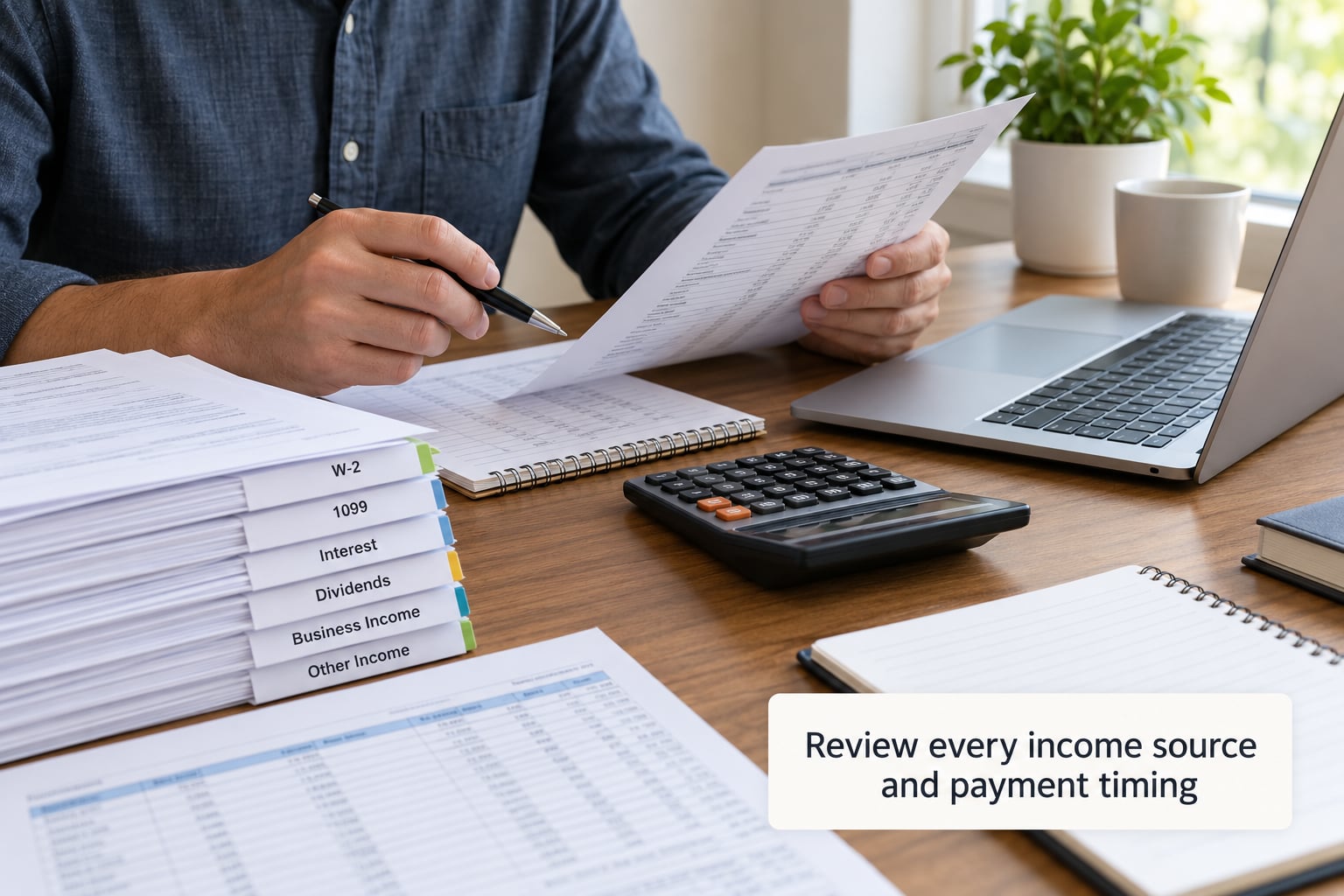
Start by listing every dollar that will be reported to the IRS this tax year, not just your salary. Wages, freelance and contract income, rental income, interest, dividends, capital gains, retirement distributions, and taxable benefits all count toward the total.
Then look at the dates. A contractor invoice paid in December and one paid in January land in different tax years, which means an income-timing decision is often the simplest lever available to you. Watch for items that are taxable on receipt rather than on payment, including bonuses, vested equity, and most retirement distributions.
2. Maximize the deductions you already qualify for
Write down every candidate deduction and check its eligibility rules before counting on it. Common ones include the standard or itemized deduction, qualified business expenses, unreimbursed medical costs, mortgage interest where applicable, charitable contributions, and certain education expenses.
The practical part is documentation. A receipt you kept, a mileage log, a charitable acknowledgment letter, and a Form 1098 are what turn a claim into something defensible. When a deduction has a cap, a phaseout, or an income limit, check the current IRS figure rather than assuming last year’s number still applies.
3. Claim the credits that reduce the tax you owe
Credits do not reduce taxable income. They reduce the tax calculated on your taxable income, which means they are worth more than a deduction of the same size for a taxpayer in a higher bracket.
Run a screen for education credits, credits for dependents, employer-sponsored health coverage credits, energy credits, and savings credits. The Child Tax Credit and the earned income credit both interact with the amount of income you report, so a change in one can quietly change the other. Order matters too: some credits are nonrefundable, meaning they erase tax owed but not more than that.
4. Time income and deductible expenses strategically

If your income varies, you have room to move it. A large payment or a year-end bonus can sometimes be shifted across tax years, and a deductible purchase can sometimes be pushed into the year that suits you better. Stacking two unusually high-income years back to back is what creates a problem worth planning around.
Two warnings. Delaying income for a self-employed worker or contractor triggers estimated tax obligations along the way, and the payment deadlines do not move with the invoice. And no receipt date can be backdated, so the timing choice has to be made before the money moves.
5. Use retirement and benefit accounts correctly
Contributions to qualifying pre-tax accounts generally reduce the income reported for the year, which is why filling an available workplace plan is usually the fastest way to lower your taxable income. Traditional accounts lower it now and are taxed later on withdrawal. Roth accounts do the opposite: no current reduction, but qualified withdrawals are tax free in retirement.
Health savings accounts and other health accounts add another lever for people who qualify, and some employers offer a limited-purpose account for those on a high-deductible plan. Catch-up contributions open up at age 50 and carry additional room. Confirm your own limits against the current IRS figures, and note that employer plans and individual accounts have separate ceilings.
6. Reconsider withholding and estimated payments
Withholding is not a tax strategy by itself. It is a prepayment method, and cutting it down mostly means paying more later, with possible penalties if the timing goes wrong.
What is worth doing is the comparison. Add up the withholding already taken from your paychecks, compare it against your expected total tax for the year, and adjust your W-4 if the two are far apart. A lower bracket this year, a large deductible expense, or a mid-year income drop can all justify a change before the next pay period rather than a surprise at filing.
7. Evaluate business and self-employment deductions
If you are paid on a 1099, run a business-expense review at least once a year. Ordinary and necessary expenses for your trade carry their own definition, and typical categories include a portion of your home used regularly and exclusively for work, business mileage, equipment, professional development, insurance, and software.
Track them in real time. Reconstructing a year of expenses from memory in April is how legitimate deductions get missed. Once a business passes certain thresholds, structuring choices and asset expensing options can matter a great deal, and the qualified business income deduction applies to many pass-through owners. Those decisions belong with a preparer rather than a checklist.
8. Review filing status and dependent-related changes
Married, divorced, widowed, or head of household status changes the brackets, the standard deduction, and the credits you can claim. A marriage, a birth or adoption, a child aging out, or a parent you support can all shift which status fits your household best.
Give the dependents section the same attention. Credit eligibility turns on age, relationship, support, and how long a child has lived with you, and the rules are stricter than most people assume. Review it annually rather than copying last year’s answer forward.
9. Compare the result with a tax professional
There is a clear point where a preparer or CPA earns their fee: substantial self-employment income, a business that changed shape, multi-state income, investments, an audit, or a large deduction you are unsure about. A single hour early in the year often replaces a costly scramble in April.
Bring your return drafts, your income inventory from step 1, and a written question. Ask what changes your marginal rate, what the estimated tax consequences are, and which assumptions are fragile. That last question is the one that most improves the answer you get.
Common Mistakes When You Try to Lower Your Taxable Income
- Treating gross income as taxable income. They are not the same number, and the gap is where most legitimate reductions live. Build the picture from adjusted gross income down to taxable income.
- Confusing deductions with credits. A deduction reduces the base; a credit reduces the tax. Ranking them as equal can send you chasing the smaller benefit.
- Ignoring phaseouts and limits. Many deductions and credits shrink or vanish as income rises. Check where you sit against the current thresholds.
- Assuming a strategy applies to everyone. Roth eligibility, the child tax credit, and pass-through benefits all have income tests that differ in structure.
- Missing the filing deadline for a deduction. Some elections must be made on or before the return due date. Filing an extension does not extend them.
- Forgetting records until the next year. Receipts, mileage logs, and donation letters are the difference between a claim and a dispute.
- Making last-minute timing moves. Shifting income late can create estimated tax penalties you did not price in. Model both years first.
- Adjusting withholding and calling it a savings. Less money withheld today is usually more money owed later.
One habit covers most of these: run a rough estimate twice a year, in the middle of the year and again in December. Fifteen minutes with last year’s return catches a bracket shift long before it becomes a bill.
Frequently Asked Questions
What lowers taxable income the most?
The largest reductions usually come from pre-tax contributions to a workplace retirement plan or a traditional individual retirement account, followed by legitimate business deductions for self-employed filers. Amounts vary widely by income level and account type, so check the current IRS contribution limits for the year rather than assuming a figure.
Can I lower taxable income to zero?
Rarely. Even with the standard deduction and every eligible contribution, most households still have some taxable income. Self-employed filers with large expenses come closest, though business deductions cannot erase wages or create a loss against them. A better goal is lowering the rate applied to what remains and staying clear of higher brackets.
Do deductions reduce my take-home pay?
They reduce your tax bill, not your paycheck. Take a retirement contribution as the example: it lowers taxable income now, and your take-home pay drops only by the amount of tax the contribution saved. If a deduction saves you less tax than it costs in current take-home pay, the difference is deferred to retirement, which is often worth the tradeoff.
Should I itemize deductions instead of taking the standard deduction?
Compare your total itemized expenses against the standard deduction for your filing status, since only the larger figure reduces taxable income. Itemizing pays off when mortgage interest, state and local taxes, charitable gifts, and medical costs add up meaningfully. The IRS also publishes an itemized deductions worksheet that shows your break-even point.
How do retirement contributions affect taxable income?
Pre-tax contributions reduce the income reported for the year dollar for dollar, which can move you into a lower bracket and change which credits you qualify for. Roth contributions do not reduce current taxable income, but qualified withdrawals in retirement are tax free. HSA and other eligible health account contributions can reduce it further.
When should I consult a tax professional about lowering taxable income?
Reach out early in the year when you have self-employment income, business changes, investment sales, multi-state earnings, or a large deduction you are unsure about. Professionals are also worth the cost before a sale, a relocation, a retirement transition, or an IRS notice. If your situation involves how to lower your taxable income across several accounts, that review is the entire value.
Start this week with one page: your income inventory from step 1. Once you can see every source and its date, the rest of the review becomes arithmetic instead of guesswork, and the moves that lower your taxable income stop being the ones your coworker happened to try.