
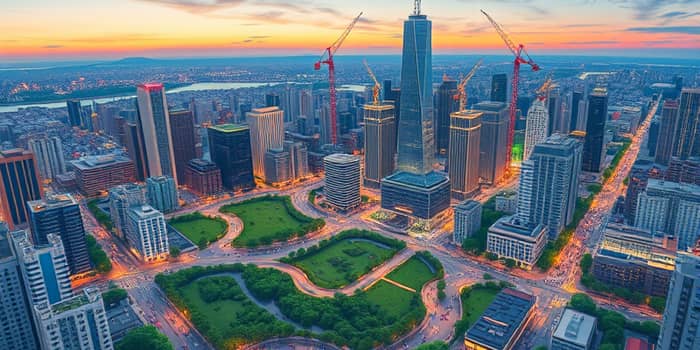
Our world is in the midst of an unprecedented shift in population as millions move from rural villages into bustling urban centers each year. This mass migration reshapes economies, cultures, and landscapes, positioning cities as pivotal actors in the global growth story.
Historical and Global Trends in Urbanization
Urbanization accelerated dramatically over the past seven decades. In 1950, only 751 million people lived in cities; by 2018, that number surged to 4.2 billion—a sixfold increase. Today, 58% of the world population resides in urban areas, and projections suggest this will reach 5 billion by 2030.
Developed regions now average 86.6% urbanization, while Africa and Asia continue their rapid transitions. Rural populations are plateauing and even declining in some places, underscoring the dramatic productivity and innovation gains cities can deliver as population density rises.
Core Mechanisms Driving Economic Growth
Cities amplify economic output through a set of interlocking forces often referred to as agglomeration economies. These mechanisms unlock dynamic engines of economic growth by concentrating talent, capital, and infrastructure in proximity.
- Thick Labor Markets: Larger pools enable firms to match skills more efficiently, reducing unemployment.
- Customer and Supplier Linkages: Proximity lowers transportation costs and fosters industry clusters.
- Knowledge Spillovers: Face-to-face interactions accelerate innovation through informal exchanges.
- Structural Transformation: Shifts from agriculture to industry and services raise productivity.
- Economic Mobility for Migrants: Cities offer wage premiums and informal learning opportunities.
Empirical Evidence and Statistics
Empirical research consistently ties urbanization to higher GDP per capita. Panel regressions from 1980 to 2011 reveal positive correlations: a doubling of city size lifts worker productivity by 3–8%, while log-model coefficients show significant links between urban share and national income.
Drivers of Urbanization
People move to cities under the influence of multiple forces—a complex interplay of push and pull factors shaping global urbanization patterns.
- Rural Push: Agricultural shocks, low wages, and conflict drive outmigration.
- Urban Pull: Better public services, amenities, and employment prospects.
- Natural Urban Growth: Lower mortality and higher birth rates within cities.
Regional and Country Variations
While all regions experience urban–rural wage gaps, the magnitude varies. In low-income countries, it can exceed threefold, reflecting high barriers to rural opportunity. Mid-sized cities (500,000–5 million residents) are poised to generate powerful growth by 2030, even as megacities face congestion and resource strain.
Counterexamples remind us that rapid urbanization does not guarantee prosperity. Gabon’s 1.02% annual urbanization between 1980 and 2011 coincided with a –0.63% GDP growth, illustrating the risk of a decoupling of urbanization and economic expansion when policy and infrastructure lag.
Cities' Role in Prosperity
Cities concentrate over 83% of global household spending and generate more than half of many nations’ GDPs. In Pakistan, urban areas account for 90% of tax revenue despite hosting fewer than half the population. These figures highlight the critical fiscal contributions of metropolitan areas to national budgets.
- Innovation hubs attracting global investment.
- Labor markets supporting diverse skill sets.
- Real estate and infrastructure as engines of capital growth.
Challenges and Nuances
Urbanization can widen inequalities and foster spatial polarization. Competitive cities draw talent and capital, but marginalized neighborhoods may be left behind without targeted redistribution. Environmental pressures—air pollution, heat islands, water stress—demand sustainable urban planning and investment in green infrastructure.
Future Projections and Policy Implications
By 2050, urban shares will climb further, especially in Africa and Asia. Policymakers face choices: focus on massive megacities or bolster mid-sized hubs. Evidence suggests that balanced urban networks across regions can spread growth more equitably and reduce congestion.
- Prioritize connectivity between urban centers and rural areas.
- Invest in public transit, affordable housing, and clean energy.
- Implement policies linking urban planning to broader economic objectives.
Ultimately, cities remain indispensable drivers of global prosperity. By harnessing agglomeration benefits, mitigating disparities, and promoting sustainability, urbanization can continue to transform human well-being for generations to come.
References
- https://regions.regionalstudies.org/ezine/article/urbanization-cities-and-economic-growth-trends-recent-evidence-and-policy-implications/?print=print
- https://pmc.ncbi.nlm.nih.gov/articles/PMC4123908/
- https://www.weforum.org/stories/2024/06/how-cities-drive-global-prosperity/
- https://www.weforum.org/stories/2019/09/mapped-the-dramatic-global-rise-of-urbanization-1950-2020/
- https://www.theigc.org/blogs/cities-growth-developing-countries
- https://www.unfpa.org/urbanization
- https://ontgroei.degrowth.net/the-urban-drivers-of-economic-growth/
- https://data.worldbank.org/indicator/SP.URB.GROW
- https://ourworldindata.org/urbanization
- https://population.un.org/wup/
- https://publications.wri.org/transformations-equitable-sustainable-cities/current-urbanization-global-south-realities
- https://www.statista.com/statistics/671366/change-in-urbanization-of-countries-worldwide-by-regional-development/
- https://urbanization.yale.edu/research/theme-2