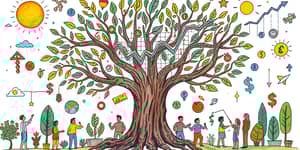

Across communities and nations, education stands as a beacon of possibility and progress. When individuals acquire new skills and knowledge, entire societies benefit through more robust innovation, resilience, and prosperity. In today’s fast-paced world, committing resources to learning is not just a moral imperative—it is a strategic decision that yields substantial economic rewards.
The concept of human capital positions education as a vital asset akin to machinery or technology. By expanding the stock of knowledge, skills, and personal characteristics within a population, governments and families set the stage for higher productivity, rising incomes, and reduced unemployment. This article explores how directing investments toward schooling and training can transform lives, strengthen economies, and cultivate social cohesion.
The Economic Power of Education
Studies consistently show that each additional year of schooling translates into roughly a ten percent wage increase. In the United States, the lifetime earnings premium for holders of a four-year degree exceeds the total cost of tuition plus forgone earnings by a factor of four. Remarkably, this corresponds to an annualized real return of 12-14%, far outpacing the seven percent return delivered by stocks over the past century.
Beyond individual paychecks, expanding educational attainment at scale triggers economic growth via human capital accumulation. As more citizens gain analytical abilities, technical know-how, and critical thinking skills, entire industries become more competitive. This process shifts national economies to higher steady-state income levels, creating a virtuous cycle of investment and return.
Quantifying the Returns
To illustrate the magnitude of benefits, consider how a collective $2.6 billion investment in college tuition nets $34.2 billion in lifetime earnings for graduates. That ratio of $5.60 earned per dollar invested underscores why education is often described as one of the highest-yielding investments available.
These figures highlight how focused spending on pre-primary, secondary, and tertiary education generates tangible dividends. Regions that raise graduation rates and reduce attainment gaps unlock millions in annual net public benefits, fueling infrastructure, health, and innovation.
Social and National Transformations
Investment in learning extends far beyond wallets and balance sheets. Communities with strong educational systems experience lower crime rates, improved health outcomes, and deeper civic engagement. Children with access to quality preschool are more likely to graduate high school, attend college, and earn stable incomes, creating intergenerational uplifts.
From a national perspective, equipping citizens with advanced skills bolsters competitiveness on the global stage. Countries that prioritize human capital see faster productivity gains, attract foreign investment, and foster cutting-edge research. Educational spillovers also reduce poverty and inequality, forging more cohesive, resilient societies.
Effective Policies for Lasting Impact
Not all interventions are equally powerful. Evidence identifies several high-return strategies that can transform an education system:
- Pre-primary attendance expansion – Yields a double dividend through better early outcomes and later societal savings.
- University autonomy and affordability – Drives innovation, talent retention, and broader access to degrees.
- Comprehensive socioemotional support – Addresses students’ holistic needs, raising attainment and reducing dropouts.
- Accelerated curricula and integration – Boosts learning efficiency and fosters diverse classrooms that benefit all learners.
When these policies align with sustained funding, data-driven accountability, and community engagement, the payoff is magnified. In contrast, piecemeal reforms or underfunded programs risk widening equity gaps and undermining public trust.
Overcoming Challenges and Embracing Equity
Despite compelling evidence, the U.S. often falls short in per-pupil spending compared to peer nations. High-poverty districts can trail by thousands of dollars per student, deepening achievement gaps. Addressing these disparities requires targeted subsidies, resource reallocation, and a commitment to equal opportunity.
Reducing unemployment through quality human capital depends on ensuring every child—regardless of zip code—benefits from enriching early learning, robust K–12 instruction, and accessible postsecondary pathways. By closing racial and economic divides in education, societies unlock untapped potential and foster social mobility.
Charting a Path Forward
Governments, educators, and families must unite around a shared vision: treat education as a strategic economic asset, not an expense. This means prioritizing efficient resource allocation, adopting proven interventions, and continuously measuring outcomes. It also demands listening to students and communities, adapting to changing workforce needs, and harnessing technological innovations in teaching.
When stakeholders rally behind this vision, the payoff is profound: an engaged, skilled citizenry ready to tackle tomorrow’s challenges, industries that innovate and expand, and communities that thrive. By viewing each dollar invested in education as planting a seed for future prosperity, we can cultivate a world where knowledge, opportunity, and well-being flourish together.
References
- https://economist.asu.edu/universities-knowledge/high-return
- https://www.cgdev.org/publication/funding-education-investment-future
- https://digitalcommons.odu.edu/cgi/viewcontent.cgi?article=1157&context=efl_etds
- https://learningpolicyinstitute.org/product/how-money-matters-factsheet
- https://seis.ucla.edu/news/new-study-affirms-economic-and-social-benefits-of-investment-in-public-education/
- https://www.oecd.org/en/topics/human-capital-and-educational-policies.html
- https://www.jec.senate.gov/public/index.cfm/democrats/2024/4/the-many-economic-benefits-of-investing-in-early-childhood-education
- https://blogs.worldbank.org/en/investinpeople/human-capital-investments-spur-economic-growth-and-development
- https://www.csis.org/analysis/investing-quality-education-economic-development-peace-and-stability
- https://www.epi.org/press/new-report-details-how-u-s-investment-in-public-education-is-at-risk/
- https://repo.ijiert.org/index.php/ijiert/article/view/3826/3255
- https://www.jstor.org/stable/1829107