
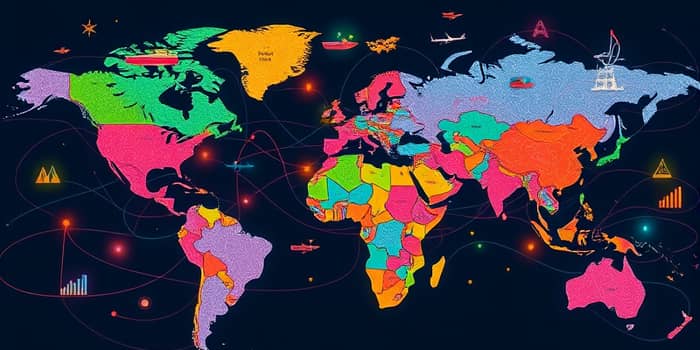
In today’s rapidly evolving world, no economy stands alone. The threads of trade, finance, and production weave nations together in complex patterns, shaping opportunities and challenges alike.
Defining Economic Interdependence
Economic interdependence refers to the mutual reliance of nations on each other through trade, investment, and financial exchanges. Over recent decades, this phenomenon has deepened, driven by free trade agreements, technological breakthroughs, and the rise of global institutions.
At its core, interdependence manifests in three dimensions:
- Trade interdependence: cross-border exchange of goods and services.
- Financial interdependence: international capital flows and portfolio investments.
- Production interdependence: globally dispersed supply chains and manufacturing.
Historical Drivers of Global Integration
Several forces have propelled economies toward integration:
- Technological advancement in transport and communication reduced costs and delivery times.
- Trade liberalization through agreements like NAFTA and the EU’s Single Market.
- Institutional development such as the IMF and World Bank, fostering financial cooperation.
Containerization in the 20th century alone slashed shipping friction, while digital platforms now enable instant payments and borderless services.
Key Metrics of Interconnectedness
Quantifiable data highlight the scale of global ties:
These figures underscore how policy alignment and national strengths can reshape the global economy.
Dimensions of Modern Interdependence
The intricate web of global ties spans three main dimensions:
- Trade in intermediate goods flows through complex chains, exemplified by an iPhone sourcing parts from over 50 countries.
- Financial markets now operate in real time, with investors in New York and Tokyo trading across continents.
- Production networks fragment tasks worldwide: the Boeing 787 Dreamliner uses components from 75 countries.
Benefits and Opportunities
Deep economic links yield tangible gains:
For advanced economies, access to cheaper inputs and diverse innovations lowers costs and fuels consumer choice. Emerging markets attract foreign direct investment, boosting job creation and infrastructure development.
More broadly, integration has been a powerful force in:
- Spurring global growth and raising average incomes.
- Reducing absolute poverty through technology diffusion.
- Enhancing risk sharing and capital allocation efficiency.
Risks and Vulnerabilities
Yet, interdependence carries hazards:
Supply chain fragility became clear during the COVID-19 pandemic, when PPE shortages arose as four out of five units came from one country. Semiconductor disruptions echoed across 169 industries, highlighting concentrated dependencies.
Geopolitical tensions can weaponize trade: export controls and selective licensing turn components into leverage points in great power competition.
Managing Complex Dependencies
To harness benefits while mitigating risks, policymakers pursue coordination mechanisms such as:
- International trade agreements and dispute-resolution frameworks.
- Monetary policy coordination and macroeconomic surveillance.
- Harmonizing regulations, addressing trade barriers, currency exchange rates, and financial rules.
The IMF’s spillover analysis exemplifies how events in one economy reverberate globally, reinforcing the case for synchronized policies.
Emerging Trends and Future Outlook
Global integration has shown mixed momentum: while digital service exports soar, some trade measures have stalled or reversed. No region today is truly self-sufficient; each relies on shared inputs and markets.
Looking forward, resilience and sustainability will shape the next phase of interconnectedness. Climate considerations, digital infrastructure, and inclusive governance will determine whether global ties uplift all participants or deepen divides.
Understanding and navigating these complex networks is essential for businesses, governments, and communities aiming to leverage opportunities and safeguard against shocks. As economies continue to intertwine, strategic cooperation and adaptive policies will remain the bedrock of shared prosperity.
References
- https://www.imf.org/en/news/articles/2015/09/28/04/53/sp091913
- https://www.hilarispublisher.com/open-access/economic-interdependence-in-a-globalized-world-108421.html
- https://obr.uk/box/why-interconnection-matters-for-the-economy/
- https://study.com/academy/lesson/economic-interdependence-definition-causes-effects.html
- https://ucigcc.org/blog/how-economic-interdependence-shapes-international-security/
- https://www.open.edu/openlearn/society-politics-law/introducing-key-global-development-challenges/content-section-1
- https://www.cato.org/publications/dangers-misunderstanding-economic-interdependence
- https://www.igi-global.com/book/global-economic-interconnectedness/339689
- https://www.mckinsey.com/mgi/our-research/global-trade-explorer-how-interdependent-are-two-economies
- https://www.un.org/esa/coordination/globalization.htm