
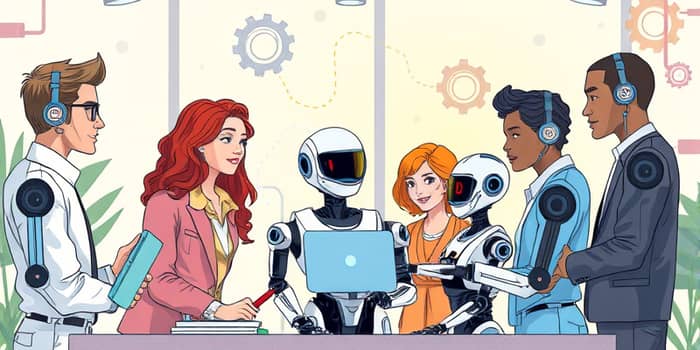
The rapid rise of artificial intelligence is reshaping how we work, collaborate, and grow. Across boardrooms and factory floors, smart algorithms are weaving themselves into everyday tasks, promising unprecedented gains. Yet alongside this promise lies uncertainty: How do we harness technology without leaving people behind? In this exploration, we journey through data, human stories, and practical strategies to create a future where productivity and purpose advance hand in hand.
Today’s workforce stands at a crossroads. On one side, studies indicate that AI could touch nearly 40% of jobs worldwide, automating routine tasks and enhancing decision making. On the other, millions of roles face transformation or displacement. This moment compels leaders, employees, and policymakers to define pathways that turn disruption into opportunity and resentment into empowerment.
AI-Driven Productivity Gains
Organizations that adopt AI effectively report measurable efficiency and speed improvements. From supply chains that predict demand spikes to customer service agents powered by chatbots, automate up to 45% of tasks and reallocate human effort to creative problem solving. Legal teams halve research time, manufacturers optimize machine usage, and data teams unlock insights in seconds.
In advanced economies, experts project a 1.8% to 2% annual rise in productivity as level effects materialize. Over a decade, this could double growth rates in certain sectors—fueling revenue, R&D investment, and new business ventures. However, raw numbers alone do not guarantee shared gains.
Challenges and the Productivity-Wage Divergence
Since the late 1970s, productivity gains have outpaced wage growth for median workers, creating a gulf between economic expansion and household prosperity. From 1979 to 2019, productivity leapt by over 70%, while typical wages rose less than 20%. This disconnect threatens social cohesion and undermines trust in institutions. Without deliberate policy and corporate leadership, the fruits of efficiency risk accruing to capital owners and specialized talent.
AI exacerbates this trend when companies cut costs by replacing tasks rather than augmenting roles. Because algorithms operate around the clock without traditional wages or benefits, productivity spikes can translate directly to margins, not paychecks. Closing this gap demands intentional design of compensation structures, transparent profit-sharing, and reinforced worker voice in strategic decisions.
Employment and Labor Market Dynamics
While concerns about displacement are valid, history teaches a subtler truth: Technology often reshapes roles rather than obliterating them. When AI frees employees from repetitive duties, they pivot to oversee systems, interpret complex data, and innovate new solutions. In many firms, exposure to AI has led to a 3% employment uptick in high-wage positions over five years.
Moreover, AI infrastructure itself generates jobs in data centers, cloud services, and cybersecurity. Regions that invest in digital ecosystems can capture this growth, creating clusters of high-value work. Policymakers can facilitate these transitions by funding digital infrastructure, incentivizing regional upskilling, and supporting small businesses in tech adoption.
Skills and Workforce Transformation
Preparing for tomorrow means investing in human capital today. By 2025, more than half of all professions will require new skills or deeper digital literacy. Organizations are shifting from narrow technical roles to interdisciplinary teams combining coding, design thinking, and interpersonal strengths. This multi-talented approach fuels resilience by enabling employees to tackle unpredictable challenges and collaborate across domains.
Successful reskilling hinges on continuous learning cultures. Microcredentials, in-house boot camps, and mentorship networks empower workers to own their development. Employers can partner with educational institutions to deliver tailored curricula, ensuring that both seasoned employees and new hires master emerging tools and methodologies.
Practical Strategies for Businesses and Workers
Building a thriving future of work requires concrete action from all stakeholders. Below are key tactics to balance efficiency with equity:
- Design hybrid workflows that blend AI and human insight, optimizing each for tasks they perform best.
- Implement profit-sharing or bonus schemes directly tied to productivity improvements, ensuring workers benefit from gains.
- Offer flexible learning stipends and paid learning time, signaling commitment to long-term career growth.
- Create cross-functional teams where nontechnical staff collaborate with data scientists, fostering empathy and innovation.
- Develop clear transition plans for roles at risk, including redeployment pathways and financial support for retraining.
Looking Ahead: Crafting a Balanced Future
The transformation underway is as significant as the industrial revolutions of prior centuries. AI’s impact will extend beyond workplaces into communities, social norms, and individual identities. As tech reshapes tasks, we must safeguard the intrinsic value of work: purpose, connection, and dignity.
By embracing inclusive policies, redefining compensation, and prioritizing learning, we can ensure that productivity becomes a shared victory. When employees see themselves as partners in innovation rather than casualties of automation, trust deepens and organizations thrive. Together, we can turn the market’s momentum into a force for broad-based prosperity, crafting a future where every individual has the chance to contribute, grow, and flourish.
References
- https://www.investing.com/analysis/ai-productivity-is-rising-fast-and-the-labor-market-is-falling-behind-200673361
- https://speakwrite.com/blog/trends-in-productivity/
- https://mitsloan.mit.edu/ideas-made-to-matter/how-artificial-intelligence-impacts-us-labor-market
- https://quantive.com/resources/articles/future-of-work
- https://www.youtube.com/watch?v=Cup1q-aFFlo
- https://www.vistage.com/research-center/business-operations/productivity-execution/productivity-trends-for-2026-and-beyond/
- https://www.goldmansachs.com/insights/articles/how-will-ai-affect-the-us-labor-market
- https://www.weforum.org/publications/the-future-of-jobs-report-2025/digest/
- https://hatchery.emory.edu/articles/future-work-automation.html
- https://www.avocor.com/blog/future-of-work-trends/
- https://www.mckinsey.com/featured-insights/future-of-work
- https://eptura.com/discover-more/blog/rethinking-productivity-2025-workplace-statistics/
- https://www.aisi.gov.uk/blog/ai-and-the-future-of-work-measuring-ai-driven-productivity-gains-for-workplace-tasks
- https://www.microsoft.com/en-us/worklab/work-trend-index
- https://www.oecd.org/en/topics/policy-issues/future-of-work.html