
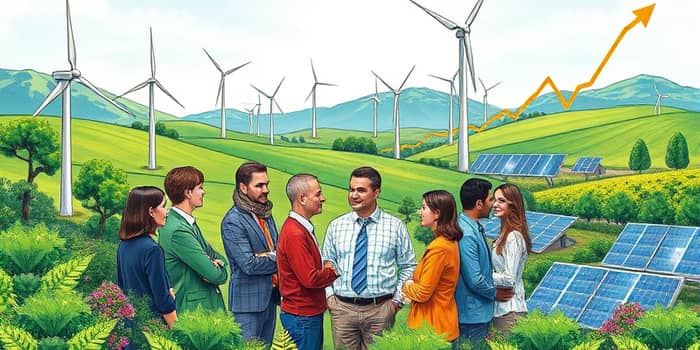
The global financial landscape is undergoing a profound transformation. As traditional markets face growing volatility, a new investment frontier is emerging, one that aligns profit with purpose.
In the heart of this movement lies sustainable investing—an approach that seeks to decouple economic growth from environmental harm and social inequity. Investors are discovering that a greener portfolio can deliver robust returns, reduce risk, and build lasting resilience.
Market Size and Growth
Over the past decade, the green economy has expanded at an unprecedented pace. Global valuations for sustainable sectors now represent a significant share of total market capitalization, driven by policy incentives and corporate commitments.
- Global green economy valued at US$7.9 trillion (8.6% of listed equity markets)
- Green bond market reached US$2.9 trillion as of Q1 2025
- Revenues from green products and services topped US$5 trillion, projected to exceed US$7 trillion by 2030
- Low-carbon private investments grew 123% over five years
- China’s US$659 billion clean energy commitment fueling over 60% of global renewable capacity additions
These figures underscore the rise of renewables, clean tech innovation and emerging circular economies. With a compound annual growth rate of 15%—second only to technology—green sectors are rewriting the rules of long-term investment.
Performance Metrics and Resilience
Evidence from multiple studies highlights the strong performance of sustainable assets. Green equities have delivered competitive returns, often with lower volatility during market downturns. Corporate green bonds have demonstrated resilience amid shifting interest rates.
Investors report a reduction in portfolio volatility and enhanced resilience during contractions. The principle of climate risk integration is becoming standard practice, as global warming impacts financial stability.
Investor Sentiment Driving Change
Sentiment surveys reveal a seismic shift in priorities. Capital is flowing into funds that offer both market returns and environmental or social benefits.
- 88% of investors interested in sustainability-resilience portfolios
- 59% plan to increase allocations within a year
- 90% seek market-rate returns with positive social or environmental outcomes
- 70% consider company sustainability performance in decision making
This groundswell of demand reflects a recognition that long-term value creation is inseparable from sustainable business models. Companies that lead in ESG adoption often enjoy a valuation premium and stronger stakeholder loyalty.
Policy and Regional Highlights
Government initiatives and regulatory frameworks play a crucial role in steering capital toward low-carbon solutions. From carbon pricing to green subsidies, policy support underpins market expansion.
- EU’s Resource Efficiency Roadmap and Europe 2020 strategy
- US Inflation Reduction Act fueling US$14 billion in clean manufacturing investment in Q1 2025
- China’s clean energy leadership, with over 60% of global renewable capacity additions
- Instruments: carbon credits, green bonds, sustainability-linked loans
Such measures have transformed entire industries, making green finance instruments like sustainability-linked loans mainstream. As policy frameworks evolve, investors gain confidence in the stability of sustainable assets.
Risks and Future Outlook
No investment is without risk, and sustainable strategies face challenges. Short-term volatility can arise from shifting regulatory landscapes or technology costs. Approximately 20% of deep decarbonization technologies still require policy support to achieve cost parity.
Yet the long-term drivers remain compelling. Energy transition, climate adaptation and circular economic models are not fleeting trends—they are essential pathways to global stability. Analysts estimate that US$109 trillion to US$275 trillion in cumulative climate investment will be required by 2050.
By embracing long-term value creation over short-term gains, investors position themselves at the forefront of a transformative wave. Success stories in renewables, battery technology and sustainable infrastructure illustrate the potential for outsized returns.
Conclusion
Sustainable investing is more than a moral imperative; it is a strategic advantage. As the green economy grows to represent a quarter of global GDP in the coming decades, early adopters of ESG integration and green finance instruments will be best placed to capture lasting value.
For investors seeking both financial performance and positive impact, the path is clear. By aligning portfolios with sustainability goals, one can harness the dual power of profitability and purpose—securing returns, managing risk and contributing to a resilient, low-carbon future.
References
- https://unglobalcompact.org/compactjournal/investing-future-rise-sustainable-finance
- https://stata-france.com/blog/the-green-economy-can-sustainable-investments-drive-growth.html
- https://www.weforum.org/press/2025/12/the-multi-trillion-dollar-growth-opportunity-new-report-shows-green-economy-expected-to-surpass-7-trillion-in-annual-value-by-2030/
- https://dfpi.ca.gov/news/insights/embracing-sustainable-investment-practices-with-esg-investing/
- https://www.cleaninvestmentmonitor.org/reports/us-clean-energy-supply-chains-2025
- https://eelet.org.uk/index.php/journal/article/view/4116
- https://www.youtube.com/watch?v=VcTW3ugJHlg
- https://www.morganstanley.com/insights/articles/sustainable-investing-interest-2025
- https://www.schroders.com/en-us/us/individual/insights/2025-sustainable-investment-outlook-top-8-trends-for-north-america-in-the-year-ahead/
- https://www.annualreviews.org/content/journals/10.1146/annurev-financial-113023-111705
- https://www.fidelity.com/mutual-funds/sustainable